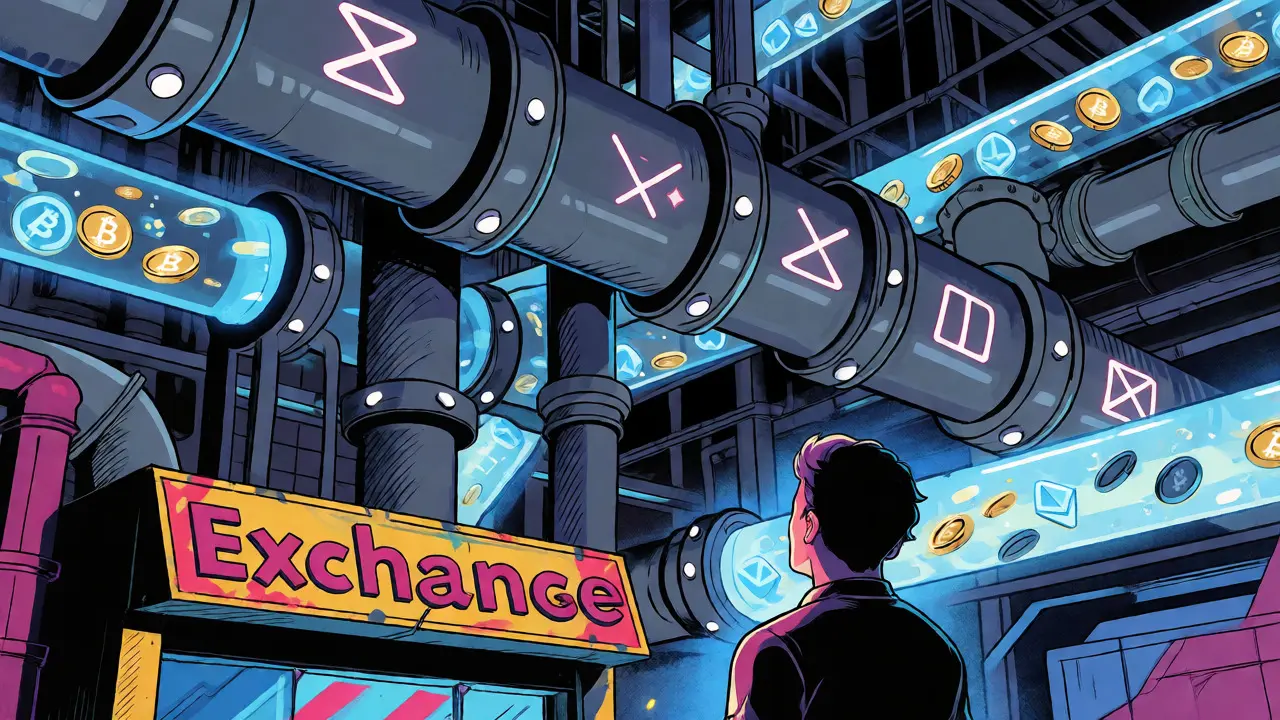
You bought Bitcoin in a country that says it doesn't exist. You used Ethereum to pay for coffee in a place where digital assets are technically contraband. Now what? Do you go to jail? Do you pay a fine? Or does the law simply ignore you because enforcement is practically impossible?
The reality of criminal penalties for crypto ban violations isn't as black and white as headlines suggest. While some nations threaten severe punishment, the actual legal landscape is a messy patchwork of unenforced decrees, vague financial regulations, and targeted sanctions against bad actors rather than everyday users. If you're holding digital assets in a restricted jurisdiction, or just curious about how the world handles these 'forbidden' coins, you need to understand the difference between a scary headline and real legal risk.
Who Actually Bans Crypto and Why?
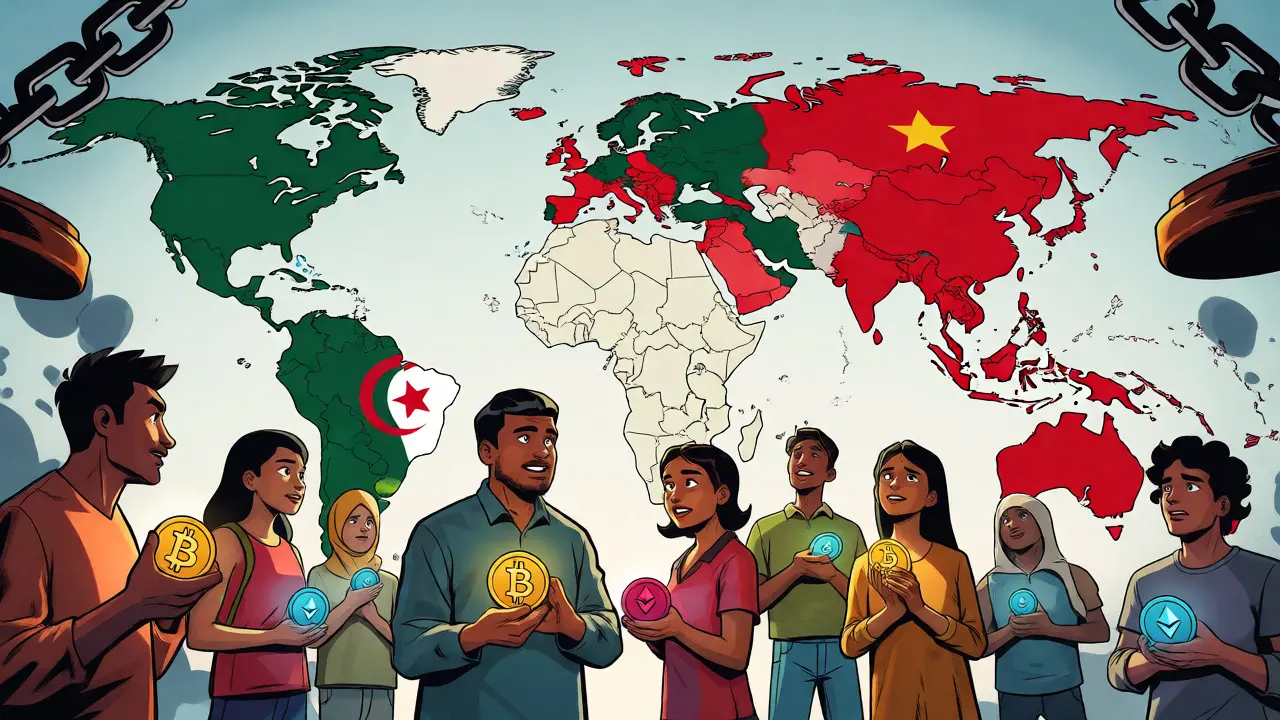
First, let's clear up who is actually on the banned list. It’s not just one or two rogue states. According to the Atlantic Council's Cryptocurrency Regulation Tracker (2025), out of 75 countries studied, 10 have generally banned cryptocurrencies, and another 20 have partial bans. That means nearly 40% of the surveyed world has some form of restriction. But why? It usually boils down to three fears: money laundering, terrorist financing, and capital flight. Governments worry that if citizens can move wealth outside the banking system instantly, they lose control over their economy.
Take China, for example. Since 2021, Beijing has implemented comprehensive bans on exchanges, trading, and mining. The goal was to curb speculative bubbles and keep capital within the yuan system. Contrast this with Algeria, which prohibits the purchase, sale, use, and holding of virtual currency under Article 117 of its official journal. Or Morocco, where the Office des Changes declared transactions via virtual currencies an infringement of exchange regulations back in 2017. These aren't just warnings; they are legal prohibitions. Yet, the reason behind them often differs. China targets infrastructure and market stability, while North African nations focus heavily on foreign exchange controls.
It’s worth noting that even among G20 nations, only 12 maintain fully legal frameworks. This leaves a significant portion of the global economy operating in gray areas or outright prohibition zones. However, the motivation for banning rarely includes a desire to punish individuals for using technology. Instead, it’s about controlling the flow of money.
What Are the Actual Criminal Penalties?
Here is where things get tricky. Most people assume a ban equals prison time. In reality, specific criminal penalties for individual users are surprisingly rare or poorly defined. Let’s look at the specifics.
In Algeria, the law states that any breach is punishable according to existing laws, but it doesn’t quantify the penalty. Is it a fine? Jail? Both? The ambiguity is intentional, serving as a deterrent without creating a massive burden on the court system to prosecute every teenager buying Dogecoin. Similarly, Egypt maintains an outright prohibition for individuals, banks, and financial institutions, but enforcement mechanisms remain unspecified in public documentation.
Morocco offers a clearer path through its exchange regulations. Transactions are considered infringements liable to penalties and fines provided by existing laws. Bank Al-Maghrib Governor Abdellatif Jouahri clarified that bitcoin isn't recognized as currency but as a risky financial asset. The penalty here is typically financial, tied to foreign exchange violations rather than a standalone 'crypto crime.'
China represents the strictest environment, but even there, the hammer falls mostly on businesses. Enforcement targets exchanges and mining operations. For individual holders, specific criminal penalty figures for simple possession or peer-to-peer trading remain undocumented in most legal analyses. The government prefers administrative pressure and shutting down access points over arresting millions of users.
| Country | Ban Type | Primary Target | Individual Penalty Risk |
|---|---|---|---|
| China | Comprehensive Ban | Exchanges, Mining, Institutions | Low for holders; High for operators |
| Algeria | Total Prohibition | All usage (buy/sell/hold) | Vague; relies on general financial laws |
| Morocco | Exchange Restriction | Foreign Exchange Regulations | Fines for FX violations |
| Egypt | Religious/Legal Ban | Financial Institutions & Individuals | Unspecified; low enforcement visibility |

The Gap Between Law and Reality
If the penalties were severe and strictly enforced, you’d expect adoption rates to plummet in banned countries. They haven’t. The Atlantic Council’s 2025 analysis found that even in countries with partial or general bans, adoption rates remain high. Chainalysis estimated $28.7 billion in peer-to-peer cryptocurrency transactions originated from China in 2024, despite the official prohibitions. That’s a massive amount of underground activity.
Why the disconnect? Because enforcing a ban on decentralized technology is incredibly hard. Users bypass restrictions using Peer-to-Peer (P2P) exchanges and Decentralized Finance (DeFi) platforms. On Reddit’s r/CryptoCurrency, users from Algeria, Morocco, and Egypt report successful long-term usage without personal legal consequences. One user, u/MaghrebTrader, reported using LocalBitcoins for 18 months without incident. Another, u/CairoCrypto, noted frequent payment processor blocks but no arrests.
A CoinDesk survey from May 2025 revealed that only 12% of respondents in banned jurisdictions reported facing personal legal consequences for cryptocurrency usage. This suggests that for the average person, the risk isn't jail-it's inconvenience. Your bank might freeze your account, or your payment processor might block a transaction, but you’re unlikely to be handcuffed for owning Bitcoin.
Sanctions vs. General Bans: A Critical Distinction
It’s crucial to distinguish between a general ban on crypto and sanctions against specific entities. The latter carries much heavier weight. The U.S. Department of the Treasury’s Office of Foreign Assets Control (OFAC) increasingly uses sanctions as an enforcement tool. In 2024 alone, OFAC issued 13 sanctions designations including 86 cryptocurrency addresses targeting Russia-related entities, Hamas, and Hezbollah.
These aren't penalties for using crypto; they are penalties for using crypto to evade sanctions or fund illicit activities. For example, Mustafa Ayash, founder of GazaNow, was sanctioned for raising funds for Hamas following the October 7 attack. This triggers severe consequences, including asset freezes and potential imprisonment for those facilitating the transfers. Compare this to Elena Chirkinyan and Khadzi-Murat Dalgatovich Magomedov, designated for money laundering roles. Their crimes weren't 'using Bitcoin,' but 'using Bitcoin to hide dirty money.'
This shift toward targeted enforcement is evident in the U.S. Department of Justice’s April 2025 memorandum, 'Ending Regulation by Prosecution.' It re-scoped digital asset enforcement to prioritize misappropriation of client assets, sanctions evasion, fraud, and unlicensed money transmission. It explicitly deprioritized using criminal tools to resolve regulatory classification disputes. Essentially, regulators are realizing that prosecuting someone for the *nature* of their asset is less effective than prosecuting them for the *misuse* of it.

Global Trends: Moving Away from Blanket Criminalization
The global trend is moving away from blanket criminalization toward nuanced regulation. The European Union’s MiCA (Markets in Crypto-Assets) framework, implemented in 2024, establishes strict licensing requirements for service providers but avoids criminal penalties for usage. South Korea passed the Virtual Asset Users Protection Act in 2023, focusing on record-keeping and transparency rather than punishing users. Even Canada, which lists prohibited platforms like KuCoin and Poloniex, focuses enforcement on platform operations rather than individual users.
In the United States, the GENIUS Act, signed into law in July 2025, regulates stablecoins as payment instruments. It enhances the Treasury Department's ability to combat illicit stablecoin activities but stops short of criminalizing ownership. This reflects a growing consensus: broad criminal penalties are difficult to enforce and often counterproductive. Dr. Sarah Bloom Raskin, former Deputy Secretary of the U.S. Treasury, noted that criminalization creates significant enforcement challenges when adoption remains high.
Furthermore, over 90% of countries analyzed now have active Central Bank Digital Currency (CBDC) projects. Governments want digital money-they just want to control it. This explains why many 'bans' are actually attempts to protect sovereign currency dominance rather than moral objections to blockchain technology.
Practical Implications for Users
So, what should you do if you live in a restricted country? First, assess your risk profile. If you are a small holder using P2P markets, your primary risk is liquidity and banking friction, not incarceration. Banks may close accounts associated with crypto transactions due to compliance fears, even if the law doesn't explicitly forbid the transaction.
Second, watch the infrastructure. When governments ban crypto, they usually target the off-ramps-exchanges and payment processors. Access to these services can disappear overnight. Having multiple ways to cash out is essential. Third, stay informed about sanctions. If you are transacting with counterparties in sanctioned regions, the rules change drastically. Simple trades become complex legal minefields involving OFAC guidelines.
Finally, remember that laws evolve rapidly. The collapse of FTX accelerated global regulatory responses. Sweden’s Finance Minister Elisabeth Svantesson emphasized the urgent need for rules to protect investors and prevent misuse. As CBDCs roll out, private crypto usage may face new pressures, not necessarily from bans, but from competition and tighter KYC (Know Your Customer) requirements on all digital payments.
Can I go to jail for owning Bitcoin in a banned country?
In most cases, no. While countries like Algeria and Egypt prohibit ownership, specific criminal penalties for individual holders are rarely enforced. Legal risks are typically financial fines related to foreign exchange violations rather than imprisonment. Enforcement usually targets businesses and large-scale illicit activities.
Which countries have the strictest crypto bans?
China, Algeria, Morocco, and Egypt are among the strictest. China bans exchanges and mining comprehensively. Algeria and Egypt prohibit purchase, sale, and holding. Morocco restricts transactions under exchange regulations. However, 'strictness' varies by enforcement intensity, with China having the most robust infrastructure shutdowns.
Do crypto bans stop people from using cryptocurrency?
No. Adoption rates remain high in banned jurisdictions. For instance, Chainalysis estimated $28.7 billion in P2P transactions from China in 2024 despite the ban. Users rely on decentralized networks and P2P exchanges to bypass centralized restrictions.
What is the difference between a ban and a sanction?
A ban prohibits the use of cryptocurrency generally within a country. Sanctions target specific individuals, entities, or countries (e.g., Russia, Iran) prohibiting transactions with them. Violating sanctions can lead to severe federal charges, asset freezes, and international legal issues, whereas violating a local ban might result in minor fines or account closures.
Are there criminal penalties for using DeFi in banned countries?
Legally, yes, if the law prohibits 'holding' or 'using' crypto. Practically, it is difficult to enforce because DeFi operates on decentralized protocols without central authorities to subpoena. Risks are higher if you interact with centralized bridges or exchanges that comply with local regulations.