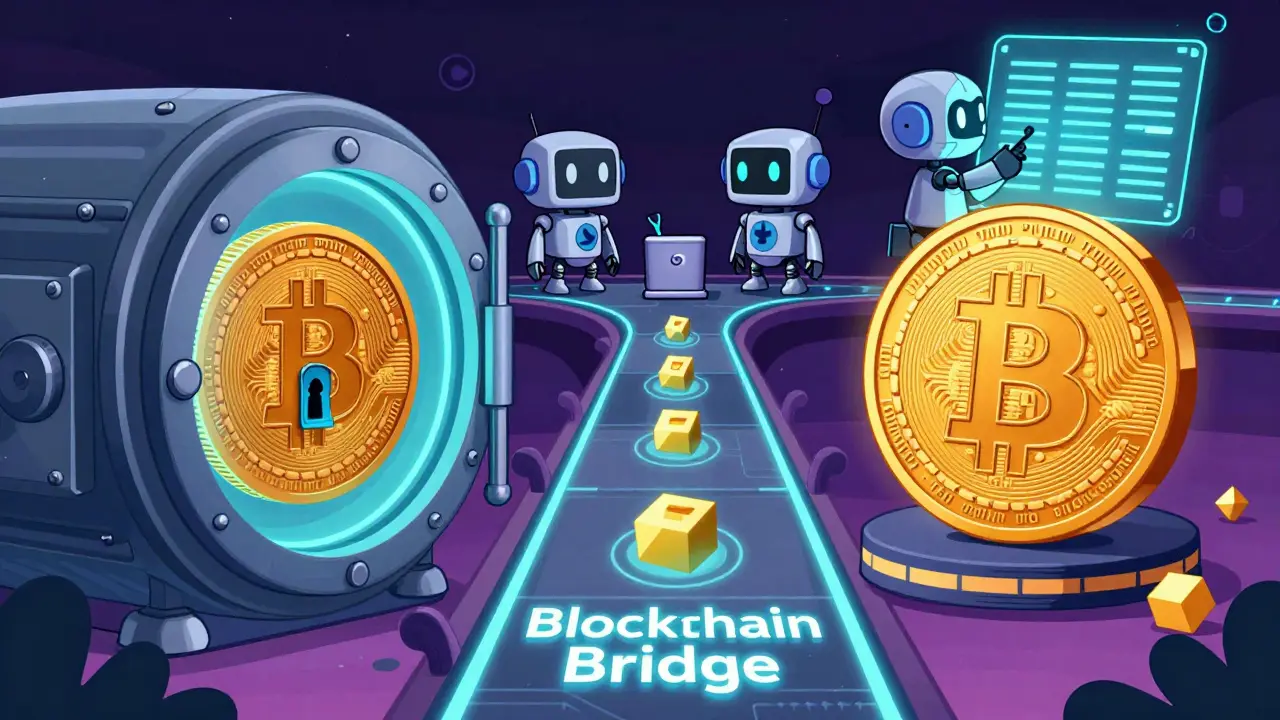
Imagine you own Bitcoin but want to use it in a DeFi app on Ethereum. You can’t just send Bitcoin directly - the two networks speak different languages. That’s where blockchain bridges come in. They’re not magic portals. They’re smart, secure systems that let assets move between blockchains without being copied, stolen, or lost. Without them, your Bitcoin would be stuck on its own chain, useless for lending, trading, or earning interest on Ethereum.
How Blockchain Bridges Actually Work
Most people think bridges move coins from one chain to another. They don’t. Instead, they lock your original asset and create a digital twin on the new chain. This twin is called a wrapped token. For example, if you send 1 BTC to a bridge, it locks that Bitcoin in a smart contract on the Bitcoin network. Then, it mints 1 WBTC (Wrapped Bitcoin) on Ethereum. You now have WBTC - a token that behaves like Bitcoin but runs on Ethereum’s network.
The key here is trust. The bridge doesn’t just hand out tokens. It waits for proof that your Bitcoin was locked. Validator nodes - often run by multiple independent parties - check the Bitcoin transaction. They confirm the amount, the sender, and the destination. Only then does the bridge mint the WBTC. If the proof fails, no tokens are created. This keeps the system honest.
When you want your Bitcoin back, you send the WBTC to the bridge. It burns the WBTC on Ethereum and unlocks your original Bitcoin on the Bitcoin network. The supply stays balanced: one locked Bitcoin = one minted WBTC. No extra coins are created. No inflation. Just a digital swap.
The Two Main Methods: Wrapped vs. Liquidity Pools
There are two big ways bridges operate. The most common is the wrapped asset method. It’s simple: lock, mint, burn, unlock. This method is used by WBTC, wETH (wrapped Ether), and USDC bridges. It’s reliable because the value is always 1:1 backed. If you have 10 WBTC, you know exactly 10 BTC are locked somewhere.
The second method is the liquidity pool approach. Instead of locking assets, the bridge uses a shared pool of funds from both chains. You deposit your asset into the pool on the source chain. Someone else on the destination chain withdraws an equivalent amount from the pool. The bridge doesn’t mint new tokens - it just shifts existing liquidity. This is faster and cheaper but riskier. If the pool runs low or gets hacked, users might not get their full value back.
Most users stick with wrapped tokens because they’re predictable. Liquidity pools are great for high-frequency trading between chains, but they’re not ideal if you’re holding long-term.
Why This Matters for DeFi and NFTs
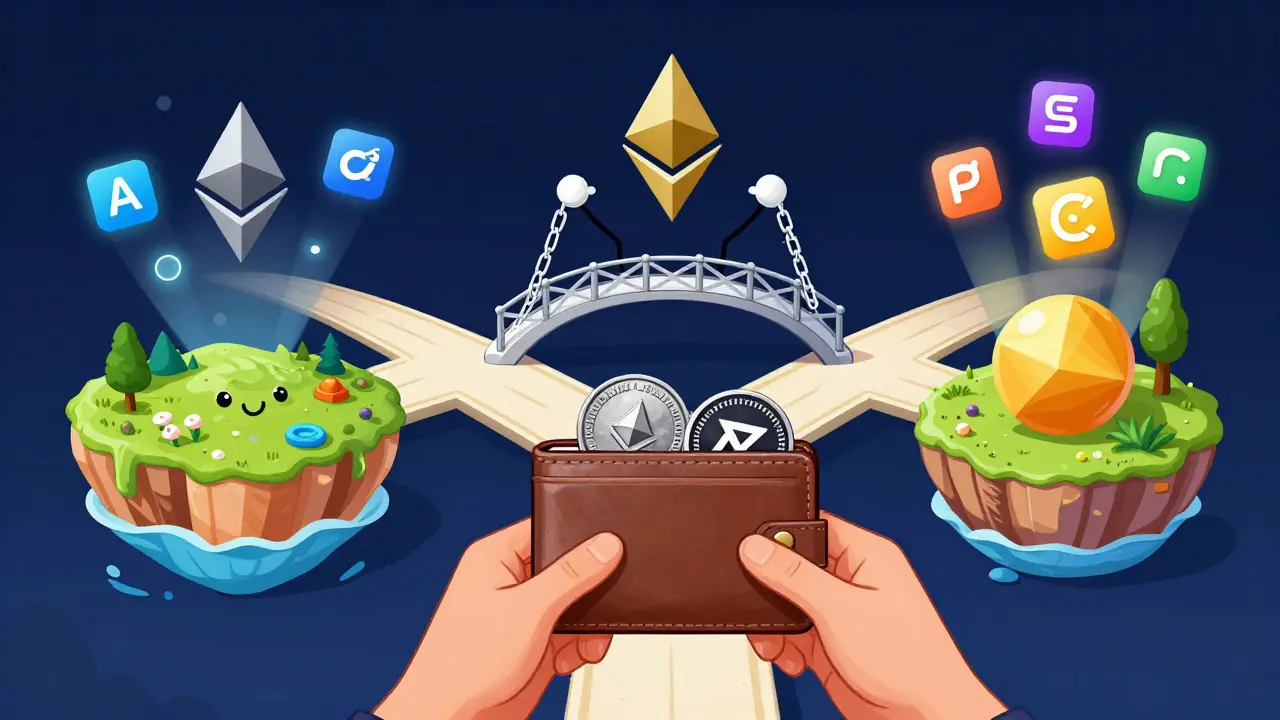
Before bridges, DeFi was split. Ethereum had the best lending protocols. Solana had low fees and fast trades. Polygon had cheap NFT minting. But you could only use one at a time. If you owned ETH, you couldn’t earn interest on Solana. If you had an NFT on Polygon, you couldn’t sell it on Ethereum’s OpenSea.
Bridges changed that. Now, you can take your ETH from Ethereum, bridge it to Avalanche, and lend it on Trader Joe for 8% APY. You can take your Bored Ape NFT from Ethereum and list it on Solana’s Magic Eden. Suddenly, the whole crypto world opens up. You’re not locked into one chain’s limitations.
Projects like Aave, Curve, and Yearn now use bridges to move liquidity where it’s needed most. If borrowing rates spike on Ethereum, they shift funds to Arbitrum or Base. This keeps yields high and systems stable. Without bridges, DeFi would be a collection of isolated islands.
Real-World Examples
Let’s say you want to move USDC from Ethereum to Solana. You go to a bridge like Portal Bridge or Wormhole. You connect your wallet, pick USDC as the asset, select Solana as the destination, and enter the amount. You confirm the transaction. The bridge locks your USDC on Ethereum. Validators check the transaction. Within minutes, you get equivalent USDC on Solana. You can now use it to buy tokens, pay for services, or stake in Solana’s DeFi apps.
Or take WBTC. Over $12 billion worth of Bitcoin is locked in wrapped form on Ethereum and other chains. That’s not because people want to sell Bitcoin. It’s because they want to use it in DeFi. WBTC lets Bitcoin holders earn yield without selling. That’s huge. Bitcoin’s value is locked in its network. WBTC unlocks its utility.
NFTs benefit too. An NFT created on Flow can be bridged to Ethereum and sold on OpenSea. A game asset from Polygon can be used in a metaverse on Aptos. Bridges turn static digital items into mobile, usable assets across platforms.
What You Need to Do to Use a Bridge
Using a bridge isn’t complicated, but it’s not risk-free. Here’s how to do it right:
- Choose a bridge that supports your source and target chains. Not all bridges work with every network. Check their website.
- Connect your wallet (MetaMask, Phantom, etc.). Never give your private keys to any bridge interface.
- Select the asset you want to transfer. Make sure it’s supported. Some bridges only handle major tokens like ETH, USDC, or WBTC.
- Enter the amount. Double-check it. Mistakes can’t be undone.
- Confirm the transaction. You’ll pay a small fee on the source chain (gas). Wait for confirmation.
- Wait. Transfer times vary. Some take 10 minutes. Others take 20 minutes or more, depending on network congestion.
- Check your destination wallet. The tokens should appear. If they don’t, wait. Don’t try again - you might lock funds twice.
Always use official bridge websites. Fake bridges look real. They steal funds. Bookmark trusted ones like Multichain, Across, or LayerZero. Never click a bridge link from a tweet or Discord message.
Security Risks and How to Avoid Them
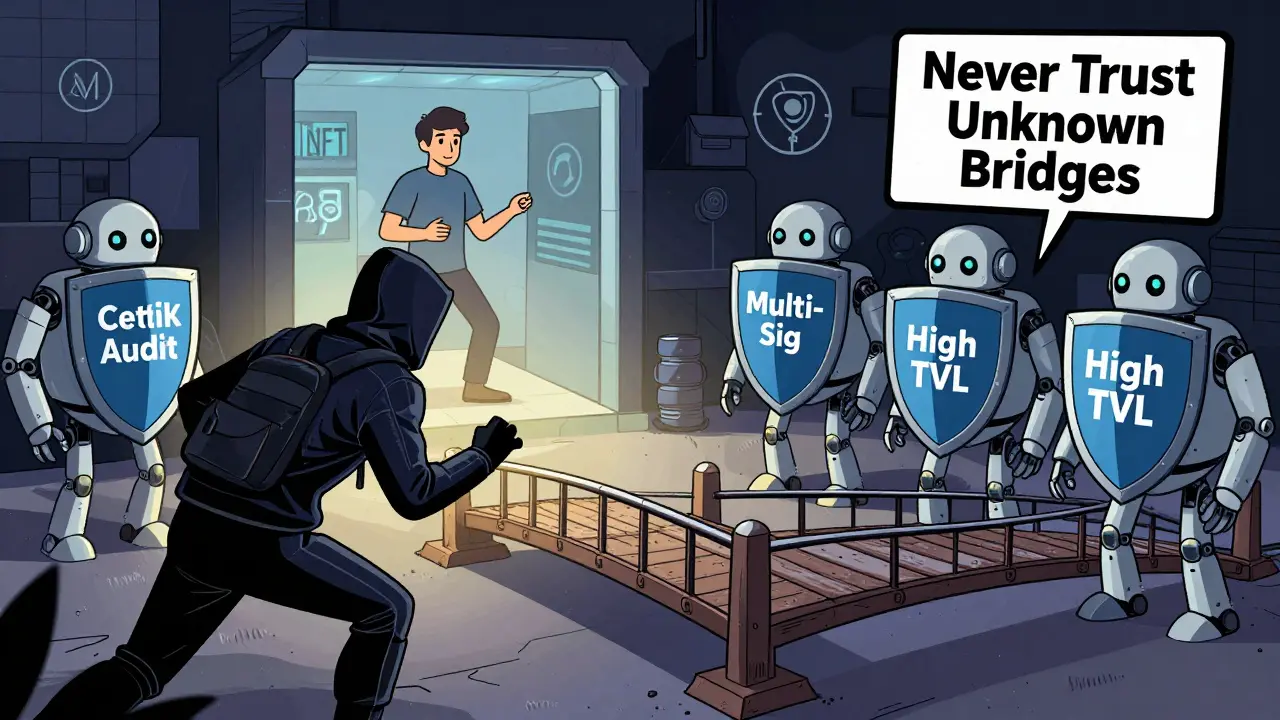
Bridges have been hacked. In 2022, the Wormhole bridge lost $320 million. The Ronin bridge lost $600 million. These weren’t flaws in blockchain tech - they were flaws in smart contract code or validator systems.
Here’s how to protect yourself:
- Use bridges with multi-signature validation. That means at least 3-5 independent parties must approve each transfer. Single validators are dangerous.
- Check if the bridge has been audited by reputable firms like CertiK, Trail of Bits, or Quantstamp. Look for public audit reports.
- Start small. Test with $50 before moving $5,000.
- Avoid bridges with low TVL (Total Value Locked). If only $1 million is locked, it’s not trusted by the community.
- Never use a bridge that asks for your seed phrase. Legit bridges only need wallet access.
Remember: bridges are custodians. They hold your money. If they’re poorly built, your funds vanish. Choose wisely.
The Future of Cross-Chain Transfers
Bridges are evolving fast. New ones are being built with zero-knowledge proofs (ZKPs) that make verification faster and more secure. Instead of waiting for validators to check transactions, ZK bridges use math to prove everything is correct - instantly.
Some projects are moving toward universal bridges - one bridge that works with every chain. This could reduce complexity and risk. But it also creates a single point of failure. The industry is still figuring out the best balance.
One thing’s clear: the future isn’t one blockchain. It’s many. And bridges are the highways between them. As more chains emerge - for gaming, finance, identity, AI - the need to move assets between them will only grow. The bridges we use today might look primitive in five years. But right now, they’re the only thing making multi-chain crypto possible.
Can I transfer any cryptocurrency using a blockchain bridge?
No. Bridges only support specific assets. Most handle major tokens like Bitcoin, Ethereum, USDC, and DAI. Smaller tokens or new coins may not be supported. Always check the bridge’s official website for a list of supported assets before attempting a transfer.
How long does a blockchain bridge transfer take?
Transfer times vary from 5 minutes to over an hour. It depends on the block confirmation times of the source and destination chains. For example, transferring between Ethereum and Polygon might take 10 minutes. Moving from Bitcoin to Solana could take 30-60 minutes because Bitcoin blocks are slower. Always allow extra time.
Are blockchain bridges safe to use?
Some are, some aren’t. Bridges with strong audits, multiple validators, and high total value locked (TVL) are generally safer. Avoid bridges with unknown teams, no public audits, or low TVL. Always test with a small amount first. Never use a bridge you don’t fully trust.
What happens if a bridge shuts down?
If a bridge shuts down, you usually can’t redeem your wrapped tokens. That’s why it’s critical to use bridges backed by large, active communities and well-funded teams. Some bridges have emergency withdrawal mechanisms, but most don’t. Treat wrapped assets like any other investment - assume the bridge could disappear.
Do I pay fees when using a blockchain bridge?
Yes. You pay gas fees on the source blockchain to lock your asset. Some bridges also charge a small service fee - usually under 0.1%. The fee on the destination chain is typically zero because tokens are minted, not transferred. Always check the bridge’s fee structure before confirming.



Gaurav Mathur
February 9, 2026 AT 12:41Jeremy Lim
February 10, 2026 AT 02:01John Doyle
February 11, 2026 AT 07:34kelvin joseph-kanyin
February 13, 2026 AT 06:54Michelle Cochran
February 14, 2026 AT 20:46monique mannino
February 15, 2026 AT 19:15Christopher Wardle
February 16, 2026 AT 10:09