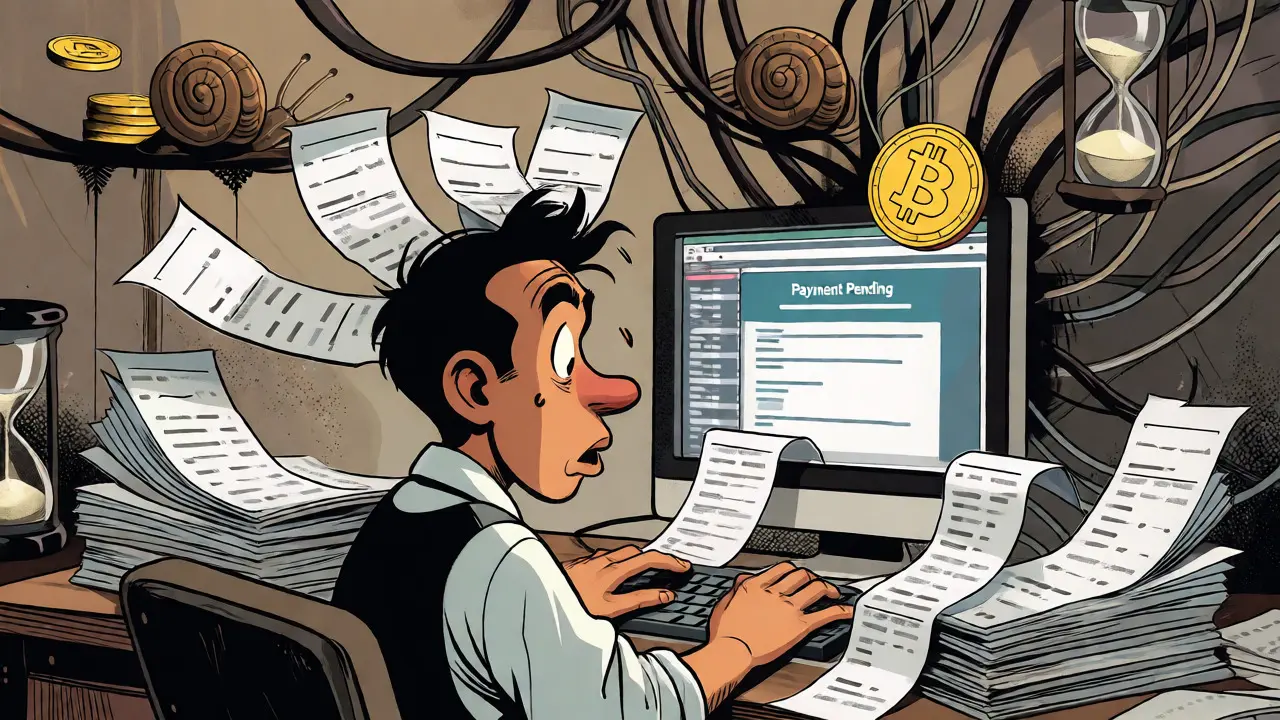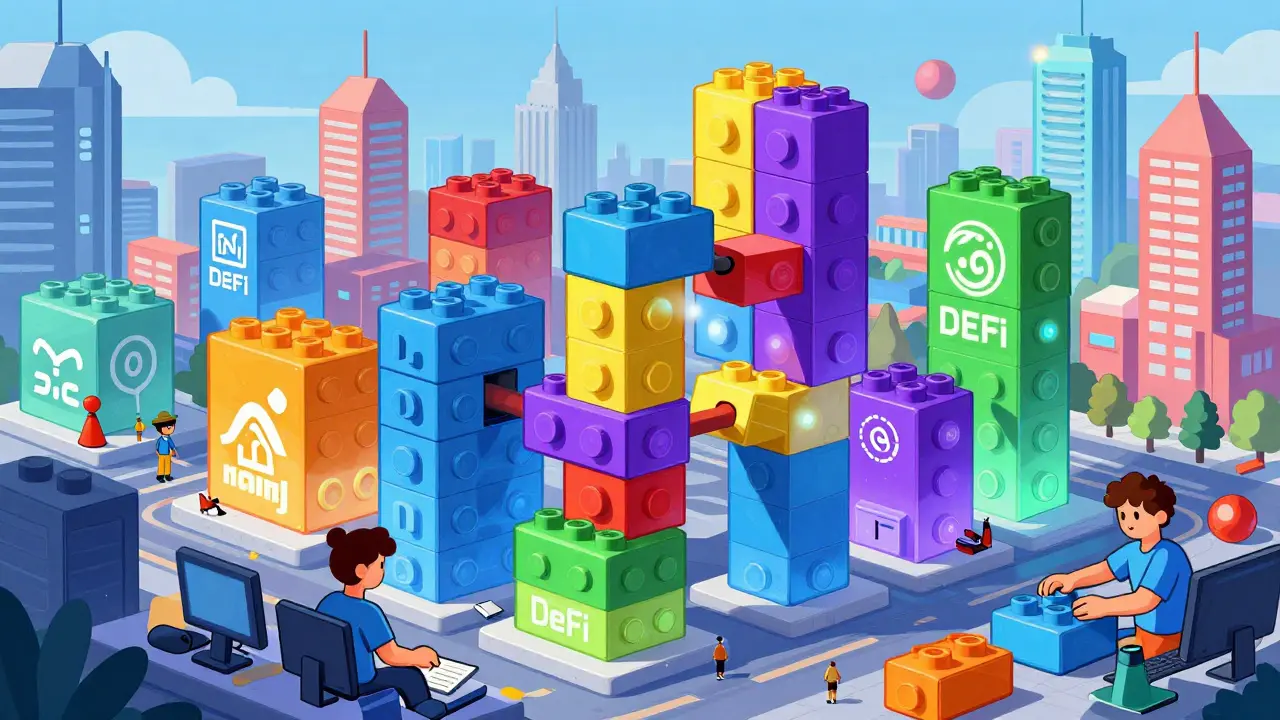
Imagine building a house where every brick, window, and door comes from a different manufacturer, yet they all fit together perfectly without needing custom modifications. That is the promise of composability in Decentralized Finance (DeFi). It is often called "Money Legos" because it allows developers and users to snap together different financial protocols to create new products instantly. This concept is not just a technical feature; it is the engine driving innovation in blockchain.
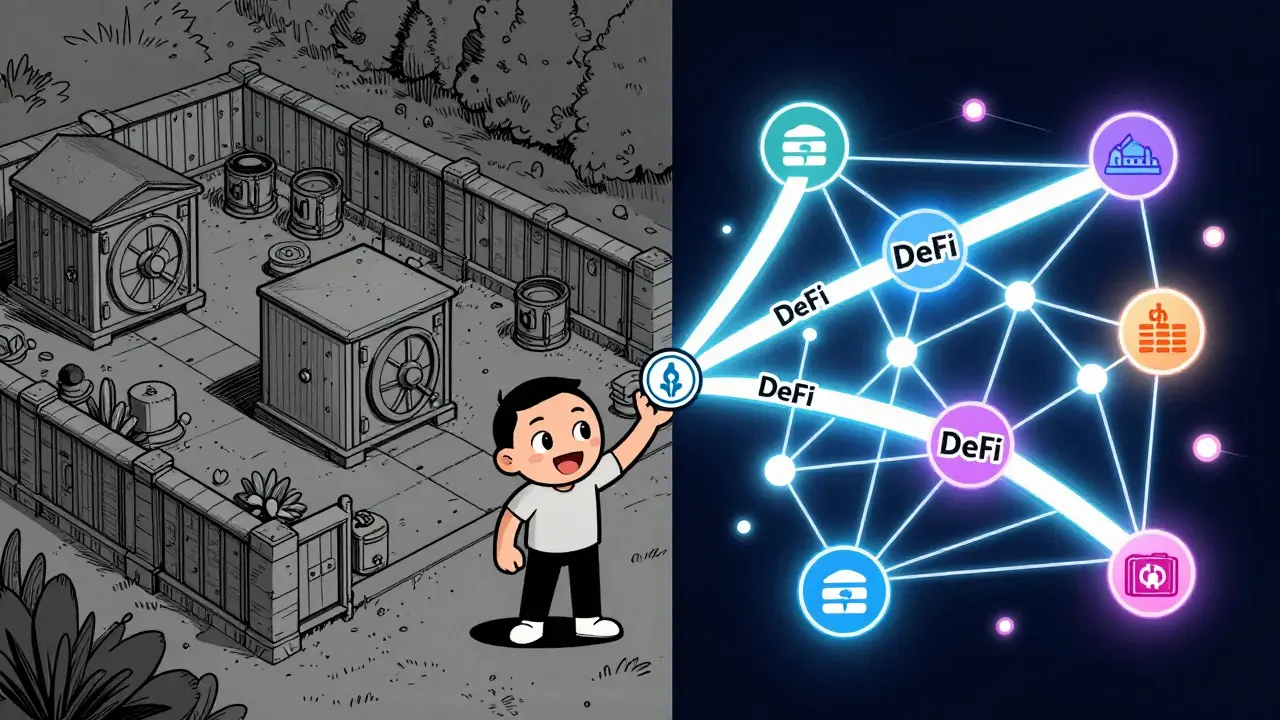
In traditional finance, banks operate like walled gardens. Your savings account at one bank does not talk to your brokerage account at another. You have to move money manually, often paying fees and waiting days for settlements. In DeFi, however, protocols are open-source and interconnected. The output of one protocol becomes the input for another. This seamless interaction creates a financial ecosystem that evolves at internet speed rather than the decade-long cycles typical of traditional banking.
The Mechanics of Money Legos
To understand how this works, we need to look under the hood. Composability relies on three main pillars: smart contracts, application programming interfaces (APIs), and standardized token formats. When Ethereum launched its smart contract functionality in 2015, it laid the groundwork. But it was the introduction of the ERC-20 token standard in November 2015 that truly unlocked interoperability. This standard ensures that any token created on Ethereum can be recognized and used by any wallet or exchange that supports the same standard.
Think of ERC-20 as the universal language of value. Because these tokens follow strict rules, a protocol like Uniswap can easily integrate with Aave or Compound. Developers do not need to build bridges between each pair of protocols. They simply write code that interacts with the common standards. According to Chainlink’s January 2022 report, this approach reduces development time by approximately 60-70%. Instead of building infrastructure from scratch, developers leverage existing, audited codebases.
This efficiency has led to an explosion of innovation. During "DeFi Summer" in 2020, the total value locked (TVL) in DeFi protocols surged from $1 billion to over $10 billion in just five months. This growth was fueled by developers creating composite applications-products that combine multiple underlying protocols into a single user experience. For example, a yield aggregator might automatically move your funds between lending platforms to find the highest interest rate, all within a single transaction.
Capital Efficiency and Yield Strategies
One of the most compelling benefits of composability is capital efficiency. In traditional finance, if you want to earn interest on your savings while using those same assets as collateral for a loan, you typically need separate accounts and significant amounts of idle cash. In DeFi, you can deploy the same asset across multiple protocols simultaneously.
Consider this scenario: You mint DAI stablecoins through MakerDAO using your ETH as collateral. You then deposit that DAI into Compound to earn interest. The resulting cDAI tokens, which represent your deposited DAI plus accrued interest, can then be used as collateral in Aave to borrow more stablecoins. This creates a multiplier effect where your initial capital is working in three different places at once. This strategy, often referred to as "yield farming," was impossible in traditional banking structures due to siloed data and rigid regulatory frameworks.
User experiences reflect this power. On Reddit’s r/ethfinance forum, users frequently share strategies involving complex composites. One user reported earning 12.7% APY by combining Aave, Uniswap, and Yearn Finance. They noted, "I'm using the same ETH as collateral across three platforms simultaneously-something impossible in traditional finance." This level of flexibility attracts sophisticated investors looking to maximize returns on their digital assets.
| Feature | Traditional Finance | DeFi Composability |
|---|---|---|
| Interoperability | Low (Walled Gardens) | High (Open Standards) |
| Development Speed | Months to Years | Days to Weeks |
| Capital Efficiency | Siloed Assets | Multiplexed Assets |
| Risk Management | Regulatory Firewalls | Code Audits & Governance |
The Double-Edged Sword: Systemic Risk
However, composability is not without its dangers. The very connectivity that drives innovation also amplifies risk. In traditional finance, if one bank fails, firewalls prevent the collapse from spreading immediately to others. In DeFi, a vulnerability in one protocol can cascade through the entire ecosystem.
A stark example occurred in March 2023 with the Euler Finance exploit. Hackers exploited a vulnerability in Euler’s smart contracts, draining $600 million. Because Euler was integrated with other protocols, the impact rippled outward, affecting users who had deposited assets into composite strategies involving Euler. Critics like Nouriel Roubini have argued that unconstrained composability creates a "house of cards" where the failure of one component can collapse the entire structure.
This systemic risk requires careful management. Unlike traditional banks backed by government insurance, DeFi relies on code audits, bug bounties, and decentralized governance. Users must understand that higher yields often come with higher risks. Tools like Zapper.fi and Zerion help visualize these connections, allowing users to see how their assets are exposed across different protocols. However, even with these tools, monitoring the health of the underlying stack remains a challenge.
Technical Challenges and Gas Fees
Implementing composability-driven strategies is not trivial. It requires intermediate to advanced technical knowledge. Most users face a learning curve of 3-6 months before they feel comfortable managing complex multi-protocol positions. One major hurdle is gas fees. On the Ethereum mainnet, executing a composite transaction that interacts with three different protocols can cost 2.3 times more than a single-protocol interaction.
During periods of high network congestion, gas fees can spike dramatically, making small transactions economically unviable. This has driven the adoption of Layer 2 solutions like Arbitrum and Optimism, which offer lower fees and faster finality. Additionally, the upcoming Ethereum Dencun upgrade, scheduled for Q1 2024, introduces proto-danksharding, which aims to reduce gas costs for composability transactions by approximately 90%. These improvements are crucial for scaling DeFi to mainstream adoption.
Another challenge is documentation quality. While established protocols like MakerDAO provide comprehensive developer resources, newer projects often lack clear guides. A survey by DeFiYield found that 43% of users encountered implementation issues due to incomplete documentation. This highlights the need for better standards and community support to lower the barrier to entry.

The Future of Composable Finance
Despite the challenges, the trajectory is clear. Composability is becoming the standard for financial infrastructure. Messari predicts that by 2030, 95% of financial infrastructure will incorporate composable features. We are already seeing enterprise adoption. J.P. Morgan’s Onyx division launched JPM Coin in October 2023, implementing composable patterns for institutional settlements. Even central banks are taking notice. The European Central Bank acknowledged composability as a fundamental architectural advantage of decentralized finance in a July 2023 discussion paper, while also highlighting concerns about systemic risk transmission.
Cross-chain composability is the next frontier. Currently, most composability happens within a single blockchain, primarily Ethereum. However, projects like Chainlink CCIP are working to enable secure cross-chain interactions. By Q2 2024, Chainlink plans to integrate with 11 major blockchains, allowing assets to move seamlessly between networks like Solana, Arbitrum, and Base. This expansion will further increase liquidity and innovation opportunities.
As we move forward, the focus will shift from pure innovation to stability and security. Circuit breakers, risk isolation mechanisms, and standardized interaction patterns will become essential. The goal is to retain the speed and flexibility of Money Legos while mitigating the risks of cascading failures. For users, this means more robust tools and clearer risk disclosures. For developers, it means adhering to stricter security standards and contributing to a more resilient ecosystem.
Conclusion
Composability is the secret sauce of DeFi. It transforms isolated applications into a cohesive, interconnected financial system. While it presents challenges related to security and complexity, the benefits of capital efficiency and rapid innovation are undeniable. As technology matures and standards improve, we can expect composability to play an increasingly central role in both decentralized and traditional finance. Understanding these dynamics is key for anyone looking to navigate the future of money.
What is composability in DeFi?
Composability in DeFi refers to the ability of different protocols and smart contracts to interact and combine seamlessly, like Lego blocks. This allows developers to build new financial products by leveraging existing infrastructure without needing permission.
Why is it called "Money Legos"?
The term "Money Legos" is used because DeFi protocols are modular and interchangeable. Just as you can snap Lego bricks together to build various structures, developers can connect different DeFi protocols to create complex financial strategies.
What are the risks of composability?
The primary risk is systemic vulnerability. If one protocol in a chain has a bug or is hacked, it can affect all connected protocols. This was seen in the Euler Finance exploit, where losses cascaded through interconnected systems.
How does composability improve capital efficiency?
Composability allows assets to be used in multiple protocols simultaneously. For example, an asset can serve as collateral in one protocol while earning yield in another, maximizing the utility of the same capital.
What role do smart contracts play in composability?
Smart contracts are the foundational building blocks. They execute predefined rules automatically, ensuring that interactions between different protocols happen securely and without intermediaries, provided they adhere to common standards like ERC-20.