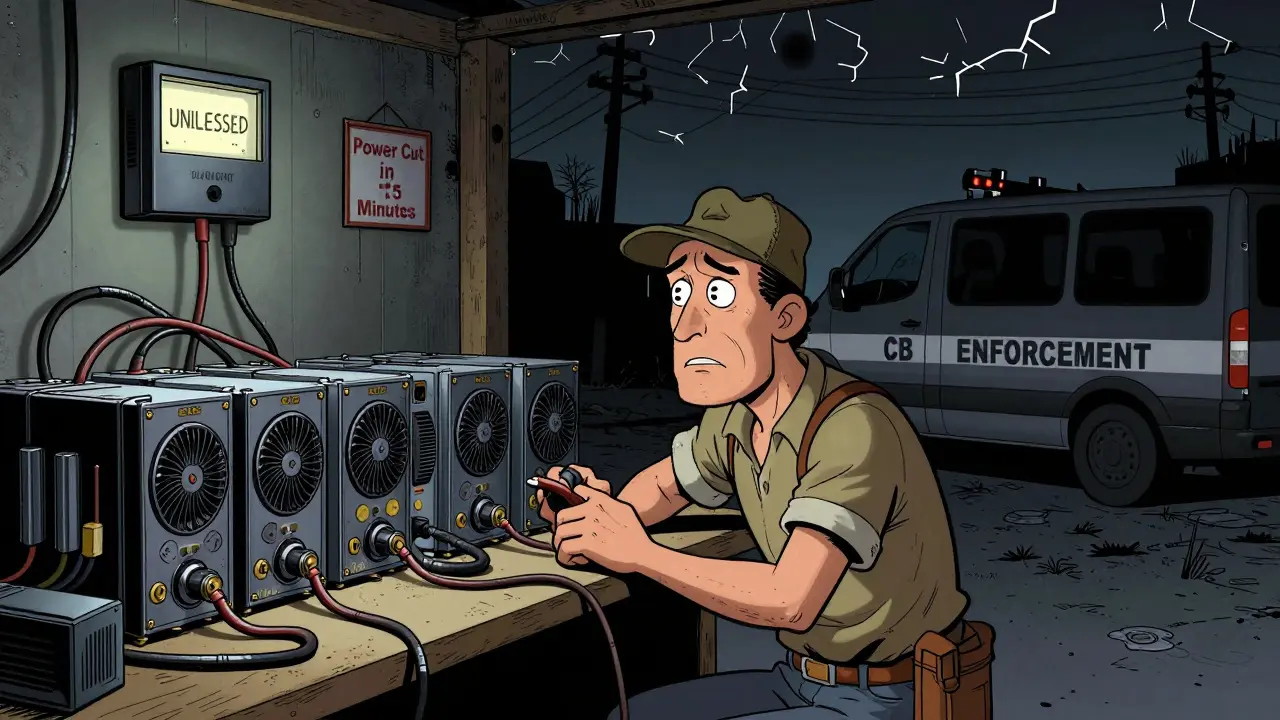
Bitcoin mining in Iran isn’t banned-but it’s far from free. If you think you can set up a rig in your garage and start earning crypto, think again. The Iranian government allows mining, but only under a maze of rules that change every few months. And if you’re not connected to the right people, you’re likely to get shut down, fined, or left without power when the grid collapses.
Legal, but Controlled
Cryptocurrency mining has been legal in Iran since 2018, but that didn’t mean it was regulated. At first, the government turned a blind eye as thousands of miners plugged in rigs, drawn by electricity prices as low as $0.004 per kWh-the cheapest in the world. By 2021, Iran was responsible for nearly 5% of global Bitcoin mining. But then the power outages started.
In summer 2024, the country faced its worst blackout in years. The government blamed unauthorized mining operations for siphoning off 2,000 megawatts of electricity-enough to power a small city. In response, they shut down all mining for four months. After that, they didn’t lift the ban. They built a system to control it.
By January 2025, the Central Bank of Iran (CBI) became the only legal authority for licensing crypto mining. Every miner-individual or company-must now apply for a license. No license? No power. No power? No mining. Simple as that.
The Licensing Trap
Getting a license sounds straightforward: apply to the Ministry of Industry, Mine and Trade, prove your hardware is approved, submit energy usage projections, and open a CBI-monitored rial account. But in practice, it’s a nightmare.
- Only government-approved ASIC miners are allowed. No secondhand rigs. No custom builds.
- Electricity tariffs for miners are the highest in Iran’s industrial sector-even higher than steel factories. You pay more for power than you earn in crypto.
- All transactions must go through CBI-approved channels. No private exchanges. No peer-to-peer payments unless tracked and logged.
- You must report every dollar earned, every rig running, every kilowatt used. The CBI has full access to your mining data.
And if you miss a report? Your license gets suspended. No warning. No appeal. Just power cut.
The Two-Tier System
Here’s the real story: not everyone plays by the rules. While regular miners scramble to file paperwork, powerful groups operate openly-without paying a dime.
The Islamic Revolutionary Guard Corps (IRGC) runs at least one 175-megawatt Bitcoin farm in Rafsanjan. It’s a joint venture with Chinese investors. They don’t pay for electricity. They don’t get licensed. They just take what they need from the grid.
And it’s not just the IRGC. Mosques, religious foundations, and government-affiliated companies have quietly turned their buildings into mining hubs. These places get free power from the state. So while a licensed miner pays $0.08 per kWh, a state-linked miner pays $0.00.
This creates a brutal imbalance. Legal miners lose money. Illegal miners thrive. And the government? They pretend to crack down while quietly benefiting from the underground network.

Why the Energy War?
Iran’s power grid is old, fragile, and poorly managed. When demand spikes, transformers blow. Cities go dark. The government blames miners. Miners blame the grid.
But the truth? It’s both. Iran’s infrastructure can’t handle the load. Even if all mining stopped tomorrow, blackouts would still happen. But blaming miners is easier than fixing the grid.
That’s why every time the power system flirts with collapse, the government slams the brakes on mining. The 2024 blackout led to a four-month ban. The 2025 winter surge led to new electricity caps. And now, in early 2026, mining operations are being forced to reduce output during peak hours-7 a.m. to 11 p.m.-to save power for homes.
There’s no long-term plan. Just crisis management.
The Advertising Ban and Payment Block
It’s not just mining that’s being restricted. The whole crypto ecosystem is being suffocated.
In February 2025, Iran banned all cryptocurrency advertising-online or offline. No YouTube videos. No billboards. No social media posts. Even discussing crypto on public forums can get you flagged.
Then came the payment blockade. In December 2024, the CBI cut off all crypto-to-rial conversions through websites. For 23 days, one million Iranians couldn’t buy Bitcoin to pay for imports, medicine, or food. People turned to peer-to-peer trading. LocalBitcoins saw a 78% spike in Iranian volume.
By January 2025, the government reopened exchanges-but only through their own API. Every transaction is monitored. Every user profile is logged. You can trade again, but you’re being watched.
Trustpilot ratings for Iranian crypto platforms dropped from 4.1 to 2.4 stars in two months. Users are angry. They’re scared. And they’re losing trust.

What’s Next? The Digital Rial
The government isn’t trying to stop crypto because it’s dangerous. They’re trying to replace it.
Iran’s Central Bank is rolling out the Digital Rial-a state-controlled digital currency that can’t be mined, can’t be decentralized, and can’t be transferred outside the country. It’s not blockchain. It’s just a database owned by the government.
Once the Digital Rial is fully live, all official transactions will shift to it. Crypto will be pushed to the margins. Mining will become a relic. And the few remaining legal miners? They’ll be forced to shut down or join the state system.
International analysts agree: crypto won’t help Iran bypass sanctions. The regime doesn’t want to evade sanctions. It wants to control every dollar that moves inside its borders.
Should You Mine in Iran?
If you’re a foreign investor, the low electricity prices look tempting. But the risks are extreme.
- Your equipment could be seized during a sudden ban.
- Your profits could be frozen if the CBI decides your account is suspicious.
- Your miners might be targeted by state-backed competitors who don’t pay for power.
- One power outage could wipe out months of earnings.
There are no guarantees. No legal protections. No recourse. The government can change the rules tomorrow-and you won’t even get a notice.
For Iranians? Mining is a gamble. Some do it on the side, using family-run operations or hidden rigs. But most have given up. They’re turning to P2P trading or simply waiting for the Digital Rial to take over.
Iran’s crypto mining story isn’t about innovation. It’s about control. And right now, the state is winning.
Is crypto mining legal in Iran in 2026?
Yes, but only if you have a license from the Central Bank of Iran and the Ministry of Industry, Mine and Trade. Unlicensed mining is illegal and can result in equipment seizure, fines, or power cutoffs.
Why does Iran allow crypto mining if it causes blackouts?
Iran allows mining because it generates hard currency through exports of mined Bitcoin. But when the power grid gets overloaded, the government shuts it down to protect homes and factories. It’s a cycle: allow mining for revenue, ban it during crises, then allow it again.
Can foreigners legally mine crypto in Iran?
Yes, foreign investors can apply for mining licenses, but they must comply with all Iranian regulations, including using CBI-monitored accounts and approved hardware. Many foreign operators have pulled out due to instability and risk of sudden bans.
What happens if you mine without a license?
Your mining equipment can be confiscated, your electricity supply cut off, and you may face fines or legal action. Authorities have raided hundreds of unlicensed operations since 2024, especially in areas with high electricity theft.
Why are mosques being used for mining?
Mosques and religious institutions receive government-subsidized or free electricity. Some operators have set up mining rigs inside them to avoid paying the high mining tariff. These operations are often linked to state-affiliated groups and are rarely shut down.
Is the Digital Rial replacing Bitcoin in Iran?
Yes. The Central Bank of Iran is rolling out the Digital Rial as a state-controlled digital currency that replaces decentralized cryptocurrencies in official transactions. It cannot be mined, and its supply is fully controlled by the government. This is part of a broader effort to eliminate private crypto use.
How has crypto usage changed in Iran since 2024?
Crypto inflows dropped 11% in the first half of 2025. Trading volumes fell sharply after payment restrictions and the advertising ban. Many users switched to peer-to-peer platforms like LocalBitcoins. Adoption among regular citizens has declined due to uncertainty and fear of government crackdowns.

Anthony Marshall
March 13, 2026 AT 01:36Iran’s whole crypto setup is a joke. They want to control everything-power, money, data-but they can’t even fix their damn grid. If you’re mining legally, you’re getting screwed. If you’re not, you’re playing Russian roulette with your equipment. Either way, you lose. The state’s just using miners as a lightning rod while their buddies at the IRGC run billion-dollar farms on free electricity. It’s not regulation-it’s theft with paperwork.
Lindsay Girvan
March 14, 2026 AT 00:32Let’s be real: no one cares about the rules. People mine because they’re desperate. The Digital Rial? A prison cell with a blockchain logo. They’re not banning crypto to protect the grid-they’re banning it to keep power in their own hands. The real crime? Making a nation of engineers and tinkerers pay for the state’s incompetence.
Douglas Anderson
March 14, 2026 AT 07:31There’s a pattern here that’s easy to miss. Iran isn’t trying to stop mining because it’s illegal-it’s trying to stop mining because it’s *too* effective. Bitcoin mining bypasses sanctions, creates hard currency, and gives people financial autonomy. That’s why they’re so aggressive. The licensing system isn’t about compliance-it’s about surveillance and extraction. Every rig you register becomes a data point. Every transaction logged becomes leverage. They don’t want to eliminate crypto. They want to own it.
And the mosques? That’s not corruption. That’s institutional capture. When religious entities get state-subsidized power to mine, it’s not just about profit-it’s about legitimacy. It turns crypto from a rebellion into a state-sanctioned ritual. Brilliantly sinister.
The real tragedy? The miners who follow the rules. They’re the ones getting crushed under bureaucracy, tariffs, and blackouts. Meanwhile, the IRGC’s rigs hum along 24/7, powered by the same grid that leaves Tehran in the dark. This isn’t a policy failure. It’s a feature.
Tina Keller
March 15, 2026 AT 22:46I’ve read a lot about state control, but Iran’s crypto saga feels like a Kafka novel written by an engineer. You show up with your ASICs, your spreadsheets, your CBI account-ready to play by the rules. And then the lights go out. Not because you used too much power-but because someone else’s cousin’s uncle’s mosque got a free pass. The system doesn’t punish rule-breakers. It rewards insiders. And the people who tried to do it right? They’re the ones left with cold hardware and a broken dream.
It’s not about Bitcoin. It’s about who gets to decide what value means. The government isn’t afraid of decentralization. It’s afraid of *meaning*. If people can mine their own money, they don’t need the state to tell them what’s worth anything anymore.
The Digital Rial isn’t the future. It’s the last gasp of a regime that can’t stand the idea of a dollar it didn’t print.
vasantharaj Rajagopal
March 17, 2026 AT 11:19From a systems engineering standpoint, the Iranian model represents a classic case of misaligned incentives. The marginal cost of electricity for mining is below the marginal revenue of BTC, yet regulatory intervention creates artificial scarcity in power allocation. The licensing regime introduces transaction costs that exceed the operational ROI for small-scale miners. Meanwhile, state-affiliated actors operate with zero marginal cost due to subsidized infrastructure-creating a negative externality that distorts market equilibrium. The CBI’s monitoring protocols are technically sound but institutionally corrupt, as audit trails are selectively enforced. This is not regulation-it’s rent-seeking disguised as governance.
William Montgomery
March 18, 2026 AT 15:41Stop pretending this is about energy. This is about control. If Iran wanted to fix the grid, they’d invest in it. Instead, they’re using miners as a scapegoat so they don’t have to admit their infrastructure is a 1970s relic. Meanwhile, the IRGC’s mining farms? They’re not even hiding. They’re flaunting it. And the government? They look the other way. Why? Because they’re getting paid. Not in rials-in Bitcoin. And they’re not even paying taxes on it.
Adam Ashworth
March 20, 2026 AT 06:11My cousin tried mining in Tehran last year. Got a license. Paid the fees. Installed the rigs. Then, during peak hours, the power got cut. No warning. No explanation. Just silence. He called the CBI. They said his ‘usage profile’ was flagged. He didn’t even know what that meant. A week later, his equipment was seized. No court. No paperwork. Just a note on his door: ‘Violation of Article 12.3.’ He’s still trying to get it back. Meanwhile, his neighbor’s uncle runs a 200-rig farm out of a mosque. No power cuts. No fines. Just profit.
This isn’t capitalism. It’s feudalism with ASICs.
Tom Jewell
March 22, 2026 AT 06:08The Digital Rial isn’t a currency. It’s a leash. Every transaction is a confession. Every transfer, a confession of loyalty. They don’t want you to stop using crypto-they want you to stop thinking for yourself. Bitcoin is dangerous not because it’s decentralized, but because it’s *personal*. It doesn’t care who you are, where you’re from, or what your name is on the government’s list. It just works. And that terrifies them more than any blackout ever could.
They’re not afraid of hackers. They’re afraid of hope.
karan narware
March 22, 2026 AT 09:43Wow. So the state is literally stealing electricity from the people… and then charging them for it? And the miners who follow the rules? They’re the ones getting the boot. Meanwhile, the IRGC’s mining farm is probably running on solar panels they stole from a school. Classic. The only thing more ironic than this system is that it’s still somehow ‘legal.’
vishnu mr
March 23, 2026 AT 05:43So… if the government is the only one who can mine legally… and they’re the ones using the free power… then… is mining even real? Or is it just a way to make people think they have a chance? Feels like a scam with a license.