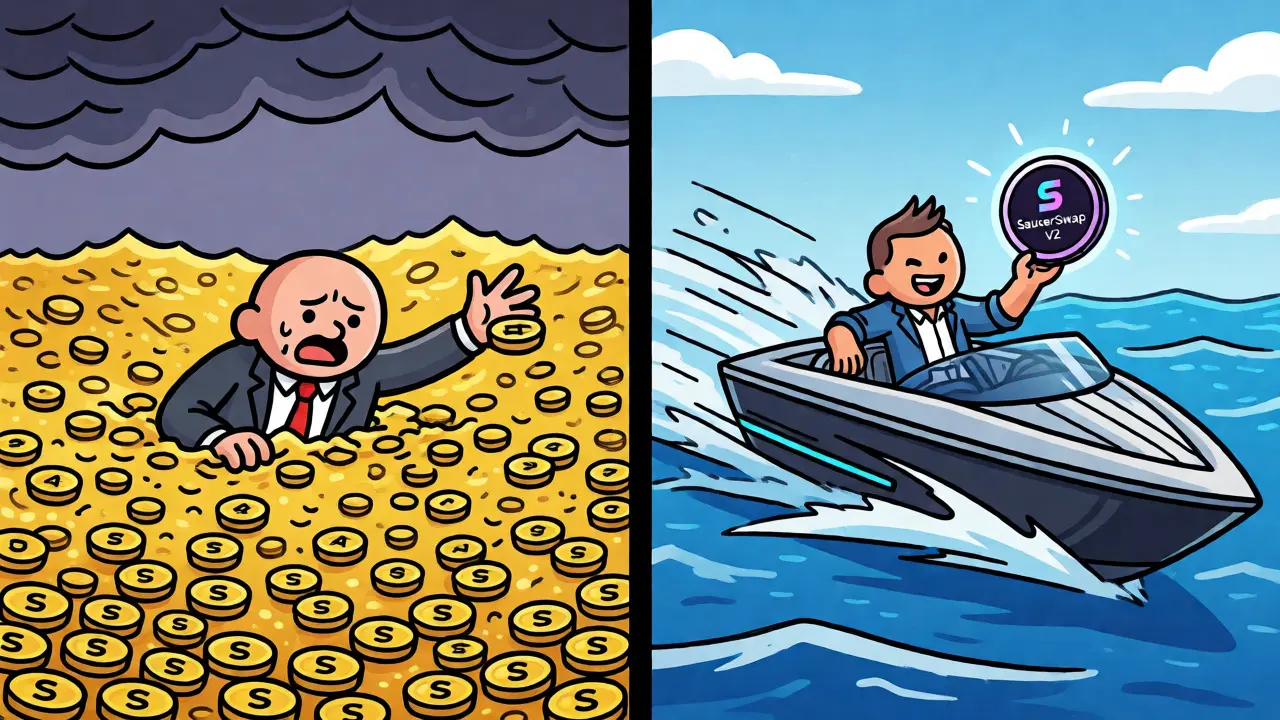
You probably know the pain of paying $50 in gas fees just to swap a few dollars' worth of tokens on Ethereum. It kills small trades and makes frequent trading a nightmare for regular people. Now imagine a decentralized exchange (DEX) where swaps cost fractions of a cent and settle in seconds. That is the core promise of SaucerSwap V2, a leading decentralized exchange operating on the Hedera network that adapts Uniswap V3's concentrated liquidity model for faster, cheaper transactions. But does it actually deliver on that promise, or is it just another copycat protocol with a fancy interface? I spent some time digging into its mechanics, fees, and real-world performance to give you a straight answer.
What Exactly Is SaucerSwap V2?
Think of SaucerSwap V2 as the upgraded engine room of the Hedera DeFi ecosystem. Launched in November 2023, it replaced the original SaucerSwap V1 by borrowing the best parts of Uniswap V3-specifically, the concentrated liquidity feature-and tailoring them for Hedera’s unique infrastructure. Unlike traditional automated market makers (AMMs) that spread your money across all possible prices, SaucerSwap V2 lets you pick specific price ranges. If you think Bitcoin will stay between $60k and $70k, you only put your money there. This means less capital sitting idle and more fees earned per dollar provided.
The platform isn't just a clone, though. Hedera handles tokens and smart contracts differently than Ethereum. SaucerSwap had to modify its code to talk to Hedera Token Service (HTS) while still using the Smart Contract Service (HSCS). The result? You get native support for HTS tokens without the usual compatibility headaches. As of late 2025, it holds the #601 rank among all cryptocurrencies, but within the Hedera world, it is the dominant player for swapping and staking.
The Concentrated Liquidity Advantage
Here is where things get interesting for traders and liquidity providers (LPs). In old-school AMMs like Uniswap V2, if you provided liquidity, your funds were spread thin from zero to infinity. Most of that capital never touched an actual trade. SaucerSwap V2 fixes this. You choose a range, say $1.00 to $1.10 for a stablecoin pair. Your liquidity only works when the price is inside that box. If the price moves out, you stop earning fees until it comes back.
This setup creates a composite curve that aggregates all these individual positions into one big pool. For traders, this means tighter spreads and less slippage. For LPs, it means higher capital efficiency. But be warned: it requires active management. If you set a narrow range and the price jumps out, you are left holding whichever asset dropped in value relative to the other. It is not "set it and forget it" unless you use wider ranges, which dilutes your fee earnings.
| Feature | Traditional AMM (e.g., V1) | SaucerSwap V2 |
|---|---|---|
| Liquidity Distribution | Uniform across all prices | Concentrated in user-defined ranges |
| Capital Efficiency | Low (capital sits idle) | High (capital works harder) |
| Slippage | Higher due to thinner effective depth | Lower due to deeper effective depth |
| User Effort | Passive | Active monitoring required |
| Fee Structure | Fixed (usually 0.3%) | Tiered based on volatility |
Fees, Tokens, and The Cost of Trading
Let’s talk numbers because that is what matters most. Hedera is known for low fees, and SaucerSwap leverages that. Swaps here are dirt cheap compared to Ethereum mainnet. You aren’t worrying about gas spikes eating your profits. The platform uses a multi-tiered fee structure. Volatile pairs charge higher fees to compensate LPs for the risk of impermanent loss, while stable-stable pairs have lower fees. This aligns incentives better than a flat rate.
The governance token, SAUCE, trades around $0.06 as of late 2025. With a market cap hovering near $47 million, it is a mid-cap asset. Recent data shows a 5.42% growth over seven days and nearly 12% monthly gain. While this looks positive, remember that crypto markets are volatile. Analysts from WalletInvestor predict a mixed outlook for 2025, with some seeing prices dip below $0.05 before potentially recovering. Don’t buy SAUCE expecting moonshots; view it as a utility token for governance and fee discounts.

Security and Trustworthiness
Is your money safe? SaucerSwap V2 has undergone security audits by Omniscia, a reputable firm specializing in smart contract security. They reviewed the modified Uniswap V3 contracts to ensure no vulnerabilities slipped in during the adaptation for Hedera. This is crucial because adapting complex DeFi protocols to new blockchains often introduces bugs.
Beyond audits, the team maintains transparency through public GitHub repositories and community forums. However, always remember the golden rule of DeFi: code is law, but bugs happen. Never invest more than you can afford to lose, especially in newer protocols. The fact that it powers billions of daily requests for partners like Instagram (via Hedera’s broader ecosystem) adds a layer of institutional credibility, but retail users should still exercise caution.
User Experience: Smooth Sailing or Steep Learning Curve?
If you are coming from Coinbase or Binance, SaucerSwap V2 might feel overwhelming at first. Connecting a wallet like HashPack or Blade is straightforward. But managing liquidity positions? That takes practice. The interface allows you to visualize your position’s profit and loss in real-time, which helps. You can see exactly how much you earn in fees versus how much you lose to price movements.
For simple swaps, the experience is fast. Transactions confirm in seconds. For liquidity provision, you need to understand concepts like "range orders." If you don’t monitor your positions, you could end up with assets you didn’t intend to hold long-term. The documentation has improved since launch, offering guides on strategy, but beginners might find themselves Googling terms like "impermanent loss" more often than they’d like.
Who Should Use SaucerSwap V2?
This platform shines for three types of users:
- Frequent Traders: If you make multiple trades a day, the low fees save you significant money compared to Ethereum-based DEXs.
- Hedera Holders: If you already believe in the Hedera network for its enterprise focus and speed, SaucerSwap is the natural place to put your HBAR and HTS tokens to work.
- Sophisticated LPs: If you understand market trends and want to maximize yield by concentrating liquidity, you can outperform passive strategies significantly.
It is less ideal for absolute beginners who want to park their money and forget it, or for those who only trade major coins like BTC and ETH via wrapped versions that might have limited liquidity compared to centralized exchanges.
Final Verdict: A Solid Niche Player
SaucerSwap V2 isn’t trying to beat Uniswap globally; it is trying to win the Hedera niche. And so far, it is doing a great job. By bringing concentrated liquidity to a low-fee chain, it solves two major pain points: high costs and inefficient capital use. The risks involve the complexity of managing positions and the reliance on Hedera’s overall adoption. If Hedera grows, SaucerSwap grows. If Hedera stalls, SaucerSwap struggles. For now, it remains the go-to DeFi hub for the network, backed by solid tech and reasonable tokenomics.
Is SaucerSwap V2 safer than centralized exchanges?
SaucerSwap V2 offers self-custody, meaning you control your private keys, unlike centralized exchanges that hold your funds. This reduces counterparty risk (like FTX-style collapses). However, you face smart contract risk. Since it was audited by Omniscia, the code is vetted, but no system is 100% bug-free. Always use hardware wallets for large amounts.
Do I need HBAR to use SaucerSwap V2?
Yes, you need HBAR to pay for transaction fees (gas) on the Hedera network. However, fees are extremely low, typically costing less than $0.01 per transaction. You do not need HBAR to provide liquidity or swap tokens, only to initiate the blockchain action.
What happens if the price moves out of my liquidity range?
If the price moves outside your chosen range, your liquidity stops working. You stop earning trading fees, and your position converts entirely into one of the two assets in the pair (the one that lost value relative to the other). You must manually adjust your range or close the position to resume earning fees.
Can I bridge assets from Ethereum to SaucerSwap?
Yes, cross-chain bridges exist to move assets like USDC or ETH (as wrapped tokens) from Ethereum to Hedera. Once bridged, these assets become HTS-compatible and can be traded on SaucerSwap V2. Keep in mind that bridging involves additional steps and potential delays.
How does the SAUCE token provide value?
The SAUCE token is used for governance, allowing holders to vote on protocol upgrades and fee structures. It may also offer fee discounts for liquidity providers in future updates. Its value is tied to the usage volume of the SaucerSwap platform and the broader success of the Hedera ecosystem.