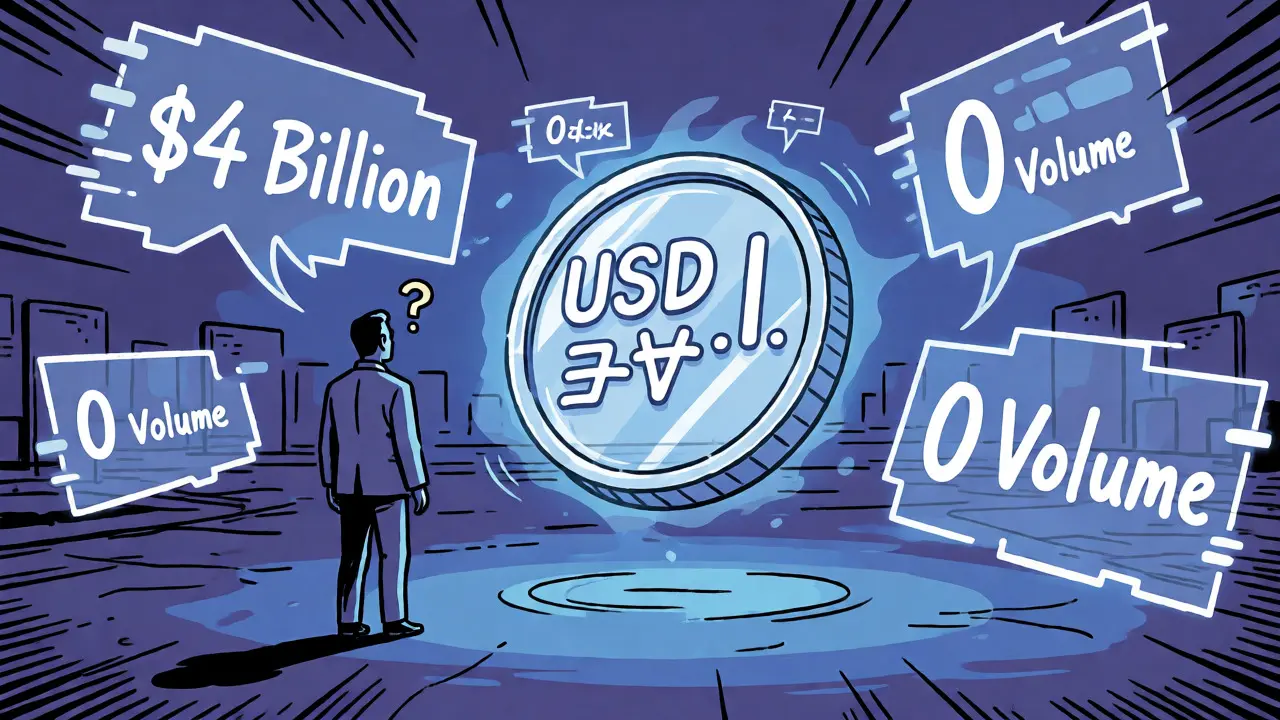
Imagine seeing a token listed with a market cap of over $4 billion, but when you try to buy it, the trading volume is exactly zero. That’s the confusing reality surrounding Tregrity USD, also known by its ticker USD.I. It markets itself as a next-generation stablecoin on the BNB Smart Chain, promising privacy and multi-chain operability. But for most investors, this token looks less like a financial tool and more like a digital ghost-present in data feeds, but absent in actual markets.
The Basic Facts About Tregrity USD
At its core, Tregrity USD is a BEP-20 token deployed on the BNB Smart Chain (BSC). Its smart contract address is 0xa0Af324cC24ad0060bcE52dE359aFfD6deCb5cF2. The project claims a maximum supply of 12 billion tokens, which would theoretically make it one of the largest stablecoins if fully issued and backed. However, the technical details are sparse. The contract implements standard functions like transfer and approve, but there is no public verification of advanced mechanisms like pausing or blacklisting. Without verified source code or third-party audits from firms like CertiK or OpenZeppelin, users cannot confirm if the contract has hidden risks, such as the ability for developers to mint unlimited tokens or freeze user balances.
Why The Market Data Looks Broken
If you check different cryptocurrency aggregators, you’ll find wildly inconsistent numbers. One site might report a price of $1.001, while another shows $0.9996. More strangely, some platforms list a circulating supply of zero tokens, yet simultaneously display a market capitalization in the billions. How does that happen? Most likely, these sites use automated formulas that assume a $1 peg for any token labeled "stablecoin," multiplying the max supply by $1 to generate a fake market cap. In reality, major exchanges like Binance and Coinbase do not offer spot trading pairs for USD.I. They merely host informational pages that scrape data from external feeds, leading to contradictions where a token is "trading" on two markets with $0.00 in volume.
| Platform | Reported Price | Circulating Supply | Market Cap | 24h Volume |
|---|---|---|---|---|
| FIN-PLAN | $1.00106 | 0 | $4.06 Billion | $0 |
| Binance (Info Page) | NaN / $1.000092 | 0 | $0 | $0 |
| Coinbase | $0.9996 | N/A | N/A | $0.00 |
| CoinCarp | No Data | N/A | N/A | Not Listed |
Liquidity and On-Chain Activity
A stablecoin is only useful if people can actually trade it. For Tregrity USD, liquidity is virtually non-existent. Analytics platforms like Nansen show minimal transaction history and no significant decentralized finance (DeFi) integrations. You won’t find USD.I in major lending protocols like Aave or Venus, nor in large liquidity pools on PancakeSwap or Uniswap. The number of token holders is extremely low-often just tens of addresses rather than thousands. This suggests that the token isn’t being used for payments, savings, or yield farming. Instead, it sits idle in wallets, possibly held by early adopters or insiders who haven’t moved their assets.
The Transparency Problem
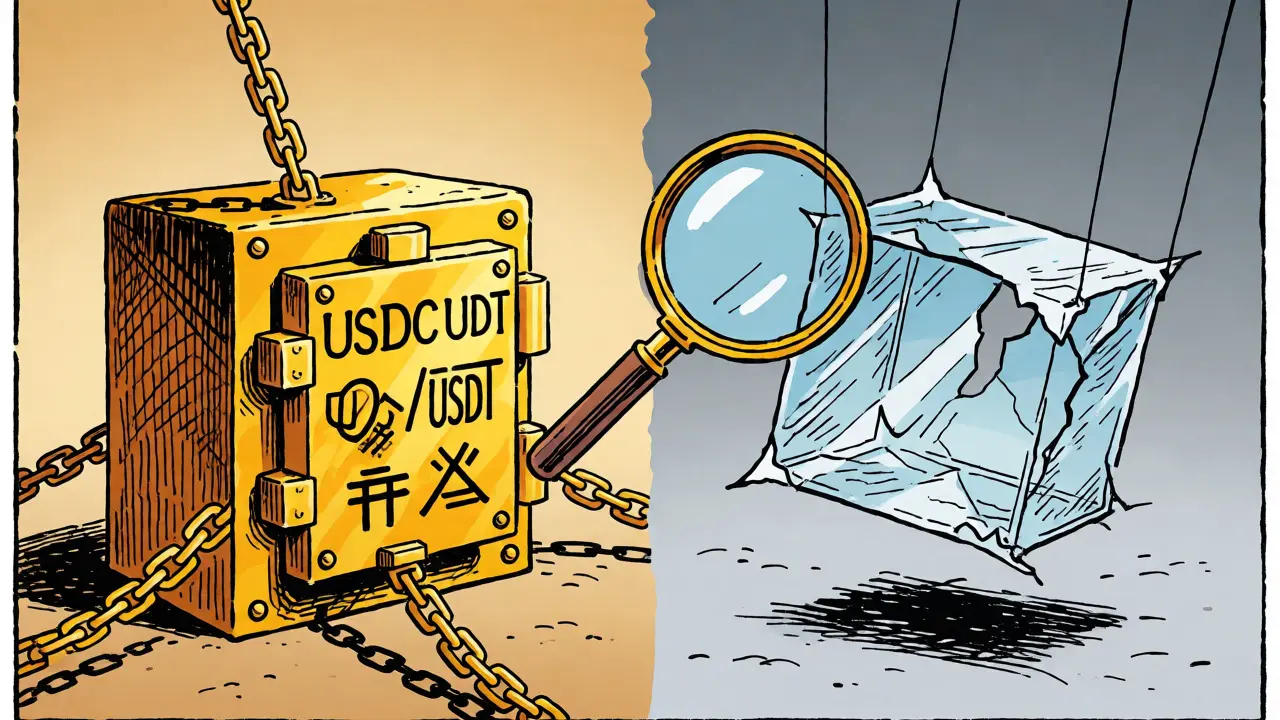
Compare Tregrity USD to established players like USDC or USDT. Circle, the issuer of USDC, publishes monthly attestations from Grant Thornton proving they hold enough cash and short-term treasuries to back every coin. Tether provides similar reports. Now look at Tregrity’s official website, usditoken.io. There are no named founders, no legal entity disclosures, and no audited financial statements. The site uses generic marketing language about "privacy" and "accessibility" but fails to explain how the token maintains its peg. Is it backed by cash? Crypto collateral? Algorithmic mechanisms? The lack of a whitepaper or technical documentation makes it impossible to assess the underlying value proposition.
Risks for Potential Buyers
Buying an obscure stablecoin comes with specific dangers that mainstream coins don’t have. First is redemption risk. If you hold USD.I, can you actually swap it back for US dollars? With no clear mint/redeem process documented, you’re dependent on finding another buyer. Second is counterparty risk. Since we don’t know who runs Tregrity, we don’t know if they are regulated or if they even exist as a legal corporation. If the project abandons development, your tokens could become worthless. Third is regulatory uncertainty. Unlike PayPal’s PYUSD or regulated EU stablecoins, Tregrity doesn’t mention compliance with frameworks like MiCA or oversight by bodies like the NYDFS. This leaves users exposed to potential future crackdowns without any consumer protections.
How To Interact With USD.I
If you still want to experiment with this token, here’s the practical path. Since there are no centralized exchange listings, you need to operate on-chain. First, install a wallet like MetaMask and configure it for BNB Smart Chain using the RPC endpoint bsc-dataseed.binance.org. Next, manually add the token contract address: 0xa0Af324cC24ad0060bcE52dE359aFfD6deCb5cF2. Finally, you’ll need to acquire USD.I through a direct peer-to-peer transfer or a very small, illiquid DEX pair if one exists. Be prepared for high slippage due to low liquidity. There is no fiat on-ramp partner mentioned, so you’ll likely need to convert USD to USDT first, then swap for USD.I, assuming you can find a seller.
Frequently Asked Questions
Is Tregrity USD (USD.I) a scam?
It is not necessarily a scam in the sense of a Ponzi scheme, but it exhibits many red flags associated with low-quality or abandoned projects. The lack of transparency, zero trading volume, and missing team information suggest it carries a very high risk of total loss or illiquidity.
Can I buy Tregrity USD on Binance?
No, you cannot trade Tregrity USD directly on Binance’s spot market. Binance only hosts an informational page for the asset. To buy it, you would need to use a decentralized exchange on BNB Smart Chain or find a private seller.
What backs the value of USD.I?
The project claims it is backed 1:1 by USD reserves, but there are no public audits or bank statements to verify this. Unlike USDC or USDT, there is no proof of reserves available to the public.
Why does the market cap say billions if volume is zero?
This is likely an error in data aggregation. Many sites calculate market cap by multiplying the total supply by the assumed $1 price, ignoring whether those tokens are actually in circulation or tradable. It creates a misleading picture of size.
Is Tregrity USD safe to hold?
For most users, it is considered unsafe due to the lack of smart contract audits and issuer transparency. If the smart contract has bugs or malicious functions, funds could be lost. Additionally, the lack of liquidity means you might not be able to sell when you want to exit.

Mark Regan
October 24, 2026 AT 18:36Oh, fantastic. Another token that exists solely to inflate the aggregate market cap of crypto so we can feel like this 'asset class' is actually real!!! I love how the data feeds just blindly multiply max supply by $1 without checking if a single human being has ever traded it... absolutely hilarious. It’s not even a ghost; ghosts have more substance than a BEP-20 contract with zero volume and no audits. The fact that Binance lists it as an info page while Coinbase shows NaN prices proves that these aggregators are completely broken and rely on lazy scraping scripts rather than actual liquidity metrics. We spend billions pretending these numbers matter when in reality, you couldn't sell $5 worth of this stuff without crashing the price into the ground. It’s the perfect metaphor for the entire altcoin sector: huge theoretical value, zero practical utility, and a total lack of transparency. Keep buying the dip, folks, because clearly, nobody else is interested.
Sean J Fortune
October 25, 2026 AT 10:53It is frankly embarrassing that anyone in the financial community still falls for these simplistic aggregation errors which plague our industry due to a profound lack of rigorous due diligence standards among retail participants who simply do not understand the mechanics of decentralized finance protocols or the specific implications of unverified smart contracts on the BNB Smart Chain ecosystem. When one observes the disparity between the claimed four billion dollar market capitalization and the absolute void of trading volume, it becomes immediately apparent that the project is either dead on arrival or was never truly alive to begin with, representing nothing more than a vanity metric designed to satisfy the superficial requirements of certain listing algorithms that fail to distinguish between circulating supply and total maximum supply in any meaningful way. Furthermore, the absence of third-party audits from reputable firms such as CertiK or OpenZeppelin indicates a fundamental disregard for security best practices, suggesting that the developers either lacked the budget for proper verification or, more likely, possessed something to hide regarding the minting capabilities and potential admin privileges embedded within the bytecode itself. This is not merely a case of poor marketing but rather a systemic failure of information asymmetry where the issuer holds all the cards and the investor is left holding a digital IOU backed by nothing more than hope and generic website copy that fails to address the most basic questions regarding collateralization and redemption mechanisms. Until there is a transparent proof of reserves comparable to those provided by regulated entities like Circle or Tether, this asset remains speculative fiction rather than financial reality, and treating it as anything else demonstrates a worrying ignorance of basic risk management principles that every serious investor should possess regardless of their experience level in the cryptocurrency markets.
Ellie Probus
October 25, 2026 AT 23:28THIS IS SCAMMY AS HELL AND I AM SO ANGRY ABOUT IT!!! 😡😡😡 How dare they put a $4 BILLION market cap on something that literally nobody is trading?? It’s insulting!! They think we’re stupid?? The website looks like it was made by a teenager in 2015 with no whitepaper and no team names?? DISGUSTING!! 🤮🤮🤮 If I saw this on my portfolio tracker I would scream because it makes the whole market look fake and inflated just to make us feel rich when we are actually broke!! ZERO VOLUME MEANS DEAD PROJECT, PEOPLE!! WAKE UP!!! 💀💀💀
Samantha McClafferty
October 27, 2026 AT 03:54I appreciate the detailed breakdown here, and I want to encourage everyone to take this as a learning opportunity rather than just getting frustrated!
It is completely normal to feel confused when seeing discrepancies like a $4B market cap with $0 volume, and your feelings about the lack of transparency are valid.
However, let's remember that early-stage projects often face these exact hurdles before gaining traction, so instead of dismissing them entirely, maybe we can view this as a signal to dig deeper into the technical aspects?
Your caution is well-founded, especially regarding the lack of audits, but try not to let the drama overshadow the potential for future development if the team steps up.
Let's support each other in navigating these complex waters!
Mark Regan
October 28, 2026 AT 00:49Supportive coach? Really?? You're telling me that 'digging deeper' into a contract with no source code verification and no named founders is a viable strategy for preserving capital??? That sounds less like encouragement and more like enabling bad habits... I'm sorry if my sarcasm hurts your feelings, but someone has to point out that 'potential for future development' is just another way of saying 'we have no idea what we're doing.'
Also, claiming that early-stage projects 'often face these hurdles' ignores the fact that most successful ones had at least a verified contract and a known team from day one. This isn't a hurdle; it's a red flag the size of Texas.
Samantha McClafferty
October 28, 2026 AT 13:34I hear your frustration, Mark, and I respect your protective stance over investors!
You are right that caution is key, and perhaps my optimism was too broad given the specific red flags you highlighted.
Let's agree that thorough due diligence is non-negotiable, and thank you for reminding us to stay grounded in the facts rather than just the hype!
Tony Byrne
October 29, 2026 AT 00:09It is quite concerning, indeed... to see such a large discrepancy in the data... one really needs to be careful with these obscure tokens, as they can easily trap unsuspecting investors who trust the aggregators too much... it is important to verify everything oneself... don't lose heart though, as education is the best defense against these kinds of pitfalls...