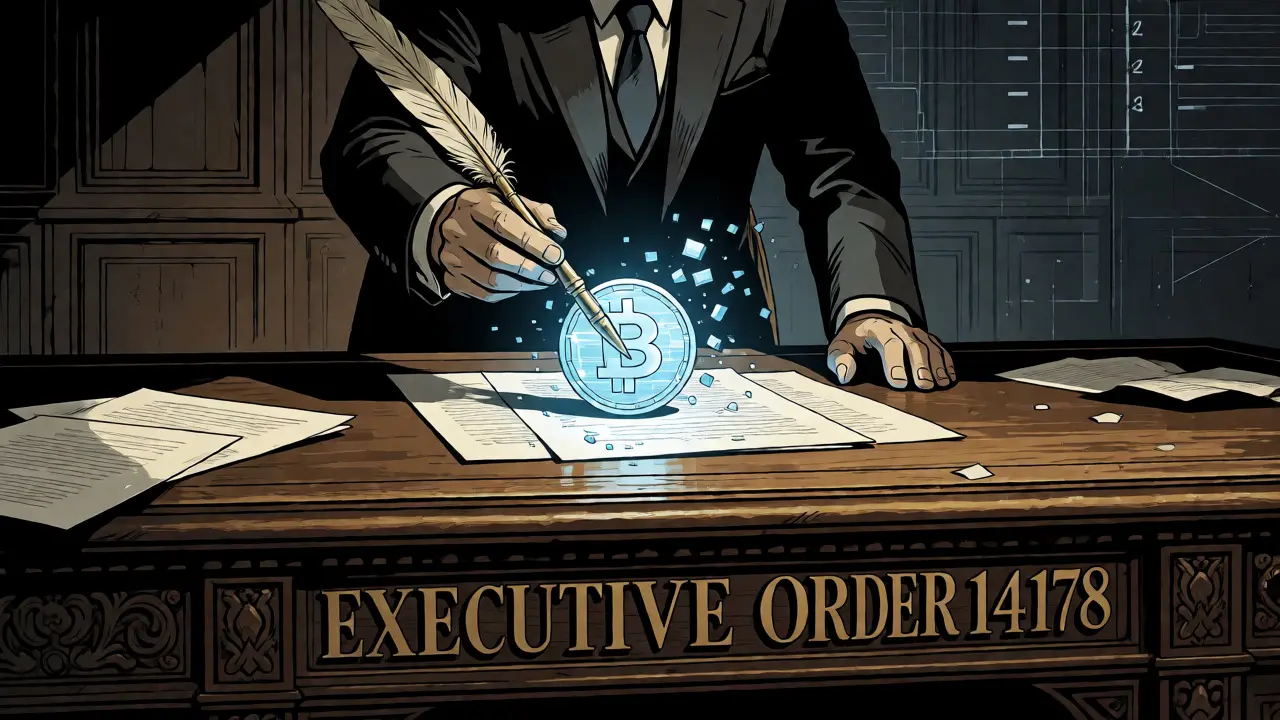
Imagine walking into a coffee shop in 2026 and paying with a government-issued digital token that’s as stable as the cash in your wallet but moves instantly like Bitcoin. For years, economists predicted this future was inevitable for the United States. Then, abruptly, it wasn’t. In 2025, President Donald Trump signed Executive Order 14178, a directive that halted all U.S. government efforts to create or promote a central bank digital currency (CBDC). This move didn’t just pause a pilot program; it effectively killed the "FedCoin" project before it could launch, marking a sharp ideological break from the previous administration’s push for a sovereign digital dollar.
If you’ve been following crypto news, you might wonder: why stop now? The world is moving toward digital money, with over 130 countries exploring or testing their own versions. So why did the U.S. pull the emergency brake? It comes down to a mix of privacy concerns, political ideology, and a bet that private companies-not the Federal Reserve-should lead the way in digital finance. Let’s break down what happened, why it matters, and what it means for your money.
The Policy Flip: From Biden’s Urgency to Trump’s Ban
To understand the halt, you have to look at where we were just three years ago. In 2022, President Biden issued Executive Order 14067, which placed the "highest urgency" on researching a U.S. CBDC. The goal was clear: ensure America didn’t fall behind China’s digital yuan or Europe’s digital euro. Agencies like the Treasury and the Federal Reserve formed working groups to study how a digital dollar would work. They looked at everything from payment speed to financial inclusion.
Then came the shift. Executive Order 14178 reversed course completely. It didn’t just say "take it slow." It stopped development. Federal Reserve Chair Jerome Powell backed this up, stating he wouldn’t support issuing a CBDC while he leads the bank. This wasn’t a technical delay due to bugs; it was a strategic decision to reject the concept of a government-controlled digital wallet for everyday citizens.
| Feature | Biden Administration (EO 14067) | Trump Administration (EO 14178) |
|---|---|---|
| Primary Goal | Research and design options for a U.S. CBDC | Halt creation/promotion of a U.S. CBDC |
| Federal Reserve Role | Active R&D and pilot participation | No issuance under current leadership |
| Private Sector Focus | Complement to private innovation | Replace public CBDC with private stablecoins |
| Global Context | Align with G-20 digital trends | Differentiate via free-market approach |
Why the Sudden Stop? Privacy and Surveillance Fears
The biggest driver behind the halt wasn’t economic-it was political and cultural. Many Americans, particularly those aligned with conservative fiscal policies, view a CBDC as the ultimate surveillance tool. If every transaction goes through a central bank ledger, the government can theoretically see exactly where you spend your money. Could they block you from buying certain goods? Could they expire your money if you don’t spend it fast enough?
These aren’t just sci-fi worries. Current banking regulations already require institutions to file over 26 million reports annually to the government on customer activity. A CBDC could expand this visibility exponentially. Critics argued that a digital dollar would give the state too much power over individual financial freedom. By halting the project, the administration signaled that privacy and decentralization are non-negotiable values in American finance.
There’s also the issue of civil asset forfeiture. In a system where the government controls the digital ledger, the ability to freeze assets becomes technically trivial. Opponents of the CBDC feared this would make it easier to seize funds without traditional judicial hurdles. For many, the risk of losing financial autonomy outweighed the benefits of faster payments.

The Global Outlier: The U.S. vs. The World
Here’s the uncomfortable truth: the U.S. is now an outlier. While Washington pulled back, the rest of the world accelerated. As of early 2025, 134 countries and currency unions are actively working on CBDCs. That’s up from about 114 in 2023. Seventy-two nations are in advanced stages, including pilots and full launches. Eleven countries have already launched their digital currencies.
Look at the G-20. Nineteen members are exploring CBDCs, and sixteen are deep in development or pilot phases. China’s digital yuan is live and expanding. The European Central Bank is pushing ahead with its wholesale CBDC initiative, aiming to settle transactions on distributed ledger technology. Even allies like Japan, Australia, and the UK are moving forward. The U.S. decision creates a vacuum in global monetary standards. Who sets the rules for cross-border digital payments if not the issuer of the world’s reserve currency?
This isn’t just academic. The value of global CBDC transactions is projected to hit $213 billion in 2025, more than double the $100 billion seen in 2023. By opting out, the U.S. risks letting other jurisdictions define the infrastructure of future international trade.
The Stablecoin Bet: Private Money to Fill the Void
If the government won’t issue a digital dollar, who will? The answer, according to the new policy framework, is the private sector. The halt on CBDC development coincides with a push for regulatory clarity around stablecoins. These are cryptocurrencies pegged to the U.S. dollar, like USDT or USDC. They offer similar speed and efficiency to a CBDC but are issued by private companies, not the Federal Reserve.
Major financial players like State Street have noted that institutional investors want high-quality digital cash assets. Without a FedCoin, stablecoins become the default choice for tokenized assets and smart contracts. Projects like Fnality International, a consortium involving major banks, are stepping in to provide settlement rails that mimic some CBDC features. The logic is simple: let competition drive innovation rather than a monolithic government platform.
However, this strategy has risks. Stablecoins rely on the solvency of their issuers. If a major stablecoin collapses-as TerraUSD did in 2022-the fallout could be severe. A CBDC, backed by the full faith and credit of the U.S. government, carries no such counterparty risk. By choosing stablecoins, the U.S. accepts higher systemic risk in exchange for greater market freedom.

Economic Implications: What You Lose and Gain
For the average consumer, the immediate impact is minimal. You still use dollars, whether physical or digital. But long-term, there are trade-offs. On one hand, you gain privacy protection and avoid potential government overreach in your spending habits. On the other, you might miss out on the efficiency gains that CBDCs promise.
Central banks worldwide cite financial inclusion as a top motivation for CBDCs. About 62% of them believe digital currencies help unbanked populations access financial services. Payment efficiency is another key driver, reducing costs associated with legacy banking systems. Physical cash logistics alone can cost up to 1.5% of GDP in some economies. By rejecting a CBDC, the U.S. relies on private fintech solutions to solve these problems. Will they succeed? Maybe. But they’ll likely come with fees that a public utility wouldn’t charge.
There’s also the question of monetary policy transmission. A CBDC allows for programmable money. Imagine stimulus checks that automatically adjust based on inflation data or tax refunds that expire if not spent within a month. These tools could make economic management more precise. Without a CBDC, the Federal Reserve loses this lever, relying instead on interest rates and quantitative easing-blunter instruments.
What Happens Next? The Road Ahead for Digital Finance
The halt doesn’t mean digital finance stops in the U.S. It just changes direction. Expect increased legislative activity focused on regulating stablecoins and tokenized deposits. Congress may pass laws defining reserves requirements and auditing standards for private issuers. This creates a clearer environment for businesses adopting digital payments.
Internationally, watch for friction. Cross-border payments between the U.S. and countries with active CBDCs may face compatibility issues. Standards bodies like the Bank for International Settlements will play a crucial role in bridging these gaps. The U.S. position emphasizes interoperability with private networks rather than direct central bank integration.
Ultimately, this is a philosophical experiment. Can a free-market approach to digital money compete with state-led models? Early indicators suggest yes, especially if regulation keeps stablecoins safe. But if a crisis hits and confidence in private issuers wavers, the call for a government-backed alternative might return louder than ever.
Did the U.S. completely ban cryptocurrency?
No. The executive order specifically targeted Central Bank Digital Currencies (CBDCs), which are government-issued digital tokens. Cryptocurrencies like Bitcoin and Ethereum, as well as private stablecoins, remain legal and operational. The policy actually encourages private digital asset innovation rather than restricting it.
Why did the Federal Reserve oppose issuing a CBDC?
Federal Reserve Chair Jerome Powell stated he would not support issuing a CBDC without congressional approval and during his tenure. Concerns included potential impacts on bank intermediation, financial stability, and privacy. The Fed preferred to observe developments rather than lead the rollout.
How does this affect my daily transactions?
For most people, nothing changes immediately. You continue using physical cash and commercial bank deposits. However, you may see faster growth in stablecoin adoption for online purchases and peer-to-peer transfers, as these fill the gap left by the absent digital dollar.
Are other countries still launching digital currencies?
Yes. As of 2025, 11 countries have fully launched CBDCs, including Nigeria, Jamaica, and China. Over 70 others are in pilot or development phases. The global trend remains strongly positive despite the U.S. withdrawal.
Could a future president reverse this decision?
Absolutely. Executive orders can be revoked by subsequent presidents. If geopolitical pressure increases or private stablecoin failures occur, a future administration might restart CBDC research. However, building consensus and infrastructure takes years, so any reversal would result in a delayed launch.