
Buying an ASIC Miner is a specialized hardware device designed for cryptocurrency mining that offers high hash rates but requires significant upfront investment and power consumption feels like buying a lottery ticket where you know the odds, but not the price of the next draw. You see the shiny specs-180 TH/s, low joules per terahash-and your brain screams "profit." But then you look at your electric bill. Suddenly, that shiny machine looks like a very expensive space heater.
This is why every serious miner needs an ASIC Miner Profitability Calculator is a digital tool that estimates potential earnings from cryptocurrency mining by analyzing hardware performance, electricity costs, network difficulty, and current market prices. It’s not just about guessing if you’ll make money; it’s about knowing exactly when you break even, how much risk you’re taking, and whether your setup can survive the next market crash or network difficulty spike. In 2026, with the post-halving reality settling in, these calculators have evolved from simple math sheets into complex financial models that factor in everything from chip degradation to carbon taxes.
The Core Inputs That Make or Break Your Calculation
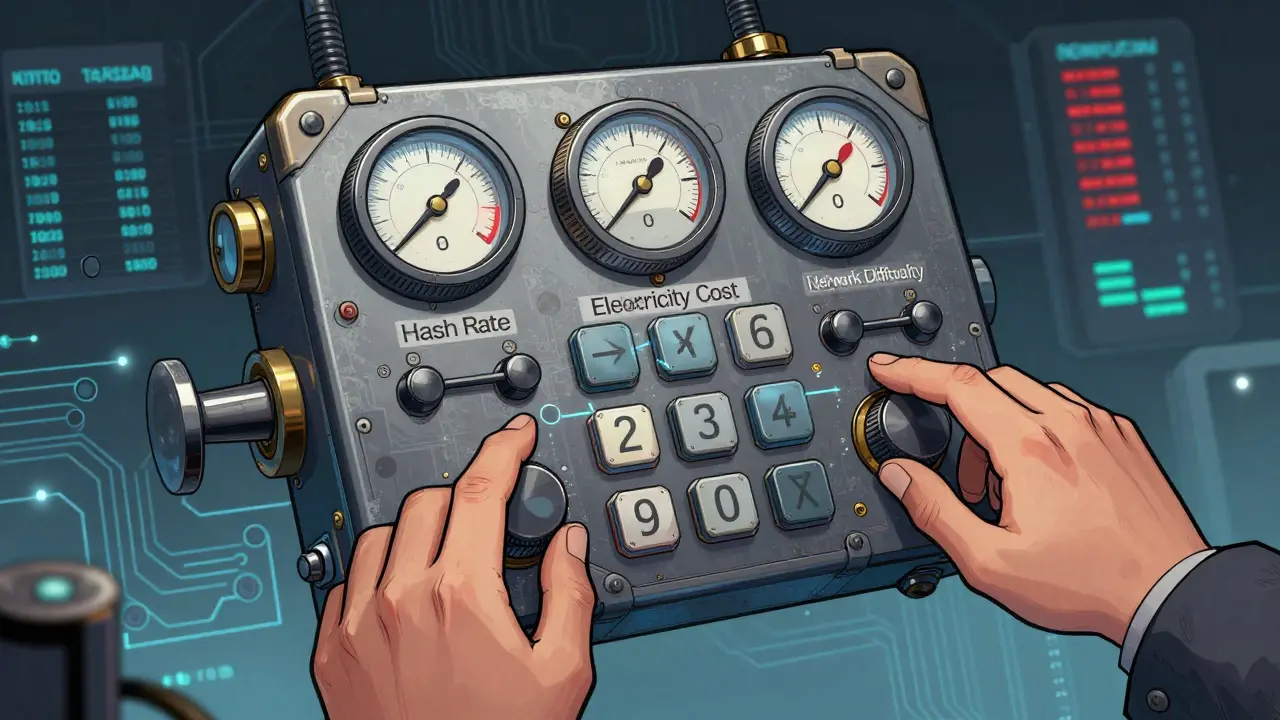
A profitability calculator is only as good as the data you feed it. Garbage in, garbage out. If you plug in optimistic numbers, you’ll get optimistic profits that don’t exist. To get a realistic estimate, you need to nail down five critical inputs.
- Hash Rate (TH/s): This is your machine’s speed. An Antminer S21 might punch out 200 TH/s, while an older S9 struggles at 14 TH/s. Higher hash rate means more chances to solve blocks, but it also usually means higher power draw.
- Power Consumption (Watts): This is the killer. Most modern ASICs run between 2,500W and 3,500W. You need the exact wattage, not just the marketing number. Measure it with a Kill-A-Watt meter if you can. Even a 10% variance here changes your daily profit significantly.
- Electricity Cost ($/kWh): This is the most important variable. The U.S. average hovers around $0.13/kWh, but miners often secure rates closer to $0.05-$0.08/kWh through industrial contracts or renewable energy setups. If your rate is above $0.12/kWh, profitability becomes razor-thin unless Bitcoin’s price surges.
- Network Difficulty: Bitcoin’s difficulty adjusts every two weeks (every 2,016 blocks). Calculators use current difficulty, but smart ones project future increases. As more miners join, difficulty rises, making each block harder to find.
- Cryptocurrency Price: Volatility is the enemy of static calculations. A calculator using today’s BTC price might be wrong tomorrow. Look for tools that offer historical averages or conservative price scenarios.
Don’t forget pool fees. Most miners join pools like F2Pool or ViaBTC, which charge 1-3% of your rewards. Some calculators hide this; others let you input it manually. Always subtract it.
Comparing Top ASIC Profitability Calculators
Not all calculators are created equal. Some update their data every minute; others lag by hours. Here’s how the major players stack up in 2026:
| Platform | Data Refresh Rate | Key Strength | Weakness | Best For |
|---|---|---|---|---|
| WhatToMine | 5-10 minutes | Supports 150+ coins, great for cross-crypto comparison | Slower updates can miss short-term price spikes | Miners exploring altcoins |
| Mining Now | Real-time (1 min) | High accuracy for Bitcoin-only operations | Limited to Bitcoin, fewer advanced features | Pure Bitcoin miners |
| ASICMinerValue | Every 60 seconds | Live income estimates for 47+ ASIC models | Interface can be cluttered for beginners | Data-driven investors |
| EcoHash Cloud | 30 minutes | Integrates carbon savings and green energy metrics | Slower data updates | Sustainable/Solar-powered miners |
| BlockForge Mining | Real-time | Enterprise-grade thermal management cost projections | Requires minimum 1 PH/s hash rate | Large-scale industrial farms |
If you’re a hobbyist, WhatToMine or ASICMinerValue gives you enough detail without overwhelming you. If you’re running a farm with immersion cooling, BlockForge’s enterprise tools account for heat dissipation costs that standard calculators ignore.
Why Most Calculators Overestimate Your Profits
Here’s the uncomfortable truth: most online calculators will show you a higher profit than what you actually earn. Dr. Alex de Vries from Digiconomist notes that many tools overestimate profitability by 20-30%. Why? Because they treat your ASIC like a perpetual motion machine.
In reality, hardware degrades. Dust clogs fans, chips wear out, and efficiency drops over time. An Antminer S19 Pro bought new might start at 32 J/TH, but after six months, it could drift to 35 J/TH due to thermal throttling or component aging. Few calculators adjust for this depreciation automatically.
Then there’s the “hidden” electricity cost. Your bill isn’t just for the ASIC. It’s for the air conditioning, the server rack, the UPS battery charging, and the transformer losses. ASICMinerValue’s recent update includes transformer efficiency metrics, noting a 5-8% energy loss in power conversion alone. If you’re plugging into a residential outlet, you’re likely paying retail rates without accounting for peak-hour surcharges during summer heatwaves when your mining rig acts like a furnace.
To fix this, add a 10-15% buffer to your electricity cost input. If you pay $0.08/kWh, calculate as if you pay $0.09. It sounds small, but over a year, that extra cent covers your maintenance, replacement parts, and unexpected downtime.
Understanding Payback Period and ROI
Profitability isn’t just about daily earnings; it’s about time. The key metric is your payback period-how long until your mining revenue equals the cost of the hardware + installation.
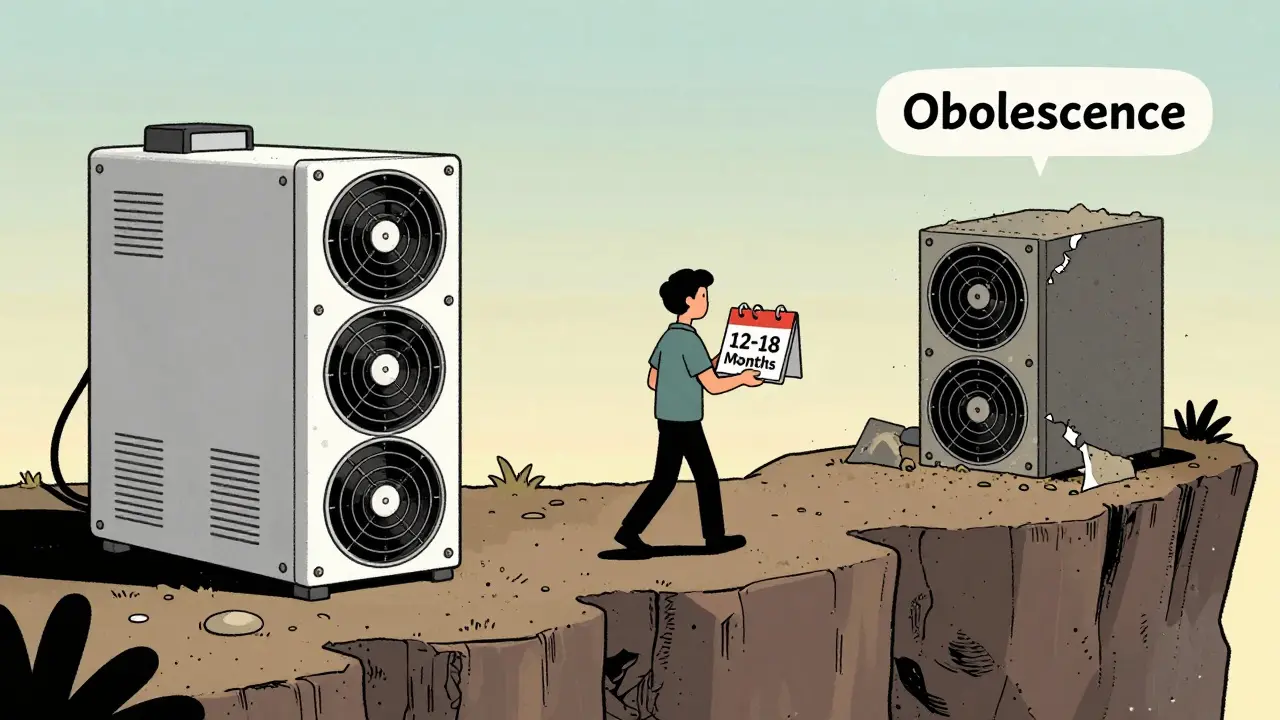
In 2026, a reasonable payback period for a new ASIC is 12-18 months. If a calculator shows you’ll break even in 4 months, double-check your assumptions. You’re probably underestimating difficulty growth or overestimating Bitcoin’s price stability. Conversely, a 36-month payback is risky. Hardware becomes obsolete quickly. By month 30, newer, more efficient models will hit the market, making your old rig uncompetitive.
Return on Investment (ROI) should be calculated annually. A common mistake is looking at monthly profit and ignoring the initial capital outlay. Use this formula:
(Annual Net Profit / Total Hardware Cost) * 100 = Annual ROI %
If your annual ROI is below 15%, you might be better off simply buying Bitcoin directly. Mining adds complexity, noise, heat, and maintenance. Only mine if the ROI beats passive holding by a comfortable margin.
Advanced Factors: Difficulty Halvings and Network Trends
Bitcoin’s halving event in April 2024 cut block rewards to 3.125 BTC. This didn’t just reduce income; it triggered a massive difficulty adjustment as less efficient miners shut down. Post-halving, difficulty has been rising steadily as remaining miners optimize their operations.
Calculators like Mining Now now incorporate machine learning-based difficulty forecasting. These tools analyze historical trends to predict how hard it will be to mine in 30, 60, or 90 days. This is crucial because difficulty doesn’t move linearly. It can jump 10% in a single week if a large mining pool migrates to a new algorithm or if institutional miners deploy thousands of new units simultaneously.
Also, consider regulatory costs. In the EU, MiCA compliance added 2-5% to operational expenses for professional miners in 2024. While individual home miners aren’t affected, if you plan to scale, factor in legal and reporting costs. Tools like EcoHash Cloud help here by integrating carbon tax implications based on your local grid’s energy mix.
Practical Tips for Accurate Calculations
Don’t rely on a single calculator. Use three. Compare WhatToMine, ASICMinerValue, and Mining Now. Average their results. This triangulation method helps cancel out biases in any one platform’s data source.
Update your inputs weekly. Electricity rates change, especially with time-of-use plans. Network difficulty shifts. Bitcoin’s price fluctuates. A calculation done on Monday might be irrelevant by Friday.
Track your actual vs. predicted profits. After your first month of mining, compare the calculator’s forecast to your real wallet deposits. Did you earn 90% of the projected amount? 110%? Adjust your model accordingly. This feedback loop turns a generic tool into a personalized financial dashboard.
Finally, remember that mining is a business, not a hobby. Treat your calculator as a risk management tool, not a promise of wealth. The goal isn’t to maximize daily profit at all costs; it’s to ensure sustainable, long-term viability in a volatile market.
Which ASIC miner profitability calculator is most accurate?
Mining Now and ASICMinerValue are considered among the most accurate for Bitcoin mining due to their real-time data updates (every 1-60 seconds). However, no calculator is perfect. Experts recommend using multiple tools and averaging results to account for different data sources and estimation methodologies.
How do I calculate my electricity cost for mining?
Multiply your ASIC's power consumption in kilowatts (kW) by your local electricity rate in dollars per kWh. For example, a 3 kW ASIC running 24/7 uses 72 kWh daily. At $0.10/kWh, that’s $7.20/day. Add 10-15% for cooling and auxiliary equipment to get a realistic total.
What is a good payback period for an ASIC miner?
In 2026, a payback period of 12-18 months is considered healthy. Less than 12 months may indicate overly optimistic assumptions, while more than 24 months exposes you to high risk of hardware obsolescence before you recoup your investment.
Do ASIC profitability calculators account for hardware depreciation?
Most basic calculators do not. Advanced enterprise tools like BlockForge Mining include hardware lifespan and efficiency degradation metrics. For personal use, manually reduce your expected hash rate by 5-10% per year to simulate natural wear and tear.
Can I mine profitably with residential electricity rates?
It is challenging. With U.S. residential rates averaging $0.13/kWh, profitability is thin unless Bitcoin’s price is very high or you use ultra-efficient hardware like the Antminer S21. Many residential miners operate at a loss or break-even, treating mining as a hedge rather than a primary income source.





Ellie Riddell
May 7, 2026 AT 06:39So we are back to the classic 'buy the dip' but with hardware that sounds like a jet engine and costs more than my first car.
The part about calculators overestimating profits by 30% is hilarious because I feel like they underestimate the headache factor by at least 100%. You buy this thing, you plug it in, and suddenly your house looks like a server room from a 90s sci-fi movie. The heat alone is enough to make you rethink your life choices.
I tried mining for fun back in the day, mostly just to see if I could turn my garage into a sauna without actually sweating. Spoiler alert: you do sweat. And not the good kind. The kind where you question why you thought electricity was free.
But seriously, the point about difficulty adjustments is spot on. It is not static. It moves. It breathes. It eats less efficient miners for breakfast. If you are looking at a payback period of 4 months, you are either dreaming or using a calculator made by someone who wants you to fail so they can sell you the next shiny toy.
Just remember that mining is not passive income. It is active stress with a side of noise pollution.
Destiny Kilby
May 8, 2026 AT 02:21i read through this and it feels very heavy on the math side which i respect but sometimes i forget that these machines are physical objects that take up space and create heat
the mention of transformer losses is something most people ignore until their bill arrives and then it becomes a personal attack on their intelligence
i think the advice to use three different calculators is solid because no single source has all the truth and averaging them out gives you a buffer against bad data
also the bit about hardware degradation is scary because you spend thousands on something that starts losing value the moment you unbox it
Jerry CUNNINGHAM SR
May 8, 2026 AT 22:58This is a comprehensive overview of the current landscape for ASIC mining profitability. It is important to acknowledge that while the technology advances, the fundamental economic principles remain consistent. The emphasis on accurate input data is commendable, as many enthusiasts overlook the nuances of power consumption and network difficulty.
I would add that community support and shared knowledge are invaluable resources for those entering this field. By discussing experiences and challenges openly, we can help each other avoid common pitfalls. The suggestion to track actual versus predicted profits is particularly insightful, as it fosters a culture of continuous improvement and realistic expectation management.
Furthermore, the consideration of environmental factors and carbon taxes is a step towards more sustainable practices within the industry. It is encouraging to see tools like EcoHash Cloud integrating these metrics, as it aligns with broader societal goals for responsible energy usage.
Shelby Cantu
May 9, 2026 AT 05:12Great tips here. Keep it simple. Use multiple calculators. Check your numbers weekly. Do not trust one source. Mining is hard work. Stay focused. Stay disciplined. Your wallet will thank you later.
Tobias Gjerlufsen
May 10, 2026 AT 10:17you people are still falling for the same old tricks thinking a calculator can predict the future when the market is driven by emotion and speculation
the article mentions difficulty adjustments but fails to grasp that difficulty is just a mechanism to maintain block times regardless of how many idiots plug in their toys
if you cannot measure your own power draw with a kill-a-watt meter you have no business touching an asic
most of you are going to lose money because you treat it like a lottery ticket instead of a industrial operation
stop complaining about high electricity rates and figure out how to get commercial pricing or stay out of the game
Ruben Michel
May 12, 2026 AT 06:43One must appreciate the rigorous analytical framework presented herein. The distinction between hobbyist tools and enterprise-grade solutions is not merely semantic but fundamentally operational. Tools such as BlockForge Mining cater to a demographic that understands the intricacies of thermal dynamics and power efficiency at scale.
It is quite amusing to observe the layperson’s fascination with 'real-time' updates, when in reality, the latency of data propagation is negligible compared to the strategic decision-making cycle. The pretense of precision offered by consumer-facing calculators is often misleading, lacking the granular detail required for sophisticated risk assessment.
Furthermore, the integration of regulatory compliance costs, such as MiCA, is a critical component often ignored by the amateur enthusiast. One does not simply 'mine' in 2026; one operates within a complex legal and financial ecosystem. Those who fail to recognize this nuance are destined for obsolescence.
Gavin Wonnacott
May 12, 2026 AT 14:00Oh look another article telling you how to waste your money on hardware that will be obsolete in six months
I bet you all think you are smart for reading this but you are just sheep following the herd
The fact that you need a calculator to tell you if you are making profit means you are already failing
Go buy bitcoin directly and save yourself the headache of dealing with noisy boxes that melt your roof
I hope your electric bill spikes enough to teach you a lesson
Samara McCallum
May 12, 2026 AT 21:52it is funny how everyone treats these calculators like crystal balls when they are really just fancy spreadsheets with anxiety built in
i mean sure you can plug in numbers and get a result but what does that say about us that we need permission to spend our money
maybe the real profit is the friends we make along the way debugging our rigs at 3am
but seriously if you are not ready to deal with the heat and noise maybe you should just stick to buying coffee beans
Sheldon Friesen
May 13, 2026 AT 08:49Let's be honest here! The idea that you can just sit back and watch your ASICs print money is about as realistic as expecting a hamster to run a marathon!
You need to treat this like a business! Not a hobby! Not a side hustle! A full-blown industrial operation with all the headaches that come with it!
And don't get me started on the 'hidden' costs! The cooling! The maintenance! The sheer existential dread of watching your ROI shrink every time Bitcoin dips!
But hey! If you are going to do it! Do it right! Use multiple calculators! Update your inputs! And for the love of Satoshi! Measure your power consumption!
Because otherwise! You are just burning cash to keep your neighbors awake! And that is not profitable! That is just rude!