Imagine earning money by simply plugging a device into your wall. No trading charts to watch, no complex yield farming strategies-just hardware doing its job while you sleep. This isn't a sci-fi dream; it's the core promise of DePIN, or Decentralized Physical Infrastructure Networks. But here is the million-dollar question: why do some of these tokens skyrocket while others crash to zero? The answer rarely lies in the tech stack alone. It lies in the math behind the money.
If you've ever wondered how a wireless hotspot owner in Boulder competes with a telecom giant, or why a storage provider gets paid in a volatile asset, you're looking at the wrong place if you only look at price charts. You need to understand DePIN token economics. This isn't just about hype cycles. It's about sustainable incentive structures that bridge the gap between physical reality and blockchain coordination. As of late 2024, the sector boasts over 75 active projects with a combined market cap exceeding $8 billion. Yet, many participants are still confused about where the value actually comes from. Let's break down the mechanics that separate robust networks from speculative bubbles.
The Core Mechanism: Incentivizing Hardware Deployment
Traditional infrastructure companies like AT&T or Comcast spend billions building towers and laying fiber. They recover costs through subscription fees over decades. DePIN flips this model. Instead of one company bearing the capital expenditure, thousands of individuals deploy hardware. To make this work, you need a reward system that aligns individual profit with network growth. This is where tokenomics enters the picture.
The basic loop looks like this:
- Deployment: Users buy and install hardware (hotspots, GPUs, sensors).
- Proof of Service: The network verifies the hardware is working correctly via cryptographic proofs.
- Reward Distribution: Tokens are minted or distributed to users based on their contribution.
- Utility Consumption: End-users (businesses or other people) pay for services using those same tokens.
This circular flow creates demand for the token beyond mere speculation. If nobody uses the network, the token has no utility. If the network grows but rewards are too high, inflation crushes the price. Finding the balance is the art of DePIN design.
Supply Dynamics and Emission Schedules
One of the biggest pitfalls in early crypto projects was infinite supply or poorly managed emissions. In DePIN, supply control is critical because you are rewarding physical labor. If you emit too many tokens, the cost per unit of service drops, making it unprofitable for providers to keep their hardware running. Conversely, if you emit too few, new entrants won't join, stalling network expansion.
Most successful models use a halving mechanism or a fixed emission schedule tied to network milestones. For instance, Helium initially rewarded hotspots with HNT tokens, with the total supply capped at 223 million. As the network matured, emissions decreased, shifting the burden of payment from new token issuance to actual revenue generated from data usage. This transition is known as "moving from subsidy to sustainability."
| Allocation Category | Typical Percentage | Purpose | Vesting Schedule |
|---|---|---|---|
| Network Participants | 40-50% | Rewards for hardware providers and validators | Emission-based (continuous) |
| Team & Founders | 15-20% | Incentive alignment for long-term development | 3-4 year linear vesting |
| Treasury | 10-15% | Reserve for grants, partnerships, and emergencies | Locked, released by governance |
| Community/Incentives | 15-20% | Airdrops, liquidity mining, marketing campaigns | Staggered over 1-2 years |
Notice the emphasis on long-term vesting for teams. In a sector where hardware takes months to deploy and scale, short-term thinking kills projects. A team dumping their tokens after six months signals a lack of confidence in the long-term infrastructure build-out.
Demand Side: Who Is Actually Paying?
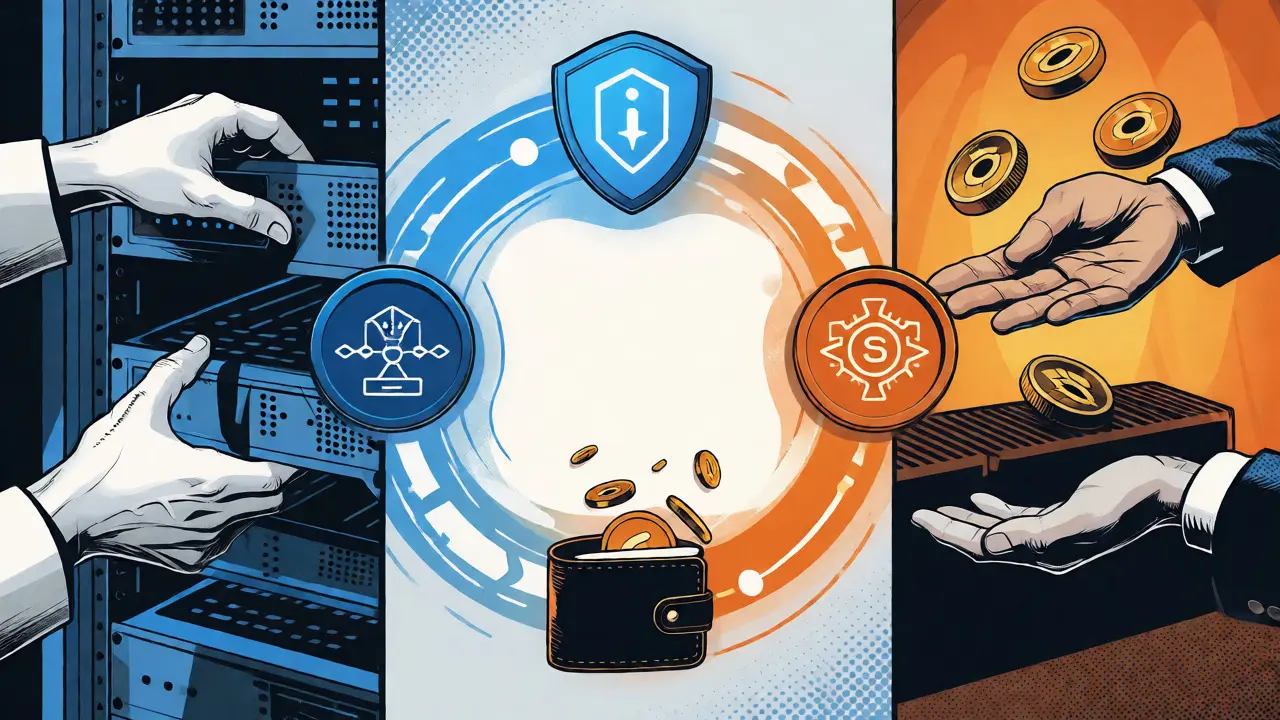
You can have the best incentives in the world, but if nobody buys the service, the economy collapses. This is where DePIN differs sharply from meme coins. Meme coins rely on social sentiment. DePIN relies on enterprise contracts and consumer utility.
Consider Filecoin. It doesn't just store data for crypto enthusiasts; it provides decentralized storage for enterprises. In Q4 2022, during a brutal market crash, Filecoin maintained relative stability partly because it generated $12.7 million in quarterly revenue from real-world storage contracts. That revenue flows back into the ecosystem, creating organic demand for the FIL token.
Another powerful example is IoTeX. They implemented a buy-and-burn mechanism where 30% of service revenue is used to buy IOTX tokens from the open market and burn them. This reduces circulating supply, creating deflationary pressure. Since implementing this in 2023, the supply has dropped by roughly 2.1% annually. This ties the token's value directly to the network's commercial success.
Governance and Stakeholder Alignment
Who decides the future of the network? In centralized systems, shareholders vote. In DePIN, token holders often govern protocol upgrades, fee structures, and treasury spending. However, pure plutocracy (rule by the wealthy) can lead to centralization, which defeats the purpose of decentralization.
To combat this, many projects use quadratic voting or delegated proof-of-stake systems. Helium, for example, moved to a three-tier voting structure. HNT holders elect validators who then govern network upgrades. This adds a layer of abstraction, preventing whales from directly dictating every minor change while still giving significant weight to large stakeholders.
Governance isn't just about voting rights; it's about risk management. If a proposal to lower rewards passes, hardware providers might quit. If they raise fees too high, customers leave. Governance mechanisms must be designed to find the equilibrium point that maximizes both provider retention and customer acquisition.
Challenges and Risks in DePIN Economies
It's not all smooth sailing. DePIN faces unique hurdles that pure software protocols don't encounter.
- Hardware Obsolescence: Unlike code, hardware wears out. A GPU node today might be inefficient in two years. Token models must account for replacement costs.
- Regulatory Uncertainty: According to Chainalysis, 78% of jurisdictions lack specific regulations for DePIN. This creates legal risks for operators, especially regarding tax treatment of token rewards.
- Adoption Lag: Building physical infrastructure takes time. While a DeFi app can launch globally overnight, a wireless network requires local deployment. This slower curve can frustrate investors expecting quick returns.
Furthermore, there is the issue of "phantom revenue." Some projects claim massive enterprise adoption, but on-chain verification tells a different story. Experts like Ryan Watkins from Messari warn that without transparent, on-chain revenue verification, investors are flying blind. Always check if the project publishes audited revenue reports or if the data is verifiable directly on the blockchain.
How to Evaluate a DePIN Project's Health
If you're looking to invest or participate, ignore the hype and look at these metrics:
- Revenue-to-Market-Cap Ratio: Is the project generating actual cash flow from non-crypto customers? A high ratio suggests the token is backed by real economic activity.
- Provider Retention Rate: Are existing hardware owners staying online? High churn indicates that rewards aren't covering operational costs like electricity and maintenance.
- Utilization Rate: What percentage of the network's capacity is actually being used? An idle network generates no fees, meaning token emissions are purely dilutive.
- Buyback Mechanics: Does the protocol burn tokens? Deflationary pressures can support price floors during bear markets.
For example, Render Network struggled initially with inconsistent demand, leading to low earnings for GPU providers. By adjusting their tokenomics to better match supply with rendering jobs, they stabilized their economy. Success in DePIN is iterative; the token model must evolve alongside the technology.
What is the main difference between DePIN tokens and standard utility tokens?
While standard utility tokens grant access to a software platform, DePIN tokens incentivize the provision of physical resources. Their value is derived from the scarcity and utility of real-world assets like bandwidth, storage space, or computing power, rather than just software features. Additionally, DePIN tokens often have direct links to physical hardware performance and geographic coverage.
How does inflation affect DePIN token prices?
High inflation rates from token emissions can suppress prices if demand doesn't grow proportionally. Successful DePIN projects manage inflation by tying emissions to verified service delivery and implementing burn mechanisms funded by real revenue. This ensures that the circulating supply remains balanced against actual network usage.
Can DePIN projects survive without external investment?
Yes, but it is difficult. Most DePIN projects require initial capital to bootstrap the network and subsidize early adopters. However, long-term survival depends on transitioning to a self-sustaining model where service fees cover operational costs and reward payouts. Projects relying solely on VC funding without organic revenue streams often struggle when market conditions turn unfavorable.
Why is hardware obsolescence a risk for DePIN tokenomics?
Physical hardware degrades or becomes outdated faster than software protocols evolve. If token rewards do not account for the cost of upgrading equipment, providers may exit the network. Robust tokenomics include provisions for hardware lifecycle management, such as higher rewards for newer devices or mechanisms to retire older nodes gracefully.
How do regulatory issues impact DePIN economies?
Unclear regulations can deter institutional partners and create tax complexities for individual providers. For instance, if token rewards are classified as taxable income upon receipt rather than upon sale, it increases the financial burden on small operators. Regulatory clarity helps stabilize the market and encourages broader adoption by traditional businesses.