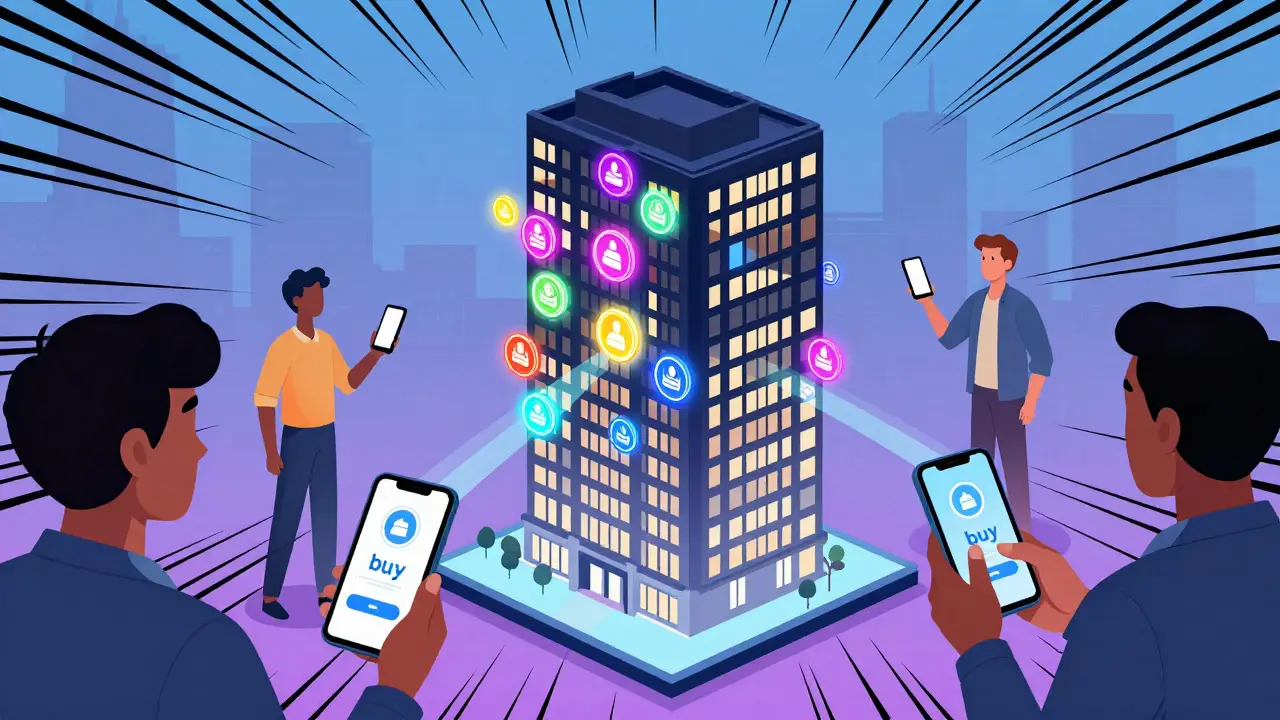
Imagine buying a slice of a luxury apartment in Manhattan or a commercial building in London without needing hundreds of thousands of dollars upfront. You don't need a mortgage broker, a title company, or weeks of paperwork. Instead, you click "buy" on a digital platform, and within seconds, you own a fraction of that property represented by a digital token on a blockchain. This isn't science fiction; it's the current reality of real estate tokenization, which is the process of converting physical property rights into tradable digital assets on a distributed ledger. As of 2024, this market has exploded to $10.1 billion, driven by platforms like RealT and Brickblock.
For decades, real estate was the ultimate illiquid asset. Selling a house could take months, and buying one required massive capital. Blockchain technology shatters these barriers by turning static bricks-and-mortar assets into liquid, divisible digital shares. But how does this actually work under the hood? And is it safe for your money? Let's break down the mechanics, the legal frameworks, and the risks involved in this rapidly evolving sector.
The Mechanics: Turning Concrete into Code
At its core, tokenization is about representation. When we talk about property tokenization, we mean issuing digital certificates of ownership that are legally binding and tradeable on a blockchain network. Think of it like a stock certificate, but instead of representing a share in a corporation, it represents a direct claim on a specific physical asset.
The process starts with a rigorous due diligence phase. Professional appraisers evaluate the property using metrics like Walk Score for location desirability and ASTM E2018-15 standards for physical condition. Once valued-say, at $1 million-the property is fractionalized. If the issuer decides to create 1,000 tokens, each token represents $1,000 of equity. These tokens are usually built on Ethereum using standards like ERC-3643 (T-REX) or ERC-1400, which allow for programmable compliance rules. For example, the smart contract can automatically prevent a token from being sold to someone in a jurisdiction where such investments are illegal.
There are three main structural approaches to linking the digital token to the physical deed:
- On-chain: All legal information is embedded directly in the token metadata. This is used in about 29% of cases but raises privacy concerns.
- Off-chain: The token acts as a pointer to a traditional registry, like the UK Land Registry. This accounts for 41% of implementations and feels more familiar to traditional investors.
- Hybrid: Ownership records live on the blockchain, while sensitive documents stay with traditional custodians. This is the most popular model, adopted by 30% of platforms, balancing transparency with privacy.
Platforms like Securitize and Polymath provide the infrastructure to manage these complexities, ensuring that when you buy a token, you're not just buying a jpeg-you're buying a legally recognized stake in the underlying asset.
Why Investors Are Flocking to Tokenized Real Estate
The primary driver behind this shift is accessibility. Traditionally, investing in prime real estate meant joining a Real Estate Investment Trust (REIT) or having at least $50,000 to $100,000 for a private fund. Tokenization slashes this entry barrier to as low as $100 per token. According to Chainalysis data from 2024, this democratization has opened the market to 92% of retail investors who were previously locked out.
Liquidity is another game-changer. In the traditional market, selling a property involves listing, showing, negotiating, and closing-a process that can take 30 to 90 days. With tokenized assets, trading happens 24/7 on secondary markets. While full liquidity varies by platform, the ability to sell your stake instantly during market hours significantly reduces the opportunity cost of holding real estate.
Cost efficiency also plays a huge role. Traditional real estate transactions incur fees ranging from 5% to 6%, covering agent commissions, legal fees, and transfer taxes. Tokenization streamlines this through automation, reducing transaction costs to just 1-2%. Deloitte’s 2024 analysis confirms that these savings are passed on to investors, boosting net returns over time.
| Feature | Traditional Real Estate | Tokenized Real Estate |
|---|---|---|
| Minimum Investment | $50,000 - $100,000+ | $100 - $500 |
| Liquidity | Low (30-90 days to sell) | High (24/7 trading potential) |
| Transaction Costs | 5% - 6% | 1% - 2% |
| Ownership Structure | Direct Title or REIT Shares | Fractional Digital Tokens |
| Transparency | Opaque (Private records) | Transparent (Public ledger) |

Regulatory Landscape: Navigating the Legal Maze
Here’s the catch: just because you *can* tokenize a property doesn’t mean you *should* without proper legal structure. Real estate tokens are generally classified as securities, meaning they fall under strict financial regulations. The European Union has taken a leading role with the Markets in Crypto-Assets Regulation (MiCA), which came into full effect in December 2024. MiCA treats tokenized real estate as financial products, requiring issuers to hold specific licenses and maintain minimum asset backing levels.
In the United States, the landscape is fragmented. As of mid-2024, only 17 of the 50 states have specific legislation addressing tokenized real estate. The SEC has been active in enforcement, citing improperly structured offerings that fail to comply with securities laws. This regulatory arbitrage risk is significant. Platforms must use legal wrappers, often Special Purpose Vehicles (SPVs), to ensure that token holders have clear legal recourse and that the offering complies with local jurisdiction rules.
Luxembourg has emerged as a hub for compliant tokenization, with its Blockchain Law IV creating a favorable environment. Nearly half of EU-based projects now incorporate Luxembourg entities to leverage this clarity. For investors, this means checking if a platform is regulated in a reputable jurisdiction before committing funds. Unregulated platforms pose higher risks of fraud or legal entanglement.
Risks and Challenges You Can't Ignore
Despite the hype, tokenized real estate isn't risk-free. One major concern is smart contract vulnerability. Chainalysis reports that 12.7% of real estate tokenization platforms had critical security flaws in their initial launches. A bug in the code could theoretically freeze assets or allow unauthorized transfers. Always look for platforms that undergo third-party audits from firms like CertiK or OpenZeppelin.
Another challenge is property management. Who fixes the roof when a pipe bursts? In fractional ownership, decision-making can be slow. Most platforms solve this by hiring professional property managers who act on behalf of all token holders. However, this adds a layer of operational complexity and cost that investors should understand. Platforms like Propy integrate blockchain-based management systems to streamline these interactions, but the human element remains crucial.
Liquidity promises aren't always guaranteed. While secondary markets exist, they may lack depth for niche properties. If everyone tries to sell at once, prices can drop sharply. Additionally, tax implications vary widely. In some jurisdictions, selling tokens triggers capital gains tax immediately, whereas holding physical property might offer depreciation benefits. Consult a tax advisor familiar with digital assets before investing.
Who Should Invest in Tokenized Property?
This innovation suits different profiles depending on goals. Retail investors with limited capital benefit most from the low entry threshold and diversification opportunities. You can own fractions of ten different buildings across five cities with the same money it would take to put a down payment on one house.
Institutional players, such as pension funds and family offices, are increasingly allocating 0.5-2.0% of portfolios to tokenized assets. They value the transparency, reduced administrative burden, and faster settlement times. Commercial properties, particularly multi-family residential and office spaces, dominate this space because they generate predictable rental income, making them ideal for tokenized yield generation.
However, if you're looking for emotional satisfaction from owning a home to live in, tokenization isn't for you. It's purely an investment vehicle. Also, if you prefer total control over renovations or tenant selection, traditional ownership offers more autonomy. Fractional owners vote on major decisions, but day-to-day operations are managed by professionals.
Future Outlook: Where Is This Heading?
The trajectory points toward mainstream adoption. Deloitte predicts that tokenized real estate could represent 15-20% of alternative investment flows by 2030. Institutional-grade funds, like Kin Capital’s planned $100 million debt fund on the Chintai blockchain, signal growing confidence among big players. AWS’s Real Estate Tokenization Accelerator, launched in 2024, is lowering technical barriers, allowing developers to build compliant platforms faster.
As regulatory frameworks mature globally, we’ll see less fragmentation and more cross-border investment. The key will be international harmonization of laws to prevent jurisdiction shopping. Until then, investors should stick to platforms operating in well-regulated regions like the EU or specific US states with clear guidelines.
Blockchain tokenization isn't replacing traditional real estate overnight. It’s complementing it, offering a new layer of liquidity and access. By understanding the mechanics, respecting the regulations, and acknowledging the risks, you can position yourself to benefit from this digital transformation of one of the world’s oldest asset classes.
Is tokenized real estate legal in the US?
Yes, but it is heavily regulated. Most tokenized real estate offerings are classified as securities and must comply with SEC regulations. Only 17 US states have specific laws addressing this, so investors should verify that the platform operates within legal boundaries and uses proper SPV structures.
What happens if the physical property is damaged?
The underlying property is typically insured by the special purpose vehicle (SPV) that holds the title. Insurance payouts go into the SPV account and are distributed to token holders proportionally. The token itself remains valid, representing your share of the repaired or compensated asset.
Can I sell my tokens anytime?
Not necessarily. While secondary markets allow for faster sales than traditional real estate, liquidity depends on demand. Some platforms impose lock-up periods (e.g., 1-3 years) to comply with securities laws. Always check the platform’s trading policies before buying.
Which blockchain is best for real estate tokenization?
Ethereum dominates with 68.3% of the market due to its robust developer ecosystem and established security standards. Polygon and Binance Smart Chain are also popular for lower transaction fees. The choice depends on the platform’s architecture and regulatory requirements.
How do I verify the legitimacy of a tokenization platform?
Check for regulatory licenses (e.g., MiCA compliance in Europe), third-party smart contract audits, transparent fee structures, and partnerships with established financial institutions. Avoid platforms promising guaranteed high returns, as real estate values fluctuate.