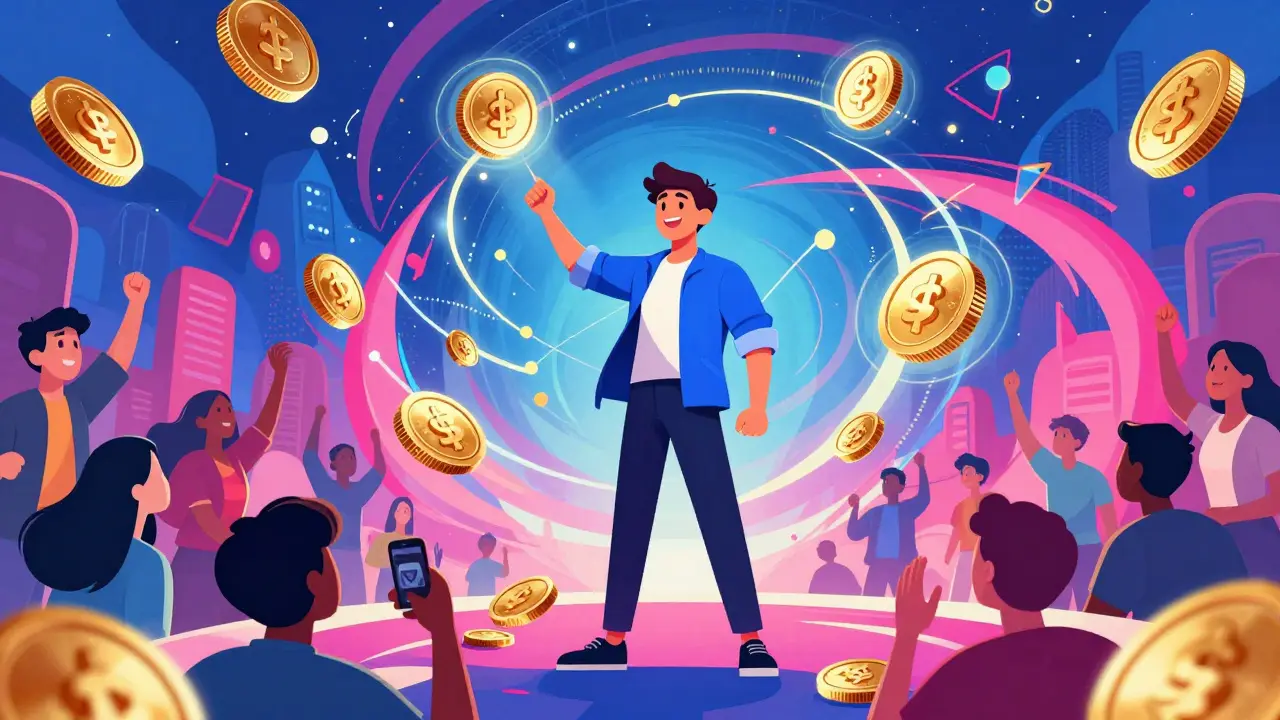
Imagine if your followers didn't just like your posts, but actually owned a piece of your brand's success. That is the core idea behind Social Tokens is a specialized category of cryptocurrency designed to monetize personal brands, communities, or influencer ecosystems. Unlike Bitcoin, which acts as digital gold, these tokens derive their value from your social capital and the utility you provide to your community. If you have a loyal audience, you're no longer just a content creator; you're essentially the CEO of your own micro-economy.
The Quick Blueprint for Launching
Before getting into the weeds, here is the fast track to getting a token live. If you're looking for a shortcut, focus on these three pillars:
- Utility First: Decide exactly what a token gets a fan (e.g., 100 tokens = 1 monthly 1-on-1 call).
- Network Choice: Pick between high-security/high-cost (Ethereum) or high-speed/low-cost (Solana).
- Community Gating: Use a platform that lets you hide content behind a "token wall."
What Exactly Are Social Tokens?
At their simplest, social tokens are a way to turn your influence into a tradable asset. While an NFT represents a specific piece of art or a collectible, a social token represents an ongoing relationship. Think of it like a membership card that the community can trade. If you become more popular or offer more value, the demand for your tokens usually goes up.
There are three main flavors of these assets. First, you have Creator Tokens, which are tied to a single person. Musician RAC was a pioneer here with $RAC, allowing fans to unlock exclusive tracks. Then there are Community Tokens, like those used by Friends With Benefits (FWB), which focus on shared governance and group ownership. Finally, Platform Tokens, such as those from Rally, provide the underlying infrastructure for thousands of creators to launch their own assets.
| Feature | Creator Tokens | Community Tokens | NFTs |
|---|---|---|---|
| Primary Value | Personal Brand | Collective Goal | Digital Scarcity/Art |
| Core Use Case | Exclusive Access | Governance/Voting | Ownership/Collecting |
| Revenue Model | Recurring Utility | Ecosystem Growth | One-time Sale/Royalties |
| Holder Retention | Moderate | High | Variable |
Designing Your Tokenomics
Don't just pick a random number of tokens. Your "tokenomics"-the economic logic of your token-will determine if your project thrives or crashes. A common mistake creators make is keeping too many tokens for themselves, which looks like a "rug pull" waiting to happen. A healthy distribution usually limits the creator's share to around 20%, often locked in a vesting schedule for 6 to 12 months. This proves to your fans that you aren't just going to dump your tokens and vanish.
You also need a clear value proposition. Why should someone hold your token instead of just following you on Instagram? You need a utility map. For example, if you're a fitness coach, you might decide that holding 500 tokens grants access to a private Discord channel, while 2,000 tokens gets them a personalized workout plan. Without this, your token is just a speculative gamble, and as analysts like Nic Carter have warned, speculative tokens without utility usually fail within six months.
Choosing the Right Blockchain
The technical side can feel overwhelming, but it boils down to a trade-off between prestige and practicality. Ethereum is the gold standard for security and trust, utilizing the ERC-20 standard. However, it can be expensive. Even after the Dencun upgrade, gas fees can spike during high traffic, making it annoying for fans to buy small amounts of tokens. If you're launching a high-value, exclusive token, Ethereum is the way to go.
If you want your token to be accessible to everyone, Solana is a powerhouse. It handles thousands of transactions per second with fees often costing less than a penny. This makes it ideal for "micro-utilities" where fans might trade tokens frequently. Other options like Polygon offer a middle ground, providing Ethereum-compatible tech with much lower costs through its Layer 2 scaling solution.
Regardless of the chain, you'll need a compatible wallet. Most users stick to MetaMask for Ethereum-based projects or Phantom for Solana. Integrating these into your workflow is essential so your fans can actually hold and move their assets.
The Step-by-Step Launch Process
Launching a token isn't as simple as clicking "create." It requires a phased approach to avoid technical glitches and community backlash. If you rush this, you risk being part of the 18% of projects that launch with critical smart contract vulnerabilities.
- The Warm-Up (3-6 Months): Start talking about the token before it exists. Build a waitlist and explain the utility. A project with a pre-existing, engaged community of at least 5,000 to 10,000 people has a significantly higher survival rate.
- Technical Setup: Develop your smart contract. If you aren't a coder, use a launch platform like TokenMinds or Rally. If you're writing custom code, spend $5,000 to $15,000 on a professional audit from a firm like CertiK to ensure there are no backdoors.
- Private Sale: Give your most loyal "super-fans" first dibs. This creates an initial base of holders who are incentivized to see the project succeed.
- Public Launch: List your token on a Decentralized Exchange (DEX) like Uniswap (for Ethereum) or Raydium (for Solana). This allows anyone to buy and sell based on market demand.
- Gating Implementation: Set up your "token-gated" content. This is where the magic happens-connecting your token to your website or community platform so only holders can enter certain areas.
Navigating the Risks and Legal Gray Areas
We have to talk about the elephant in the room: the law. Depending on where you live, the SEC (U.S. Securities and Exchange Commission) might view your social token as an investment contract, which is a legal nightmare. In 2024, many social tokens landed in a legal gray area because they promised "future value" rather than "current utility." To stay safe, focus your marketing on the utility (what the token does now) rather than the investment (how much the price will go up).
Then there is the volatility. Your token's price is essentially a real-time mood ring for your reputation. If you have a public controversy, your token value can plummet instantly. This creates a high-pressure environment where your personal behavior directly impacts your community's financial holdings. This is why transparency and consistent content delivery are non-negotiable.
Future-Proofing Your Social Economy
The most successful social tokens are moving away from simple "access keys" and toward deeper integration. We're seeing a shift toward decentralized identity systems, such as the Ethereum Name Service (ENS), which helps users manage their digital presence. Projects that integrate with these systems tend to have much higher retention rates because they become part of a larger Web3 ecosystem rather than an isolated island.
As platforms like Coinbase and Patreon start exploring token-gated tiers, the barrier to entry is dropping. You no longer need to be a blockchain expert to manage a social economy, but you do need to be a master of community management. The transition from "influencer" to "token issuer" is a shift from being a celebrity to being a governor of a digital city. Treat it with that level of responsibility.
How much does it cost to launch a social token?
Costs vary wildly by blockchain. On Ethereum, gas fees for deployment can range from $220 to $1,100. On Solana, it can be as low as $0.01 per transaction. However, if you want a professionally audited smart contract to prevent hacks, expect to pay between $5,000 and $15,000 for a security review.
Do I need to be a coder to start a social token?
No, you don't. While knowing Solidity (for Ethereum) or Rust (for Solana) helps, most creators use "no-code" launch platforms like Rally or TokenMinds. These services handle the smart contract deployment and provide the tools for token gating without requiring you to write a single line of code.
How many followers do I need before launching?
While there's no hard rule, data suggests that creators with fewer than 10,000 highly engaged followers face an 82% failure rate. A minimum of 5,000 active, loyal supporters is generally recommended to ensure there is enough initial demand to keep the token liquid.
What is the difference between a social token and an NFT?
An NFT (Non-Fungible Token) is a unique digital asset-like a piece of art-that you own. A social token is fungible, meaning every token is identical to every other token. NFTs monetize specific creations, while social tokens monetize the ongoing relationship and access to the creator.
Is it legal to launch a social token in the US?
It is legal, but risky. The SEC often scrutinizes tokens that look like securities (investments for profit). To mitigate risk, ensure your token has clear utility (access to services or content) and avoid promising financial returns to your holders. Consulting a digital asset lawyer is highly recommended.



Erica Mahmood
April 9, 2026 AT 12:43honestly solana is the play for this stuff because gas on mainnet eth is basically a tax on your fans lol
if you're doing micro-utilities you need low latency and negligible fees or nobody will actually use the token for its intended purpose
Emma Pease-Byron
April 11, 2026 AT 04:58The notion that a 'loyal audience' is an adequate foundation for a financial asset is utterly quaint. One assumes that the author believes a few thousand Instagram followers constitute a stable economy, but in reality, most of these tokens are merely digital vanity projects for people who lack the discipline to build a traditional business.
gladys christine
April 12, 2026 AT 13:30OMG this is literally a game changer for all the amazing artists out there!!!
imagine the possibilities when we finally stop letting corporations take all the money and just give it back to the creators who actually do the work!!! i am so here for this energy
Evan Borisoff
April 13, 2026 AT 21:25From a sovereign perspective, the implementation of these decentralized financial instruments is the only way to bypass the systemic failures of the centralized legacy banking apparatus which has spent decades eroding the purchasing power of the American worker through inflationary monetary policy and strategic devaluation of the dollar
We need to be leveraging these ERC-20 standards and high-throughput Solana lattices to establish a parallel economic infrastructure that ensures the domestic creator class maintains absolute hegemony over their own intellectual property without the parasitic interference of globalist intermediaries or the suffocating regulatory overreach of the SEC's outdated interpretive frameworks regarding securities laws
Brooke Herold
April 14, 2026 AT 06:20really interesting way to think about community