
You might have heard the rumor that Pakistan is slashing its cryptocurrency taxes to zero. It sounds like a dream for anyone holding digital assets in South Asia. But if you are planning your trades or mining operations based on that headline, you need to stop and look at the actual law. As of May 2026, there is no official policy declining the capital gains tax from 15% to 0%. In fact, the current framework is quite different from that speculative claim.
The reality on the ground is defined by the Virtual Assets Ordinance promulgated in July 2025. This legislation marked a massive shift from previous regulatory skepticism to formal recognition of digital assets. Instead of a sliding scale toward zero, the government implemented a flat 15% Capital Gains Tax (CGT) on cryptocurrency profits. This rate was jointly recommended by the International Monetary Fund (IMF) and the newly formed Pakistan Crypto Council (PCC), which later evolved into the Pakistan Digital Assets Authority (PDAA). Understanding this distinction is crucial because it changes how you calculate your liabilities and plan your exit strategies.
The Current Tax Framework: Flat Rates and No Short-Term Bias
To navigate this landscape, you first need to understand what triggers the tax. The 15% CGT applies specifically when you sell cryptocurrencies for fiat currency-like Pakistani Rupees-at a profit. There is currently no differentiation between short-term and long-term holdings. If you buy Bitcoin today and sell it tomorrow for a profit, you pay 15%. If you hold Ethereum for five years and sell it for a profit, you still pay 15%. This uniform approach simplifies compliance but removes incentives for long-term investing that exist in other jurisdictions.
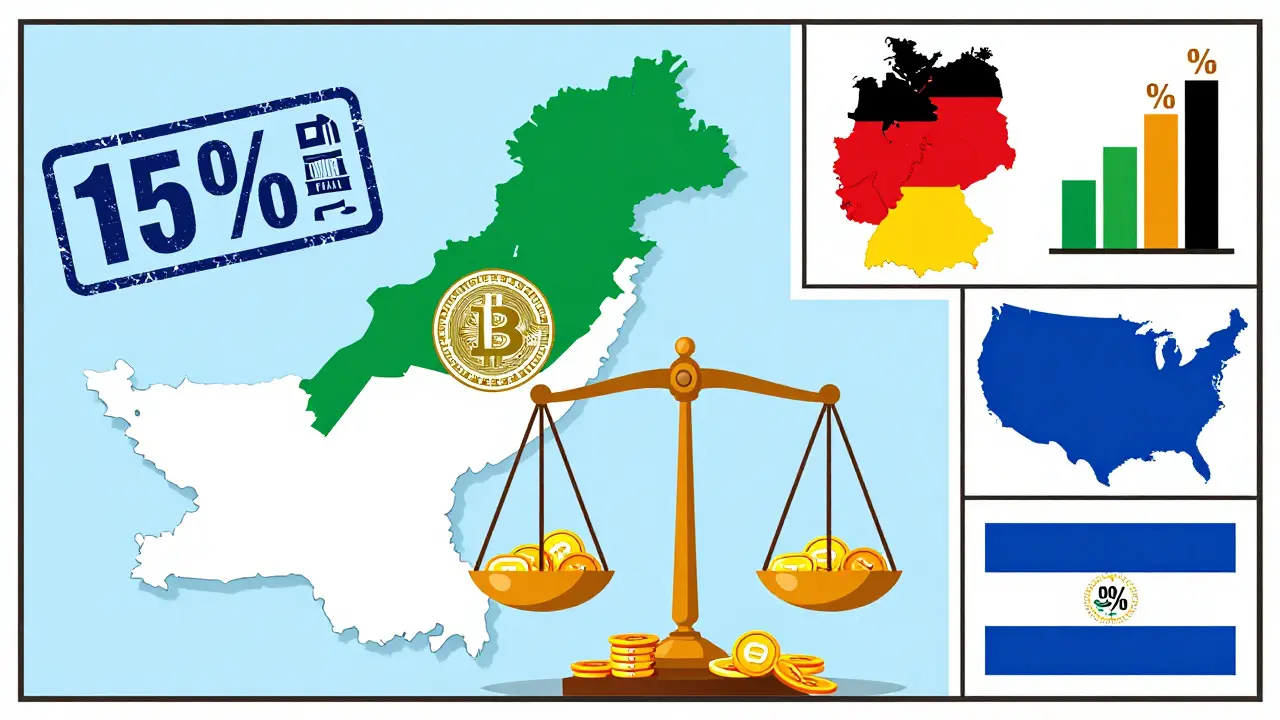
This structure contrasts sharply with countries like Germany, where holding periods over one year can eliminate capital gains tax entirely, or the United States, where rates vary based on income level and duration. Pakistan’s model is closer to Thailand’s approach, which also adopted a flat 15% tax in 2022. However, unlike El Salvador, which explicitly exempts Bitcoin exchanges from capital gains tax under its Bitcoin Law, Pakistan has opted for a moderate taxation strategy designed to balance revenue generation with market development.
| Country | Crypto Capital Gains Tax | Long-Term Holding Incentive | Regulatory Body |
|---|---|---|---|
| Pakistan | Flat 15% | No (as of 2026) | Pakistan Digital Assets Authority (PDAA) |
| United States | 0% - 20% | Yes (lower rates after 1 year) | IRS / SEC |
| Germany | Progressive Income Tax | Yes (0% after 1 year) | BaFin |
| El Salvador | 0% | N/A | Bitcoin Commission |
| India | 30% + 1% TDS | No | Income Tax Department |
Taxing Mining, Staking, and Business Income
The 15% rate isn't the only number you need to know. If your income comes from activities other than simple buying and selling, the rules change significantly. Income derived from cryptocurrency mining, staking rewards, or payments received in digital assets for services is taxed as regular income. This means it falls under Pakistan's progressive tax brackets.
For individual miners or stakers, these brackets range from 5% for annual income up to ₨600,000 to 35% for income exceeding ₨12 million. This is a critical distinction. A casual trader paying 15% on gains might find themselves paying up to 35% on their mining hardware returns if their total taxable income pushes them into the highest bracket. For businesses engaging in cryptocurrency activities, such as running an exchange or providing blockchain consulting services, the corporate tax rate stands at 29%.
There is also a nuance regarding foreign accounts. Converting crypto to rupees through foreign accounts may incur a 5% tax, while Roshan Digital Accounts face a 10% rate according to proposals from the Federation of Pakistan Chambers of Commerce and Industry (FPCCI). These variations highlight the importance of keeping your financial channels domestic unless you have a specific reason to use offshore structures, which come with their own compliance costs.
Compliance Requirements and Reporting Deadlines
Knowing the rate is half the battle; reporting it is the other. The regulatory architecture requires mandatory reporting through Form IT-1. The annual filing deadline is September 30. Missing this date can lead to penalties that far exceed the tax itself. Furthermore, starting mid-2025, cryptocurrency exchanges are required to share transaction data directly with the Federal Board of Revenue (FBR). This means the days of flying under the radar are effectively over.
The Pakistan Digital Assets Authority (PDAA) has been instrumental in enforcing this transparency. Established in May 2025 under Minister of State for Blockchain and Crypto Bilal Bin Saqib, the PDAA oversees the implementation of these rules. They launched a taxpayer education portal in August 2025 featuring tutorial videos and a transaction calculator. While user reviews suggest only 43% found these resources sufficiently clear, they represent the official standard for compliance.
A major pain point for users remains the lack of standardized reporting formats between domestic exchanges like Rain and international platforms. Many Pakistanis use global exchanges due to liquidity needs, creating reconciliation difficulties. Third-party tools like Koinly and CoinTracker have become essential for many users, processing over 28,000 Pakistani accounts by October 2025. These tools help aggregate data from multiple sources to generate reports compatible with FBR requirements, saving users an estimated 15-20 hours of manual work annually.

Addressing the "Zero Percent" Misconception
So where did the idea of a declining tax rate to 0% come from? It likely stems from confusion with draft regulations or speculative analyst forecasts rather than enacted law. In October 2025, the PDAA announced draft regulations for 'long-term holding incentives.' These drafts suggested potential reduced tax rates for assets held over specific periods, but details remained unclear and were not finalized into law by early 2026.
Industry analysts at Deloitte Pakistan predicted in October 2025 that Pakistan might introduce a tiered system by 2026, potentially reducing rates to 10% for holdings over one year and 5% for holdings over two years. However, predictions are not policies. As of May 2026, no official documentation indicates a scheduled decline to 0%. Dr. Ayesha Siddiqa, Senior Fellow at Quaid-i-Azam University, noted that the current flat 15% represents a pragmatic middle ground, acknowledging the sector's economic potential while addressing IMF concerns about revenue leakage. The absence of a zero-rate policy ensures that the state continues to capture value from the growing $3.2 billion crypto market in Pakistan.
Practical Steps for Crypto Users in Pakistan
If you are active in the Pakistani crypto space, here is how you should proceed given the current legal environment:
- Track Every Transaction: Since exchanges now report to the FBR, you must maintain records of every buy, sell, swap, and transfer. Use wallet tracking software to automate this process.
- Calculate Cost Basis Carefully: The PwC Worldwide Tax Summaries warn that the lack of clear guidance on valuation methodologies creates compliance challenges. Ensure you are using consistent methods for calculating gains, especially for pre-2025 holdings.
- Separate Trading from Mining: Keep your trading profits separate from mining or staking income. Trading profits attract the 15% CGT, while mining income is added to your total taxable income and taxed at progressive rates.
- File Before September 30: Mark your calendar. Late filings invite scrutiny and penalties. Consider hiring a chartered accountant who has completed the mandatory tax training sessions scheduled by the FBR across major cities.
- Monitor PDAA Announcements: While the 0% rate is not real yet, keep an eye on the PDAA website for any updates on long-term holding incentives. Policy can change, and being informed helps you adapt quickly.
The market context shows that despite these taxes, adoption is soaring. Pakistan's crypto user base grew to approximately 12.7 million individuals by September 2025, representing 5.3% of the population. Trading volume increased 217% year-over-year following regulatory clarity. This growth suggests that while the tax burden exists, the opportunity within the market outweighs the cost for most participants. The Special Investment Facilitation Council (SIFC) even issued Pakistan's first high-performance computing data center license for bitcoin mining in August 2025, allocating 2,000 megawatts of electricity specifically for mining operations. This signals strong government support for the infrastructure, even if the tax regime remains firm.
Is the 15% capital gains tax applied to all crypto transactions?
No, the 15% Capital Gains Tax applies specifically when cryptocurrencies are sold for fiat currency at a profit. It does not apply to transactions where you trade one cryptocurrency for another (e.g., swapping Bitcoin for Ethereum) without converting to fiat, nor does it apply to mining or staking rewards, which are taxed as regular income.
Will Pakistan reduce crypto taxes to 0% in the future?
As of May 2026, there is no official policy to reduce taxes to 0%. While draft regulations mentioned potential incentives for long-term holdings, no concrete timeline or rate reduction to zero has been enacted. Analysts predict possible tiered reductions (e.g., 10% or 5%) for long-term holders, but these remain speculative.
How is mining income taxed in Pakistan?
Mining income is taxed as regular income under Pakistan's progressive tax brackets. This means it is added to your other annual income and taxed at rates ranging from 5% to 35%, depending on your total earnings. This is distinct from the flat 15% capital gains tax applied to trading profits.
What is the deadline for filing crypto taxes?
The annual filing deadline for cryptocurrency taxes is September 30. You must submit Form IT-1 to the Federal Board of Revenue (FBR) by this date. Late filings can result in penalties and increased scrutiny.
Are small transactions exempt from crypto taxes?
There are potential exemptions for small transactions under ₨50,000, but experts criticize this threshold as arbitrarily low. Most active traders will exceed this limit, so it is safer to assume that all profitable conversions to fiat are subject to the 15% capital gains tax.
Do I need to report transactions from international exchanges?
Yes. While domestic exchanges like Rain are mandated to share data with the FBR, you are personally responsible for reporting transactions from international platforms. The FBR expects full disclosure of all crypto assets held globally by Pakistani residents.