Imagine you deposit $10,000 into a crypto pool. The market moves up. You check your dashboard and see you’ve earned $500 in trading fees. But wait-your total value is actually down $300 compared to just holding the coins. Did you lose money? Or did you make it? This is the core dilemma of decentralized finance (DeFi) in 2026. It’s the battle between impermanent loss and the trading fees you earn.
If you’re providing liquidity on platforms like Uniswap or Curve, you are essentially acting as the bank for traders. They pay you fees to swap tokens. In return, you take on the risk that the price of those tokens will change relative to each other. That price change creates impermanent loss. If the fees don’t cover that loss, you end up poorer than if you had just sat on your hands and held the assets. Let’s break down exactly how this math works and how you can tilt the odds in your favor.
The Mechanics of Impermanent Loss
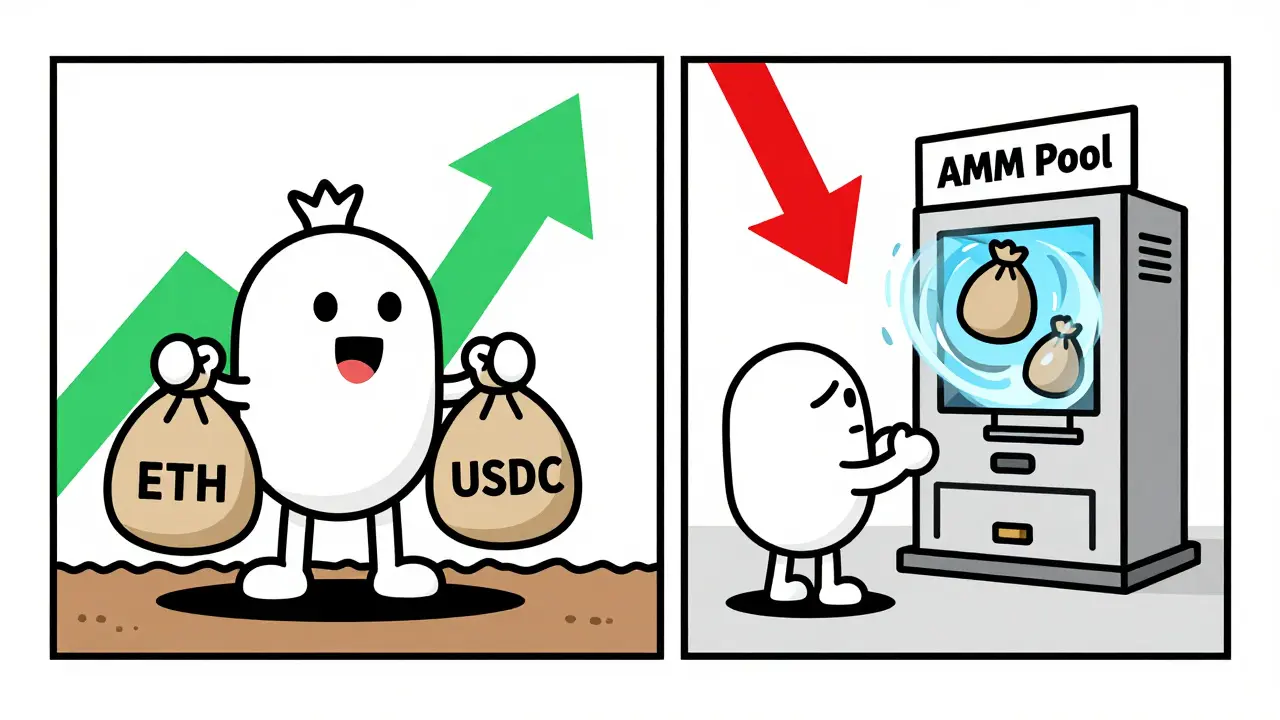
To understand why you might lose value, we need to look at how automated market makers (AMMs) work. Most major DEXs use a formula called x*y=k. This means the product of the two token reserves in the pool must remain constant. When someone buys ETH from an ETH/USDC pool, they take out ETH and put in USDC. The price adjusts automatically based on supply and demand.
Here is where the loss happens. Imagine you start with equal value of ETH and USDC. If ETH doubles in price on the open market, arbitrage bots will instantly buy cheap ETH from your pool and sell it elsewhere until the prices match. Your pool now holds less ETH and more USDC than when you started. Because ETH went up, holding ETH would have been more profitable than having your portfolio rebalanced by the pool. The difference between "holding" and "providing liquidity" is impermanent loss.
It’s called "impermanent" because if the price returns to your entry point, the loss disappears. However, if you withdraw while the price is still diverged, that loss becomes permanent. According to data from BlockApps in 2025, about 63% of experienced LPs now calculate this risk before depositing a single dollar. Ignoring it is no longer an option.
| Price Change (Ratio) | Impermanent Loss | Impact Level |
|---|---|---|
| 25% (1.25x) | 0.6% | Negligible |
| 50% (1.5x) | 2.0% | Moderate |
| 100% (2x) | 5.7% | Significant |
| 300% (4x) | 20.0% | Severe |
| 400% (5x) | 25.5% | Critical |
Earning Back the Loss: Trading Fees
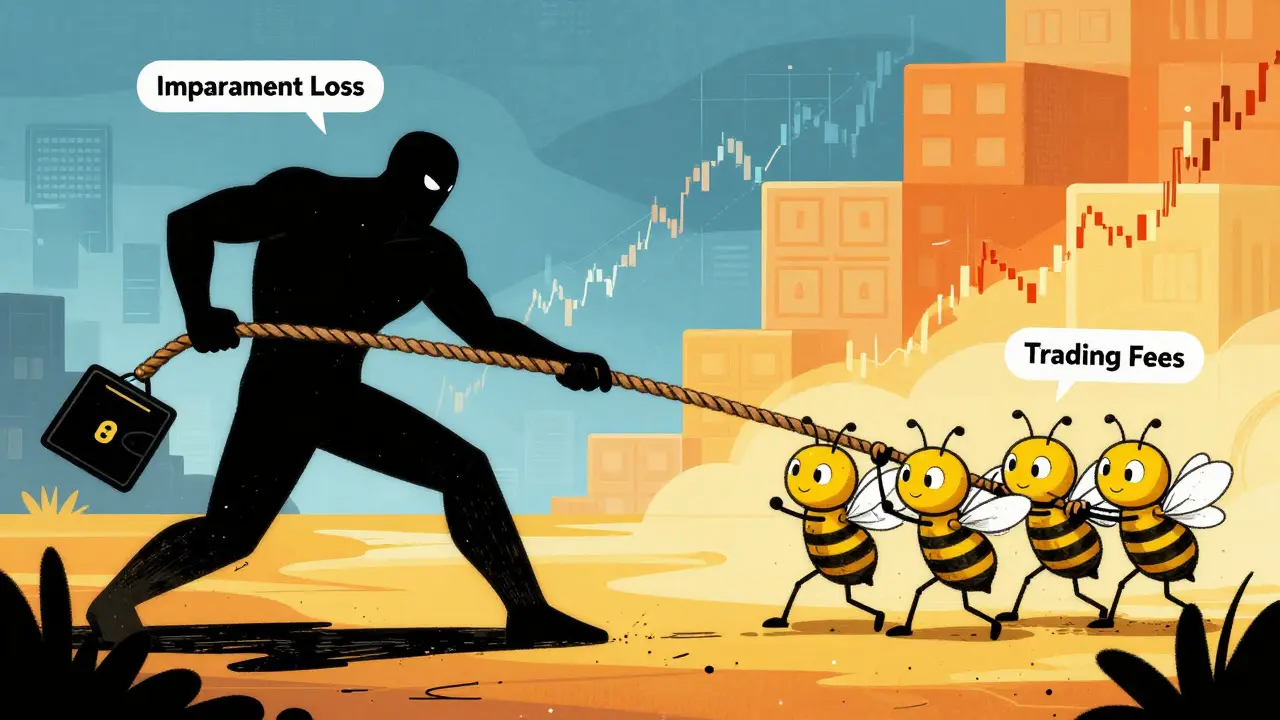
So why do people provide liquidity at all? Because of the fees. Every time a trader swaps tokens in your pool, they pay a small percentage. That fee goes directly to you, the liquidity provider. This is your income stream. The goal is simple: earn enough in fees to cover the impermanent loss and then some.
Fee structures vary wildly. On Uniswap V3, stablecoin pairs like USDC/DAI charge just 0.05%. Standard pairs like ETH/USDC charge 0.30%. Exotic pairs, often new or risky tokens, can charge 1.00% or more. Higher fees mean you need less volume to break even. But high-fee pools usually involve riskier assets that are more likely to crash or pump, increasing your impermanent loss risk.
Dr. Jane Chen, Chief Economist at Amberdata, puts it plainly: "Impermanent loss isn't a fee but an opportunity cost. In high-volume pools, this cost is routinely covered within weeks." If a pool has massive daily volume, you can collect thousands in fees quickly. If the pool is quiet, you sit there accumulating loss without any income to offset it.
The Breakeven Point: Doing the Math
You don’t need to be a mathematician to figure out if a pool is worth it, but you do need to know the breakeven point. This is the amount of trading volume required to cover your potential impermanent loss.
Let’s look at a real-world example from 2025 data. Suppose you deposit $1,000 into a standard 50/50 ETH/USDC pool with a 0.30% fee tier. If ETH moves 50% (a 1.5x ratio), you face a 2.0% impermanent loss. That’s a $20 hit. To earn back $20 in fees at a 0.30% rate, the pool needs to process roughly $6,666 in trading volume against your specific liquidity position. If the pool is tiny and only sees $100 in trades a day, you’ll wait months to break even. If it’s a mega-pool seeing millions in volume, you might break even in a few days.
Stablecoin pairs are different. A USDC/USDT pair rarely sees large price divergences. Even with a 10% divergence (which is rare for stables), the loss is under 1%. The fees are lower too, but the volume is often consistent. For many conservative LPs, stable pools offer the safest path to net positive returns, albeit with lower APYs (often 0.5-3%).
Uniswap V3: High Risk, High Reward
In 2021, Uniswap launched V3, introducing concentrated liquidity. This changed the game. Instead of spreading your capital across all possible prices, you pick a range. If the price stays in your range, you earn up to 10x more fees than on V2. But if the price leaves your range, you stop earning fees entirely, and you are left holding only one asset, fully exposed to impermanent loss.
This model requires active management. You have to monitor the price and adjust your ranges. MEXC Research found in early 2026 that over 54.7% of Uniswap V3 LPs in volatile pairs were unprofitable in 2025. Why? Because they set their ranges too wide or forgot to rebalance when the market moved. Concentrated liquidity amplifies both your gains and your losses. It’s not a "set it and forget it" strategy anymore.

Strategies to Minimize Loss and Maximize Fees
How do successful LPs stay ahead? They treat it like a business, not a lottery. Here are the strategies that worked best in 2025 and continue to define the landscape in 2026:
- Stick to Stable Pairs: If you want sleep at night, provide liquidity for USDC/USDT or similar pairs. The impermanent loss is minimal, and the risk of rug pulls is low. Yes, the APY is lower, but it’s reliable.
- Chase Volume, Not Just APY: A pool showing 100% APY might be backed by empty promises or low volume. Look for pools where daily volume exceeds 5% of the total liquidity. High volume means faster fee accumulation.
- Use IL Calculators: Tools like ImpermanentLoss.io or the built-in calculators on Zapper.fi let you simulate scenarios. Enter a 2x price change and see what your loss looks like. Compare that to the projected fees. If the fees don’t cover the loss within a reasonable timeframe, skip the pool.
- Avoid "Dusting": Don’t put tiny amounts into dozens of pools. Focus your capital on 2-3 high-quality pools where you can actively manage positions and understand the risks.
- Watch for Token Incentives: Many protocols offer extra rewards in their native tokens. These can help offset impermanent loss, but remember: those reward tokens also have price risk. If the reward token crashes, your "offset" vanishes.
The Future of Liquidity Provision
The industry is evolving to protect LPs. By 2026, innovations are making impermanent loss less painful. Bancor’s single-asset exposure model reduces IL by 50-70% by allowing users to deposit just one token. KyberSwap uses dynamic fees that rise during volatility, helping to cover losses when they happen most. Uniswap’s upcoming V4 roadmap includes "IL insurance pools," which could cover up to 50% of losses for qualifying positions.
Chainlink oracles are also being used to create hedging products. You can now buy derivatives that pay out if the price moves too far, effectively insuring your liquidity position. While these tools add complexity, they represent a maturation of the DeFi space. We are moving from the Wild West era of "trust me bro" to a structured environment with risk management tools.
However, caution remains key. Michael Saylor of MicroStrategy warned in early 2026 that over 60% of LPs in volatile pairs still experienced net losses in 2025. The math hasn’t changed; only the tools have improved. You still need to do the homework.
Is impermanent loss really a loss?
Yes, if you withdraw while the price has diverged. It is the difference between the value of your assets in the pool versus the value if you had simply held them in your wallet. It becomes permanent only when you exit the position.
Can trading fees always cover impermanent loss?
Not always. It depends on the trading volume. In high-volume pools, fees can cover IL quickly. In low-volume pools, you may accumulate loss for months without earning enough fees to break even. Always check the volume-to-liquidity ratio.
What is the safest way to provide liquidity?
Providing liquidity to stablecoin pairs (like USDC/USDT) is the safest. The price divergence is minimal, so impermanent loss is negligible. The returns are lower, but the risk of losing principal value is significantly reduced.
How does Uniswap V3 affect impermanent loss?
Uniswap V3 allows concentrated liquidity, which boosts fee earnings but increases IL risk if the price moves outside your selected range. It requires active monitoring and rebalancing, unlike older versions where capital was spread across all prices.
Should I avoid providing liquidity altogether?
No, but you should be strategic. If you believe in the long-term value of the assets and choose high-volume pools, you can profit. Avoid low-volume pools and exotic tokens unless you fully understand the high risk of severe impermanent loss.