Have you ever stumbled upon a cryptocurrency that promises to save the planet just by holding it? It sounds like the perfect mix of financial gain and environmental good. That’s exactly what Carboncoin (CARBON) claims to be. Launched back in 2014, it pitched itself as an energy-efficient digital currency dedicated to planting trees and restoring forests. But if you are looking at this coin today, you need to look past the green marketing and check the cold, hard data.
The short answer? Carboncoin is largely a ghost town. While it still exists on paper and has a website, it lacks active trading volume, significant community engagement, or verifiable proof that it is actually planting those promised trees. For most investors, it represents a cautionary tale about "greenwashing" in the early days of crypto rather than a viable investment opportunity.
The Origin Story: Bitcoin’s Green Cousin?
To understand where we stand today, we have to look back at February 11, 2014. This was the era when Bitcoin was gaining mainstream attention but facing heavy criticism for its massive electricity consumption. Enter Carboncoin. Its creators positioned it as a "scalable and secure evolution of Bitcoin." They claimed to keep the best parts of Satoshi Nakamoto’s protocol while fixing the environmental damage.
The technical backbone of Carboncoin relies on the Scrypt algorithm. Unlike Bitcoin, which uses SHA-256, Scrypt was designed to be more memory-intensive, theoretically allowing miners to use standard hardware rather than specialized ASICs. The project’s official site stated that their blockchain had been live for years without security breaches and operated using a "tiny amount of electricity."
But here is the catch. While Scrypt is different from SHA-256, it is still a Proof-of-Work (PoW) consensus mechanism. Proof-of-work inherently requires computational power and energy. Claiming to remove "competitive mining" while remaining a PoW coin is technically contradictory. Mining is, by definition, competitive. So, while it might use less energy than Bitcoin, calling it truly "energy efficient" compared to modern standards is a stretch.
The Environmental Promise vs. Reality
The core selling point of Carboncoin is its mission: "to raise unlimited funding for planting biodiverse forest." The idea is noble. You buy or mine CARBON, and the system funds reforestation. But after a decade, where is the evidence?
If you dig into the details, you will find a glaring absence of third-party verification. Legitimate environmental projects usually partner with established NGOs or carbon credit registries. Carboncoin’s website makes bold claims about restoring ecosystems, but there are no links to verified tree-planting reports, no partnerships with organizations like the World Wildlife Fund, and no transparent ledger showing how many trees were planted per coin mined.
This lack of transparency is a major red flag. In the world of crypto, trust is built on code and data. Without audited reports proving that funds are actually going to reforestation, the "eco-friendly" label feels more like marketing fluff than a functional utility. It’s important to distinguish Carboncoin from actual carbon credit tokens that integrate with regulated markets. Those projects provide receipts; Carboncoin provides promises.
Market Data: The Ghost Town Effect
Let’s talk numbers, because they tell the real story of Carboncoin’s current status. If you check major tracking platforms like CoinMarketCap or CoinGecko, the picture is bleak.
| Metric | Data Point | Implication |
|---|---|---|
| Trading Volume (24h) | $0 | No liquidity; you cannot easily buy or sell. |
| All-Time High Price | $0.002519 (Jan 2018) | Peak activity was over 8 years ago. |
| Current Price | ~$0.0000097 | Down over 99% from peak. |
| Market Cap Discrepancy | $18M (CMC) vs $149K (Coinlore) | Data inconsistency suggests low reliability. |
| Circulating Supply | ~15.39 Billion | Most coins already mined; little left for new miners. |
Notice the zero trading volume. In crypto, volume is life. It means people are exchanging hands. Zero volume means the market is frozen. You might see a price listed, but if you tried to sell 10,000 CARBON coins, you would likely find no buyers. This illiquidity makes the coin practically useless as a medium of exchange or store of value.
The discrepancy in market cap figures is also telling. One platform lists it at nearly $19 million, while another shows it under $150 thousand. This variance often happens with dead or zombie coins where automated scrapers pull stale data. It highlights that Carboncoin has slipped off the radar of serious analysts.
Community and Development: Is Anyone Left?
A cryptocurrency needs three things to survive: developers, users, and traders. Carboncoin appears to have lost all three.
First, let’s look at development. The project claims to be open-source, meaning anyone can review the code. However, a search for active GitHub repositories associated with Carboncoin yields little to no recent activity. No major updates, no bug fixes, no roadmap announcements. The last significant price action happened in 2018. Since then, silence.
Second, the community. Go to Reddit, Twitter, or Telegram. Search for "Carboncoin." You will find very little. There are no heated debates, no support threads, no hype. Even obscure micro-cap coins usually have a small group of holders discussing price predictions. Carboncoin has none. This absence of social sentiment is a strong indicator that the project has been abandoned by its original team and its user base.
Third, merchant adoption. The website mentions a tool called "Carbonshopper" to help merchants accept payments. Yet, there is no evidence of any real-world stores accepting CARBON. No integration guides, no API documentation, and no case studies. It remains a theoretical feature that never materialized.
Carboncoin vs. Modern Eco-Crypto
If you are interested in environmentally friendly cryptocurrencies, why choose Carboncoin? You don’t have to. The landscape has evolved significantly since 2014. Today, we have legitimate alternatives that actually solve the energy problem.
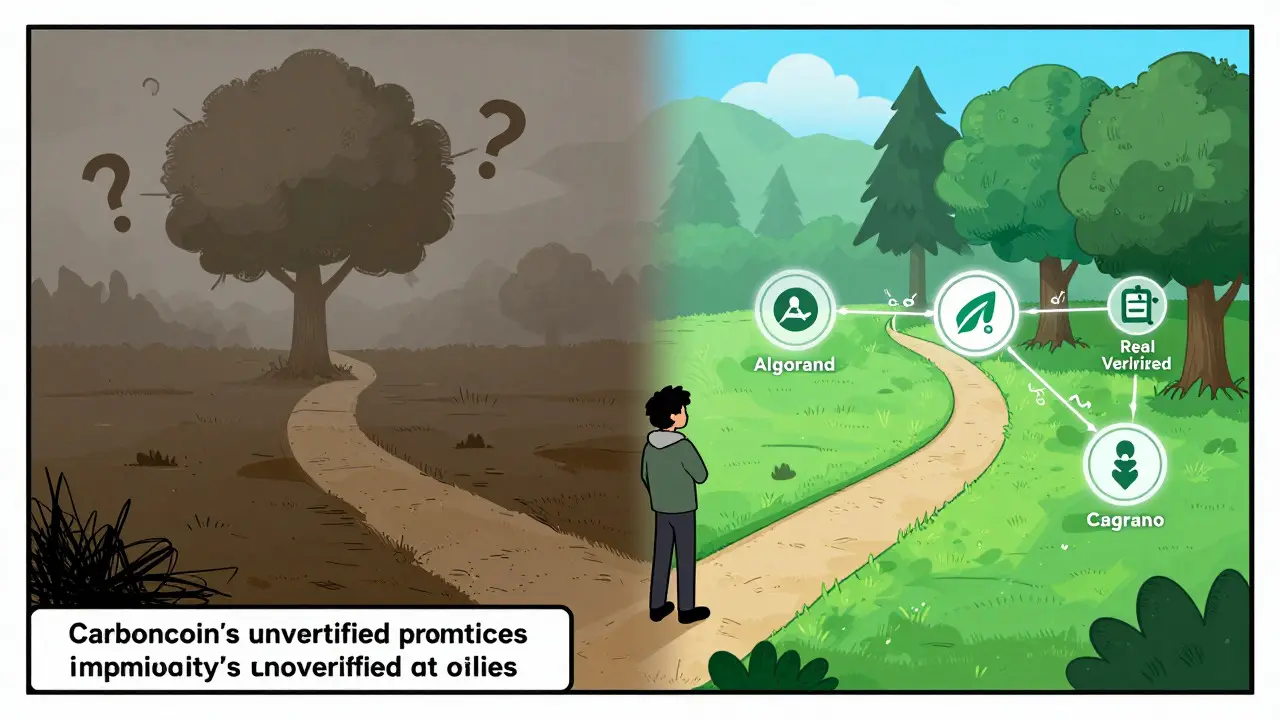
Consider Algorand or Cardano. These networks use Proof-of-Stake (PoS) consensus mechanisms. PoS reduces energy consumption by up to 99.9% compared to Proof-of-Work. They are not just claiming to be green; they are mathematically proven to be efficient. Plus, they have billions in market cap, active developer communities, and real-world applications.
Then there are true carbon credit tokens, like those issued by the Poseidon Foundation or KlimaDAO. These projects tokenize actual carbon offsets from verified forestry projects. When you hold these tokens, you own a share of a real-world environmental asset. Carboncoin, by contrast, offers a speculative token with an unverified promise. It’s the difference between buying a stock in a renewable energy company and buying a lottery ticket labeled "Green."
Is Carboncoin a Scam?
Calling it a "scam" implies malicious intent to steal money upfront. There is no evidence of a rug pull or fraud in the traditional sense. The founders didn’t vanish with millions in initial capital; they launched a coin that simply failed to gain traction.
However, it suffers from "vaporware" characteristics. It promises features (tree planting, easy merchant adoption) that never fully delivered or verified. For latecomers buying in hopes of a revival, it carries high risk. The lack of transparency regarding fund usage for reforestation borders on misleading. If you bought CARBON believing you were directly funding a verified NGO, you may have been misled by vague marketing language.
Final Verdict: Proceed with Extreme Caution
So, what is Carboncoin (CARBON)? It is a relic from the early days of altcoins-a well-intentioned but ultimately failed experiment in combining crypto with environmentalism. It lacks liquidity, development, community, and verifiable impact.
If you are a collector of old coins, you might find some historical interest in holding a few CARBON tokens. But as an investment? It’s a dead end. As an environmental tool? It’s ineffective. Your money and your carbon footprint would be better served by investing in established green technologies or donating directly to verified reforestation NGOs.
In the fast-moving world of crypto, survival of the fittest applies. Carboncoin did not survive. Don’t let its green label fool you into thinking it’s alive.
Is Carboncoin (CARBON) still being mined?
Technically, yes, as it uses a Proof-of-Work algorithm. However, with over 95% of the total supply already in circulation and near-zero block rewards or demand, mining it is economically unviable for almost everyone. The energy spent likely exceeds the value of the coins produced.
Does Carboncoin really plant trees?
The project claims to do so, but there is no publicly available, third-party audited evidence verifying how many trees have been planted or how funds are allocated. Unlike certified carbon credit projects, Carboncoin lacks transparent reporting on its environmental impact.
Where can I buy Carboncoin?
Carboncoin is listed on very few exchanges, if any active ones remain. Most major platforms have delisted it due to low volume. If found on a decentralized exchange, expect extreme slippage and illiquidity, meaning you may not be able to sell your holdings easily.
What is the difference between Carboncoin and Carbon Credits?
Carbon credits are standardized instruments representing one ton of CO2 removed from the atmosphere, often backed by verified projects. Carboncoin is a speculative cryptocurrency that *claims* to fund such projects but does not represent a direct ownership stake in verified carbon offsets.
Is Carboncoin a good investment in 2026?
Generally, no. With zero trading volume, no active development, and a 99% drop from its all-time high, it lacks the fundamentals required for growth. It is considered a "zombie coin" with minimal prospects for recovery.




Rita Dutta
August 9, 2026 AT 09:37oh my god this is such a deep dive into the existential dread of digital assets 🌿 basically what ur saying is that the whole concept of "green" crypto was just a shiny wrapper for the same old capitalist machine grinding away at our planet's soul u know? like we thought we were saving the trees but really we were just feeding the beast with slightly less electricity which is ironic because the beast eats everything including hope and dreams and also carbon credits are probably just paper tigers roaring in an empty jungle while the real forests burn down unnoticed by everyone scrolling through their phones looking for the next pump 💀 its fascinating how we project our moral failings onto code thinking that if the algorithm is nice enough it will forgive us for existing but no the code doesn't care about your karma it only cares about the hash rate and the hash rate is hungry always hungry for more power more heat more death to the ozone layer so yeah maybe plant a real tree instead of buying a fake one on a blockchain that nobody uses anymore because at least the real tree will die naturally and return to the earth unlike these zombie coins that haunt our wallets forever
Paul Smith
August 10, 2026 AT 09:35Hey there! 👋 Great read. It’s wild to see how far the space has come since 2014. I remember back then, every new coin had some grand environmental mission, but most fizzled out fast. 😅 Thanks for breaking down the difference between actual PoS chains like Cardano and these older PoW experiments. Really helps clear up the confusion for folks who might be tempted by the "eco-friendly" label without checking the tech underneath. 🌍💚 Keep up the good work!
Rodmun Tarnowski
August 12, 2026 AT 04:39Indeed; this analysis is quite illuminating!! It is absolutely crucial that investors distinguish between marketing rhetoric and verifiable data!!! The lack of third-party verification for Carboncoin’s reforestation claims is a significant oversight!!! One must always demand transparency in any financial instrument, especially those purporting to have social or environmental benefits!!! The comparison to modern Proof-of-Stake networks is particularly apt, as it highlights the technological evolution that has rendered many early projects obsolete!!! Caution is not merely advisable; it is imperative!!!
Matthew Smith
August 13, 2026 AT 11:49the problem isnt just the tech its the morality of selling nature as a commodity we treat the earth like a ledger where we can offset our sins with tokens but you cant buy forgiveness from a dying ecosystem with a coin that has zero volume its arrogant to think we can code our way out of climate change while ignoring the systemic issues driving consumption in the first place carboncoin failed because it tried to monetize virtue without doing the hard work of actual conservation now we have klimaDAO and others trying to do it right but even they are part of a market that commodifies survival we need to stop looking for financial gain in environmental action and start acting because the planet needs us not our portfolios
Prudence Flemming
August 14, 2026 AT 17:30look at the liquidity metrics and you see the truth dead markets dont have narratives they have ghosts the scrypt algo was never truly green just less energy intensive than sha-256 which is a low bar to clear calling it eco-friendly was pure greenwashing from day one now its a relic a museum piece of bad design and worse marketing if you want real impact look at the tokenized carbon credits with verified registries not this vaporware that promises trees but delivers nothing but dust