Imagine trying to guess a random number between 1 and 10. Easy, right? Now imagine guessing a specific 64-character hexadecimal string that starts with eighteen zeros. That’s the kind of needle-in-a-haystack problem every Bitcoin miner faces every ten minutes. But here is the twist: as more people join the game with faster computers, the puzzle doesn’t just get harder; it gets exponentially harder in a way that keeps the average solution time constant at exactly ten minutes. This balancing act is governed by two intertwined metrics: hash rate and mining difficulty. Understanding how these two forces interact isn't just academic trivia-it determines whether your mining rig makes money or loses you cash on electricity bills.
The Core Mechanism: Why Ten Minutes Matters
At its heart, Bitcoin is designed to produce a new block roughly every ten minutes. This cadence is crucial for network stability. If blocks came too fast, you’d have massive amounts of "orphaned" blocks-valid blocks that get discarded because they arrived slightly later than a competing block, leading to wasted energy and potential forks. If blocks came too slowly, transaction confirmation times would drag out, making Bitcoin unusable for daily payments.
To keep this ten-minute heartbeat steady despite the ever-changing amount of computing power thrown at the network, Satoshi Nakamoto introduced an automatic adjustment mechanism. Every 2,016 blocks-which takes about two weeks-the protocol looks back at how long it actually took to mine those blocks. If the last epoch took less than 20,160 minutes (the target), the network assumes miners got faster, so it increases the difficulty. If it took longer, the network lowers the difficulty. It’s a feedback loop that has worked flawlessly since the Genesis Block was mined on January 3, 2009.
Hash Rate: The Muscle Behind the Network
Hash rate is simply the total computational power securing the Bitcoin network, measured in hashes per second (H/s). Think of it as the collective brainpower of every miner worldwide. As of early 2026, this figure sits around 650 exahashes per second (EH/s). To put that in perspective, one exahash is a billion billion calculations per second. No single computer could come close to this; it requires the combined effort of thousands of specialized machines called ASICs (Application-Specific Integrated Circuits).
When hash rate goes up, it means more miners are online or existing miners have upgraded their hardware. This influx of power threatens to speed up block production. The network detects this acceleration and responds by raising the difficulty threshold. Conversely, if miners shut down due to high electricity costs or regulatory bans-as seen during China’s mining crackdown in 2021-hash rate drops. The network notices the slowdown and lowers difficulty to ensure blocks still arrive every ten minutes.
Mining Difficulty: The Digital Lockpick
Mining difficulty is not a fixed number; it’s a dynamic target. Formally, it represents how difficult it is to find a hash value below a certain target threshold. In practical terms, higher difficulty means you need to perform more attempts (hashes) before you stumble upon a valid block. Currently, the difficulty stands at approximately 52.39 trillion. This number essentially tells a miner: "On average, you need to make 52.39 trillion guesses to find one winner."
The relationship is direct but inverse in effect. High hash rate leads to high difficulty. Low hash rate leads to low difficulty. However, the adjustment isn’t instantaneous. It happens in discrete steps every two weeks. This lag creates periods where miners might be over-mining (earning less than expected because difficulty hasn’t caught up yet) or under-mining (earning more than expected because difficulty is still too high after a hash rate drop).
| Metric | Definition | Current Value (Early 2026) | Impact on Miners |
|---|---|---|---|
| Hash Rate | Total computational power of the network | ~650 EH/s | Higher rate = more competition, lower individual share |
| Difficulty | Measure of effort required to mine a block | ~52.39 Trillion | Higher difficulty = fewer blocks found per unit of power |
| Block Time | Average time between blocks | ~10 Minutes | Stability metric; deviations trigger difficulty adjustments |
| Adjustment Interval | Frequency of difficulty recalibration | Every 2,016 blocks (~14 days) | Creates short-term volatility in profitability |
The Mathematics of Adjustment
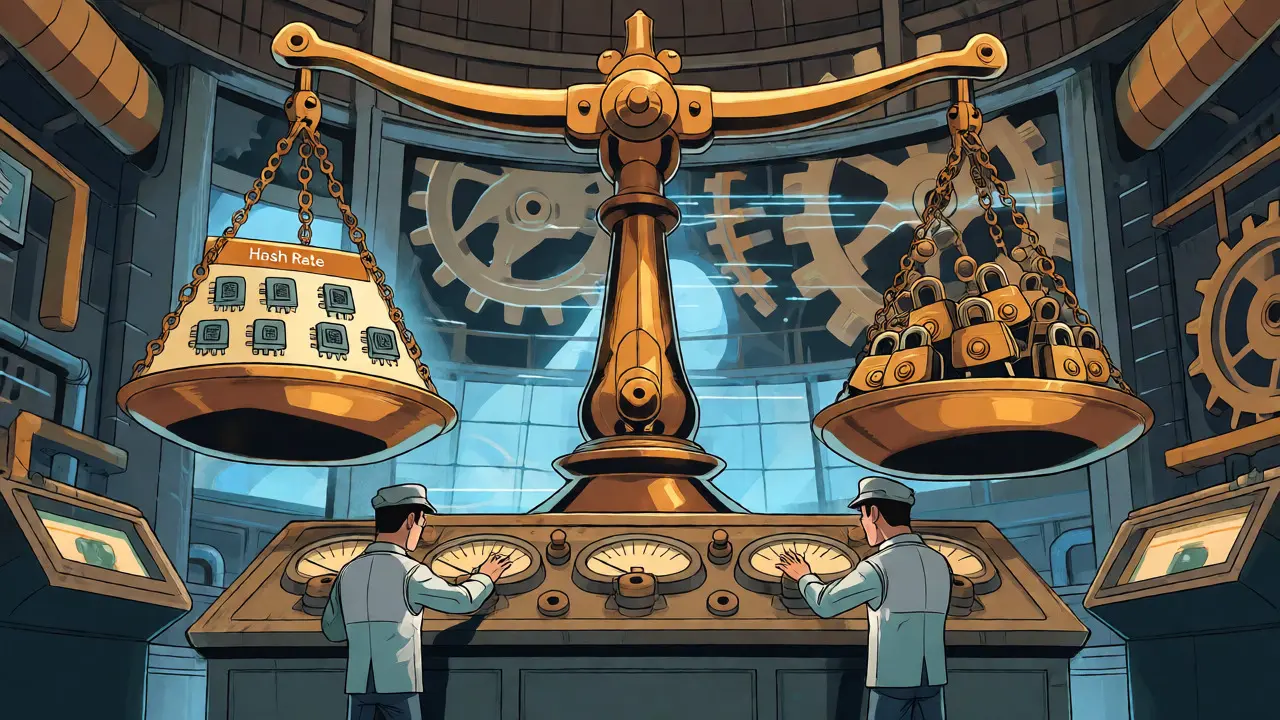
How does the network decide exactly how much to change the difficulty? It uses a straightforward ratio formula. The new difficulty equals the previous difficulty multiplied by the ratio of actual time taken versus expected time. If the last 2,016 blocks were mined in 18,000 minutes instead of the expected 20,160, the network sees that blocks are coming too fast. It adjusts the difficulty upward proportionally to slow things down.
This algorithm has a built-in safety feature known as damping. Even if hash rate swings wildly, the difficulty can only change by a maximum of 4x in either direction per adjustment period. This prevents extreme oscillations that could destabilize the network. For instance, if all miners turned off overnight, difficulty wouldn’t plummet instantly; it would step down gradually over several epochs until equilibrium is restored.
Economic Reality for Miners
For anyone running a mining rig, understanding this relationship is vital for survival. Your revenue depends on your share of the total hash rate relative to the difficulty. If you operate an Antminer S21 Hyd producing 300 terahashes per second (TH/s), your earnings depend entirely on what everyone else is doing. If global hash rate spikes while your machine stays constant, your slice of the pie shrinks even if the price of Bitcoin remains flat.
Data from recent years shows that small-scale miners suffer disproportionately from difficulty spikes. While institutional players like Riot Platforms or Marathon Digital hedge against these changes using futures markets and automated strategies, independent miners often face sudden profitability crashes. A study of user reviews indicates that nearly 70% of small operations cite difficulty adjustments as their primary financial risk. They must maintain efficiency margins of at least 15% above break-even to survive typical bi-weekly adjustments.

Future Trends and Challenges
The relationship between hash rate and difficulty is evolving. With the upcoming halving events projected to reduce block rewards, miners will rely more heavily on transaction fees and operational efficiency. Proposals like "difficulty adjustment smoothing" aim to replace the rigid two-week window with a moving average, potentially reducing volatility by nearly 40%. However, developers caution that changing the fundamental timing could introduce new security risks, such as making the network vulnerable to temporary attacks during rapid hash rate shifts.
As we move through 2026, the concentration of hash rate among top pools also impacts this dynamic. When five pools control over 60% of the network’s power, their coordinated actions can cause sharper-than-average difficulty jumps. Miners must now watch pool behavior as closely as they watch global hash rate charts.
Frequently Asked Questions
Why does Bitcoin adjust mining difficulty?
Bitcoin adjusts difficulty to maintain a consistent block time of approximately ten minutes. Since the number of miners and their hardware capabilities change constantly, the network automatically tweaks the difficulty level every 2,016 blocks to compensate for fluctuations in total hash rate, ensuring predictable network performance and security.
What happens to my mining profits when difficulty increases?
If your hash rate remains constant while network difficulty increases, your probability of finding a block decreases. This directly reduces your mining rewards unless the price of Bitcoin rises enough to offset the loss in volume. Essentially, each unit of electricity generates fewer bitcoins.
Can hash rate drop suddenly?
Yes, hash rate can drop significantly due to external factors like regulatory bans, seasonal weather affecting hydro-powered mines, or economic shutdowns during bear markets. When this happens, difficulty will eventually decrease in the next adjustment cycle, improving profitability for remaining miners.
Is mining difficulty related to Bitcoin price?
Not directly. Difficulty is determined solely by computational power (hash rate). However, indirectly, a higher Bitcoin price attracts more miners, increasing hash rate, which then raises difficulty. So, while price doesn't set difficulty, it drives the market behavior that influences it.
How often does mining difficulty change?
Mining difficulty adjusts every 2,016 blocks, which typically takes about two weeks. This interval balances responsiveness to network changes with stability, preventing excessive volatility in block times.