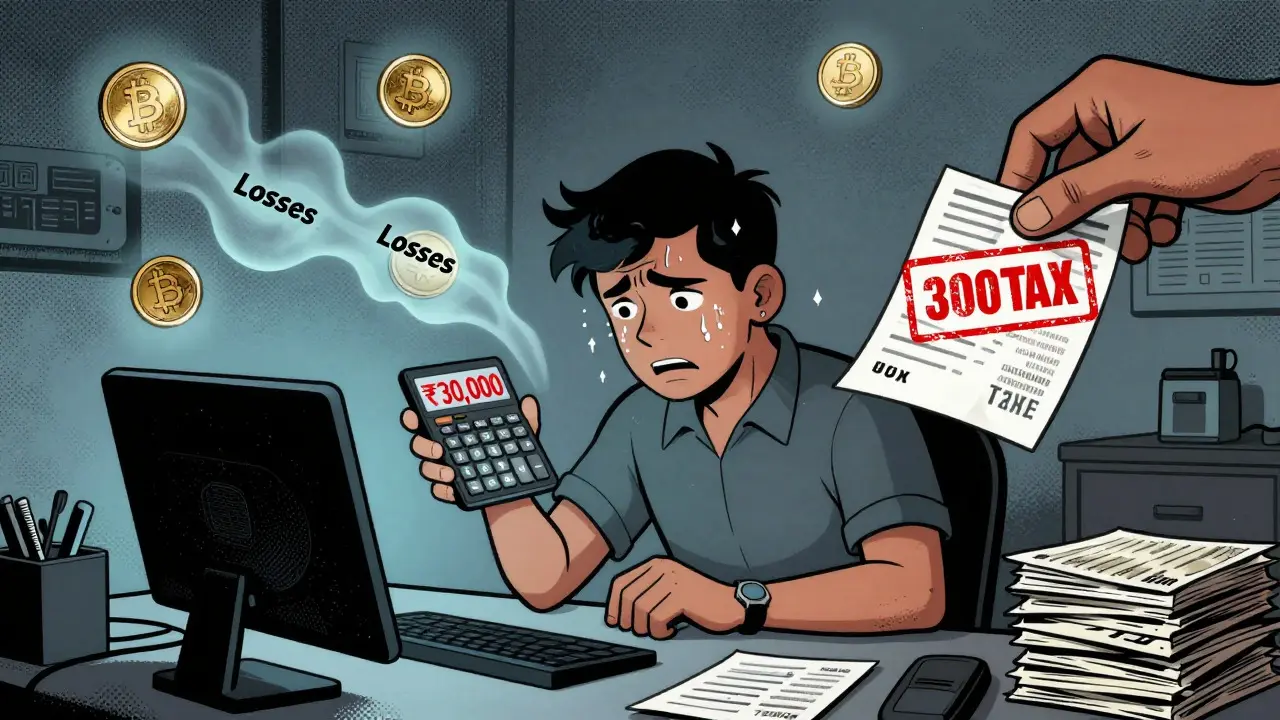
You make a trade. You win ₹100,000. Then you make another trade. You lose ₹80,000. On paper, your net profit is just ₹20,000. But when you file your taxes in India, the government doesn't care about that net number. They see the ₹100,000 gain and slap a 30% tax on it. That’s ₹30,000 gone. Your actual pocket balance? You’re down ₹10,000. This isn’t a hypothetical nightmare scenario; it is the daily reality for thousands of cryptocurrency investors in India due to the no loss offset rule.
If you are holding Bitcoin, Ethereum, or any other Virtual Digital Asset (VDA) in India, understanding this rule is not optional-it is survival. The framework introduced in 2022 and tightened through 2025 and into 2026 has created one of the most restrictive tax environments for digital assets in the world. Unlike traditional stock markets where losses can cushion gains, the Indian crypto tax regime treats every winning trade as a taxable event in isolation. Let’s break down exactly how this works, why it hurts your bottom line, and what strategies traders are using to cope.
The Mechanics of Section 115BBH: Why Losses Don’t Count
To understand the pain, you have to look at the law itself. The core of this issue lies in Section 115BBH of the Income Tax Act. Specifically, subsection (2)(b) states that no deduction shall be allowed in respect of any loss incurred in relation to virtual digital assets.
In plain English, this means two things:
- No Set-Off: If you sell BTC for a profit and ETH for a loss, the ETH loss does not reduce the taxable income from the BTC sale. Each transaction is calculated independently.
- No Carry-Forward: In traditional equity trading, if you have excess losses, you can carry them forward for up to eight years to offset future profits. With crypto, those losses vanish. Once the financial year ends, that loss is dead weight. It provides zero tax benefit ever again.
This creates an asymmetric burden. The taxman takes his cut of the upside but offers no relief on the downside. For active traders who rely on high-frequency buying and selling, this structure is devastating. A swing trader might have five winning trades and three losing ones in a month. In the US or Europe, the losses might neutralize some of the gains. In India, only the five wins are taxed. The effective tax rate on your *net* profit can skyrocket well above the nominal 30%.
The 30% Flat Rate and Hidden Costs
The no-loss-offset rule doesn’t operate in a vacuum. It sits atop a flat 30% tax rate on all capital gains from VDAs. This rate applies regardless of your income slab. Whether you earn ₹5 lakh or ₹5 crore a year from salary, your crypto gains are taxed at 30%. Add to this the health and education cess (4%) and applicable surcharges, and the effective rate often exceeds 31%.
But wait, there’s more. The calculation of "gain" is strict. Under current rules, the only expense you can deduct from your selling price is the cost of acquisition. What about gas fees? What about exchange transaction fees? What about the electricity bill for mining? None of these count. You cannot claim operational expenses against your crypto income. This further inflates the taxable base, making the lack of loss offset even more painful.
| Feature | Equity Shares (Listed) | Virtual Digital Assets (Crypto) |
|---|---|---|
| Tax Rate | 10% (STCG) / 12.5% (LTCG above ₹1.25L) | 30% + Cess (Flat) |
| Loss Set-Off | Allowed within same category | Not Allowed |
| Carry Forward | Up to 8 years | Not Allowed |
| Deductible Expenses | Brokerage, STT, Transaction Charges | Only Cost of Acquisition |
| Holding Period Benefit | Long-term gains taxed lower | No distinction between short/long term |
The TDS Trap: Cash Flow Strangulation
Even before you file your annual return, the government gets its hands on your money through Tax Deducted at Source (TDS). Under Section 194S, exchanges must deduct 1% TDS on the gross value of every crypto transfer exceeding ₹10,000 per day (or ₹50,000 for HUFs and small traders).
Here is why this hurts: TDS is deducted on the *gross* amount, not the profit. If you swap ₹1 lakh worth of USDT for BTC, ₹1,000 is deducted immediately. If that trade results in a loss later, you don’t get that ₹1,000 back as a refund against the loss-you only get it credited against your total tax liability at the end of the year. For many traders, especially those with net losses, this creates a massive cash flow blockage. You are paying out 1% on every single transaction, locking up liquidity that could be used for trading or living expenses.
Furthermore, if you engage in peer-to-peer (P2P) transactions or over-the-counter (OTC) deals, the buyer is responsible for deducting TDS. If they fail to do so, the seller (you) becomes liable to pay the tax directly, along with potential penalties for non-compliance. This adds a layer of administrative headache to every informal trade.

Real-World Scenarios: Who Gets Hurt Most?
Let’s look at specific trader profiles to see how the no-loss-offset rule plays out in practice.
The Day Trader: Rahul trades altcoins daily. He makes 20 trades a week. Statistically, he wins 55% of the time. However, because his winning trades are smaller than his occasional large losses, his net monthly P&L is often negative or break-even. Yet, every winning trade triggers a 30% tax liability. By year-end, Rahul owes lakhs in tax despite having made little to no real profit. He also has ₹50,000+ stuck in TDS credits that he won’t see until he files his ITR months later.
The Long-Term Holder: Priya bought Bitcoin in 2020 at ₹20,000. She sells half in 2026 at ₹80,000. Her gain is clear. The tax is straightforward. However, she still faces the 30% rate, which is significantly higher than the long-term capital gains tax on stocks. She loses the benefit of indexation (adjusting purchase price for inflation), meaning her real post-tax return is much lower than it appears.
The NFT Collector: Amit buys an NFT for ₹50,000. It crashes to ₹10,000. He sells it. He has a ₹40,000 loss. This loss is worthless for tax purposes. Later, he buys another NFT for ₹20,000 which goes to ₹60,000. He pays 30% tax on the ₹40,000 gain. The previous ₹40,000 loss offered him nothing. The asymmetry is stark.
Compliance Nightmares and Penalties
Avoiding the tax by ignoring it is dangerous. The Budget 2025 and subsequent enforcement actions have made compliance "non-negotiable." The Income Tax Department now has sophisticated tools to track crypto wallets and exchange data.
If you fail to report your VDA holdings, the consequences are severe. Under Section 158B, undisclosed crypto holdings can be taxed at a punitive rate of 60%, applicable retrospectively from February 1, 2025. This is not a typo. Sixty percent. Plus interest and potential prosecution for willful evasion.
Reporting requires filing Schedule VDA in your ITR-2 or ITR-3 forms. You cannot use the simpler ITR-1 if you hold crypto. You must maintain meticulous records of:
- Date of acquisition
- Cost of acquisition (in INR)
- Date of transfer
- Fair market value at the time of transfer
For someone with hundreds of micro-transactions, this is a bureaucratic nightmare. Many traders hire specialized crypto tax consultants, adding another layer of cost to an already expensive hobby.

Workarounds and Risks: Going Offshore?
Frustrated by the domestic regime, many Indian traders are looking abroad. They open accounts on international exchanges like Binance (via derivatives), Bybit, or KuCoin. The logic is simple: if the transaction happens outside India, maybe Indian tax laws don’t apply as strictly, or at least the TDS mechanism is bypassed.
However, this is a risky game. India’s Liberalised Remittance Scheme (LRS) allows individuals to send up to $250,000 abroad per year. But if you remit more than ₹7 lakh, a 20% Tax Collected at Source (TCS) is applied. This effectively kills the arbitrage opportunity for large traders. Furthermore, the Income Tax Department considers global income. If you hold crypto on a foreign exchange, you are still required to declare it in your Indian tax returns. Failure to do so invites the 60% penalty mentioned earlier.
Some traders move into crypto futures and options. Since derivatives are not classified as VDAs under the current definition, they are not subject to the 30% tax or 1% TDS. Instead, they fall under speculative business income, which is taxed according to your income slab. While this sounds better, it comes with its own complexities: you must treat trading as a business, maintain books of accounts, and face audit risks if your turnover exceeds certain thresholds.
The Future Outlook: Reform or Rigidity?
As we move through 2026, there is little sign of relief. Industry bodies like NASSCOM and various crypto associations continue to lobby for changes, arguing that the current regime stifles innovation and drives activity underground. They point to countries like Germany, where crypto held for over a year is tax-free, or the US, which allows loss offsetting.
However, the government’s stance remains firm. The focus is on revenue collection and curbing money laundering rather than fostering growth. The introduction of harsher penalties in recent budgets suggests that the trend is toward stricter enforcement, not relaxation. Experts predict that without significant legislative change, official trading volumes on Indian exchanges may continue to stagnate, while offshore and decentralized finance (DeFi) activities grow in the shadows.
For the individual trader, the message is clear: assume the no-loss-offset rule is permanent. Build your trading strategy around minimizing taxable events. Hold longer to reduce frequency. Keep impeccable records. And always consult a tax professional who specializes in digital assets. In this environment, ignorance is not bliss-it is expensive.
Can I carry forward crypto losses to the next financial year in India?
No. Under Section 115BBH of the Income Tax Act, losses from Virtual Digital Assets cannot be carried forward to subsequent years. Once the financial year ends, any unrealized or realized losses are extinguished for tax purposes.
Does the 1% TDS apply to every crypto transaction?
The 1% TDS applies to the aggregate value of crypto transfers exceeding ₹10,000 in a financial year (₹50,000 for HUFs and small traders). It is deducted by the exchange at the time of transfer. Note that this is on the gross value, not the profit.
Are gas fees and exchange charges deductible from crypto gains?
Currently, no. The only allowable deduction is the cost of acquisition. Operational expenses like gas fees, network fees, and exchange transaction charges cannot be claimed as deductions against your capital gains.
What happens if I don't report my crypto holdings?
Non-disclosure can lead to severe penalties. Under Section 158B, undisclosed crypto holdings may be taxed at 60%, applicable retrospectively from February 1, 2025. Additionally, you may face interest charges and prosecution for tax evasion.
Is there a difference in tax treatment for long-term vs. short-term crypto holdings?
No. Unlike equity shares, there is no distinction between short-term and long-term capital gains for Virtual Digital Assets in India. All gains are taxed at a flat 30% plus cess, regardless of how long you held the asset.
Do crypto futures and options fall under the 30% tax rule?
Generally, no. Derivatives like futures and options are not classified as VDAs. They are treated as speculative business income and taxed according to your applicable income tax slab. However, this requires treating trading as a business and maintaining proper books of account.