
Think you can move to Portugal and pay zero tax on your crypto gains? It used to be a lot simpler, but the landscape shifted significantly over the last couple of years. If you're eyeing a move to the Algarve or Lisbon to optimize your portfolio, you need to know that the famous NHR program is no longer available for new applicants. While Portugal is still a haven for digital assets compared to the rest of Europe, the "golden era" of unrestricted tax exemptions has evolved into a more targeted system.
The Shift from NHR to IFICI (NHR 2.0)
For years, the Non-Habitual Resident (NHR) regime was the ultimate magnet for crypto whales. It offered a flat 20% tax on Portuguese income and, more importantly, often exempted foreign-sourced income entirely. However, the Portuguese government closed the door to new NHR applicants in early 2024, with a final transition window that shut on March 31, 2025. If you didn't get in by then, you're looking at a different game.
Enter IFICI, also known as NHR 2.0. The Tax Incentive for Scientific Research and Innovation is far more restrictive than its predecessor. While the 20% flat rate still exists, it's no longer for anyone who just wants to live there. Now, you have to prove you're involved in high-value professions, such as scientific research or technological development. If you are a "pure" crypto trader without a background in tech or academia, qualifying for IFICI is a steep climb. You can't simply be a wealthy investor; you have to be a specialized professional.
How Cryptocurrency is Actually Taxed in Portugal
Regardless of whether you have a special tax status, Portugal's general rules for digital assets are surprisingly clear. The IRS (Imposto sobre o Rendimento das Pessoas Singulares) handles crypto under specific categories. The most critical factor for you is the holding period.
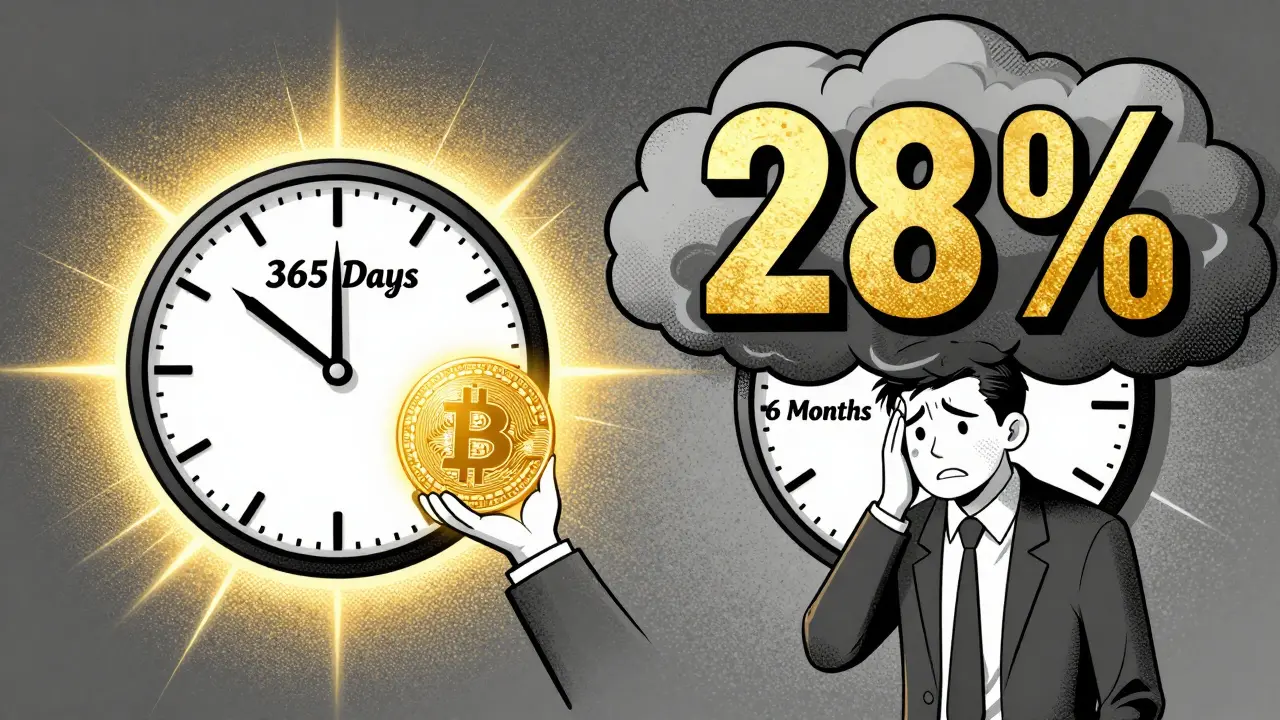
If you hold your assets for more than 365 days, the capital gains are generally tax-free. This makes a "buy and hold" strategy incredibly lucrative. However, if you flip a coin in six months and make a profit, you'll be hit with a 28% tax rate under Category G. This applies to short-term gains held for less than a year.
It's also worth noting that crypto-to-crypto trades aren't immediately taxable. You can swap Bitcoin for Ethereum or a stablecoin like USDC without triggering a tax event. The tax man only cares when you exit the crypto ecosystem and convert those assets back into fiat currency (like Euros) within a short timeframe.
| Asset Type / Activity | Holding Period | Tax Rate | Category |
|---|---|---|---|
| Long-term Capital Gains | > 365 Days | 0% | Exempt |
| Short-term Capital Gains | < 365 Days | 28% | Category G |
| Staking, Lending, Airdrops | N/A | 28% | Passive Income |
| Crypto-to-Crypto Trades | Any | 0% | Deferred |
Passive Income: The Staking and Lending Trap
Many investors mistake the 365-day rule for everything. It doesn't. While capital gains on the price appreciation of a coin might be tax-free after a year, passive income is a different story. If you're earning rewards through staking or lending, that income is generally taxed at a flat 28% from the moment you receive it. Airdrops follow a similar logic-they are viewed as a form of income rather than a capital gain.
For those who managed to secure the original NHR status before the March 2025 deadline, you're in a much better position. Your 10-year clock is still ticking, and you can likely keep those foreign-source exemptions until 2035. But for the new crowd, the 28% rate on passive income is the standard reality.
Strategic Moves for Crypto Residents
If you're planning your exit strategy, the most effective path is usually a three-step process: hold assets for over a year, convert them into stablecoins, and then cash out to fiat. This avoids the 28% short-term hit. However, if you're a U.S. citizen, stop right there. The IRS in the United States doesn't care about Portuguese law. You'll still owe taxes in the U.S. regardless of how long you held the asset or where you live, thanks to citizenship-based taxation.
Another common pitfall is record-keeping. The Portuguese Tax Authority is becoming more sophisticated. You can't just show a final balance. You need meticulous logs of timestamps, wallet addresses, and the exact fiat value at the time of every transaction. Using specialized crypto tax software isn't just a suggestion-it's a necessity to prove that 365-day threshold.

Establishing Tax Residency
You can't just claim you live in Portugal because you have a NIF (tax number). To actually benefit from these rules and avoid being taxed in your home country, you must establish formal tax residency. This usually means spending at least 183 days a year in the country or proving you have a permanent home there that you intend to occupy.
The process typically involves hiring a fiscal representative, which can cost anywhere from €1,200 to €2,500 in professional fees. It's a bit of a bureaucratic slog that takes about two months to finalize, but it's the only way to legally pivot your tax liability away from higher-tax jurisdictions like France or Italy.
Future Outlook and the MiCA Effect
Is Portugal still the best choice? It's moving from being a "tax paradise" to a "competitive European option." With the MiCA (Markets in Crypto-Assets) regulations now fully active across the EU, we're seeing a trend toward harmonization. There's a possibility that Portugal might eventually extend the short-term tax threshold from one year to two years to align with other EU directives, but don't bet your portfolio on it yet.
While the broad appeal of NHR is gone, the country remains attractive because it lacks a wealth tax and dividend tax on foreign income for those who qualify. If you can fit your professional profile into the IFICI requirements, Portugal is still a powerhouse for tax optimization. If not, you're still benefiting from one of the most transparent and relatively friendly crypto frameworks in the Eurozone.
Can I still apply for the NHR program in 2026?
No, the original NHR program is closed to new applicants. The final transition period ended on March 31, 2025. Newcomers must now look into the IFICI (NHR 2.0) regime, which has much stricter professional requirements.
Is crypto tax-free in Portugal if I hold for over a year?
Generally, yes. Capital gains on cryptocurrency held for more than 365 days are exempt from tax. However, this does not apply to passive income like staking or airdrops, which are taxed at 28%.
What is the tax rate for short-term crypto trades?
If you sell cryptocurrency that you've held for less than 365 days, you are subject to a 28% flat tax on the gains under Category G of the Portuguese tax code.
Do crypto-to-crypto trades trigger taxes?
In Portugal, swapping one cryptocurrency for another is typically not a taxable event. Taxation is usually triggered only when you convert crypto into a fiat currency like Euros.
How does IFICI differ from the original NHR?
The original NHR was broad and accessible to most foreign residents. IFICI (NHR 2.0) specifically targets professionals in scientific research, innovation, and highly qualified roles, meaning pure investors or general freelancers may no longer qualify for the 20% flat tax.
Do U.S. citizens get the same benefits?
While you may owe zero tax to Portugal for long-term gains, the U.S. taxes its citizens on worldwide income regardless of residency. You will still need to report and pay taxes to the U.S. IRS.




Rob Mitchell
April 13, 2026 AT 05:57The 365-day rule is a huge win for long-term holders. Definitely a solid spot for a base.
Agnessa Dale
April 15, 2026 AT 01:11It is so great to see people planning their futures like this! Even with the changes, Portugal still sounds like a lovely place to build a life while managing a portfolio. Positive vibes to everyone making the move!
Samson Selleck
April 15, 2026 AT 10:43The systemic pivot from NHR to IFICI represents a classic regulatory capture mechanism intended to filter for human capital rather than mere liquidity. It's quite transparent that the Portuguese state is attempting to optimize its demographic arbitrage by favoring high-utility professionals over rent-seekers. The asymmetric information regarding the 365-day threshold often leads to catastrophic fiscal slippage for those lacking a robust quantitative framework for their exits. Most retail traders operate on a level of primitive heuristic analysis that completely ignores the latent risks of Category G classification. If you aren't utilizing a sophisticated API-driven ledger for your cost-basis calculations, you're essentially gambling with your solvency. The MiCA alignment is merely the vanguard of a broader European effort to eliminate fiscal asymmetries. We are seeing the death of the tax haven as an entity and the rise of the 'compliant zone.' This is basic macro-economic evolution. Those clinging to the 2024 era of unrestricted exemptions are simply suffering from an inability to process shifting market dynamics. The irony is that most 'whales' are too intellectually lazy to read the fine print on staking income. You cannot simply iterate your way out of a 28% flat tax without a structured legal entity. It's an elementary mistake in capital allocation. The transition to a more restrictive regime is an inevitable outcome of the increased transparency brought by the Common Reporting Standard. Only a novice would think the 'golden era' was a permanent state of affairs. This is the new reality of global wealth management.
Omotola Balogun
April 16, 2026 AT 20:12Actually you forgot to mention that the NIF is just the start. Many peepel think geting the NIF means you're good to go but you really need the residency permit for the full benefit. Most dont realize the difference between tax residency and legal residency which is a big mistake in the process.
Alan Seiden
April 17, 2026 AT 12:18Typical EU nonsense. They lure you in with a few promises and then change the rules the moment you pack your bags. Absolute joke of a system.
Surender Kumar
April 18, 2026 AT 08:59this is laely helpful info. i think portgal still sounds like a cool place to chill and hold some coins for a while. thnx for sharing!
Akshay Gorad
April 19, 2026 AT 06:35I appreciate the detailed breakdown of the holding periods. It provides a clear boundary for those of us looking to avoid unnecessary tax hits.
william manes
April 21, 2026 AT 04:50USA is the only place that matters 🇺🇸. Why even move to Europe to pay taxes anyway? Stay home and win big! 🚀💰
Chidinma Sandra okafor
April 22, 2026 AT 16:02Oh look, another guide on how to hide money in Europe while the rest of the world struggles. So inspiring. I'm sure the Portuguese government loves these 'digital nomads' coming in to gentrify their cities while contributing basically nothing to the local economy. Pure brilliance.
Heather Warren
April 24, 2026 AT 07:49I can recommend a few great tools for tracking the 365-day window if anyone needs them! It makes the process so much easier and keeps everything organized for the tax man.