Imagine proving you are over 21 without showing your driver’s license. Imagine verifying a bank transaction without revealing the amount or the sender. This is not science fiction; it is the core promise of Zero-Knowledge Proofs (ZKPs), a cryptographic protocol that allows one party to prove the truth of a statement to another without revealing any underlying data. For years, this technology lived in academic papers. Today, it is the engine driving the next generation of blockchain infrastructure.
We have moved past the hype cycle. The question is no longer if zero-knowledge technology will matter, but how quickly it will become the standard for digital privacy and scalability. As we navigate through 2026, ZKPs are solving blockchain's "last unsolved problem": making networks both private and scalable simultaneously. Let’s look at where the technology stands, what is holding it back, and what the future actually looks like.
From Theory to Mainstream Infrastructure
The journey of zero-knowledge proofs began in 1985 with a paper by Shafi Goldwasser, Silvio Micali, and Charles Rackoff. For decades, it was a theoretical curiosity. The first major real-world application arrived in 2016 with Zcash, which used zk-SNARKs to enable private transactions on a public ledger. However, early adoption was niche. The landscape shifted dramatically between 2023 and 2024. The aggregate valuation of zero-knowledge crypto projects exploded from $3.2 billion to over $21 billion.
This surge wasn’t just speculative. It was driven by utility. Major Layer 2 solutions like zkSync Era, Starknet, and Polygon zkEVM began processing significant real transaction volume on the Ethereum mainnet. These platforms demonstrated that ZKPs could handle the throughput required for mass adoption. By mid-2024, analysts noted a fundamental transition: ZK technology was no longer a side project for privacy enthusiasts; it became foundational infrastructure for enterprise blockchain adoption.
Understanding the Core Technologies: SNARKs vs. STARKs
To understand the future, you need to understand the tools. Most modern ZKP implementations rely on two primary cryptographic approaches: zk-SNARKs (Zero-Knowledge Succinct Non-Interactive Argument of Knowledge) and zk-STARKs (Zero-Knowledge Scalable Transparent Arguments of Knowledge). They solve the same problem but with different trade-offs.
| Feature | zk-SNARKs | zk-STARKs |
|---|---|---|
| Proof Size | Small (~200 bytes) | Larger (~45 KB) |
| Trusted Setup | Required (Potential single point of failure) | Not Required (Cryptographically transparent) |
| Quantum Resistance | Low | High |
| Verification Speed | Very Fast | Fast |
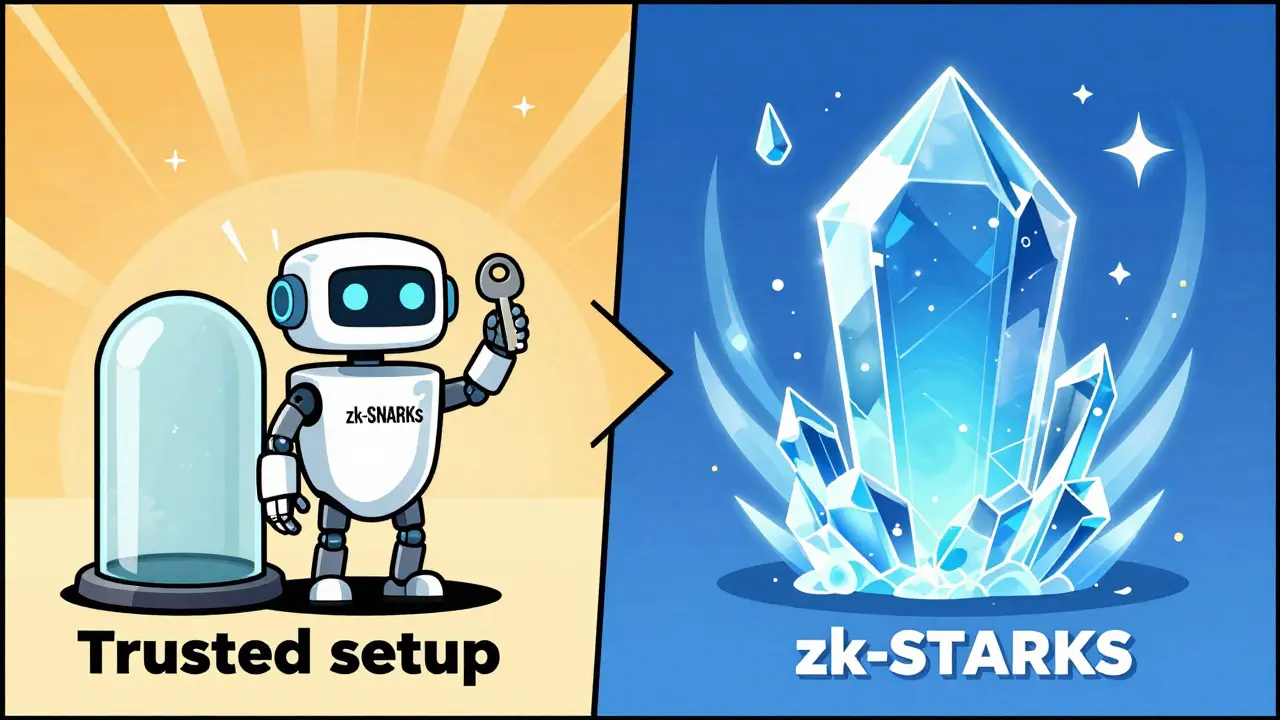
zk-SNARKs are popular because they are efficient. The small proof size means less data needs to be stored on-chain, reducing costs. However, they require a "trusted setup" ceremony. If the initial randomness generated during this setup is compromised, the entire system’s security collapses. zk-STARKs eliminate this risk by using cryptographic sortition, making them transparent and quantum-resistant. The downside? Larger proof sizes mean higher gas fees for verification, though this gap is narrowing as hardware improves.
The Hardware Revolution: Solving the Compute Bottleneck
The biggest hurdle for zero-knowledge technology has always been computational intensity. Generating a complex ZK proof requires massive amounts of RAM (16-32GB) and multi-core processors. In 2023, this made decentralized proving difficult. But 2024 and 2025 brought a hardware revolution.
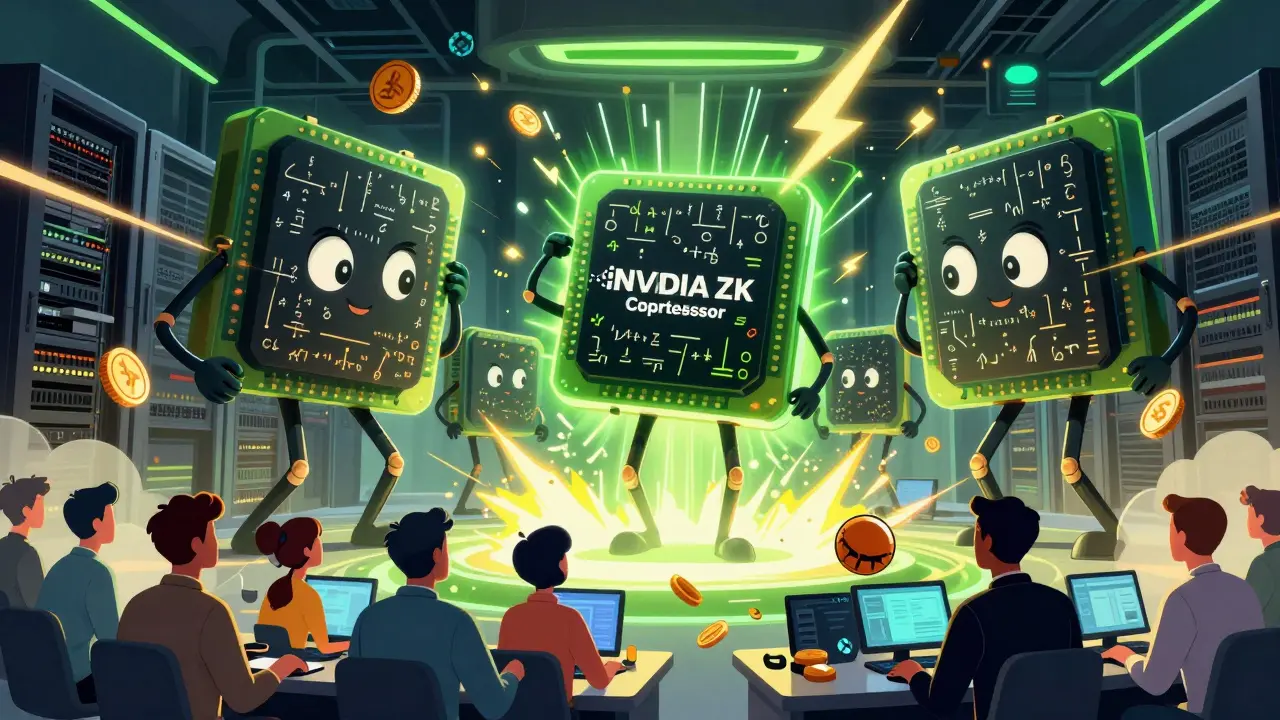
Specialized processors and GPUs are now dedicated to ZK proving. NVIDIA announced the "ZK Coprocessor," shipping in early 2025, which utilizes specialized tensor cores to accelerate proving times by up to 50x. This isn’t just about speed; it’s about cost. Dr. Eli Ben-Sasson, co-founder of StarkWare, projected that hardware acceleration would reduce proving costs below $0.001 per transaction by Q2 2025. When verification becomes cheaper than sending an email, private transactions become economically viable at scale.
This hardware shift allows Layer 2 networks to achieve impressive metrics. zkSync Era processes approximately 2,000 transactions per second (TPS) with finality in about 10 minutes. Starknet handles around 1,500 TPS with 30-minute finality. Both represent a 10-50x improvement over Ethereum’s base layer. We are moving from a world where privacy was expensive and slow to one where it is fast and cheap.
Enterprise Adoption and Regulatory Compliance
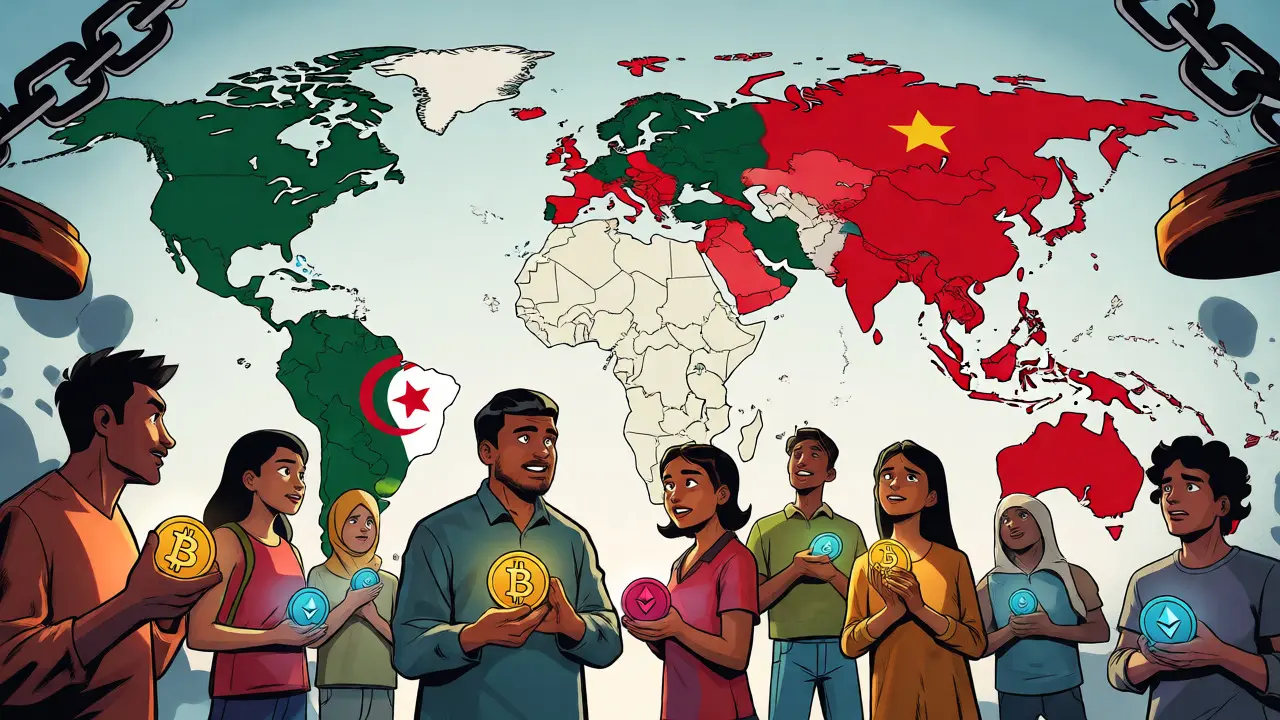
You might think privacy and regulation are enemies. In the context of ZKPs, they are partners. Traditional privacy coins like Monero use ring signatures, which hide everything. Regulators hate that. ZKPs allow for "selective disclosure." You can prove you are compliant without revealing who you are.
This capability attracted institutional giants. BlackRock launched its BUIDL Fund, tokenizing $240 million in US treasuries on Ethereum. They used ZK verification to check investor accreditation without exposing identities. HSBC reduced settlement times for tokenized gold trading by 73% using ZK proofs for confidential price discovery. Even Visa piloted ZK-based auto-payments, reducing verification costs by 87% compared to traditional methods.
Regulatory frameworks are catching up. The EU’s MiCA framework formally recognized ZK-proofs as compliant privacy technology in July 2024. Estonia implemented a nationwide ZK-based voting system in their municipal elections, processing 217,000 private votes with 100% auditability. This proves that ZKPs can satisfy the dual demands of individual privacy and state-level transparency.
The Developer Challenge: A Steep Learning Curve
Despite the benefits, adopting ZK technology is hard. It is not enough to know Solidity. Developers must learn circuit design languages like Circom or Cairo. According to GitHub developer surveys, Solidity developers need 3-6 months of additional training to master these tools. Only 12% of traditional blockchain developers possess the necessary knowledge in finite field arithmetic and elliptic curve cryptography.
The frustration is real. On Reddit’s r/ethdev, developers report spending hundreds of hours debugging single circuits. GitHub issue trackers for frameworks like zkSync’s SE show hundreds of open issues related to compilation errors, with average resolution times exceeding two weeks. Documentation quality varies wildly; while zkSync maintains high completeness, newer projects often lag behind. This talent gap is the primary bottleneck slowing wider adoption. Until tooling becomes more intuitive, ZK development will remain the domain of specialists.
Future Trends: What Comes Next?
Looking ahead to the rest of 2026 and beyond, three trends are shaping the ZK landscape:
- Cross-Chain Privacy Layers: Projects like zkBridge are enabling private asset transfers between disparate networks like Ethereum and Bitcoin. This breaks down silos, allowing liquidity to move securely across ecosystems without exposing transaction details.
- Smartphone-Based Verification: With hardware improvements, generating ZK proofs on mobile devices is becoming feasible. This could enable everyday applications, from private identity verification to secure health records, directly on your phone.
- Integration with AI: McKinsey notes that blockchain infrastructure must evolve to handle compute-intensive workloads from both ZK proofs and generative AI. We may see ZKPs used to verify AI outputs or ensure data integrity in machine learning models without exposing proprietary datasets.
Vitalik Buterin, Ethereum’s co-founder, has called ZK-proofs the "single most important cryptographic primitive for scaling Ethereum." He predicts a 100x improvement in proving performance by the end of 2025. If this holds true, ZKPs will cease to be a separate layer and become the standard architecture for 70% of blockchain applications by 2027.
Risks and Vulnerabilities
It is not all smooth sailing. The complexity of ZK implementations creates hidden attack vectors. Dr. Matthew Green from Johns Hopkins University warned that 63% of audited ZK circuits contain at least one critical vulnerability, particularly in custom circuit designs. Security audits are crucial but expensive. Furthermore, while ZKPs excel in regulated finance, they underperform in high-frequency trading scenarios requiring sub-second latency. Centralized exchanges still offer microsecond execution times, whereas ZK-verified transactions have a minimum processing window of 2-5 seconds.
Energy efficiency is another concern. While better than Proof-of-Work, generating ZK proofs is energy-intensive. McKinsey cautions that unless energy efficiency improves by 90%, scaling challenges could delay mass adoption. The industry is watching hardware advancements closely to see if they can meet these sustainability goals.
Conclusion
Zero-knowledge technology is transitioning from a niche cryptographic tool to essential digital infrastructure. It solves the trilemma of privacy, scalability, and compliance. While developer hurdles and security risks remain, the trajectory is clear. With hardware acceleration driving down costs and regulatory bodies embracing selective disclosure, ZKPs are poised to redefine how we interact with digital systems. The future is not just transparent; it is privately verifiable.
What is the main difference between zk-SNARKs and zk-STARKs?
The main difference lies in trust assumptions and proof size. zk-SNARKs require a trusted setup phase but produce very small proofs (~200 bytes), making them efficient for blockchains. zk-STARKs do not require a trusted setup (they are transparent) and are quantum-resistant, but they generate larger proofs (~45 KB), which can increase storage and verification costs.
Why are Zero-Knowledge Proofs important for blockchain scalability?
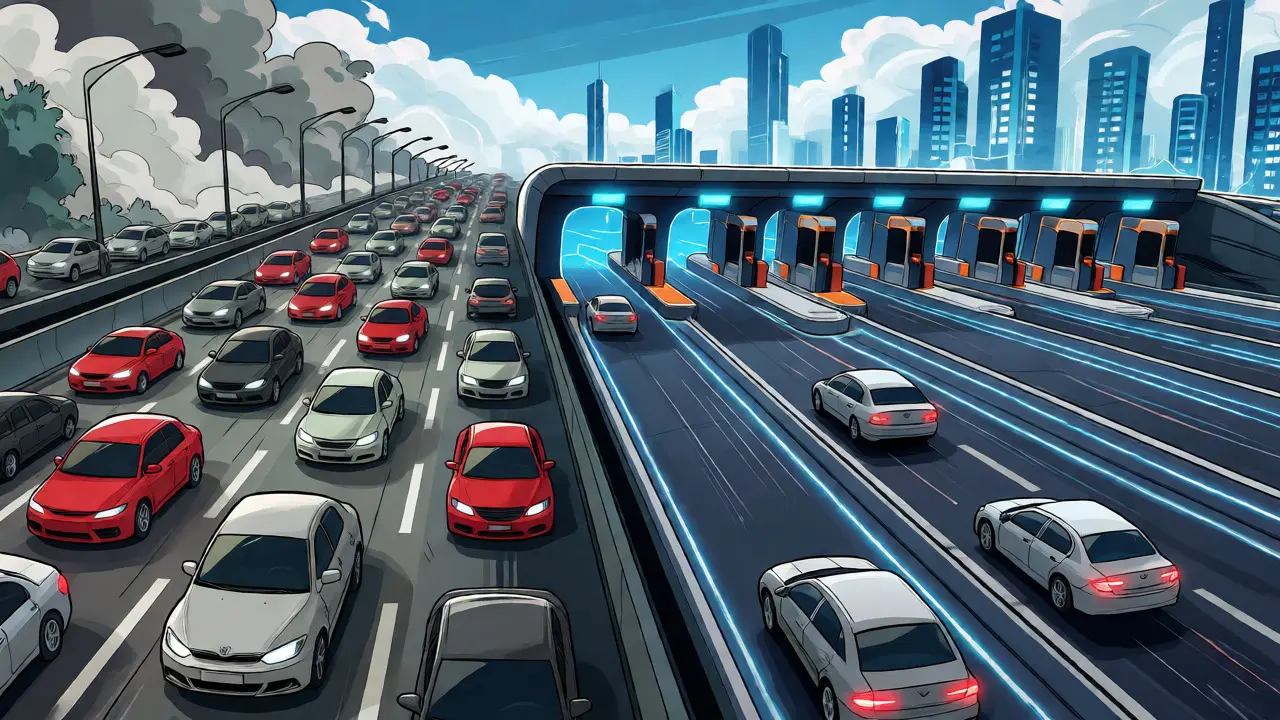
ZKPs enable ZK-rollups, which bundle thousands of transactions off-chain into a single cryptographic proof. This proof is then verified on-chain. This reduces the data load on the main blockchain by up to 90% compared to optimistic rollups, allowing networks like Ethereum to process significantly more transactions per second without compromising security.
Can Zero-Knowledge Technology be used outside of cryptocurrency?
Yes. ZKPs are being adopted in healthcare for private medical records, in supply chain for verifying authenticity without revealing supplier data, and in government for secure voting systems. Estonia’s 2024 municipal elections used ZK-based voting to ensure privacy and auditability simultaneously.
What are the biggest challenges facing ZK adoption today?
The primary challenges are the steep learning curve for developers, the high computational cost of generating proofs, and security vulnerabilities in complex circuit designs. Additionally, there is a shortage of developers skilled in finite field arithmetic and elliptic curve cryptography, which are essential for building ZK applications.
How does hardware acceleration impact ZK technology?
Hardware acceleration, such as NVIDIA’s ZK Coprocessors, drastically reduces the time and cost required to generate proofs. By utilizing specialized tensor cores, proving times can drop from minutes to seconds, and costs can fall below $0.001 per transaction. This makes ZK solutions economically viable for high-volume, everyday applications.
Is Zero-Knowledge Technology quantum-resistant?
It depends on the type. zk-STARKs are considered quantum-resistant because they rely on hash functions rather than elliptic curve cryptography. zk-SNARKs, however, are generally not quantum-resistant. As quantum computing advances, the industry is shifting towards STARKs or hybrid approaches to ensure long-term security.