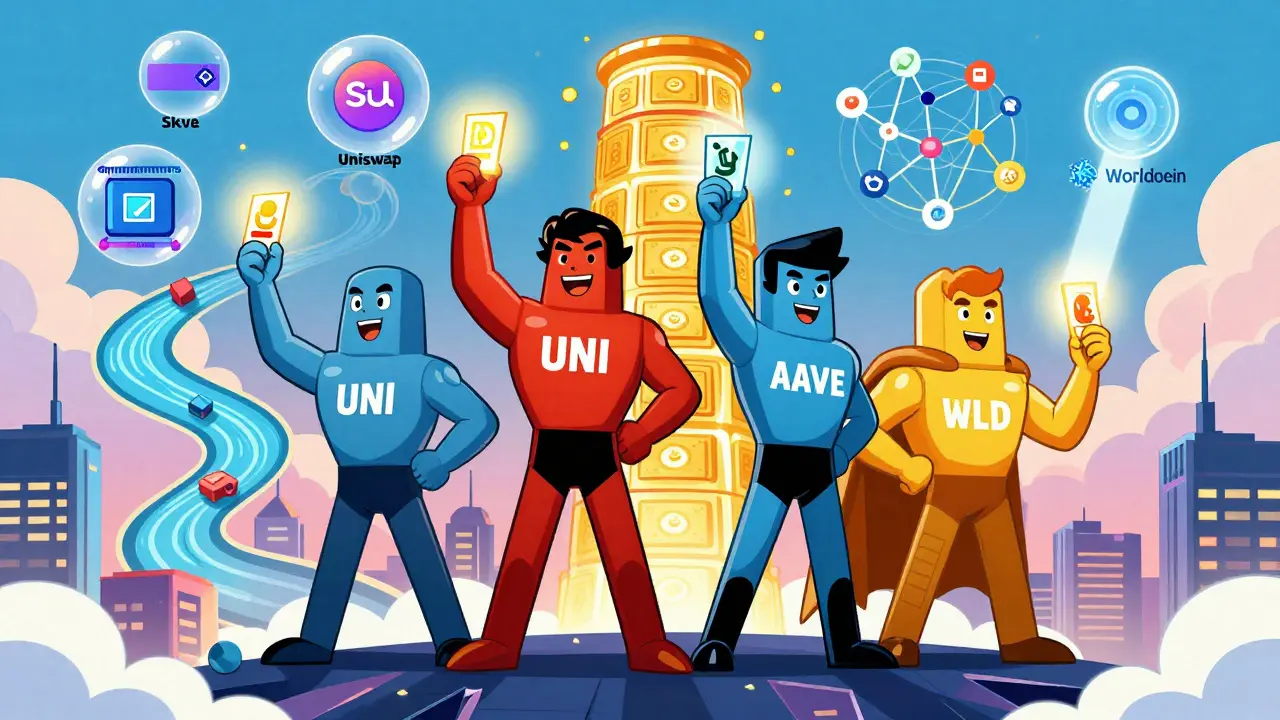
When you hold a governance token, you’re not just holding a cryptocurrency-you’re holding a vote. These tokens give you a say in how decentralized protocols run, from changing fees to adding new features or even shutting down risky parts of a system. Unlike regular coins that just store value, governance tokens are the backbone of true decentralization. As of March 2026, a few tokens dominate this space by market cap, and understanding who’s leading-and why-can help you see where real power lies in DeFi.
Who’s on Top? The Big Four Governance Tokens
The top four governance tokens by market capitalization right now are Uniswap (UNI), Aave (AAVE), Sky (SKY), and Worldcoin (WLD). Together, they account for over half of the total value locked in all governance systems. Uniswap leads with a $2.44 billion market cap. That’s not just because it’s the largest decentralized exchange. It’s because every decision about how Uniswap works-from trading fees to how liquidity providers are rewarded-is voted on by UNI holders. There are 634 million UNI tokens circulating, and each one equals one vote.Aave sits at $1.71 billion. Its token, AAVE, controls everything on its lending protocol: which assets can be borrowed, what collateral ratios are allowed, and even how the protocol’s treasury is spent. With only 3.11 million tokens in circulation, each AAVE holds serious weight. A single vote can shift risk parameters for millions in loans.
Sky (SKY) and Worldcoin (WLD) are newer but fast-growing. Sky, at $1.65 billion, is built around a decentralized identity and reputation layer that feeds into DeFi protocols. Its token lets holders vote on data pricing, access rules, and integration with other chains. Worldcoin, at $1.12 billion, is more controversial. It’s tied to a global identity project using iris scans, and its governance token decides how funds from the Worldcoin Treasury are used-whether for education, crypto access, or AI development.
How These Tokens Actually Work
Not all governance tokens are built the same. Some are designed to be democratic. Others are engineered to last.Uniswap gives out 60% of its tokens to the community over time. That means early users, liquidity providers, and developers all get a share. The rest is reserved for long-term incentives. This design encourages broad participation. You don’t need to be a whale to influence Uniswap’s future.
Aave is different. It has a fixed supply of 16 million tokens. No new ones are created. That makes AAVE scarcer, which helps preserve value. But it also means voting power is more concentrated among early adopters and large holders.
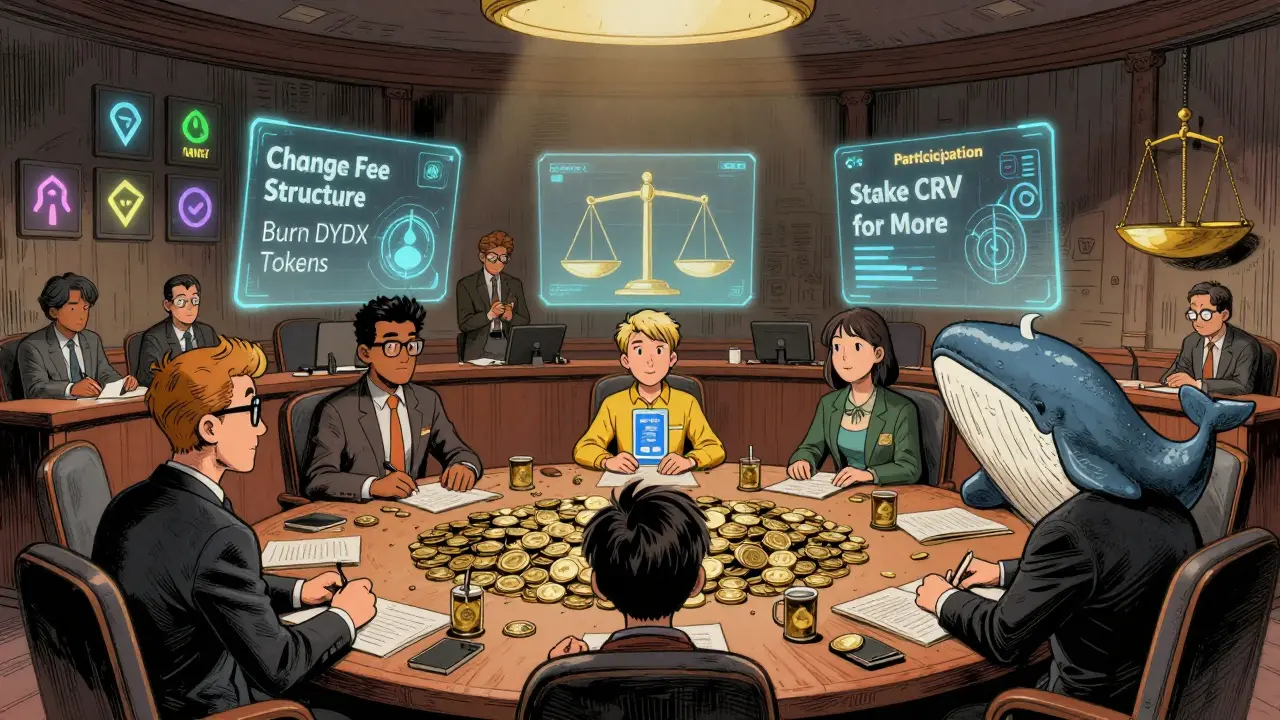
Curve DAO Token (CRV), at $359 million, uses a different trick. It doesn’t just let you vote. It lets you stake your CRV to earn more CRV over time. This creates a feedback loop: the more you hold and lock up, the more influence you gain. It’s a way to reward long-term commitment.
Then there’s DYDX. It’s one of the few governance tokens that burns tokens to reduce supply. Every time a trader pays a fee on the DYDX exchange, part of that fee buys back and destroys DYDX tokens. That’s a deflationary model. It’s not just about voting-it’s about making the token itself more valuable over time.
Market Activity and Real-World Usage
Market cap tells you how much people think these tokens are worth. But trading volume tells you how much they’re actually being used.Uniswap’s 24-hour trading volume hit $233 million. That’s not just people buying and selling UNI-it’s people trading ETH, USDC, and other assets through the protocol. Every trade adds to the ecosystem’s strength.
Aave’s volume was even higher at $347 million. That’s because Aave is used heavily for borrowing and lending. People use it to get loans without a bank, or to earn interest on their crypto. The fact that AAVE trades so heavily means its governance is active and valued.
Worldcoin’s volume is lower, but its user base is massive. Over 290 million WLD tokens are in circulation, mostly held by people who signed up through its physical identity kiosks. Most aren’t trading them-they’re waiting to see if Worldcoin becomes a global identity layer. That’s a long-term bet.
Price movements tell a story too. UNI is trading at $3.85, up 2.76% in the last week. AAVE is at $111.53, barely moved. SKY jumped 6.61% in a week, showing strong momentum. These numbers aren’t random. They reflect real shifts in community sentiment and protocol updates.
The Hidden Players: Smaller Tokens With Big Ideas
While the big four grab headlines, some smaller governance tokens are quietly building the future.Maker (MKR) doesn’t have the biggest market cap anymore, but it’s still critical. It’s the backbone of DAI, the most widely used stablecoin. MKR holders vote on everything from collateral types to stability fees. If DAI’s price slips, MKR is burned to reduce supply and stabilize it. It’s a self-correcting system.
ENS (Ethereum Name Service) at $224 million lets you own a human-readable address like yourname.eth. Its governance token decides how domain prices are set, who gets priority, and how revenue is distributed. It’s not flashy, but it’s essential infrastructure.
ZKsync (ZK) at $175 million is a layer-2 scaling solution. Its governance token lets holders vote on fee structures, upgrade paths, and integration with other chains. As Ethereum gets more crowded, ZKsync’s role grows-and so does the importance of its token.
Then there’s SushiSwap (SUSHI), PancakeSwap (CAKE), and Balancer (BAL). They all have different models. SUSHI has unlimited supply and focuses on staking rewards. CAKE adds lotteries and games to governance. BAL lets you vote on how liquidity is distributed across pools. None are top-tier by market cap, but they show how governance can be tailored to different use cases.
What Makes a Governance Token Successful?
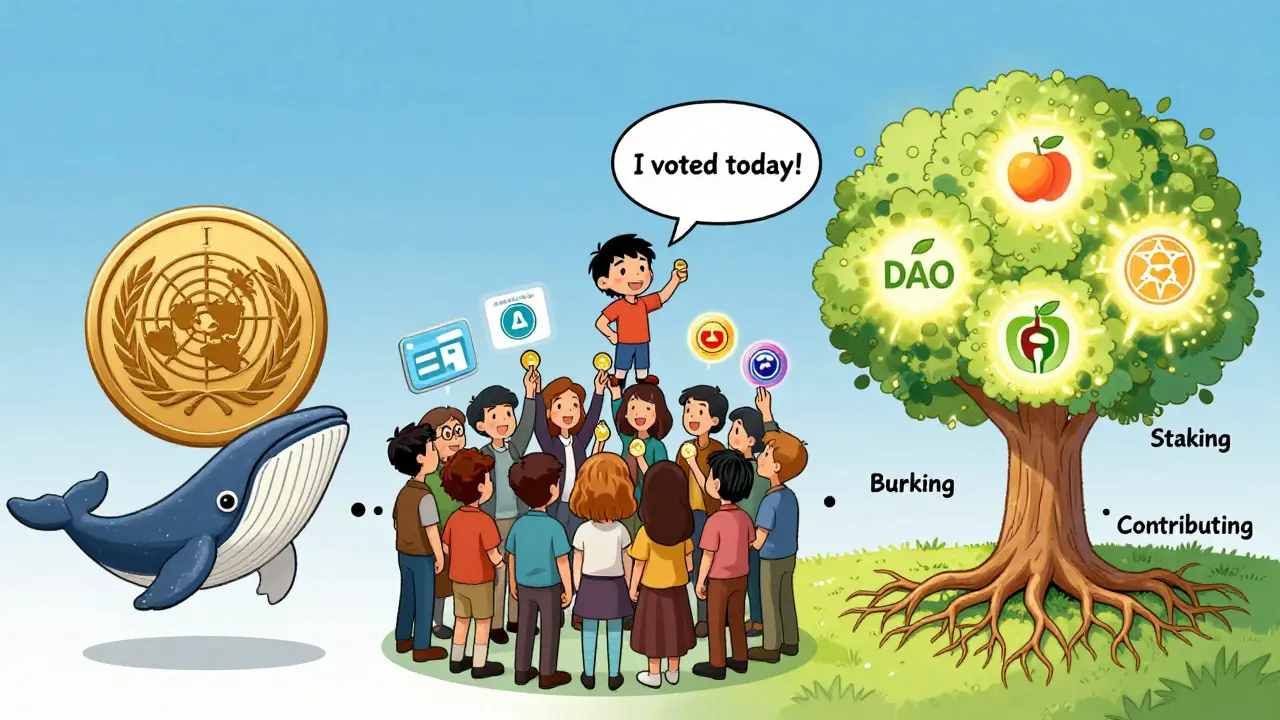
Not every token that claims to be “governance” actually works. The best ones share three traits:- Clear purpose: UNI votes on DEX fees. AAVE votes on loan rules. If you can’t explain what the token governs in one sentence, it’s probably weak.
- Active participation: If less than 5% of holders vote on proposals, the system is broken. Uniswap sees 15-20% participation. That’s healthy.
- Real economic alignment: Tokens should tie voting power to real value. DYDX burns tokens to increase scarcity. Curve rewards stakers. Maker uses burning to stabilize DAI. These aren’t just votes-they’re economic incentives.
On the flip side, tokens with no burning, no staking, no fee sharing, or no clear use case are just speculative assets. They might spike on hype, but they don’t last.
What’s Next for Governance Tokens?
The next wave isn’t just about more tokens. It’s about better governance.Projects like API3 are building governance that ties voting to real-world risk. API3 holders stake their tokens to back oracle data feeds. If the data is wrong, they lose money. That means voters have skin in the game.
Radworks (formerly Radicle) is leading in developer activity. Its governance model lets contributors earn tokens based on code contributions, not just token holdings. That’s a shift from “who has the most money” to “who does the most work.”
And then there’s the rise of hybrid models. Some protocols now combine on-chain voting with off-chain forums, AI-assisted proposal filtering, and reputation scores. The goal? To make governance faster, fairer, and less dominated by whales.
By 2026, governance isn’t a buzzword anymore. It’s the standard. And the tokens that survive aren’t the ones with the biggest market cap-they’re the ones that actually let people shape the future.
What exactly do governance tokens do?
Governance tokens let holders vote on key decisions for a decentralized protocol. This includes things like changing trading fees, adding new assets, adjusting risk settings, or allocating treasury funds. They turn users into stakeholders who have real control over the system, not just passive holders.
Are governance tokens a good investment?
Not necessarily. Many governance tokens are tied to volatile protocols and can lose value if usage drops. Their value comes from active participation and protocol success-not speculation. If you believe in a project’s long-term vision and want to help guide it, holding governance tokens makes sense. If you’re just looking to flip them, you’re likely to lose money.
Can I vote without holding a lot of tokens?
Yes, but your vote carries less weight. Most systems use one-token-one-vote. So if you hold 10 tokens, you get 10 votes. If someone holds 100,000, they get 100,000 votes. That’s why large holders often dominate. Some newer protocols are testing weighted voting based on time held or contribution history to reduce whale influence.
Why do some governance tokens have unlimited supply?
Unlimited supply is often used to reward ongoing participation. Projects like SushiSwap or PancakeSwap issue new tokens to liquidity providers and stakers to keep them engaged. It’s a way to incentivize long-term use, but it can also dilute value over time. It’s a trade-off between growth and scarcity.
How do I start voting with my governance tokens?
First, make sure your tokens are in a wallet that supports governance (like MetaMask). Then visit the project’s official governance portal-usually a website like vote.uniswap.org or governance.aave.com. Connect your wallet, check active proposals, and cast your vote. Always double-check the URL. Scammers often create fake voting sites.
Sharon Tuck
March 8, 2026 AT 21:52Really appreciate this breakdown-it’s rare to see governance tokens explained without hype. I’ve been holding UNI and AAVE for a while now, not because I think they’ll moon, but because I actually like having a say in how these protocols evolve. It feels like being part of a digital town meeting, you know? Not perfect, but way better than centralized apps.
Sherry Kirkham
March 9, 2026 AT 20:59Uniswap’s 60% community distribution is the only sane model here. Everything else is just wealth concentration with a DAO sticker. AAVE’s fixed supply? Cute. But it’s a plutocracy with a blockchain overlay. Real governance isn’t about who owns the most tokens-it’s about who’s building, testing, and maintaining the system.
Jonathan Chretien
March 11, 2026 AT 09:25Honestly? I’m more excited about Worldcoin than UNI. Think about it-290 million people with iris scans and a token? That’s not DeFi. That’s the foundation of a new social layer. The governance here isn’t just about fees-it’s about identity, access, equity. This could be bigger than Bitcoin.
Christina Young
March 12, 2026 AT 19:31Uniswap leads because it’s the most liquid. Aave because it’s the most used. Sky and Worldcoin? They’re vaporware with marketing budgets. Don’t confuse market cap with utility. Most of these tokens are just lottery tickets for degens.
prasanna tripathy
March 14, 2026 AT 16:13Love how you mentioned Maker. It’s quiet, but it’s the backbone. DAI is everywhere. If MKR fails, the whole stablecoin ecosystem shudders. People forget that governance isn’t flashy-it’s the plumbing. And plumbing doesn’t get likes.
Jennifer Pilot
March 15, 2026 AT 13:06It is, however, profoundly disconcerting, that we are now, in 2026, entrusting the future of financial infrastructure… to… *token holders*? Who, let us be candid, are often anonymous, unaccountable, and frequently, utterly unqualified. The very notion that a single vote-equivalent to a single token-is somehow democratic, is, frankly, laughable. The system is rigged by capital. And yet… we pretend otherwise.
Olivia Parsons
March 16, 2026 AT 02:29How do you even check if a proposal passed? I tried voting on Curve last month and got lost in three different websites. The UX is a mess. If governance is supposed to be for everyone, why does it feel like hacking a nuclear code?
James Burke
March 17, 2026 AT 04:08Exactly. And that’s why I’m into ZKsync and ENS. They’re simple. One vote. One proposal. No jargon. No 50-page whitepapers. If you can’t explain it in a tweet, it’s not governance-it’s theater.
Bill Pommier
March 19, 2026 AT 00:53It is imperative to note, with unequivocal clarity, that the current governance paradigm is not merely flawed-it is structurally corrupt. The illusion of decentralization is maintained by incentivizing participation through token emissions, which systematically dilutes value while concentrating power among early investors. This is not democracy. This is feudalism with smart contracts. The entire model must be re-engineered, or it will collapse under its own contradictions.