
When you hear about blockchain, you think of Bitcoin, Ethereum, or smart contracts. But none of that works without something quieter, less talked about, and just as essential: nodes. Running a node isn’t just for tech enthusiasts or miners. It’s the literal foundation of why blockchain stays decentralized, secure, and free from control by any single company or government.
What a Blockchain Node Actually Does
A blockchain node is just a computer - your laptop, a Raspberry Pi, or a server - that runs software to participate in a blockchain network. It doesn’t need to be fancy. What it does matter: it stores a full copy of the entire blockchain ledger. Every transaction ever made on Bitcoin or Ethereum is saved there, in order, from the very first block to the latest one.Think of it like this: if the blockchain is a public ledger, each node is a librarian who keeps a complete, identical copy of every page. When someone tries to add a new transaction - say, sending 0.5 BTC from Alice to Bob - the node checks it. Did Alice really have that money? Is the signature valid? Is this transaction already spent? If everything checks out, the node spreads the word to other nodes. If even one node says no, the transaction gets rejected.
This isn’t magic. It’s math and rules. Every node follows the same protocol. No central authority tells them what to do. They just agree, through code, on what’s valid. That’s how trust is built without trust.
Why Decentralization Isn’t Just a Buzzword
Decentralization sounds nice, but what does it actually mean in practice? It means no single point of failure. In a bank’s system, if their central server goes down, your money disappears from view. If a company like Visa gets hacked, millions of transactions are at risk.With blockchain, there’s no central server. There are thousands of nodes - over 15,000 for Bitcoin alone - spread across continents, homes, and data centers. If one node shuts off, the network keeps going. If ten go down, still fine. Even if a hundred go offline, the rest keep the ledger alive.
This is why blockchain networks survive attacks. Hackers can’t just break into one server and steal everything. To change the blockchain, they’d need to control more than half of all active nodes at once. That’s called a 51% attack. In practice, it’s nearly impossible on large networks because of the cost, coordination, and sheer number of machines involved.
Security Through Redundancy
Every time a transaction is confirmed, it’s verified by multiple nodes independently. That’s not just backup - it’s active defense. Each node checks the math, the signatures, the history. If one node is lying or corrupted, the others see it and ignore it.Compare that to a traditional database. A company like Amazon or Google stores your data in one place. If that system is breached, your data is gone. With blockchain, your transaction history is copied hundreds of times across the globe. You don’t need to trust Amazon. You just need to trust the math.
Cryptographic signatures make sure only the rightful owner can spend their coins. Nodes verify those signatures without knowing who you are. Your identity stays hidden. Your transaction history? Public. Tamper-proof. Permanent.
Nodes Keep the Network Honest
Consensus mechanisms - like Proof of Work (Bitcoin) or Proof of Stake (Ethereum) - are how nodes agree on what’s true. But those mechanisms only work if there are enough independent nodes.Imagine if only five companies ran all the nodes on Bitcoin. They could collude. They could change the rules. They could block certain transactions. That’s not decentralization. That’s just a private network with a fancy name.
But when thousands of people - from a student in Nairobi to a small business owner in Poland - run their own nodes, no one group can take over. The network becomes resilient because it’s diverse. Different locations. Different motivations. Different hardware. That’s what makes it strong.

Who Gets to Decide What Happens Next?
Blockchains don’t just store data - they evolve. Upgrades happen. Rules change. New features get added. But who decides?In centralized systems, it’s the CEO. In Bitcoin, it’s the node operators. When a proposal for a protocol upgrade comes up - like increasing block size or changing how fees work - nodes vote by choosing which version of the software to run. If most nodes upgrade, the network moves forward. If they don’t, the change dies.
This is where things get powerful. Networks like Dash and Decred let node operators vote on funding proposals. Masternodes in Dash can approve budgets for marketing, development, or outreach. In MakerDAO, holders of MKR tokens run nodes that vote on interest rates, collateral rules, and even which assets get accepted into the system.
No boardroom. No CEO. Just code and consensus. That’s governance by participation.
Why Economic Incentives Matter
Running a node isn’t free. It costs electricity. It needs bandwidth. It needs storage. So why do people do it?Because they get paid. In Bitcoin, miners (a type of node) earn new BTC and transaction fees. In Ethereum, stakers earn ETH for validating blocks. In networks like Solana or Polygon, node operators earn rewards just for staying online and helping the network run smoothly.
These aren’t just bonuses. They’re economic engines. They turn passive users into active participants. When you earn rewards for running a node, you have skin in the game. You’re not just using the network - you’re defending it. That alignment between personal incentive and network health is what keeps the system alive long-term.
Censorship Resistance in Action
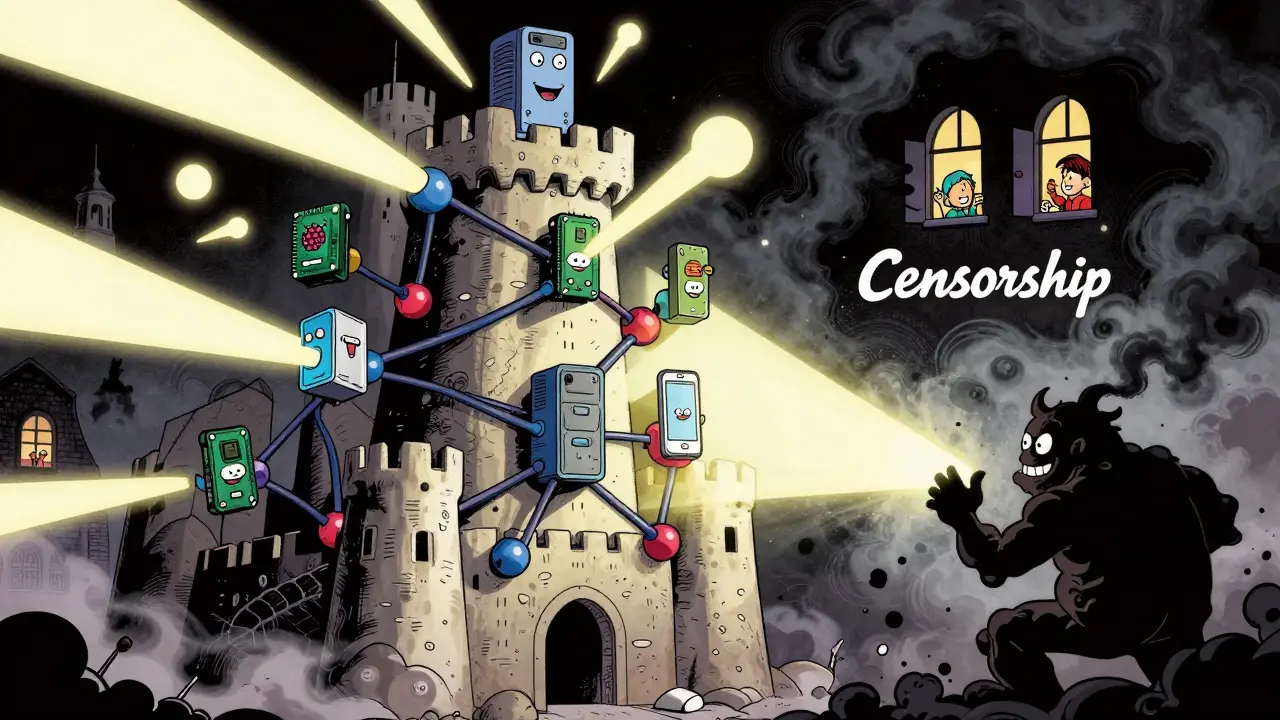
In countries where governments block access to financial services, social media, or news, blockchain nodes become lifelines. If a bank freezes your account, you’re stuck. If a government shuts down a website, you lose access.But if you have a node, you don’t need permission. You can send money. You can store data. You can access information - all without asking anyone. That’s censorship resistance.
It’s not theoretical. In Venezuela, Iran, and Ukraine, people have used Bitcoin nodes to bypass capital controls and receive aid. In places where banks refuse to serve certain users, decentralized networks offer an alternative. Nodes make that possible.
No Middlemen, No Delays
Traditional finance runs on intermediaries: banks, clearinghouses, payment processors. Each one adds cost, delay, and risk. A wire transfer takes days. A cross-border payment can cost 10% in fees.Blockchain removes them. Nodes talk directly to each other. A transaction goes from sender to receiver in minutes, verified by dozens of independent machines. No bank approval. No middleman fee. Just peer-to-peer value transfer.
That’s why supply chains, insurance, and even voting systems are testing blockchain. They don’t need a central authority to verify a shipment or a ballot. They just need nodes to confirm it.
Decentralized Identity Starts With Nodes
Your identity - your name, birthdate, passport - is usually held by governments, banks, or tech companies. If they lose it, leak it, or lock you out, you’re stuck.Decentralized identity flips that. You hold your own data. You control who sees it. Nodes store encrypted proofs of your identity, not the data itself. When you need to prove you’re over 18, you don’t send your passport. You send a cryptographic proof verified by a node network.
This system only works if enough nodes are running. If only a few exist, they can be controlled. If hundreds do, your identity stays yours.
The Future Is in Your Hands
Running a node used to require a powerful machine and technical know-how. Today? You can run a Bitcoin node on a $50 Raspberry Pi. Ethereum has lightweight clients that sync in hours, not days. Tools are getting easier. Costs are falling.And the demand is rising. More institutions - universities, hedge funds, even governments - are running their own nodes. Not because they have to. But because they want control. Security. Independence.
Every node you run adds another layer of defense. Another voice in the consensus. Another barrier against centralization. It’s not about mining or making money. It’s about ownership. The blockchain doesn’t belong to a company. It belongs to the people who run the nodes.
If you care about open systems, financial freedom, or resistance to control - running a node isn’t optional. It’s how you help keep the system alive.
Do I need a powerful computer to run a blockchain node?
Not anymore. For Bitcoin, you can run a full node on a Raspberry Pi 4 with 8GB of RAM and a 2TB SSD. Ethereum offers light clients that sync quickly and use minimal resources. The main requirements are stable internet, consistent power, and a little patience. You don’t need a gaming rig.
Can I get paid for running a node?
Yes, but it depends on the network. Bitcoin miners earn rewards, but regular full nodes don’t. Ethereum stakers earn ETH by locking up 32 ETH. Networks like Dash, Decred, and Polkadot pay node operators directly for running masternodes or validators. The reward isn’t always cash - sometimes it’s influence, voting rights, or network security.
What’s the difference between a full node and a light node?
A full node downloads and verifies the entire blockchain history - about 500GB for Bitcoin and growing. It doesn’t trust anyone. A light node only downloads block headers and asks other nodes for transaction details. It’s faster and uses less space but relies on others for verification. Full nodes strengthen the network. Light nodes are convenient for mobile use.
Does running a node make me anonymous?
Running a node doesn’t hide your IP address. Anyone on the network can see you’re a node operator. But your transactions aren’t linked to your identity unless you reveal it. Use Tor or a VPN if you want to hide your location. The node itself doesn’t track who you are - just what transactions are valid.
What happens if I stop running my node?
The network keeps going. Your personal copy of the ledger won’t update, but that doesn’t break anything. The blockchain doesn’t depend on any single node. However, when you stop, you lose the benefits: you can’t verify transactions independently, you lose voting rights (if applicable), and you’re no longer helping the network stay decentralized. It’s like stepping off the team - the game still plays, but you’re not part of it anymore.


Jesse Pals
March 15, 2026 AT 20:10Running a node is like being a volunteer firefighter for the internet 🚒🔥
No one’s paying you, no one’s thanking you, but when the whole system catches fire, you’re the one standing there with the hose.
My Raspberry Pi hums away like a sleepy dragon, and I feel like a digital knight.
It’s not about the rewards-it’s about knowing that if the banks crash, the servers go dark, or some CEO decides to delete your money-you still got your own copy of the truth.
And yeah, I’ve got a 2TB SSD just for Bitcoin. Worth every penny.
Decentralization isn’t a feature-it’s a lifestyle. 🤝
Tobias Wriedt
March 17, 2026 AT 04:32People think blockchain is about crypto wealth. Nah. It’s about refusing to be lied to. 🤬
You run a node because you don’t trust anyone-not governments, not corporations, not even your damn bank.
If you’re not running one, you’re just a tourist in someone else’s system.
And if you’re still using Coinbase as your ‘wallet’? You’re not even in the game. You’re in the lobby. 😒
Ann Liu
March 18, 2026 AT 01:23There’s a common misconception that light nodes are sufficient for security. They’re not. Light nodes rely on full nodes for validation-they’re essentially trust-minimized clients, not trustless participants.
Only full nodes verify every transaction against the entire blockchain history, ensuring consensus integrity.
Without sufficient full nodes, the network becomes vulnerable to selective dissemination attacks, where malicious actors feed false data to light clients.
Running a full node isn’t just technical-it’s an act of cryptographic sovereignty.
It’s also the only way to guarantee you’re not being fed lies by a compromised relay.
Katrina Smith
March 18, 2026 AT 12:40Oh cool so now I’m a revolutionary for having a pi running? 🙄
My node has been offline for 3 weeks because I forgot to pay the electricity bill.
Did the world end? No.
Did anyone notice? Also no.
Maybe decentralization is just a really expensive way to feel smart while your router blinks.
Diane Overwise
March 18, 2026 AT 14:57Y’all are missing the real magic here.
Running a node isn’t about tech-it’s about identity.
It’s the quiet rebellion of a mom in Ohio who refuses to let Big Finance decide what her kids can buy.
It’s the student in Lagos who sends crypto to his sister instead of using Western Union’s 20% fee.
It’s the grandpa in Berlin who still believes in privacy because he lived through the Stasi.
Nodes aren’t servers-they’re tiny acts of defiance.
And honestly? I’m proud of every one of you doing it.
Keep going. We’re building something beautiful. 💙
Graham Smith
March 20, 2026 AT 12:09Let’s be precise: the economic incentives are misaligned. Most full node operators receive zero direct compensation, which creates a classic free-rider problem in distributed systems.
Meanwhile, validators in PoS ecosystems are being subsidized at scale, creating a new class of rentiers who centralize stake.
The notion that ‘anyone can run a node’ is a neoliberal fantasy-hardware, bandwidth, and uptime are nontrivial barriers.
True decentralization requires not just technical access but structural equity in resource allocation.
Otherwise, we’re just re-creating oligarchic governance under a new cryptographic veneer.
Jerry Panson
March 21, 2026 AT 09:19I appreciate the passion here, but I must respectfully challenge the assumption that node count alone ensures decentralization.
Geographic diversity matters. Hardware diversity matters. Operational independence matters.
Recent studies show over 60% of Bitcoin full nodes are hosted on cloud providers-primarily AWS and Google Cloud.
That’s not decentralization. That’s concentrated infrastructure.
True resilience requires nodes on home networks, in rural areas, on solar-powered systems-not just VMs in data centers.
So while running a node is commendable, we must also ask: where are they physically located? And who controls their hosting?
Dionne van Diepenbeek
March 22, 2026 AT 01:43My node is running on a laptop I bought used for $80
It’s been up for 472 days
I don’t even know how to check the logs
I just leave it on
And I feel like I’m doing something
So yeah
Do it