
It’s July 2026, and the Arbitrum ecosystem has grown into a bustling hub of decentralized finance. You’ve probably heard of Uniswap or Camelot, but what about ArbSwap? It’s one of the older native DEXs on the network, having paused operations in 2024 and relaunched in early 2025 with promises of better security and lower fees. But does it actually work for you today?
The short answer is: maybe, but be careful. ArbSwap isn’t your go-to for swapping large amounts of ETH or USDC. It’s a niche player that struggles with thin liquidity outside its top few pairs. If you’re looking to trade obscure Arbitrum-native tokens that aren’t listed elsewhere, it might have some value. For everyone else, you’ll likely find better prices and deeper pools on bigger platforms.
What Exactly Is ArbSwap?
ArbSwap is a decentralized exchange (DEX) built specifically for the Arbitrum One Layer 2 network. Unlike aggregators like 1inch or multi-chain giants like Uniswap, ArbSwap focuses exclusively on assets native to Arbitrum. It uses an Automated Market Maker (AMM) model, meaning there are no order books-just liquidity pools where traders swap tokens directly against smart contracts.
Founded by an anonymous team, the platform went through a significant overhaul in 2025. After pausing during 2024, they relaunched with version 2.1, boasting faster execution times and a cleaner interface. The core idea behind ArbSwap was to solve a specific problem: many small Arbitrum projects couldn’t get listed on major DEXs because their tokens weren’t popular enough. ArbSwap aimed to fill that gap by providing dedicated liquidity for these "orphaned" tokens.
However, being a specialist comes with trade-offs. While Uniswap V3 dominates the market with over $1 billion in Total Value Locked (TVL), ArbSwap sits much lower, hovering around $47 million in TVL as of early 2025 data. That difference matters when you’re trying to move money without losing value to slippage.
The Good: Speed, UI, and Low Fees
If we’re giving credit where it’s due, ArbSwap has improved its technical performance significantly since its relaunch. Here’s what works well:
- Fast Execution: Swaps now take an average of 1.2 seconds, down from nearly 4 seconds in previous versions. On a fast network like Arbitrum, this feels instant.
- Cheap Gas Fees: Because it’s on Arbitrum One, transaction costs remain incredibly low-usually under $0.02 per swap, even during busy periods.
- Better Interface: The v2.1 update added real-time TradingView charts directly into the swap widget. No more jumping between tabs to check price action before executing a trade.
- Simple Setup: You just need an Ethereum-compatible wallet like MetaMask or Trust Wallet. There are no minimum deposit requirements, making it easy for beginners to dip their toes in.
For someone swapping a small amount of stablecoins or checking out a new token launch, the experience is smooth. The friction points that plagued older DEXs-like confusing routing or high gas spikes-are largely absent here.
The Bad: Thin Liquidity and High Slippage
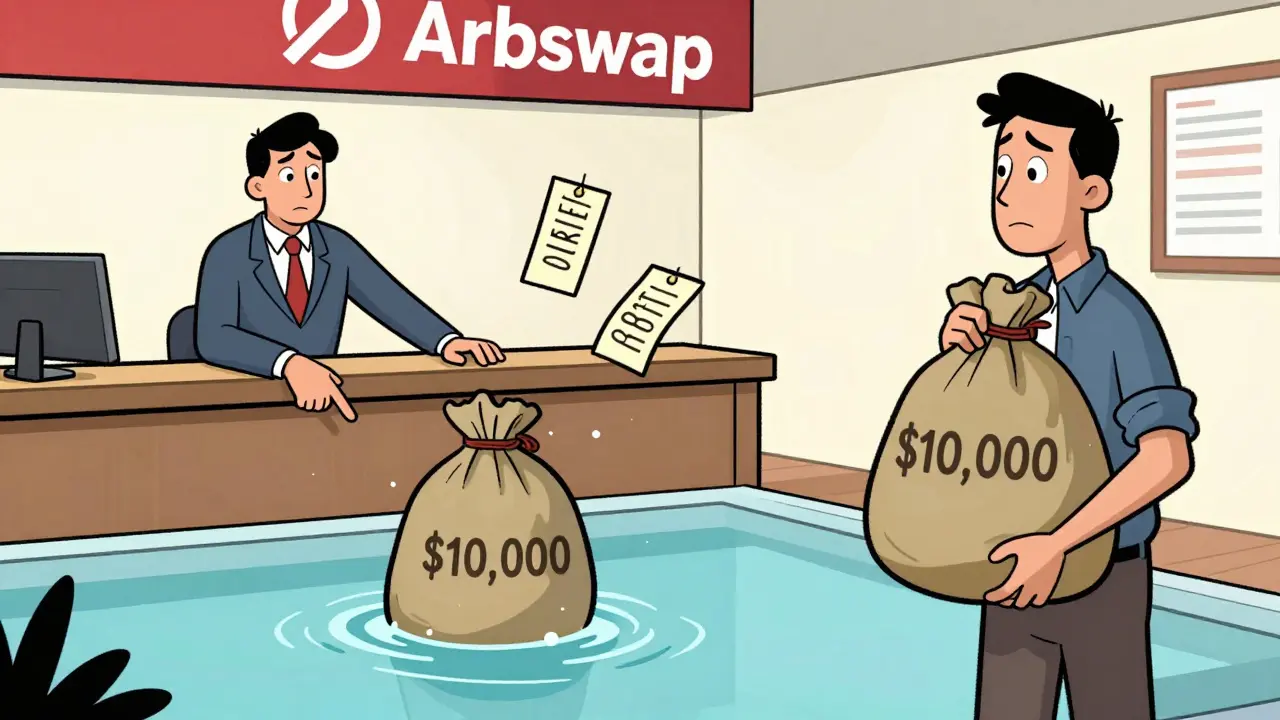
Here’s the catch that keeps most experienced traders away: liquidity concentration. According to analyses from early 2025, roughly 97% of ArbSwap’s liquidity is locked up in just five major pairs: ETH/USDC, ETH/USDT, WBTC/USDC, ARB/USDC, and GMX/USDC.
Why does this matter? Imagine you want to swap $10,000 worth of a smaller token, say RDNT (Radiant Capital). On Uniswap, you’d get a fair price because millions of dollars sit in those pools waiting for trades. On ArbSwap, if that pair only has $50,000 in total liquidity, your $10,000 trade represents 20% of the entire pool. The math doesn’t work out in your favor.
| Feature | ArbSwap | Uniswap V3 | Camelot DEX |
|---|---|---|---|
| Total Value Locked (TVL) | ~$47.8 Million | ~$1.24 Billion | ~$150 Million+ |
| Token Selection | 147+ (Niche focus) | 1,200+ (Broad) | 500+ (Mid-range) |
| Avg. Swap Fee | 0.3% | 0.05% - 1% | Variable |
| Liquidity Depth | Low (High slippage risk) | Very High | Medium-High |
| Best For | Niche/Small caps | All traders | Pro traders/Market makers |
User reviews back this up. On Reddit and Trustpilot, common complaints involve failed transactions during volatile moments or unexpected slippage. One user reported losing 4.7% in value on a $1,000 swap simply because the pool was too shallow to handle the order size. If you’re trading anything beyond the top 10 pairs, expect to pay a hidden tax in the form of price impact.
Who Should Actually Use ArbSwap?
Not every tool is for every job. ArbSwap isn’t trying to beat Uniswap at its own game; it’s trying to serve a different crowd. Here’s who might benefit:
- Holders of Obscure Tokens: If you hold a governance token for a small Arbitrum project that isn’t listed on Uniswap, ArbSwap might be your only option to sell it without bridging back to Ethereum mainnet.
- Micro-Traders: Are you swapping $50 worth of tokens? The slippage won’t hurt you much, and the low gas fees make it cost-effective.
- Liquidity Providers (With Caution): If you’re willing to provide liquidity for exotic pairs, APRs can hit upwards of 18%. However, you face significant impermanent loss risk given the volatility and lack of volume.
Conversely, if you’re a day trader moving thousands of dollars daily, or if you care about getting the absolute best price across all networks, skip ArbSwap. Use an aggregator like Jupiter or 1inch instead, which will route your trade through the deepest available pool, whether that’s on ArbSwap, Uniswap, or somewhere else.

Security and Trust Considerations
In DeFi, security isn’t just about code-it’s about incentives and transparency. ArbSwap operates with an anonymous development team. While this is common in crypto, it raises eyebrows compared to fully doxxed teams behind protocols like Aave or Compound.
The protocol itself uses standard constant product formulas (x*y=k), which are battle-tested. However, the recent relaunch emphasized "enhanced security protocols." Without public audit reports from top-tier firms like CertiK or Trail of Bits prominently displayed, users have to rely on community scrutiny. As of mid-2026, there haven’t been any major hacks reported on ArbSwap, but the lack of deep liquidity also means fewer eyes watching the contract activity closely.
Always remember: you are responsible for your own keys. Connecting your wallet to any DEX carries inherent risks. Ensure you’re using the official ArbSwap URL and never share your seed phrase.
Future Outlook: Can ArbSwap Survive?
The DeFi landscape is consolidating. By 2026, the top three DEXs on Arbitrum control over 80% of swap volume. For a niche player like ArbSwap, survival depends on execution. Their roadmap included launching a governance token and integrating with Arbitrum’s Stylus upgrade to improve speed further.
Analysts suggest that unless ArbSwap can grow its TVL to at least $200 million within the next year, it risks becoming irrelevant. Specialization is a double-edged sword. In a fragmented multi-chain world, single-chain specialists can thrive-but only if they offer something unique that giants ignore. Right now, that uniqueness is limited to very small-cap tokens.
Keep an eye on their partnership announcements. If they onboard several mid-sized projects and incentivize liquidity properly, they could carve out a sustainable niche. Until then, treat it as a backup option, not your primary trading venue.
Is ArbSwap safe to use in 2026?
Technically, yes. The smart contracts have operated without major breaches since the 2025 relaunch. However, safety in DeFi also includes financial safety. Due to thin liquidity, you may lose significant value to slippage on larger trades. Always verify the URL and start with small amounts.
How does ArbSwap compare to Uniswap?
Uniswap has vastly more liquidity, supporting over 1,200 tokens with deep pools that minimize slippage. ArbSwap supports fewer than 150 tokens, mostly niche ones. Use Uniswap for major pairs (ETH, BTC, USDC) and ArbSwap only if your specific token isn't available elsewhere.
What are the fees on ArbSwap?
The standard swap fee is 0.3%. This is slightly higher than some competitive rates on other DEXs but comparable to Uniswap's default tier. Additionally, you'll pay minimal gas fees on Arbitrum, typically less than $0.02 per transaction.
Can I earn yield by providing liquidity on ArbSwap?
Yes, liquidity providers earn a portion of the swap fees plus potential staking incentives. APRs can range from 4% for stablecoins to over 18% for exotic pairs. However, be aware of impermanent loss, especially in volatile, low-volume pairs.
Why is slippage so high on ArbSwap?
Slippage occurs when there isn't enough liquidity in a pool to fill your order at the expected price. Since 97% of ArbSwap's liquidity is concentrated in just five major pairs, trading anything else often results in high slippage (sometimes over 2-5%) because the pool is too small to absorb the trade.


Melissa Beckwith
July 8, 2026 AT 09:31I find it absolutely fascinating how the narrative around ArbSwap has shifted so dramatically since its 2024 hiatus, especially considering that the broader Arbitrum ecosystem has matured into a much more sophisticated environment for decentralized finance. It is quite telling that despite the technical improvements in version 2.1, such as the integration of TradingView charts and the reduction of execution times to a mere 1.2 seconds, the platform still struggles with the fundamental issue of liquidity depth which remains the lifeblood of any viable DEX. One must consider that while the user interface may be cleaner and the gas fees are indeed negligible at under two cents per transaction, these superficial enhancements do little to mitigate the severe slippage risks associated with trading anything other than the top five pairs like ETH/USDC or WBTC/USDC. The fact that 97% of their total value locked is concentrated in such a tiny fraction of available pairs suggests a structural weakness that no amount of UI polish can truly rectify for the average trader who might want to move significant capital without incurring hidden costs through price impact. Furthermore, the anonymity of the development team continues to be a point of contention among security-conscious investors who prefer the transparency offered by protocols like Aave or Compound, even if the smart contracts themselves have not been breached since the relaunch. It is essentially a niche tool for orphaned tokens that lacks the robustness required for serious trading volume, and anyone treating it as a primary venue for large swaps is likely setting themselves up for disappointment due to the thin order books and limited market depth compared to giants like Uniswap V3.
Steven Briggs
July 8, 2026 AT 17:04its pretty wild how people still try to use it for big trades man just stick to uniswap if you got money to burn dont wanna lose half your stack to slippage on some obscure pair
Hamza k
July 10, 2026 AT 06:49Oh, the sheer audacity of expecting a niche DEX to compete with the titans of the industry! It is like bringing a butter knife to a nuclear war zone, my friends. The drama unfolds not in the code, but in the wallets of those foolish enough to trust thin liquidity with their hard-earned crypto. ArbSwap is a beautiful tragedy, a ghost town where the only ghosts are the impermanent losses haunting the liquidity providers. Do not dare insult your intelligence by using this for anything other than dumping that worthless governance token from 2023 that nobody wants anymore!
Kim Kay
July 11, 2026 AT 09:50i think its really cool they tried to help small projects get listed tho. sometimes u just need a place to sell ur weird tokens without bridging back to eth mainnet which is so expensive right now. i used it once for like 50 bucks and it was fine no big deal just be carefull with bigger amounts ok?
Brad Semp
July 11, 2026 AT 14:15The notion that one should utilize ArbSwap for any purpose other than disposing of illiquid, low-cap assets is preposterous. Let us be unequivocally clear: the protocol’s total value locked of approximately $47 million is an absolute pittance when juxtaposed against Uniswap’s staggering $1.24 billion. To suggest that a platform with such meager liquidity depth offers competitive pricing for substantial transactions is not merely incorrect; it is intellectually dishonest. The 0.3% fee structure is standard, yes, but the true cost lies in the slippage, which can easily exceed several percentage points for trades exceeding a few thousand dollars. Only the most discerning and prudent investor would ever consider routing a significant trade through such a shallow pool. For all intents and purposes, ArbSwap is a relic, a specialized instrument for the disposal of financial refuse, and nothing more.
Korn Arrieta
July 12, 2026 AT 05:19Let's cut the fluff and look at the cold hard numbers because sentiment doesn't pay the bills. You have a TVL of $47M versus Uniswap's $1.2B. That is not a competition; that is a massacre waiting to happen for anyone who doesn't understand basic market mechanics. If you are providing liquidity to exotic pairs chasing an 18% APR, you are not earning yield; you are donating capital to impermanent loss because there is zero volume to sustain those prices. The anonymous team aspect is a red flag that screams rug pull potential, regardless of whether they have hacked the contract yet. Security is not just about code audits; it is about accountability, and there is none here. Stop pretending this is a viable alternative for serious traders. It is a graveyard for bad decisions.
Jackie D
July 13, 2026 AT 13:39hey guys i was wondering if anyone else noticed the new stylus upgrade stuff mentioned in the roadmap? seems kinda cool but im scared of getting wrecked by slippage lol. also does anyone know if they actually fixed the failed tx issues from last year or is that still a thing? just trying to figure out if its worth a small dip for some micro-trading or if i should just save my gas and stick to camelot. thanks for sharing the info btw!