
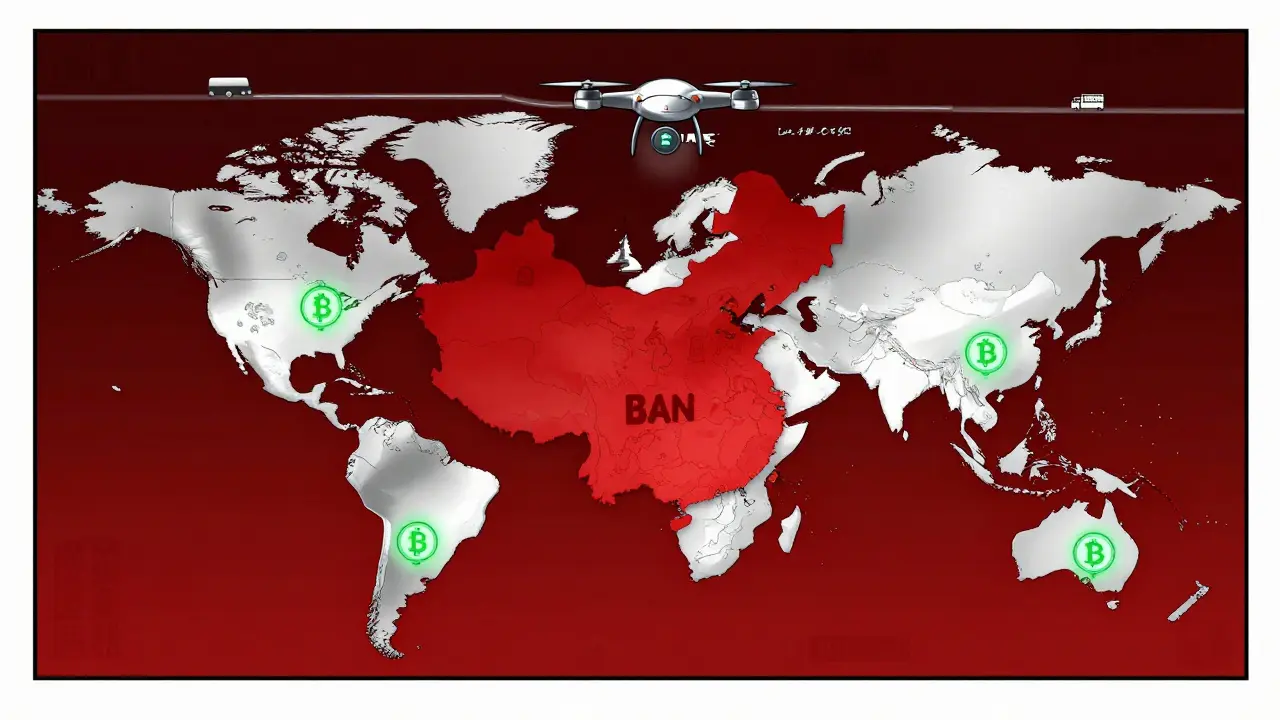
As of June 1, 2025, crypto payments are completely illegal in mainland China. This isn't a gray area or a loose rule - it's a full criminal ban. If you're running a business in Shanghai, Beijing, or Guangzhou, and you accept Bitcoin, Ethereum, or any other cryptocurrency as payment, you're breaking the law. The same goes for mining, trading, or even holding crypto in a personal wallet. The People's Bank of China made it crystal clear: no exceptions.
China didn't wake up one day and decide to ban crypto. This was a decade-long build-up. Back in 2013, banks were told not to process Bitcoin transactions. By 2017, initial coin offerings (ICOs) were shut down, and domestic crypto exchanges were forced to close. In 2021, mining operations - the computers that validate blockchain transactions - were banned nationwide. And in 2025, the final step came: even owning crypto became a legal risk. The government now has the power to seize assets, freeze bank accounts, and pursue criminal charges against individuals and companies involved in any crypto-related activity.
Why such a hard line? It’s not about technology. China isn’t against digital money - it’s against decentralized money. The government wants total control over how money moves in and out of its economy. That’s why it created the e-CNY, or digital yuan. Unlike Bitcoin or Ethereum, the e-CNY is fully backed by the state. Every transaction is tracked. Every user is identified. There’s no anonymity. No cross-border bypassing. No loss of monetary control. The e-CNY is China’s answer to crypto: digital, but entirely under state supervision.
So what about businesses that want to accept crypto? Forget about setting up a crypto payment gateway in China. There’s no legal path. Even if you use an offshore service like Binance or Coinbase, the law still applies. If a Chinese citizen sends crypto to pay for goods or services, that’s a violation. Enforcement has gotten sharper. In 2024, authorities arrested dozens of people for running unlicensed OTC (over-the-counter) crypto trades. In 2025, they started requiring companies that handle data for over one million users to report personal information protection officers - a move clearly aimed at tracking crypto activity.
But here’s the twist: China isn’t rejecting blockchain technology. In fact, it’s leading the world in one area - cross-border CBDC payments. The mBridge project, a joint effort between China, Hong Kong, Thailand, and the UAE, is using blockchain to settle international transactions using digital versions of their currencies. These aren’t Bitcoin or Ethereum. They’re state-controlled digital currencies, including the e-CNY. This system allows foreign businesses to settle payments with Chinese companies without touching private crypto. It’s a legal, government-approved path - but only for international trade, not domestic use.
This creates a strange duality. Inside China, crypto is dead. Outside China, blockchain is alive - but only if it’s state-run. You can’t use Bitcoin to buy coffee in Chengdu. But a Chinese manufacturer can use the e-CNY to settle a payment with a supplier in Dubai, using the same blockchain tech that powers crypto. The difference? One is controlled by the People’s Bank of China. The other is not.
What about Hong Kong and Singapore? They’re completely different. In Hong Kong, licensed crypto exchanges operate legally. In Singapore, stablecoins like USDC are regulated and used in everyday payments. China doesn’t allow that. Even stablecoins - digital tokens pegged to the U.S. dollar - are banned for domestic use. The only exception? A few government-approved sandboxes where researchers test blockchain applications under strict supervision. No real payments. No public access.
For international companies, this means one thing: you can’t offer crypto payments to customers in mainland China. If you’re a SaaS provider, an e-commerce store, or a gaming platform, and you want to accept crypto from Chinese users, you’re out of luck. The legal risk is too high. Even if you think you’re operating offshore, Chinese authorities can still go after users who make payments - and that’s enough to scare off most businesses.
So what’s next? Experts say China’s position won’t change anytime soon. The e-CNY is still in pilot mode across dozens of cities. The government is pouring billions into its rollout. That’s the future: a digital currency system where the state sees everything. Crypto, in contrast, is seen as a threat to that control. There were rumors in July 2025 that officials in Shanghai were discussing ways to soften the ban - especially around stablecoins. But no policy changed. No law was amended. The ban remains absolute.
If you’re a business operating in China, your only legal digital payment option is the e-CNY. If you’re a consumer, you can use it through your mobile app. If you want to use Bitcoin? Forget it. The risk isn’t just financial - it’s legal. And in China, the state doesn’t negotiate.
How China’s Crypto Ban Compares to Other Countries
| Region | Can You Accept Crypto Payments? | Is Mining Legal? | Is e-CNY Available? | Regulatory Body |
|---|---|---|---|---|
| China (mainland) | No - fully banned | No - criminal offense | Yes - state-run digital currency | People's Bank of China |
| Hong Kong | Yes - licensed exchanges | Yes - regulated | No | Securities and Futures Commission |
| Singapore | Yes - regulated stablecoins | Yes - licensed | No | Monetary Authority of Singapore |
| United States | Yes - state-by-state rules | Yes - legal | No | FinCEN, IRS, SEC |
| EU (general) | Yes - MiCA compliant | Yes - legal | No | European Central Bank |
The table above shows how extreme China’s ban really is. No other major economy has gone this far. Even countries with strict financial controls, like Russia or India, still allow some level of crypto trading or usage. China is the only one that treats holding crypto like a crime.
What Happens If You Try to Use Crypto in China?
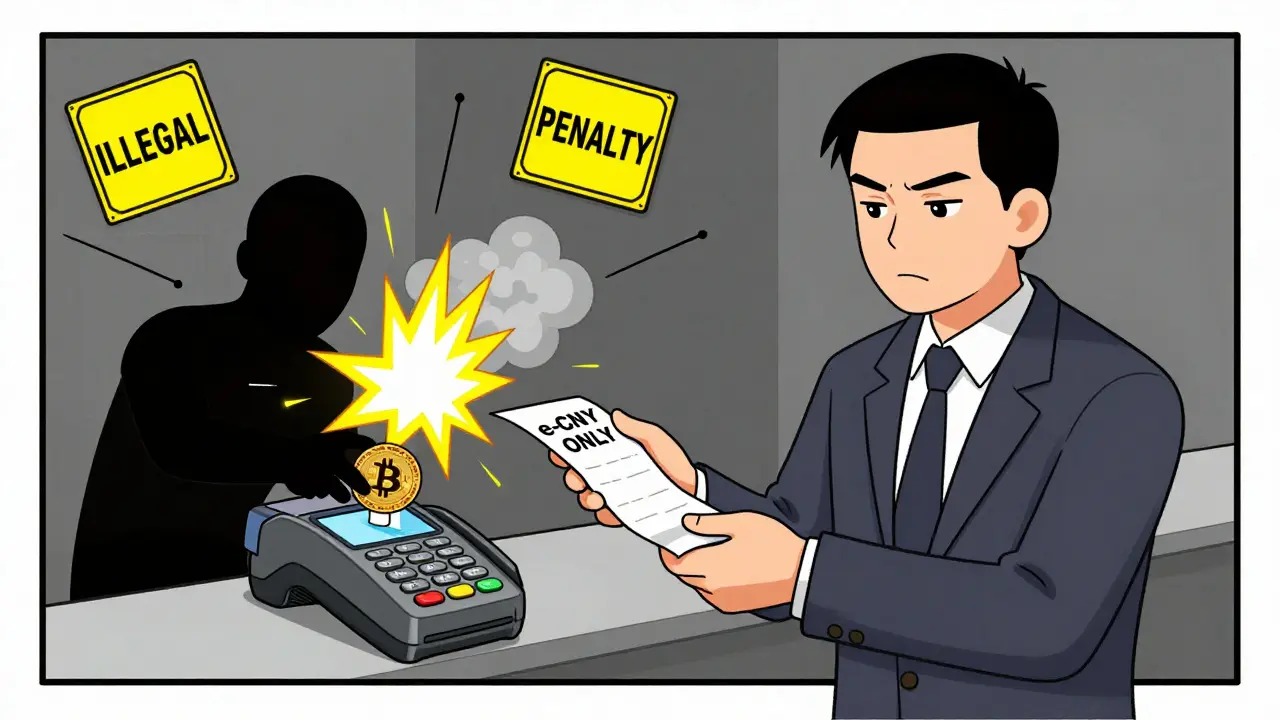
Let’s say you’re a foreign tourist and you try to pay for a hotel room in Bitcoin. The hotel staff might say yes - but they’re breaking the law. If caught, they could face fines, have their business license revoked, or even be charged with illegal fundraising. If you’re a Chinese citizen and you send crypto to a friend abroad, your bank account could be frozen. Your transaction history might be flagged. Your personal data could be reported to authorities.
There’s no official fine schedule. Enforcement is unpredictable. But the message is clear: don’t do it. The government doesn’t need to prove intent. If crypto moves through your wallet, you’re already in violation.
Can You Use Crypto Outside China and Send It In?
No. Even if you buy Bitcoin in the U.S. or Japan, and then send it to someone in China, that’s still illegal. The ban covers all forms of crypto ownership and transfer within China’s borders. The government monitors cross-border data flows. If they detect crypto transactions linked to Chinese IP addresses or bank accounts, they act.
Some people try to use peer-to-peer (P2P) platforms or OTC traders to bypass the ban. But these are high-risk. Many OTC traders have been arrested. Many accounts have been frozen. The government doesn’t need to shut down the whole system - it just needs to make enough arrests to scare everyone else away.
What About Blockchain Tech? Is It Banned Too?
No. Blockchain is fine - as long as it’s not used for crypto. Companies in China are actively building blockchain systems for supply chain tracking, land registries, and government records. The technology itself isn’t the problem. It’s the decentralization. If a system doesn’t answer to the state, it’s banned. If it’s controlled by the state, it’s encouraged.
Can Foreign Businesses Still Operate in China?
Yes - but not with crypto. If you’re selling software, electronics, or services to Chinese customers, you can still take payment. You just have to use the e-CNY, bank transfer, Alipay, or WeChat Pay. Crypto payment gateways like BitPay or Coinbase Commerce cannot legally operate in mainland China. Any company claiming otherwise is either misinformed or misleading customers.
Will the Ban Ever Change?
Don’t count on it. China’s leadership sees crypto as a threat to financial sovereignty. The e-CNY is their tool to stay in control. Until that system is fully adopted - which could take another 3-5 years - the ban will stay firm. Even if global crypto markets boom, China won’t budge. Their priority isn’t innovation. It’s control.
Are crypto payments legal in mainland China in 2025?
No. As of June 1, 2025, all cryptocurrency payments, trading, mining, and ownership are illegal in mainland China. The ban is enforced by the People's Bank of China and includes criminal penalties for violations.
Can I use Bitcoin to pay for goods in China?
No. Accepting Bitcoin or any cryptocurrency as payment is illegal. Even if a business says yes, they’re breaking the law and could face fines, asset seizures, or criminal charges.
Is the e-CNY the same as Bitcoin?
No. The e-CNY (digital yuan) is a state-controlled digital currency issued by the People's Bank of China. Unlike Bitcoin, it’s not decentralized. Every transaction is tracked, and users must be verified. It’s China’s alternative to crypto - not a replacement for it.
Can I mine cryptocurrency in China?
No. Crypto mining has been banned nationwide since 2021. Any mining equipment found in China is subject to seizure, and operators can face criminal charges.
Can I send crypto from outside China to someone inside?
No. Transferring cryptocurrency into China - even from abroad - is considered a violation of capital control laws. Authorities monitor cross-border digital transactions and can freeze accounts or investigate individuals involved.
What payment methods can I use in China instead of crypto?
You can use the e-CNY (digital yuan), Alipay, WeChat Pay, bank transfers, or credit cards. These are the only legal and widely accepted digital payment methods in mainland China.





nalini jeyapalan
March 6, 2026 AT 05:33China’s move is brutal but predictable. They don’t want decentralized money because it threatens their surveillance state. The e-CNY isn’t innovation-it’s a leash. Every transaction tracked, every citizen monitored. It’s digital authoritarianism wrapped in a UX update.
And yet, people still think this is about ‘financial stability’? Please. It’s about control. The moment someone can move value without state permission, the system cracks. That’s why they outlawed even holding crypto. No gray area. No loopholes. Just total domination.
I get why businesses panic. But let’s be real: if you’re building a product for China, you’re already signing up for compliance theater. Crypto payments? Forget it. Your only real option is to play along or get left behind.
Christina Young
March 6, 2026 AT 21:18China’s ban isn’t extreme-it’s rational. Every other country is just delaying the inevitable. Decentralized crypto is a tax evasion tool, a sanctions loophole, and a money laundering pipeline wrapped in blockchain buzzwords. The e-CNY isn’t the opposite of Bitcoin-it’s what Bitcoin should’ve been if it had any sense of responsibility.
Drago Fila
March 7, 2026 AT 22:47Look, I get why people are upset. But honestly? China’s playing 4D chess while the rest of us are still trying to figure out how to use ATMs.
The e-CNY isn’t about crushing freedom-it’s about creating a system that actually works. No more cross-border delays. No more fees. No more middlemen. It’s fast, secure, and transparent. And yeah, the government sees everything. So what? You think your bank doesn’t see your transactions? They just don’t tell you.
Maybe instead of screaming ‘dictatorship,’ we should ask: why hasn’t the US built something this efficient? Hint: it’s not because of crypto. It’s because we’re stuck in legacy systems.
Steven Lefebvre
March 8, 2026 AT 06:44Wait, so if I’m a Canadian using Coinbase and I send ETH to my cousin in Shanghai, am I breaking Chinese law? Or just the guy who receives it?
And what if I buy a $500 gift card from a Chinese retailer using USDC and they deposit it into their Alipay account? Is that still illegal?
I’m not trying to be a troll. I genuinely want to know where the line is. Because if you can’t even send a friend a birthday crypto gift without risking arrest, that’s a whole new level of control. Not ‘regulation.’ Not ‘oversight.’ This is digital policing.
Lydia Meier
March 10, 2026 AT 00:26The People's Bank of China has enacted a legally coherent, economically rational policy consistent with its broader macroprudential objectives. The prohibition of decentralized digital assets is not an aberration but a logical extension of capital controls established since the early 2000s. Comparative analysis with jurisdictions such as the United States and the European Union reveals significant regulatory fragmentation and structural asymmetry in monetary sovereignty enforcement. The e-CNY represents a technologically sophisticated sovereign currency architecture, whereas crypto ecosystems remain inherently non-compliant with anti-money laundering and know-your-customer frameworks. This is not repression. It is institutional integrity.
jay baravkar
March 11, 2026 AT 03:40Honestly? I get why China’s doing this. But let’s not pretend it’s all about control. It’s also about protecting ordinary people from scams. I’ve seen too many friends lose life savings to ‘decentralized finance’ scams that promised 500% returns. The e-CNY isn’t perfect, but at least you know who’s behind it. No anonymous devs. No rug pulls.
Maybe we’re all too quick to call it tyranny. What if it’s just… common sense?
Ian Thomas
March 11, 2026 AT 20:57So let me get this straight: China banned crypto because it’s decentralized… but they’re using blockchain to build the most centralized financial system on Earth? Brilliant.
It’s like banning bicycles because they’re not cars, then building a highway system where every vehicle is painted government blue and monitored by AI. The irony is thicker than a Silicon Valley pitch deck.
Next they’ll outlaw air because it’s not oxygen-enriched and government-approved. At least crypto lets you be anonymous. The e-CNY? It’s like a loyalty card with a camera.
Melissa Ritz
March 12, 2026 AT 04:49Ugh. I don’t even know why I’m reading this. Of course China bans crypto. They’re the same people who banned TikTok dances and forced everyone to use WeChat Pay. It’s not about money. It’s about power. And honestly? I’m tired of this whole ‘crypto vs. state control’ drama. Can’t we just… not care?
I mean, I use Venmo. My mom uses Cash App. Why does anyone think crypto is the future? It’s just… extra. Like NFTs of JPEGs. Why is this even a thing?
Denise Folituu
March 13, 2026 AT 04:32THIS IS A TOTAL VIOLATION OF HUMAN RIGHTS. PEOPLE SHOULD BE FREE TO USE ANY CURRENCY THEY WANT. CHINA IS A DICTATORSHIP. THEY’RE STEALING OUR FINANCIAL FREEDOM. I’M SO ANGRY I CAN’T EVEN THINK STRAIGHT. WHY WON’T THE WORLD DO SOMETHING? THEY’RE LOCKING PEOPLE IN CAGES FOR OWNING BITCOIN. THIS IS WORSE THAN THE IRANIAN REVOLUTION. I’M CRYING RIGHT NOW. SOMEONE PLEASE START A PETITION. I’M TAKING THIS TO THE UN. MY LIFE IS RUINED BECAUSE I CAN’T BUY A LATTÉ WITH ETHEREUM IN SHANGHAI.
Nancy Jewer
March 13, 2026 AT 11:11The e-CNY isn’t just a digital currency-it’s a sovereign digital identity layer integrated into the broader financial infrastructure stack. What’s fascinating is how it leverages distributed ledger technology without relinquishing consensus authority to non-state actors. This represents a paradigm shift in monetary sovereignty: from permissionless pseudonymity to permissioned verifiability.
Compare this to MiCA in the EU, which still allows for private stablecoin issuance under regulatory oversight. China’s approach is more holistic-it doesn’t just regulate the asset, it regulates the transactional context, the data flow, and the behavioral footprint. It’s not anti-blockchain. It’s anti-decentralized governance. And honestly? From a systemic stability standpoint, it’s arguably more resilient than the fragmented regulatory patchwork we’ve got in the West.