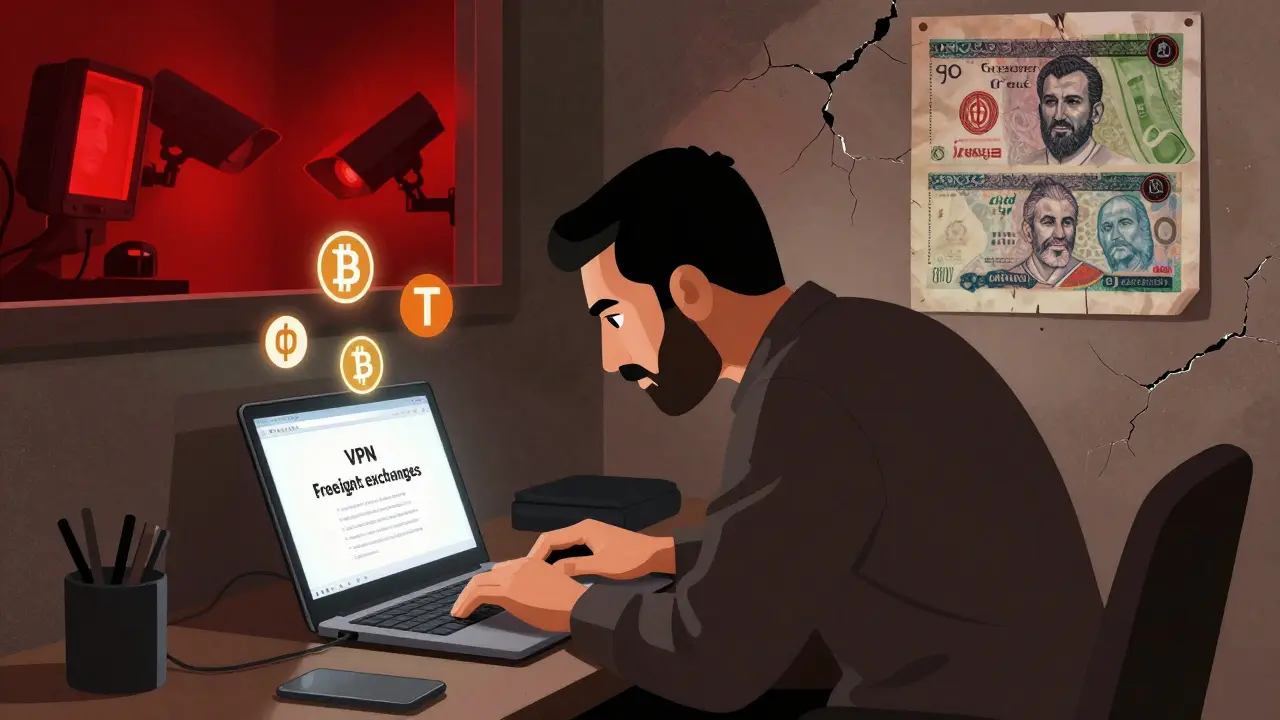
When you hear about crypto payments in Iran, you might think it’s either completely banned or wide open. The truth? It’s neither. Iran’s approach to cryptocurrency isn’t about banning it outright-it’s about controlling it. And that changes everything.
What’s Actually Legal Right Now?
As of 2026, you can’t walk into a store in Tehran and pay for groceries with Bitcoin. You can’t send crypto to a local business as payment for services. That’s not because it’s technically impossible-it’s because the government made it illegal. The Central Bank of Iran (CBI) has complete authority over all cryptocurrency activity. Since January 2025, any platform that wants to handle crypto-to-rial transactions must use a government-approved API. This means every transaction, every user, every wallet address is monitored. If you’re running a business and accept crypto? You need a license. And you have to hand over your data. The ban on unregulated payment gateways isn’t just a rule-it’s an enforcement tool. In early 2025, Iran shut down all domestic crypto-to-rial payment systems. That means exchanges like Nobitex can’t let you cash out Bitcoin into Iranian rials unless they’re using the state’s system. And even then, the government sees every step.But Mining Is Legal… Sort Of
Here’s where it gets confusing. While you can’t use crypto to pay for things, you can mine it. In fact, Iran is one of the top five countries in the world for Bitcoin mining, accounting for nearly 4.5% of global hash rate. The catch? It’s not free. Miners must get a license from the Ministry of Industry, Mine and Trade. They’re forced to buy electricity at government-set rates-rates that are higher than what regular citizens pay. Why? To make mining unprofitable for most people. And they have to sell their mined coins directly to the Central Bank of Iran. Many miners still operate underground. Power outages hit cities like Isfahan and Shiraz in late 2024, and officials blamed illegal mining for overloading the grid. The government responded by raiding warehouses full of mining rigs and prosecuting operators. So yes, mining is legal-but only if you’re playing by their rules.Advertising? Completely Banned
In February 2025, Iran went further than any other country. They banned all cryptocurrency advertising-online, on billboards, on TV, even in social media posts. No more YouTube videos promoting exchanges. No more Instagram ads for crypto wallets. No more sponsored posts from influencers. This isn’t about protecting consumers. It’s about control. The government doesn’t want the public getting excited about crypto. They want people to think about the digital rial instead.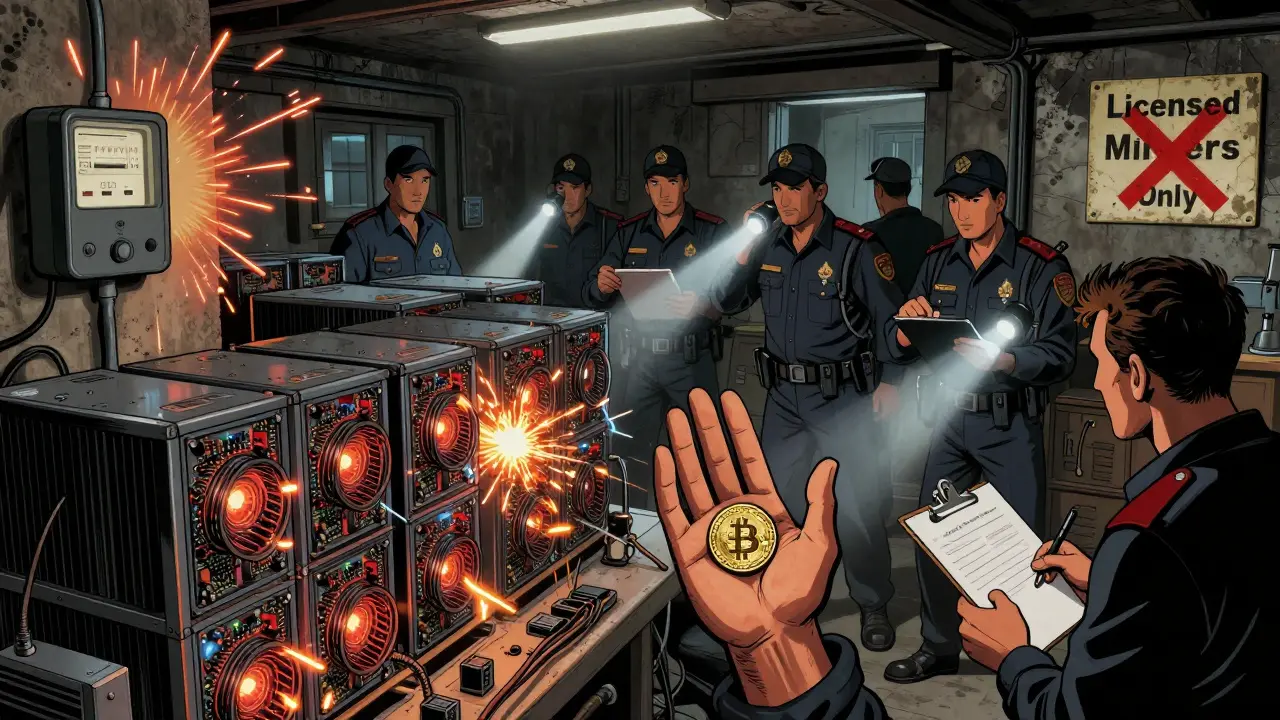
The Digital Rial Is the Real Goal
Iran isn’t trying to embrace Bitcoin. They’re trying to replace the Iranian rial with their own digital version: the Rial Currency. Unlike Bitcoin, this isn’t decentralized. It’s not mined. It’s not even open to the public yet. The digital rial is a Central Bank Digital Currency (CBDC), fully controlled by the government. It’s designed to replace cash, track spending, and cut reliance on the U.S. dollar. It’s already being tested on Kish Island, a free-trade zone where foreign visitors can use it. This is the endgame: no more Bitcoin payments. No more crypto wallets. Just one government-run digital currency that can be frozen, monitored, or blocked at a click.How Are Iranians Still Using Crypto?
Despite all the restrictions, Iranians are still using crypto. Not because they want to-but because they have to. The rial has lost over 70% of its value since 2020. Inflation is over 40%. People can’t trust their own currency. So they turn to crypto-not to get rich, but to survive. Many use VPNs to access foreign exchanges like Binance or Kraken. They buy USDT, hold it, then sell it when they need to pay for medicine, food, or imported goods. Transactions happen in private groups on Telegram. No licenses. No government oversight. Just people trying to protect their savings. Between January and July 2025, Iran saw $3.7 billion in crypto flows-a drop from 2024, but still massive. That’s not from mining. That’s from people using crypto as a lifeline.International Pressure Is Real
Iran’s crypto use has drawn serious attention from abroad. In July 2025, Tether froze 42 crypto addresses linked to Iranian users, many tied to Nobitex. The U.S. and EU have targeted wallets connected to the Islamic Revolutionary Guard Corps (IRGC), freezing millions in assets. This isn’t just about sanctions. It’s about control. The West doesn’t want Iran using crypto to bypass financial restrictions. Iran doesn’t want its citizens using crypto to bypass its own restrictions.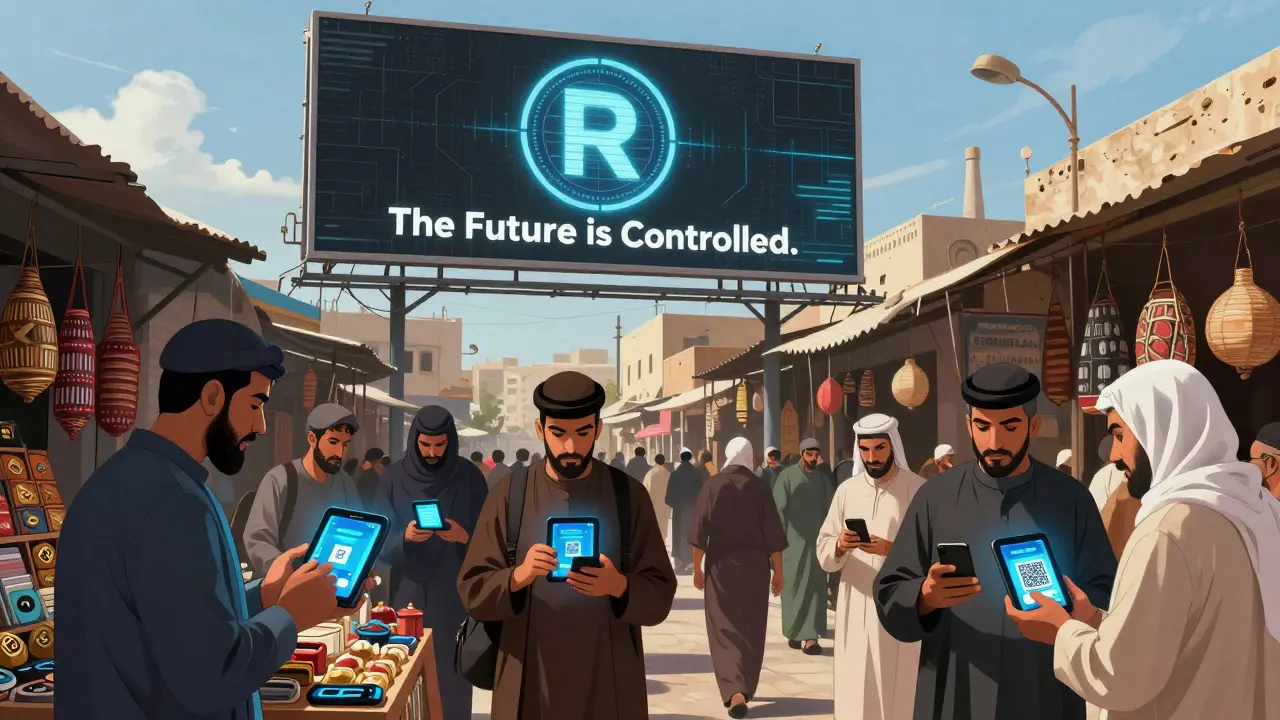





Zion Banks
March 24, 2026 AT 17:35The digital rial? That's just the deep state's next step toward total surveillance. They're not banning crypto because it's dangerous-they're banning it because it's UNCONTROLLED. And now they want to track every damn coffee purchase? This isn't economics, it's fascism with a user interface. I've seen this playbook before: first they ban cash, then they ban gold, then they ban Bitcoin. Next up? Your heartbeat. They'll call it 'financial wellness.' I'm not surprised. The IRGC has been mining crypto with stolen power for years, and now they want to monetize the whole damn system. They're not fighting crypto-they're colonizing it.
And don't even get me started on Tether freezing Iranian wallets. That's not compliance-that's collusion. The U.S. and Iran are playing the same game. One wants to control the currency, the other wants to control the people. Same coin, different sides of the table.
Mark my words: when the digital rial goes live, the first thing they'll do is block any foreign crypto transfer. Not because of sanctions. Because they know the second you can bypass their system, you stop believing in it. And once people stop believing? The whole house of cards collapses.
They think they're smart. But they don't realize crypto isn't about money-it's about autonomy. And you can't regulate autonomy. You can only crush it. And when you crush it hard enough? It doesn't disappear. It just goes underground. And then it gets dangerous.
I'm not scared of Iran's government. I'm scared of what happens when the people realize they've been lied to for years. And trust me-they're starting to.
Stay vigilant. Stay offline. And never trust a digital currency that needs a license to exist.
Annette Gilbert
March 24, 2026 AT 17:35Oh honey. Let me get this straight-you're telling me Iran is the only country that *tries* to control crypto instead of just letting it burn itself out? How quaint. Meanwhile, the rest of the world is just sitting back watching people lose their life savings on meme coins while the government yawns. At least Iran's got a plan. Even if it's a terrible one. And honestly? The digital rial sounds like the most Iranian thing ever: a state-run currency that's basically a glorified spreadsheet with a blockchain sticker on it. Congrats, you've invented the world's most boring dystopia.
Also, banning ads? Bold. Like, 'I'm so scared of people learning how to be rich' bold. Meanwhile, my cousin in Tehran just bought a new car with USDT. On Telegram. While her phone was on airplane mode. So... yeah. You can't ban what people already use to survive. The government's just playing whack-a-mole with a butter knife.
John Alde
March 25, 2026 AT 20:52There’s a critical nuance here that gets lost in the noise: Iran’s approach isn’t unique-it’s evolutionary. Countries like China, Russia, and even Nigeria have tried to suppress decentralized finance while building their own digital alternatives. The key insight is that the state doesn’t fear crypto because it’s illegal-it fears it because it’s *unmonitored*. What Iran is doing is attempting to transition from a cash-based, inflation-ridden economy into a monitored, programmable one. The digital rial isn’t a betrayal of financial freedom-it’s a redefinition of sovereignty.
Yes, the licensing and forced sales to the CBI are predatory. Yes, miners are being exploited. But the underlying goal-replacing a collapsing currency with a state-backed digital alternative-isn’t irrational. It’s what happens when hyperinflation meets technological capability. The real question isn’t whether this is ethical-it’s whether it’s sustainable. And right now, with $3.7B in crypto flows, it’s clearly working for the people, even if it’s not working for the regime’s narrative.
The irony? The more they clamp down, the more crypto becomes the informal safety net. That’s not a failure of policy-it’s a failure of imagination. They’re trying to build a digital currency that can’t be bypassed, but they’ve built one that people bypass anyway. The system is being subverted from within. That’s not chaos. That’s adaptation.
And for those saying this is a surveillance state? It is. But so is every modern economy that uses digital banking. The difference? Iranians are choosing crypto not to rebel, but to eat. That’s not a hack-it’s a human response to collapse.
manoj kumar
March 26, 2026 AT 05:45Lmao so Iran is mining Bitcoin while banning it? Classic. You can’t even make this stuff up. First they let you mine, then they force you to sell it to them at a loss, then they ban ads so you can’t even tell people about it. What a mess. Meanwhile, people are using Telegram to trade USDT like it’s Monopoly money. The government’s got more control than a high school principal during finals week. But guess what? It’s not working. You can’t stop people from using what keeps them alive. And if you think the digital rial is going to replace crypto? You’ve never lived in a country where inflation eats your salary every week. Crypto isn’t a trend-it’s a survival tool. And Iran’s just the latest country to figure that out the hard way.
Also, why are we even surprised? The same people who banned Bitcoin are the ones printing money like it’s confetti. Hypocrisy? Nah. Just incompetence with a flag.
JOHN NGEH
March 27, 2026 AT 21:33I’ve been reading about this for weeks, and I keep coming back to one thing: people aren’t using crypto because they want to. They’re using it because they have no other choice. That’s the real story here. It’s not about ideology or rebellion. It’s about a mother in Shiraz who needs insulin and can’t afford it with rials. It’s about a student in Tabriz who can’t buy textbooks because the bank won’t let her transfer money abroad. Crypto isn’t a luxury-it’s a bridge.
The government’s crackdown on advertising? That’s not about control. It’s about fear. Fear that if people realize crypto is possible, they’ll stop trusting the rial completely. And they’re right to be afraid. Because once you see an alternative that works-even if it’s illegal-you can’t unsee it.
I don’t know if the digital rial will succeed. But I do know this: no amount of surveillance or licensing can replace trust. And right now, the Iranian people have more trust in a USDT wallet than they do in their own central bank. That’s not a technical problem. That’s a human one.
Jenni Moss
March 27, 2026 AT 23:31Y’all are overcomplicating this. It’s simple: people are scared. The rial is falling. Food is expensive. Medicine is a gamble. So they turn to crypto-not because it’s cool, but because it’s *something*. Something that doesn’t vanish overnight. Something they can hold onto. The government’s response? Ban, monitor, control. But you can’t control survival. You can only try to stop it. And that’s why it’s still happening.
Be kind. Be patient. These aren’t crypto bros. These are moms, teachers, mechanics, kids. They’re not trying to get rich. They’re trying to get by. And that’s the most powerful thing of all.
vu phung
March 28, 2026 AT 12:33From a technical standpoint, what Iran’s doing is a textbook example of CBDC-driven monetary sovereignty. The Central Bank’s API mandates create a permissioned blockchain layer over existing crypto activity-effectively creating a dual-layer system where regulated flows feed into the digital rial pipeline while unregulated ones persist in the shadows. The mining licensing model is essentially a tax-and-capture mechanism: extract hash power, monetize the output, and neutralize decentralization. It’s not anti-crypto-it’s crypto absorption.
The $3.7B in flows? That’s not speculative trading-it’s capital flight via stablecoin arbitrage. USDT acts as a non-sovereign store of value, and Telegram groups are the informal settlement layer. No KYC, no banking rails, just peer-to-peer value transfer. It’s the original Bitcoin vision, but with 100x more urgency and zero ideology.
The real disruption? The digital rial’s rollout on Kish Island is a controlled sandbox. If it works there-low friction, high adoption, foreign entity integration-it becomes the template for nationwide deployment. And when that happens, the underground crypto networks won’t disappear. They’ll just evolve into decentralized settlement channels for the black market. The state doesn’t eliminate crypto. It recontextualizes it. And that’s the most dangerous part.