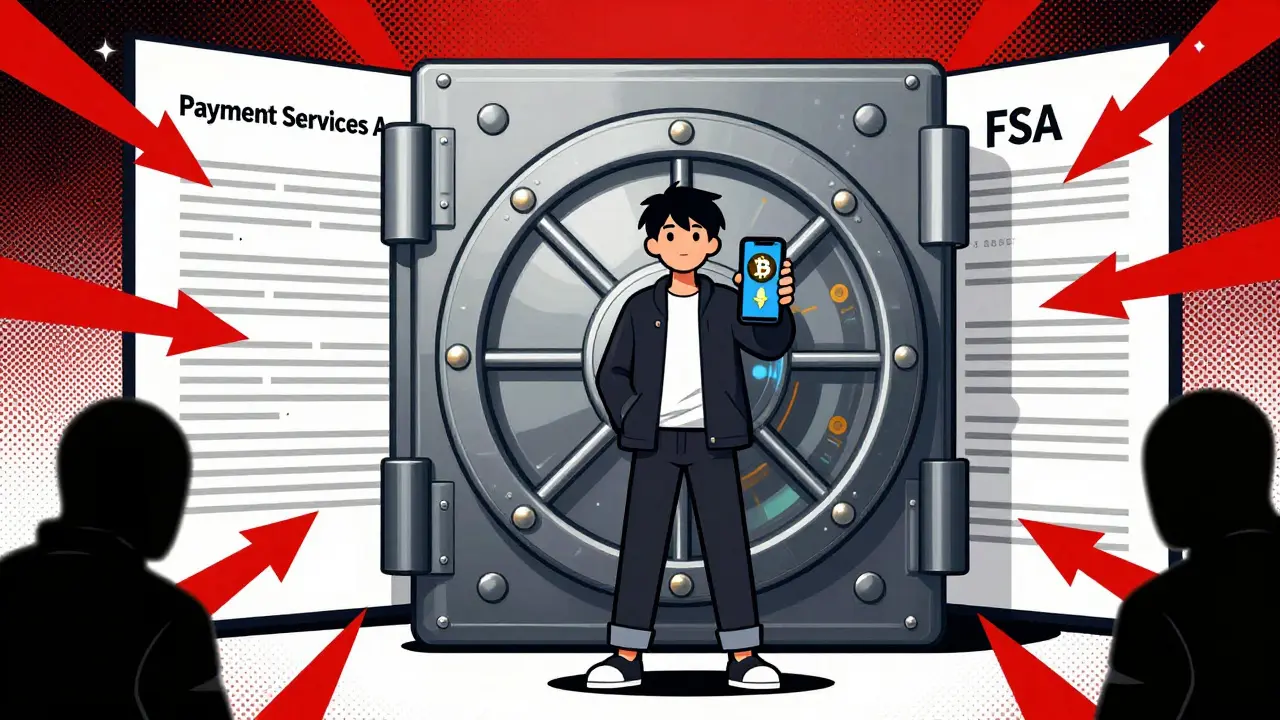
Buying Bitcoin or Ethereum in Japan isn't just about picking a coin and hitting 'buy.' It’s about stepping into one of the strictest, most structured regulatory environments on Earth. If you are holding crypto in a Japanese exchange, your money is protected by layers of government oversight that would make many other countries look lax. But what does that actually mean for your wallet? And how do these rules change if an exchange goes bust?
The short answer is safety through segregation and scrutiny. Since the Mt. Gox collapse, Japan has rebuilt its crypto infrastructure from the ground up. The Financial Services Agency (FSA) doesn't just watch; it mandates specific technical and financial behaviors for every registered exchange. For the average user, this means your funds are likely sitting in offline vaults, separated from the company's operating cash, and backed by insurance-like guarantees.
The Core Framework: Payment Services Act and FIEA
To understand why your crypto is safe in Japan, you have to look at the two pillars holding up the system: the Payment Services Act (PSA) the primary law governing cryptocurrency exchanges as payment service providers and the Financial Instruments and Exchange Act (FIEA) the securities law that now covers investment-grade tokens.
Most people think of crypto as a currency. In Japan, under the PSA, it is treated as a method of payment. This classification forces exchanges to register with the FSA. You cannot operate a crypto exchange in Japan without this registration. The penalty for ignoring this is severe: up to three years in prison or fines reaching JPY3 million. As of June 1, 2025, imprisonment penalties shifted to "confinement punishment" under updated penal codes, but the threat remains real.
However, not all tokens are created equal. If a token acts like a stock-offering governance rights or profit-sharing-it falls under the FIEA. Starting in mid-2025, the FSA began reclassifying certain digital assets as securities. This brings them under the same heavy scrutiny as traditional stocks, requiring insider trading regulations and mandatory disclosures. For you, the investor, this means fewer scams and more transparency when buying utility or governance tokens.
Cold Storage and Fund Segregation: Your Money Is Not Theirs
The biggest fear for any crypto holder is the exchange going bankrupt while holding their coins. In unregulated markets, this happens often. In Japan, it is structurally difficult for an exchange to steal your funds because they aren't allowed to touch them in the first place.
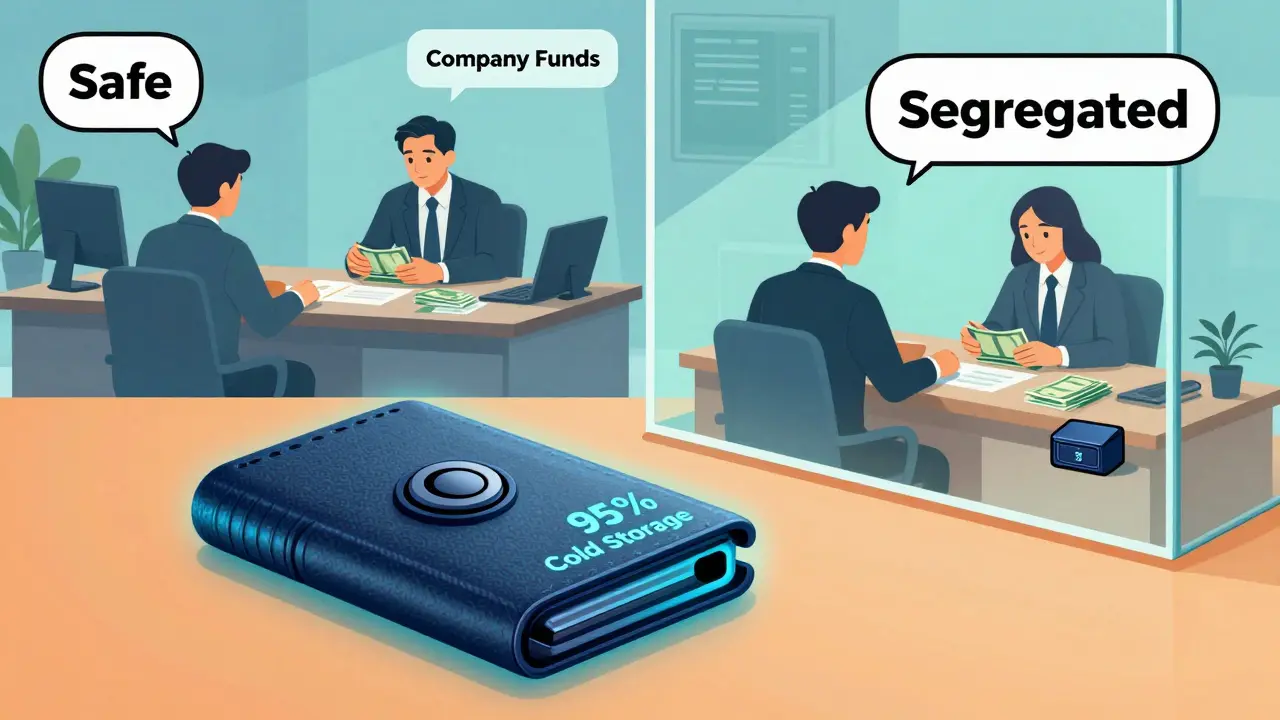
The PSA mandates strict fund segregation. Exchanges must keep customer assets completely separate from their own corporate funds. If the exchange company faces debt or bankruptcy, creditors cannot claim your Bitcoin. It belongs to you, not the company.
But separation isn't enough if hackers can access the servers. That’s why Japan enforces the "95% Rule." Registered exchanges must keep at least 95% of user assets in offline cold wallets. These are hardware devices disconnected from the internet, stored in secure physical locations. Only the remaining 5% can be kept online for immediate withdrawals. This drastically reduces the surface area for cyber attacks. Even if a hacker breaches the website, they find almost nothing of value in the hot wallets.
| Protection Measure | Requirement | Benefit to User |
|---|---|---|
| Cold Storage | Minimum 95% of assets offline | Prevents mass theft via hacking |
| Fund Segregation | Mandatory separation from company assets | Protects funds during exchange bankruptcy |
| Physical Presence | Must maintain operations within Japan | Ensures legal jurisdiction and accountability |
| KYC/AML | Strict identity verification required | Reduces fraud and illegal activity on platforms |
The 2025 Amendment: Faster Refunds and Direct Access
Regulations evolve, and Japan’s latest update in 2025 focused on speed. Previously, if an exchange failed and needed to return secured assets held in bank trusts, the process was bureaucratic and slow. Users had to wait for government-led procedures, which took at least 170 days. Imagine waiting six months to get your life savings back after a crisis. That was the old reality.
The 2025 amendment changed this dynamic significantly. It introduced direct refund options. Now, banks and trust companies can return funds to users directly, bypassing the lengthy government processing steps. This ensures faster access to your capital during business failures. It’s a small procedural tweak, but for someone needing liquidity in a crisis, it makes a massive difference.
This amendment also clarified the definition of "crypto-assets," explicitly excluding prepaid e-money cards and bank-issued coins. This distinction ensures that traditional payment tools aren’t bogged down by crypto regulations, while true cryptocurrencies remain under the strict PSA umbrella.
What Happens If You Use Credit Cards for Crypto?
Many users prefer buying crypto with credit cards for convenience. However, Japan treats this carefully. If a crypto exchange issues a credit card that allows installment payments over two months, revolving payments, or bonus lump-sum payments, it triggers additional rules.
Under the Installment Sales Act, these services constitute "credit purchase intermediation." The exchange must register as a credit purchase intermediary. This means they have to provide you with detailed customer information provisions before you buy. You can’t just swipe and forget; you must be fully informed about the costs and risks. This protects consumers from impulse buying high-volatility assets using borrowed money.

Who Is Protected? The Retail Investor Focus
Japan’s crypto market is unique because it is dominated by retail investors, not just institutional whales. Approximately 70% of cryptocurrency users in Japan are middle-income earners. They aren't day-trading bots; they are people looking for long-term price gains and portfolio diversification.
Finance Minister Katsunobu Kato has publicly acknowledged that cryptocurrencies can be part of diversified portfolios despite their volatility. This government recognition shapes the regulatory tone. The rules are designed to protect the "regular person" who might not understand blockchain technology but wants to invest safely. This is why disclosure requirements are so heavy. Exchanges must explain risks clearly, avoiding jargon that could mislead a novice investor.
Looking Ahead: DeFi and Future Regulations
The world of crypto is moving toward decentralization, but Japan isn't ignoring it. The FSA established a formal DeFi Study Group that meets every two to three months. This group includes regulators, industry experts, and academics. Their job is to figure out how to apply consumer protection principles to decentralized platforms and smart contracts.
While DeFi currently operates in a gray area, the study group ensures that regulations won't arrive overnight without warning. They are exploring how to hold developers or protocols accountable when things go wrong. For now, stick to regulated exchanges for maximum protection, but know that the framework is expanding to cover newer technologies.
By early 2026, expect formal legislation integrating more tokens into the FIEA. This will bring spot Bitcoin ETFs and other products into clearer legal categories. The goal is simple: maintain innovation while ensuring that when you click "buy," you are protected by one of the strongest financial safety nets in the world.
Is my crypto safe if a Japanese exchange goes bankrupt?
Yes, largely due to fund segregation rules. Under the Payment Services Act, exchanges must keep customer assets separate from their own corporate funds. Additionally, 95% of assets must be in cold storage, protecting them from both bankruptcy claims and cyber hacks.
What is the 95% cold storage rule?
This rule requires registered crypto exchanges in Japan to keep at least 95% of user assets in offline wallets (cold storage). Only 5% can be kept online for daily transactions. This minimizes the risk of large-scale theft via internet-based attacks.
How does the 2025 amendment help consumers?
The 2025 amendment speeds up fund recovery. Previously, refunds from secured assets took over 170 days due to government processing. Now, banks and trust companies can return funds directly to users, significantly reducing wait times during exchange failures.
Are all crypto tokens regulated the same way in Japan?
No. Tokens used primarily for payment fall under the Payment Services Act (PSA). Tokens with investment features, such as governance rights or profit-sharing, are increasingly being reclassified under the Financial Instruments and Exchange Act (FIEA), subjecting them to stricter securities laws.
Can I buy crypto with a credit card in Japan?
Yes, but with restrictions. If the payment involves installments or revolving credit, the exchange must register as a credit purchase intermediary. This ensures you receive full disclosure of costs and risks, protecting you from high-interest debt on volatile assets.



Hazel Fruitman
July 5, 2026 AT 11:06Antony Lopez
July 6, 2026 AT 16:29Kat Barr
July 6, 2026 AT 19:40Logan Edmison
July 8, 2026 AT 10:12Michelle Walker
July 9, 2026 AT 06:42Shay Thomson
July 10, 2026 AT 12:17Kristine Lawson
July 12, 2026 AT 09:59Tawny Holmes
July 13, 2026 AT 00:38