
For years, mining Bitcoin in Pakistan felt like a game of hide-and-seek. You had the Pakistan Crypto Council pushing for adoption on one side and the State Bank of Pakistan telling you it was illegal on the other. But the landscape shifted dramatically with the arrival of the Virtual Assets Act of 2025. If you're looking to set up a mining rig or run a massive data center today, you're no longer operating in a "grey area." There is now a formal system in place, though it comes with strict rules and a heavy eye on taxation.
The New Sheriff in Town: PVARA
The biggest change is the creation of the Pakistan Virtual Asset Regulatory Authority is an autonomous federal regulator established in July 2025 to oversee all virtual asset activities, including mining, trading, and exchange operations. Also known as PVARA, this agency is the single point of contact for anyone wanting to legalise their mining operations. Gone are the days of guessing whether your hardware is legal; now, you need a license from PVARA to operate officially.
To get this license, it isn't as simple as filling out a form. PVARA requires a deep dive into your business model. You have to provide your expected hash rate capacity, energy consumption metrics, and a clear plan on how you'll handle your environmental impact. If you're an international firm, the bar is even higher. To qualify for a license in Pakistan, you generally need to already be regulated by a recognized body like the US SEC or the UAE's VARA . This ensures that only serious, compliant players enter the market first.
Powering the Operation: The 2,000 MW Allocation
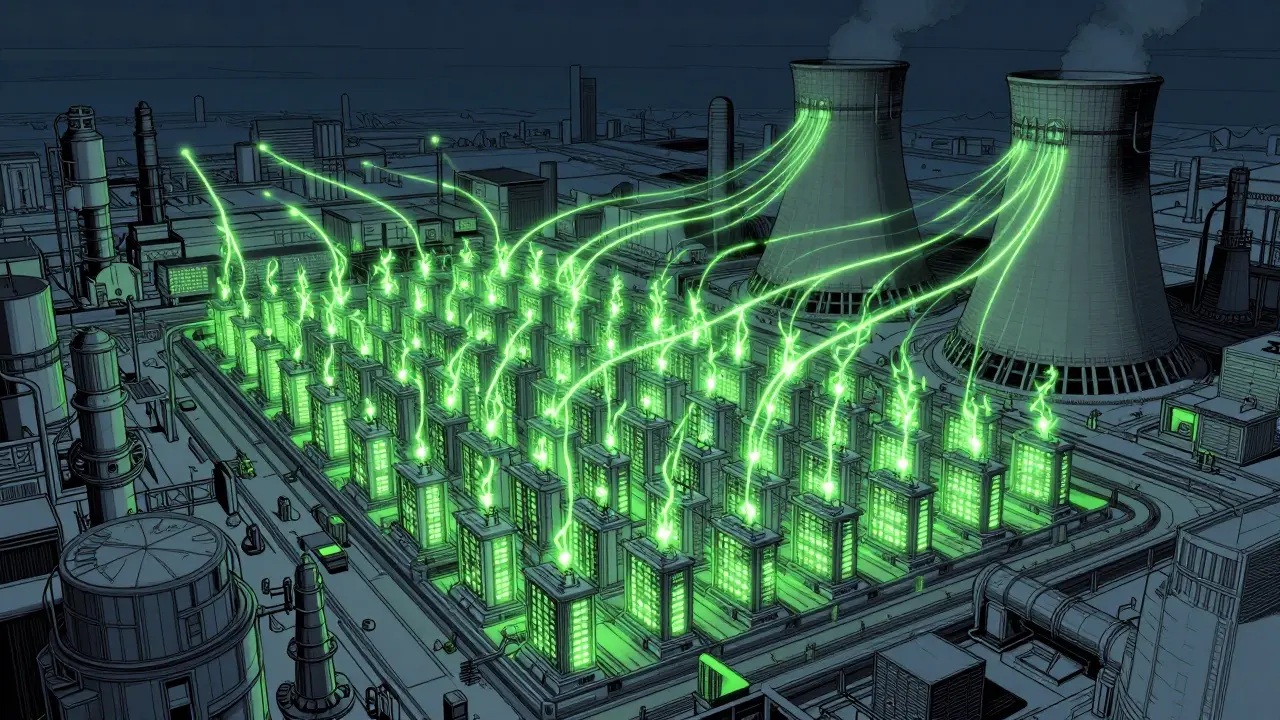
The real catalyst for the mining boom in Pakistan is the government's decision to allocate 2,000 Megawatts (MW) of electricity specifically for Bitcoin mining and AI data centers. This is a massive amount of power, strategically diverted from underutilized coal-based power stations. By using excess energy that would otherwise go to waste, Pakistan is trying to avoid crashing its national grid while attracting global investment.
If this capacity is fully utilized with modern ASIC miners (those specialized machines that handle the heavy lifting of hashing), Pakistan could potentially contribute over 60 exahashes per second (EH/s) to the global network. That would put the country in the top five mining hubs worldwide. But there's a catch: you cannot use residential electricity. If you're caught mining on a home tariff, you're violating the law. All commercial mining must use industrial tariffs with a minimum 500 kW connection to prevent "fiscal leakage" and keep the International Monetary Fund (IMF) happy.
| Feature | Phase 1 (Major International) | Phase 2 (Domestic Small-Scale) |
|---|---|---|
| Timeline | Q3-Q4 2025 | Q1 2026 |
| Minimum Capacity | 1 EH/s | 100 PH/s |
| Prerequisite | Existing Global License (SEC, FCA, MAS) | PVARA Compliance Review |
| Energy Source | Industrial Tariff / Surplus Coal | Industrial Tariff / Renewables |
Taxes and the FBR: No More Free Lunches
Mining is now a taxable profession. The Federal Board of Revenue (FBR) has a direct line to PVARA, meaning your transaction data is shared automatically. If you're mining, you're earning, and if you're earning, the government wants its cut. Crypto mining regulations in Pakistan now dictate that mining income is treated as regular income, subject to progressive tax rates.
- Income up to ₨600,000: Taxed at 5%.
- Income over ₨12 million: Taxed at 35%.
- Capital Gains: If you sell your mined coins for a profit, you pay a flat 15% tax.
Everything must be reported in Form IT-1 by the September 30 annual deadline. Ignoring this is a quick way to get your PVARA license revoked and face heavy penalties from the FBR.
The Green Mandate and Shariah Compliance
Pakistan isn't just chasing profits; it's trying to avoid the "environmental disaster" label that often follows Bitcoin mining. PVARA has released guidelines requiring mining operations to use at least 70% renewable or repurposed energy by 2027. This means miners are being pushed toward solar, wind, and the repurposed coal surplus mentioned earlier.
Another unique aspect of the Pakistani framework is the introduction of "regulatory sandboxes" for Shariah-compliant mining. Because there has been a long-standing debate among religious scholars about whether cryptocurrencies are haram or halal, these sandboxes allow operators to develop models that meet Islamic financial standards. This move has helped open the doors for a large segment of the population that was previously hesitant to enter the space.

The Banking Paradox
Despite the legal framework for mining, there is still a major headache: your bank account. The State Bank of Pakistan (SBP) continues to maintain that digital currencies are not legal tender. While you can legally mine and pay taxes on it via PVARA, the SBP still tells banks not to deal in these assets. This creates a frustrating loop where you have a legal license to mine, but you might struggle to find a bank that will let you open a corporate account specifically for your crypto business.
This contradiction is why many miners still rely on P2P markets or international accounts to move their funds, even though they are fully compliant with the Virtual Assets Act. Until the SBP and PVARA fully align their policies, the "last mile" of the financial journey remains the most difficult part of the process.
Is crypto mining legal in Pakistan in 2026?
Yes, it is legal provided you are licensed by the Pakistan Virtual Asset Regulatory Authority (PVARA) under the Virtual Assets Act of 2025. Operating without a license or using residential electricity for mining is still prohibited.
What is the tax rate for Bitcoin mining in Pakistan?
Mining income is taxed progressively from 5% (for income up to ₨600,000) up to 35% (for income over ₨12 million). Additionally, a flat 15% capital gains tax applies when you sell your mined assets.
Can I use my home electricity for mining?
No. PVARA guidelines strictly prohibit the use of subsidized residential electricity rates for mining. Commercial operations must use industrial tariffs and typically require a minimum connection of 500 kW.
Who is eligible for a PVARA mining license?
Eligibility depends on the phase. Large international firms (1 EH/s+) were prioritized in late 2025 and must have licenses from agencies like the SEC or FCA. Domestic small-scale miners (100 PH/s+) became eligible for licensing starting in Q1 2026.
Does the IMF support crypto mining in Pakistan?
The IMF initially raised objections regarding subsidized electricity and fiscal risks. However, the government addressed this by mandating industrial tariffs and prioritizing repurposed energy, and ongoing consultations continue.
Next Steps and Troubleshooting
If you are a domestic miner looking to transition to a legal setup, your first step should be auditing your hash rate. If you are below the 100 PH/s threshold, you may need to pool your resources or scale up before applying for a Phase 2 license. For those already operating, ensure your Form IT-1 is filed by September 30 to avoid FBR audits.
If you're facing banking hurdles, the best approach currently is to provide your PVARA license and the Virtual Assets Act documentation to your bank's compliance officer. While the SBP is cautious, having a federal license makes it much harder for a bank to dismiss your application as "illegal activity."


vijendra pal
April 5, 2026 AT 19:15Finally some real regulation!! 🚀 But man 100 PH/s for small scale is crazy high, most guys can't even dream of that without massive capital. Totaly overkill for domestic miners lol 😂💸
Suvoranjan Mukherjee
April 6, 2026 AT 13:59The pivot to underutilized coal-based power is a brilliant move for the hash rate efficiency. By leveraging this surplus energy, Pakistan can effectively optimize its LCOE while keeping the network secure. It is essentially a strategic arbitrage of energy waste to create digital assets, which is a win-win for the national grid and the global blockchain ecosystem. The 60 EH/s target is ambitious but totally doable if the infrastructure for ASICs scales quickly enough to meet the PVARA guidelines.
shubhu patel
April 7, 2026 AT 11:48I think it is quite interesting how they are incorporating Shariah-compliant sandboxes because it allows people who were previously hesitant due to religious concerns to finally explore the space in a way that feels safe and respectful to their values, which is a very thoughtful approach to inclusivity in a region with such deep cultural roots.
JERRY ORTEGA
April 8, 2026 AT 08:25banking paradox is the real killer here... no point in a legal license if the banks still act like it is 2013 and freeze everything on sight
Taylor Meadows
April 9, 2026 AT 09:15Typical. They create a legal framework just to tax you into oblivion. 35% for high earners is basically a joke. Most of these people probably don't even understand the volatility they are dealing with, yet they think a federal license makes them a "professional" businessman. It is just another layer of bureaucracy designed to bleed the early adopters dry before the government decides to pivot again in two years. I have seen this cycle a dozen times in different markets and it always ends with the small players getting crushed while the international firms with SEC licenses just laugh all the way to the bank. The environmental mandate is just window dressing to keep the IMF from breathing down their necks. Total hypocrisy. Just a way to make the state feel like they are doing something "green" while burning coal to mint coins. Give me a break.