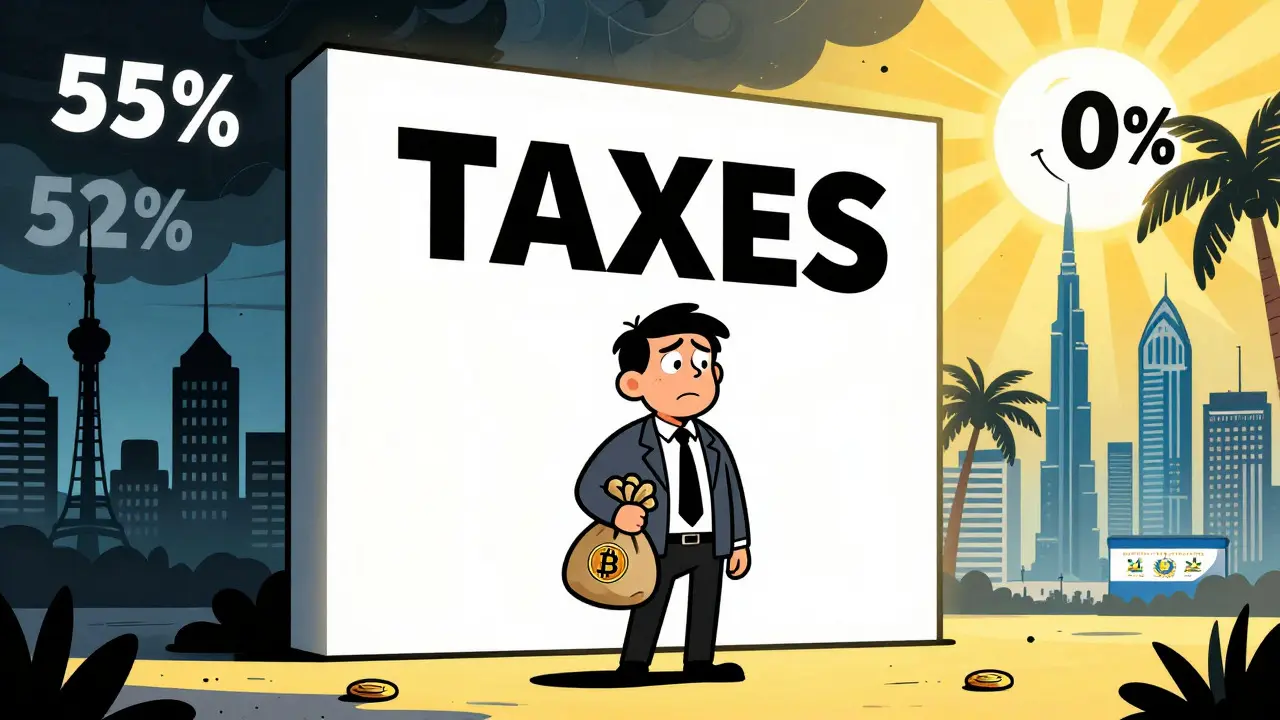
Imagine you just made a significant profit from Bitcoin or Ethereum. You’re ready to cash out, but then you hit a wall: taxes. The amount you keep depends entirely on where you live. In some places, you might pay nothing. In others, the government could take more than half of your gains. As we move through 2026, the rules are clearer than ever, but they remain wildly inconsistent across borders.
If you are looking to optimize your tax liability, understanding these differences is not just smart-it’s essential. This guide breaks down exactly how different countries treat digital assets, who pays what, and where the loopholes (or strict traps) lie.
The Global Spectrum: From 0% to 55%
Cryptocurrency taxation is not a one-size-fits-all system. Governments classify crypto differently. Some see it as property, some as currency, and others as ordinary income. This classification dictates the tax rate.
At the extreme end of the spectrum, you have countries with high progressive tax rates. Japan is currently the most expensive place for crypto investors. They apply a progressive tax structure ranging from 15% up to 55% on crypto capital gains. There is no distinction between short-term and long-term holdings; if you sell for a profit, you pay based on your total income bracket. For many traders, this makes Japan a hostile environment for active crypto investing.
Denmark follows closely behind. Here, crypto gains are treated as ordinary income, meaning they are taxed at rates between 37% and 52%. There is no separate capital gains allowance. If you trade frequently, the cumulative effect of these high rates can significantly erode your portfolio value.
On the other side of the coin, you have jurisdictions that offer complete exemption. Twelve countries currently provide a tax-free environment for cryptocurrency transactions. These include El Salvador, which adopted Bitcoin as legal tender, making it impossible to tax its use as money. Other notable zero-tax havens include the United Arab Emirates, Switzerland, and Singapore (though Singapore may impose Goods and Services Tax on certain services, capital gains are generally exempt).
| Country | Tax Type | Rate / Condition | Key Nuance |
|---|---|---|---|
| Japan | Capital Gains | 15% - 55% | Progressive rate; no long-term discount |
| USA | Capital Gains | 0% - 37% | Depends on holding period (<1yr vs >1yr) |
| Germany | Mixed | 0% - 45% | Tax-free if held >1 year (private sales) |
| France | Flat Tax | 30% | Includes social contributions; optional progressive option |
| UAE | None | 0% | No personal income tax; business activities may differ |
| UK | Capital Gains | 10% - 20% | Based on income bracket; £3,000 allowance (2025) |
The "Hold Longer" Strategy: Germany and Portugal
Not all favorable tax regimes are completely free. Some countries incentivize patience. This is known as the "holding period" rule. If you wait long enough before selling, the tax vanishes.
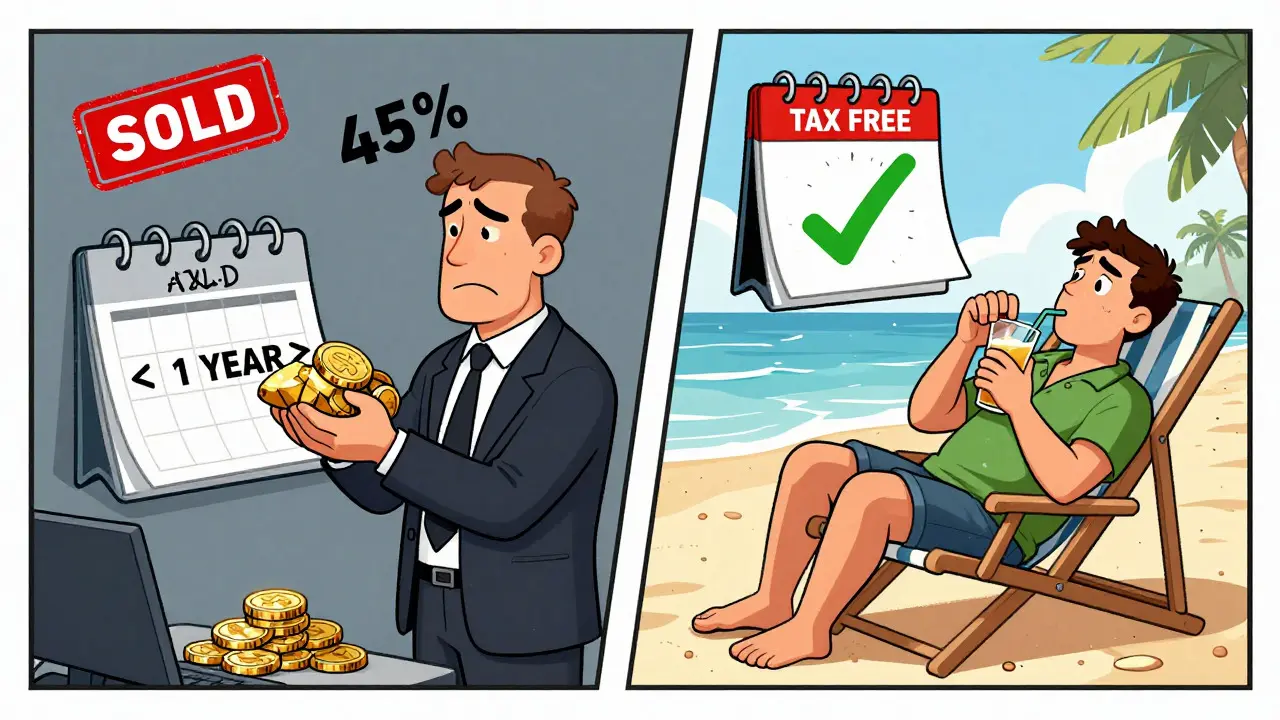
Germany is the prime example here. If you hold your cryptocurrency for more than one year, any profit you make upon selling is entirely tax-free. This applies to private asset management. However, if you sell within that first year, the gain is added to your regular income and taxed at your marginal rate, which can go up to 45% plus solidarity surcharge. This creates a massive behavioral incentive for German investors to HODL (hold on for dear life). But be careful: if you trade actively like a business, the one-year rule might not protect you, and mining or staking rewards are often taxed as income immediately.
Portugal used to be a paradise with zero tax on crypto. That changed recently. Now, short-term gains (held less than a year) are taxed at 28%. However, if you hold for more than a year, it remains tax-free. To benefit from this, you typically need to be a tax resident, which usually means spending at least 183 days in the country per year.
The United States: Short-Term vs. Long-Term
In the United States, the Internal Revenue Service (IRS) treats cryptocurrency as property. This means every time you swap one crypto for another, or spend crypto on coffee, it is a taxable event. The US uses a dual-rate system based on how long you held the asset.
- Short-Term Capital Gains: If you hold for less than one year, your profits are taxed as ordinary income. This means you pay your standard income tax bracket, which ranges from 10% to 37% depending on your total earnings.
- Long-Term Capital Gains: If you hold for more than one year, you qualify for lower rates. These range from 0% to 20%, again depending on your income level. For most middle-income earners, this rate is 15%.
Additionally, if you earn crypto through work, mining, or staking, that initial receipt of coins is taxed as ordinary income at its fair market value on the day you received it. When you eventually sell those coins, you calculate the gain or loss from that original value. This double-layered taxation can catch many new investors off guard.
Europe: A Patchwork of Rules
European Union countries are trying to harmonize their approaches, but right now, it is still a patchwork. France applies a flat 30% tax rate on crypto gains. This 30% includes both the capital gains tax and social contributions. While it sounds simple, it is often higher than the progressive income tax rate would be for lower-to-middle-income individuals. France also imposes heavy fines-up to €750 per unreported account-for failing to declare crypto holdings.
The United Kingdom treats crypto similarly to other investments. Basic-rate taxpayers pay 10% on gains, while higher-rate taxpayers pay 20%. There is an annual exempt amount (allowance), which was reduced to £3,000 in recent years. If your gains exceed this allowance, you must report them via Self-Assessment. Failure to do so can result in penalties up to 200% of the unpaid tax.
Zero-Tax Havens: Is It Really Free?
Countries like the United Arab Emirates, Panama, and Belize offer 0% tax on capital gains. This attracts many digital nomads and crypto entrepreneurs. However, "zero tax" does not mean "no rules."
You must understand residency requirements. Most countries define tax residency based on physical presence (e.g., 183 days a year) or domicile. If you are a US citizen, for instance, you are taxed on your worldwide income regardless of where you live. Moving to Dubai won’t help you avoid IRS taxes unless you renounce your citizenship. Similarly, countries like Switzerland and the UK may offer 0% tax on "private investment" gains, but if they deem your trading activity to be a "business," they will tax it as business income.

Compliance and Reporting: The Hidden Cost
Taxes are only part of the story. Compliance is the other. Many countries are cracking down on undeclared crypto accounts. The OECD’s Common Reporting Standard (CRS) allows countries to share financial data. If you hide crypto in a foreign bank account, the local authority might send that data to your home country’s tax office.
In Germany, the Federal Central Tax Office (BZSt) actively audits non-compliant taxpayers. In the UK, HMRC uses blockchain analysis firms to trace anonymous wallets. The era of hiding crypto gains is ending. Accurate record-keeping using software tools is no longer optional; it is a necessity to prove your cost basis and holding periods.
Future Trends: What to Expect in 2026 and Beyond
The trend is moving toward greater clarity and stricter enforcement. We are seeing more countries implement specific crypto legislation rather than relying on outdated property laws. The EU’s MiCA (Markets in Crypto-Assets) regulation is setting standards that influence tax reporting requirements across member states.
Expect more automation. Tax authorities are integrating directly with exchanges to receive transaction data. This means manual reporting errors will lead to faster audits. For investors, the strategy is shifting from evasion to optimization: choosing jurisdictions with favorable holding periods, utilizing tax-loss harvesting, and ensuring proper documentation of all transactions, including DeFi swaps and NFT trades.
Which countries have 0% crypto tax in 2026?
As of 2026, several countries offer 0% tax on crypto capital gains for residents. These include the United Arab Emirates, Singapore, Malaysia (for personal investments), Panama, Belize, and El Salvador. However, always verify current residency requirements and whether your specific activity (like trading vs. investing) qualifies for the exemption.
Is crypto tax-free in Germany?
Yes, but only under specific conditions. If you hold your cryptocurrency for more than one year, the profit from selling it is tax-free as a private sale. If you sell within one year, the gain is taxed as part of your regular income, potentially at rates up to 45%.
How does the US tax cryptocurrency?
The US taxes crypto as property. Short-term gains (held <1 year) are taxed as ordinary income (10%-37%). Long-term gains (held >1 year) are taxed at preferential capital gains rates (0%-20%). Every disposal event, including swapping tokens, is taxable.
What happens if I don't report my crypto gains?
Penalties vary by country but are generally severe. In the UK, fines can reach 200% of the unpaid tax. In France, you face fixed fines per unreported account plus back taxes and interest. With increased international data sharing, the risk of detection is higher than ever.
Does moving to a low-tax country eliminate my home country's taxes?
Not necessarily. Countries like the US tax based on citizenship, meaning you owe taxes globally regardless of residence. Other countries use residency rules (time spent in the country). You must formally sever tax ties with your home country to avoid double taxation or continued liability.





Jack Delasquez
July 27, 2026 AT 23:28man this is exactly what i needed right now!! im so tired of the irs taking a chunk outta my gains every time i try to cash out for groceries lol. honestly if japan is 55% thats just robbery plain and simple. i cant believe they dont even give you a break for holding long term like germany does. its crazy how different the rules are depending on where you sleep at night. makes me wanna pack my bags and move to dubai or something just to keep my own money. but then again moving is expensive too so maybe ill just suck it up and pay the tax. still feels wrong tho.
Qolbina Islami
July 28, 2026 AT 05:32THIS IS WHY WE NEED STRONGER BORDERS!!!
The government knows exactly what you have because they control the narrative!!!
If you are American, you are screwed no matter where you go!!!
They want your money!!!
Wake up sheeple!!!
Harman Singh
July 29, 2026 AT 07:51why do we always talk about taxes why not talk about how hard it is to make money in crypto first? everyone here acting like they are sitting on millions but most of us are just losing small amounts trying to figure it out. it is so exhausting reading all these guides when the market crashes every other day anyway. i feel like the system is rigged against normal people who just want to save some cash. nobody cares about the little guy anymore.
SUBHAM CHOUDHURY
July 30, 2026 AT 11:01You can totally turn this around! Just focus on the long game and don't let the stress get to you. Holding for over a year in places like Germany is such a smart move if you can stick with it. It really pays off in the end when you see that tax-free profit. Keep your head up and trust the process. You've got this!
amy miranda
July 30, 2026 AT 22:43It is absolutely infuriating how the wealthy exploit loopholes while the rest of us are forced to report every single penny with perfect precision. The moral decay of our financial systems is evident in these disparities. One must question the integrity of nations that allow such inequity to flourish under the guise of economic freedom. It is simply unjust.
Pernelia Wahkan
July 31, 2026 AT 17:10I’ve been digging into the MiCA regulations lately and it’s fascinating how they’re trying to stitch together this patchwork quilt of EU laws. The way they define ‘disposal’ events is particularly tricky for DeFi users who swap tokens constantly without realizing each hop is a taxable event. I’d recommend keeping a meticulous ledger using tools like Koinly or CoinTracker because manual tracking is basically impossible once you hit fifty transactions. The key is understanding cost basis methods-FIFO versus LIFO can drastically change your liability depending on whether prices went up or down during your holding period. Don’t sleep on tax-loss harvesting either; selling losers to offset winners is a legitimate strategy that many overlook until April arrives.
Subhash Kashyap Dm
August 1, 2026 AT 09:36they are watching you through the blockchain analysis firms mentioned in the article its not just theory anymore the crs data sharing means your offshore account is visible to your home country instantly stop thinking you can hide behind privacy coins they are being de-listed from major exchanges left and right the only real privacy is cold storage and air-gapped setups but even then metadata leaks everything prepare for total surveillance state compliance
Billy Cunningham
August 2, 2026 AT 16:53Just moved to Dubai last month 😅 No income tax feels amazing but the rent is killing me 💸 Still worth it though 🚀
Joy Kwant
August 3, 2026 AT 10:48I just find it so morally bankrupt that people rush to zero-tax havens instead of contributing to society. It’s selfish. You enjoy the infrastructure, the rule of law, and the stability provided by the state, yet you refuse to pay your fair share. It’s greed masquerading as optimization. We need to shame these behaviors more openly.