
Blockchain Validation Comparison Tool
Compare Different Blockchain Validation Methods
See how PoW, PoS, PoA, and DPoS compare across key metrics
Every time you send Bitcoin or swap tokens on Ethereum, a quiet but powerful process happens behind the scenes: block validation. This isn’t just technical jargon-it’s what keeps the entire system honest. Without it, anyone could spend the same coin twice, fake transactions, or take over the network. Block validation is the reason blockchain works without banks, governments, or middlemen. It’s the glue holding decentralized systems together.
What Happens When a Transaction Is Sent?
It starts with a simple action: you send 0.5 ETH to a friend. That transaction doesn’t go straight to a ledger. Instead, it’s broadcast to every node in the network-thousands of computers running blockchain software. Each node checks it before passing it along. They’re not trusting you. They’re verifying. Here’s what they check:- Is the digital signature valid? (Proving you own the wallet)
- Do you have enough balance? (Using UTXO or account-based models)
- Does it follow the protocol rules? (No oversized transactions, no invalid opcodes)
The Block Builder: Grouping Transactions
Once transactions are validated individually, they’re grouped into a candidate block. Bitcoin limits each block to 4MB-roughly 2,000-3,000 transactions. Ethereum doesn’t use size limits. Instead, it uses gas. Each operation costs gas. The current block gas limit is 30 million. If a block hits that cap, no more transactions fit, even if they’re valid. Miners (in PoW) or validators (in PoS) compete to build the next block. They pick transactions from the mempool, usually favoring those with higher fees. This isn’t random-it’s economic. The more you pay, the faster your transaction gets processed. That’s why during NFT drops or DeFi rushes, gas fees spike.Proof of Work: Mining as a Security Mechanism
Bitcoin still uses Proof of Work. Here, miners race to solve a cryptographic puzzle. The puzzle isn’t math you’d solve on paper-it’s a hash function. Miners try billions of random numbers per second until one finds a hash that meets the network’s target. That target adjusts every 2,016 blocks (about two weeks) to keep block time at 10 minutes. The current Bitcoin network hashes at over 400 exahashes per second. That’s 400 quintillion guesses a second. It’s like rolling a dice with 10^21 sides and hoping for a specific number. The energy cost? Around 150 terawatt-hours per year-more than Argentina uses annually. Why does this matter? Because it makes attacks expensive. To control the network, you’d need over half that hash power. That’s not just costly-it’s practically impossible. The hardware alone costs thousands of dollars per machine. ASIC miners like the Antminer S21 are built for this one task. They’re loud, hot, and eat electricity like a small house.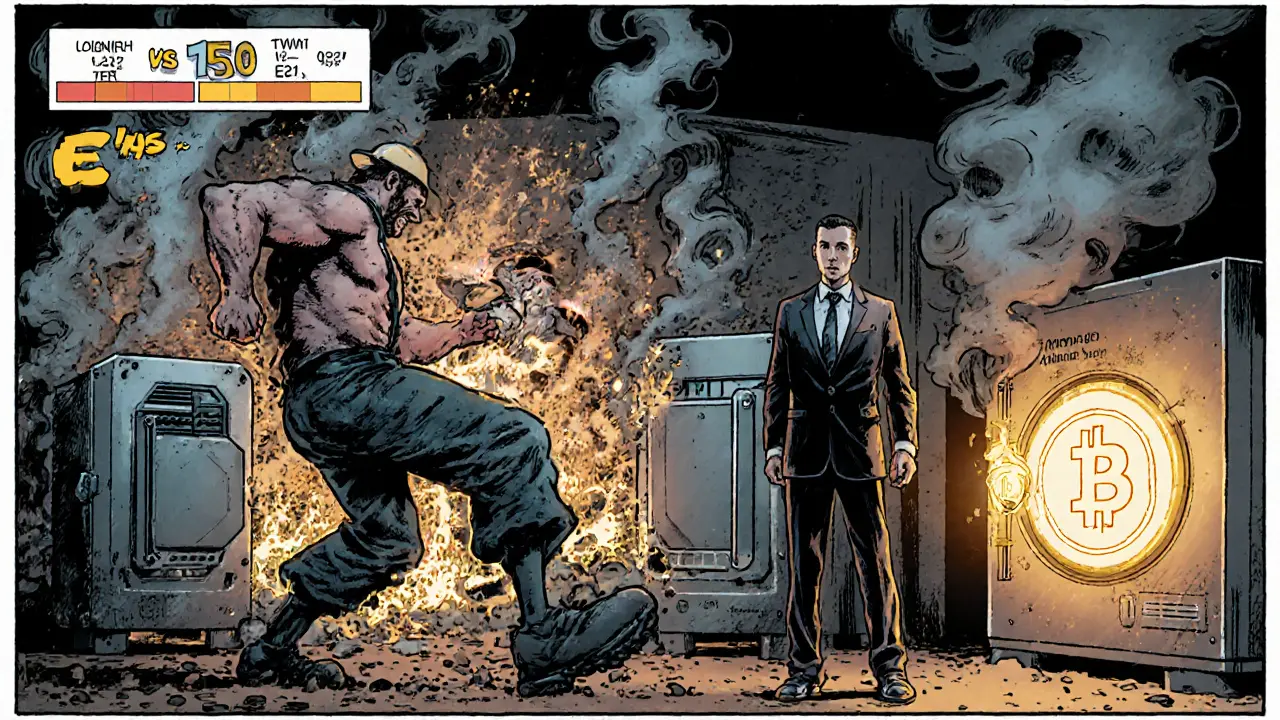
Proof of Stake: The Energy-Efficient Alternative
Ethereum switched to Proof of Stake in September 2022. No more mining rigs. No more massive power bills. Instead, validators lock up 32 ETH as collateral. That’s about $102,400 at current prices. You don’t solve puzzles-you’re chosen randomly to propose and verify blocks based on how much you’ve staked and how long you’ve been active. Validators don’t just verify blocks. They vote on them. At least two-thirds of active validators must agree a block is valid before it’s finalized. If you try to cheat-like proposing two conflicting blocks-you lose your entire stake. That’s called slashing. It’s harsh, but it works. Since the Merge, over 1,200 validators have been slashed for misbehavior, losing a total of 18,000 ETH. The energy savings? Massive. Ethereum now uses 99.95% less electricity than it did under PoW. That’s the difference between running a data center and plugging in a Raspberry Pi.Other Models: When Speed Matters More Than Decentralization
Not all blockchains need Bitcoin-level security. Some need speed. Others need control. Proof of Authority (PoA) is used by VeChain and Microsoft’s Azure Blockchain. Only pre-approved, identity-verified entities can validate. That means no random strangers. Just trusted companies or institutions. Result? Blocks finalize in 10 seconds. Throughput hits 1,500+ transactions per second. But it’s centralized. You’re trusting a handful of organizations. Delegated Proof of Stake (DPoS), used by EOS and Tron, lets token holders vote for 21 validators. It’s faster than PoS but still vulnerable to cartel behavior. If the top 5 validators collude, they can censor transactions. Each model has trade-offs:| Model | Security | Speed | Energy Use | Entry Cost | Decentralization |
|---|---|---|---|---|---|
| Proof of Work (Bitcoin) | Very High | 7 TPS | 150 TWh/year | $2K-$15K (ASIC) | High |
| Proof of Stake (Ethereum) | High | 20-30 TPS | 0.01 TWh/year | $102K (32 ETH) | Moderate |
| Proof of Authority (VeChain) | Moderate | 1,500+ TPS | Negligible | Identity + Legal Approval | Low |
| Delegated PoS (EOS) | Moderate | 4,000+ TPS | Negligible | $0 (Vote tokens) | Low-Moderate |
Real-World Risks and Failures
Validation isn’t foolproof. People mess up. On Reddit’s r/ethstaker, users report horror stories. One validator lost 8 ETH because their node went offline during the Shanghai upgrade. Another accidentally exposed their private key. Slashing isn’t theoretical-it’s real. About 12.7% of new validators make configuration errors that lead to penalties. Even big players aren’t immune. In 2023, a bug in a popular staking service caused 3,000 validators to miss attestations. The network recovered, but the event showed how fragile coordination can be. Bitcoin’s PoW isn’t safe from manipulation either. If a mining pool hits 51% of hash power, it can reverse transactions. That’s never happened on Bitcoin-but it has on smaller chains like Verge and Bitcoin Gold.
Who Runs Validators Today?
Most individual validators are tech-savvy people aged 25-44. They run nodes on home servers or cloud instances. Some use services like Coinbase Cloud or Lido to avoid the complexity. These services charge 4-10% of rewards but handle everything: updates, security, uptime. Enterprise validators are different. They’re managed by IT teams in banks, logistics firms, and government agencies. They use permissioned chains because they need control, compliance, and audit trails-not decentralization. According to Deloitte’s 2025 survey, 47% of Fortune 500 companies use blockchain for supply chain tracking or identity verification. Almost all of them use PoA or DPoS. Why? Because they don’t want strangers validating their transactions. They want lawyers and auditors involved.What’s Next for Block Validation?
The future isn’t about picking one model. It’s about mixing them. Ethereum’s upcoming Verge upgrade (Q2 2026) will replace Merkle trees with Verkle trees. This cuts validator storage from 1TB to just 10GB. That means you can validate Ethereum on a laptop. That’s huge for decentralization. Bitcoin might adopt MAST ( Merkelized Abstract Syntax Trees) to make smart contracts more efficient. That could open the door to DeFi on Bitcoin without sacrificing its security. Hybrid models are gaining traction. Some new chains use PoW to create blocks, then PoS to finalize them. This combines Bitcoin’s resistance to attacks with Ethereum’s efficiency. And then there’s quantum computing. NIST estimates it could break current cryptographic signatures in 10-15 years. Blockchain developers are already testing post-quantum algorithms. The next generation of validation will need to be quantum-resistant.Why This Matters to You
Whether you’re holding Bitcoin, using DeFi, or working for a company exploring blockchain, understanding block validation helps you make smarter choices. - If you care about security and don’t mind slow speeds, Bitcoin’s PoW is still the gold standard. - If you want low fees and green energy, Ethereum’s PoS is the way to go. - If you’re building a business system, PoA gives you control and speed-but you lose censorship resistance. Validation isn’t just a technical detail. It’s a political choice. Who gets to decide what’s valid? Miners? Stakeholders? Regulators? The answer shapes the entire system. The next time you send crypto, remember: it’s not magic. It’s math, economics, and human behavior working together to create trust without trust.How long does it take to validate a block in Bitcoin vs. Ethereum?
Bitcoin targets a 10-minute block time, adjusted every two weeks to maintain consistency. Ethereum, after switching to Proof of Stake, produces blocks every 12 seconds. Finality-meaning the transaction is irreversible-takes about 15 minutes on Ethereum, compared to 60 minutes (six confirmations) on Bitcoin.
Can I validate blocks on my home computer?
Yes, but only for Proof of Stake networks like Ethereum. You need at least 32 ETH (around $102,400), a reliable internet connection, and a computer with 4 cores, 16GB RAM, and a 1TB SSD. For Bitcoin mining, you’d need specialized ASIC hardware costing thousands of dollars and access to cheap electricity-home setups aren’t profitable anymore.
What happens if a validator goes offline?
In Proof of Stake, going offline doesn’t trigger slashing-it just means you miss rewards. But if you’re offline too often, your stake gets penalized gradually. In Proof of Work, miners who go offline simply stop earning block rewards. There’s no penalty beyond lost income.
Why do some blockchains use different validation methods?
Different goals require different tools. Bitcoin prioritizes security and decentralization over speed, so it uses PoW. Ethereum balances security, speed, and energy use, so it chose PoS. Enterprise chains like VeChain need speed and control, so they use PoA. There’s no one-size-fits-all solution.
Is Proof of Stake less secure than Proof of Work?
Not necessarily. PoW’s security comes from physical cost-miners spend money on hardware and electricity. PoS’s security comes from economic cost-validators risk losing their staked funds. Ethereum’s slashing mechanism makes attacks financially irrational. Since the Merge, Ethereum has processed over $2 trillion in transactions without a single successful attack.
How do I become a validator on Ethereum?
You need 32 ETH, a computer meeting minimum specs, and technical knowledge to run a node. You can use the Ethereum Foundation’s staking launchpad to deposit ETH and join the queue. Alternatively, use a staking service like Lido or Coinbase Cloud-they handle the setup for you in exchange for a fee (4-10%).
Are block validation rewards taxable?
Yes. In the U.S., the IRS treats staking rewards as taxable income at their fair market value when received. The EU’s MiCA regulations also classify validators as crypto asset service providers, requiring reporting. Always consult a tax professional familiar with crypto regulations in your country.





Janice Jose
November 27, 2025 AT 07:59Just read this whole thing and honestly? I didn’t think I’d care about block validation until now. It’s wild how much math and economics go into something that feels like magic when you send crypto. Thanks for breaking it down without the jargon overload.
Also, the part about Ethereum using less power than a Raspberry Pi? That’s the kind of stat that makes me feel good about using it. No more guilt trips from my eco-conscious roommate.
Savan Prajapati
November 27, 2025 AT 19:19PoW is dead. Stop pretending it’s secure. Bitcoin wastes more power than some countries. Get real.
Joel Christian
November 27, 2025 AT 23:36omg i just learned that validators can get slashed?? like… they just lose their money?? 😱 i thought blockchain was like… unbreakable??
also why do i need 100k just to run a node?? this feels like a scam now. my laptop can barely run zoom.
ps: i think i misspelled somthing. sorry.
pps: can i stake with my dogecoin? pleeeease??
Vijay Kumar
November 29, 2025 AT 01:42You think PoS is the answer? You’re naive. Power doesn’t disappear-it just moves from miners to the rich. The 32 ETH barrier? That’s not decentralization. That’s a gated community for crypto billionaires.
Real freedom is in mining. Real security is in work. Not in staking your soul for a 4% yield.
And don’t even get me started on PoA-corporate blockchain is just a database with a fancy name.
Brian Bernfeld
November 29, 2025 AT 12:52Let me tell you something real: I ran a validator node for 8 months. I had to upgrade my SSD twice, fought through 3 software updates that broke my setup, and once forgot to reboot after a kernel update-lost 0.2 ETH in missed attestations. It’s not glamorous.
But here’s the thing-it’s worth it. I’m not rich. I’m not a coder. I’m just a guy in Ohio with a server in his closet. And I helped secure a global financial system. That’s not something you can say about your 9-to-5.
And yes, the 32 ETH门槛 is brutal. That’s why services like Lido exist. You don’t need to be a tech wizard to participate. Just be consistent. Keep your node alive. That’s 90% of the battle.
Also, the Verge upgrade? If they cut validator storage to 10GB, I’ll be able to run it on my old MacBook Air. That’s the future. Not ASICs. Not corporate chains. Just regular people, running nodes, on whatever hardware they’ve got.
And if you think PoW is ‘more secure’-look at the 51% attacks on Bitcoin Gold. PoW isn’t magic. It’s just expensive. PoS makes attacks expensive *and* socially unacceptable. That’s smarter.
Finally, tax implications? Yeah, it’s messy. But that’s not the blockchain’s fault. That’s governments catching up. We’ll figure it out. We always do.
Ian Esche
November 29, 2025 AT 20:05America built Bitcoin. America made crypto real. Now we’re letting Europeans and their ‘green’ staking nonsense take over? PoW is American ingenuity. PoS is just corporate greenwashing with a blockchain label.
Get your facts straight-Ethereum’s ‘energy savings’? They’re still running servers. Just cheaper ones. And who runs those? Big tech. Big banks. That’s not freedom. That’s centralization in a hoodie.
Bitcoin is the last true decentralized network. Everything else is just a glorified cloud database.
Felicia Sue Lynn
November 29, 2025 AT 21:43There is a deeper philosophical question here: What does it mean to be ‘trustless’ when the system’s integrity depends on economic incentives rather than cryptographic guarantees? PoW anchors trust in physical scarcity; PoS anchors it in social consensus through financial stake.
One is an engineering solution. The other is a sociological one.
And yet, both rely on human behavior-on rational actors, on fear of loss, on collective adherence to protocol. Perhaps the real innovation isn’t the algorithm, but the way we’ve engineered incentive structures to replace institutions.
This is not merely technical evolution. It is the quiet collapse of the middleman, not through force, but through alignment of interest.
And perhaps, in that alignment, we find not just efficiency-but a new form of social contract.