
When you hear about a new cryptocurrency, especially one tied to AI and cloud computing, it’s easy to get lost in the hype. But Destra Network (DSYNC) isn’t just another token with a flashy whitepaper. It’s a working infrastructure project trying to fix a real problem: who controls the power behind AI? Right now, big tech companies own the GPUs, the data centers, and the cloud services that run most AI models. Destra Network wants to flip that. It’s building a decentralized network where anyone can rent out their GPU power, store data without relying on Amazon or Google, and run AI tools without asking for permission.
What Exactly Is DSYNC?
DSYNC is the native utility token of Destra Network - a blockchain-based platform designed to power decentralized AI and cloud computing. Unlike coins that are just speculative assets, DSYNC has a job: it pays for services on the network. Need to train an AI model? Pay in DSYNC. Want to rent a GPU from someone in Poland? Pay in DSYNC. Storing a file permanently on a distributed network? That’s DSYNC too. It’s not a store of value like Bitcoin. It’s the fuel.
The core innovation? Destra moves away from traditional location-based systems. Instead of saying, “Save this file on server 123.45.67.89,” it says, “Save this file by its content.” Think of it like how you search for a song by its melody, not by the store it’s sold in. This is done using IPFS (InterPlanetary File System) and Destra’s own decentralized DNS. Once data is uploaded, it’s copied across hundreds of nodes. No single company owns it. No server farm can take it down.
How Destra Network Works
Destra’s infrastructure is built on a Layer 2 blockchain optimized for fast, low-cost infrastructure transactions. This isn’t Ethereum or Solana. It’s a custom chain designed for one thing: handling requests between users and decentralized computing resources. Here’s how it breaks down:
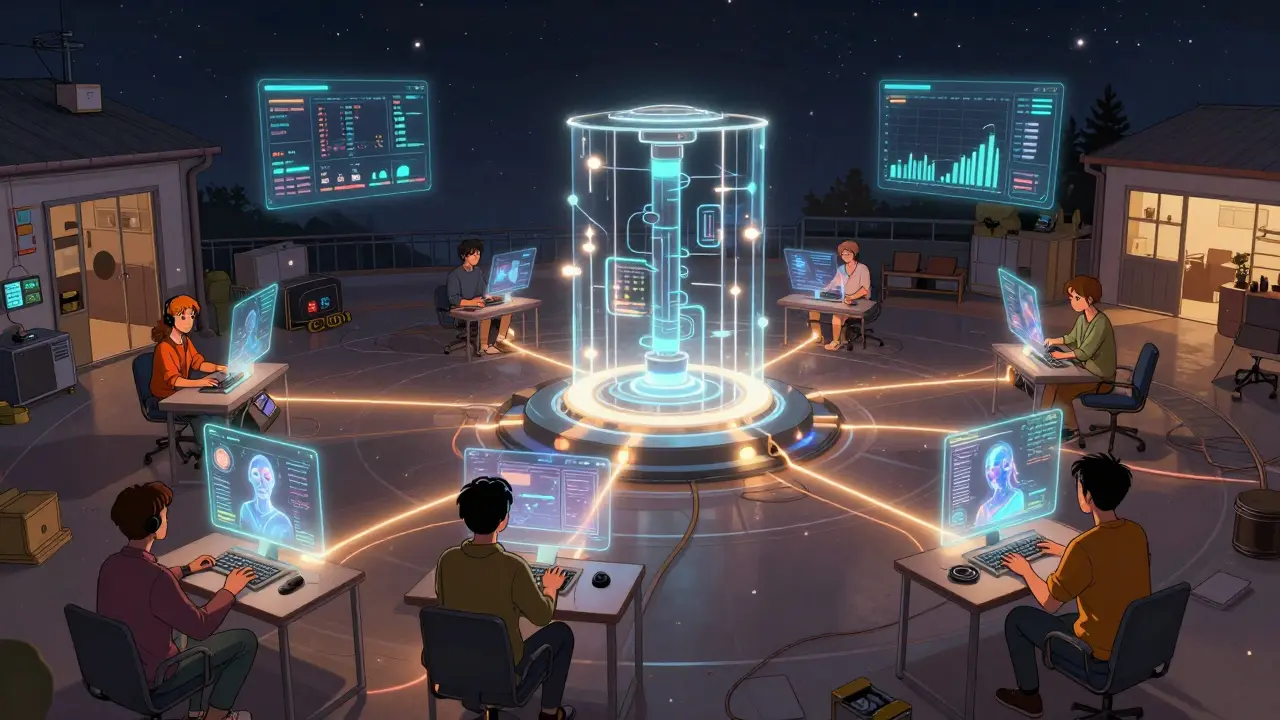
- D-Rigs: These are the hardware nodes that contribute computing power - mostly GPUs. Anyone can run a D-Rig. You plug in your graphics card, connect to the network, and start earning DSYNC for letting others use your hardware.
- Decentralized Nodes: Thousands of these nodes are spread globally. They handle storage, routing, and computation. The more nodes, the faster and more resilient the network becomes.
- Live GPU Dashboard: Unlike most crypto projects that hide their stats, Destra shows real-time data. You can see how many GPUs are online, their uptime, and performance metrics. Transparency matters when you’re trusting your AI workloads to strangers’ hardware.
- Content-Based Addressing: Files are stored by hash, not by location. This means if one node goes offline, another has the same data. No single point of failure.
The network also supports ENS (Ethereum Name Service) for human-readable addresses. Instead of typing a 64-character hash to access your AI model, you can use something like myai.destra.eth.
What Can You Do With Destra Network?
Destra isn’t just a storage network. It’s a full-stack AI infrastructure platform. Here’s what users can access:
- AI Model Training: You can train your own large language models (LLMs) using distributed GPU power. No need to rent expensive cloud instances from AWS.
- One-Click AI Deployment: Upload your trained model, and the platform automatically deploys it as a public API. Developers can integrate it into apps without managing servers.
- Exclusive AI Models: Destra has built its own AI models optimized for decentralized environments. These aren’t just open-source copies - they’re fine-tuned to run efficiently on distributed hardware.
- Decentralized RPC: Most Web3 apps rely on centralized RPC endpoints (like Infura). Destra lets you run your own secure, censorship-resistant endpoint.
- Domain Hosting: Host your website or dApp on the decentralized DNS. No need for traditional domain registrars.
Imagine building a voice assistant app. Normally, you’d pay $500/month to AWS for compute. With Destra, you pay in DSYNC - maybe $50 - and your app runs on a network of 500+ independent GPUs spread across 30 countries. If one node fails, the system reroutes automatically.
Staking and Rewards
DSYNC holders can participate in network validation through staking. By locking up their tokens, they help secure the Layer 2 blockchain and earn rewards in return. The rewards aren’t huge - they’re designed to be sustainable, not speculative. This isn’t a “get rich quick” scheme. It’s a way to align incentives: the more you stake, the more you benefit from the network’s growth.
As of October 2025, the staking mechanism is live and actively used. Exact APRs aren’t published, but early participants report returns in the 5-8% annual range - modest compared to some DeFi projects, but far more stable and tied to real utility.
Market Performance and Adoption
As of late September 2025, DSYNC trades around $0.08802. The 24-hour trading volume hovers near $4.5 million - solid for a project this niche. That’s not Coinbase-level liquidity, but it’s enough to indicate active trading and real demand.
Here’s the catch: DSYNC hasn’t had a breakout. In the same week that Bitcoin rose 3%, DSYNC fell 1.4%. Over seven days, it dropped 3.4%. Why? Because it’s not a meme coin. It’s infrastructure. People don’t buy it because they think it’ll double in a week. They buy it because they need it to run AI tools.
Destra’s Early Adopters program - offering a $100,000 reward pool - has helped attract developers and node operators. But there’s still no flood of retail users. Most of the activity comes from engineers, AI researchers, and Web3 builders who are tired of centralized cloud monopolies.
How Destra Compares to Other Projects
Destra doesn’t compete with Ethereum or Solana. It competes with Akash Network (AKT), Bittensor (TAO), and even centralized players like Lambda Labs. Here’s how it stacks up:
| Feature | Destra Network (DSYNC) | Akash Network (AKT) | Bittensor (TAO) |
|---|---|---|---|
| Primary Focus | AI training + decentralized cloud | General-purpose cloud rental | Decentralized AI models + inference |
| Storage Layer | IPFS + Decentralized DNS | Traditional cloud storage | On-chain model weights |
| GPU Network | Yes - live dashboard | Yes | Yes - incentivized by mining |
| Token Utility | Pays for services | Pays for compute | Stake to earn rewards from model predictions |
| Transparency | High - real-time node stats | Medium | Low - opaque scoring |
Destra stands out because it combines storage, compute, and AI deployment into one seamless system. Akash gives you cloud space. Bittensor gives you AI predictions. Destra gives you the whole pipeline - from training your model to deploying it as a public API - all on decentralized infrastructure.

Is Destra Network Worth Paying Attention To?
If you’re a retail investor looking for the next 10x coin, DSYNC probably isn’t it. The market is quiet. The community is small. There’s no viral Twitter buzz.
But if you’re a developer, AI researcher, or Web3 builder who’s tired of paying Amazon for every AI request - then Destra Network is one of the most compelling projects in crypto right now. It’s not trying to replace Bitcoin. It’s trying to replace AWS.
And that’s rare. Most crypto projects talk about decentralization. Destra is building it - one GPU at a time.
What’s Missing?
There are gaps. The official documentation is developer-heavy. There’s no beginner guide. No YouTube tutorials. No Reddit threads full of user stories. That’s not an accident - it’s because Destra isn’t targeting casual users. It’s targeting people who need to run AI at scale without trusting a corporation.
Also, the circulating supply isn’t public. That makes it hard to calculate market cap. That’s a red flag for some. But for others, it’s a sign the team is focused on utility, not speculation.
And yes - there’s no major exchange listing beyond a few decentralized exchanges. No Coinbase. No Kraken. That limits accessibility. But again, that’s not unusual for infrastructure tokens. Akash and Bittensor didn’t hit major exchanges until years after launch.
Final Thoughts
Destra Network (DSYNC) is not a hype coin. It’s a quiet, serious project building the backbone for the next generation of AI. It doesn’t need millions of traders. It needs thousands of developers, node operators, and AI teams who are ready to break free from centralized cloud providers.
Right now, DSYNC is trading at $0.088. Is that cheap? Maybe. Is it a good investment? That depends. If you believe the future of AI belongs to decentralized networks - not Silicon Valley - then DSYNC isn’t just a token. It’s a stake in that future.
What is DSYNC used for?
DSYNC is the utility token that powers Destra Network. It’s used to pay for GPU rental, AI model training, decentralized storage, domain hosting, and API deployment on the network. You can’t use it to buy coffee - but you can use it to run your own AI model without relying on Amazon or Google.
Can I stake DSYNC?
Yes. DSYNC holders can stake their tokens to help secure the Destra Layer 2 blockchain. In return, they earn rewards in DSYNC. Staking isn’t designed for high yields - it’s meant to align long-term incentives between users and network security.
How is Destra different from Akash Network?
Akash focuses on renting out general-purpose cloud compute. Destra is built specifically for AI workloads. It includes integrated storage (IPFS), decentralized DNS, one-click AI deployment, and its own AI models. Destra is more of a full-stack AI infrastructure platform, while Akash is a cloud rental marketplace.
Is Destra Network live?
Yes. The network is live with thousands of active GPU nodes, a working staking system, and real-time dashboards showing compute usage. Developers can already deploy AI models and use decentralized storage. It’s not a prototype - it’s operational.
Why hasn’t DSYNC price gone up?
Because it’s not built for speculation. Most of the demand comes from users who need the service - not investors hoping to flip. That means price moves slowly. It’s also not listed on major exchanges, which limits retail buying pressure. Its value comes from usage, not trading volume.
Can I run a D-Rig with my gaming GPU?
Yes. Destra allows anyone with a GPU (NVIDIA or AMD) to join as a node operator. You don’t need enterprise hardware. A mid-range gaming card like an RTX 4070 or RX 7800 XT is enough to start earning DSYNC by contributing compute power.
Where can I buy DSYNC?
DSYNC is available on decentralized exchanges like Uniswap V3 and SushiSwap. It’s not listed on centralized exchanges like Coinbase or Binance. You’ll need a crypto wallet (like MetaMask) and some ETH or USDT to swap for DSYNC.



Tom Jewell
March 11, 2026 AT 11:46There’s something quietly revolutionary about Destra. Not the kind that makes headlines, but the kind that changes how the world actually works - behind the scenes, in server rooms and developer terminals. We’ve spent decades building empires on centralized control, and now we’re finally seeing a movement to hand that power back to individuals. Not with grand speeches, but with code, GPUs, and quiet persistence. It’s not about making money. It’s about making autonomy. And honestly? That’s more valuable than any 10x coin ever could be.
Allison Davis
March 12, 2026 AT 12:12The real win here is the live GPU dashboard. Most decentralized projects hide their metrics behind walls of whitepapers. Destra puts everything out there - uptime, performance, location. That transparency isn’t just nice, it’s necessary. If you’re going to trust strangers’ hardware with your AI workload, you damn well better see what you’re getting. This isn’t speculation. It’s infrastructure. And infrastructure needs accountability.
Julie Tomek
March 13, 2026 AT 06:21I’ve spent years evaluating decentralized infrastructure projects, and Destra stands apart not because of its tokenomics, but because of its architectural integrity. The integration of IPFS, decentralized DNS, and content-based addressing creates a truly self-sustaining ecosystem. Unlike Akash, which merely rents compute, Destra builds an entire operational environment where training, deployment, and hosting are seamless. The fact that they’ve prioritized utility over hype is refreshing. This is what Web3 should have been from the start - not a casino, but a workshop. And the staking model? Brilliantly restrained. No yield farming gimmicks. Just steady, aligned incentives. If this scales, it could redefine how AI infrastructure is accessed globally.
Craig Gregory
March 13, 2026 AT 07:09Let’s be real. This is just another ‘decentralized’ project trying to sound smart while ignoring the fact that 99% of users don’t care about IPFS or node operators. They want a fast, cheap, reliable cloud. And guess what? AWS delivers that. Destra’s user base? Engineers who hate corporations. That’s not a market - that’s a niche with a martyr complex. The price isn’t going up because nobody outside of crypto bros needs this. And even they’re not using it in production yet. Stop romanticizing infrastructure. It’s not a movement. It’s a technical workaround with zero consumer appeal.
Anshita Koul
March 13, 2026 AT 12:52What excites me most is not the tech - though it’s brilliant - but the cultural shift. For the first time, a person in Mumbai, or Lagos, or Guadalajara can contribute their GPU and earn real value - not just speculation, but utility-driven income. This isn’t about replacing Amazon; it’s about democratizing access. A single RTX 4070 in someone’s basement can now compete with a data center in Virginia. And that? That’s freedom. No gatekeepers. No contracts. No corporate oversight. Just a network, built by people, for people. I’ve seen so many projects promise this - Destra is the first one that actually delivers.
PIYUSH KOTANGALE
March 14, 2026 AT 21:16Just ran my first AI model on Destra. Paid $12 in DSYNC for 3 hours of training. AWS would’ve cost $180. No paperwork. No credit card. No waiting. It just worked. Also, my node is now online - 4070, 24/7, earning. This is the future. Simple. Powerful. Real.
Anthony Marshall
March 16, 2026 AT 11:05Craig, you’re missing the point entirely. This isn’t for consumers - it’s for builders. And builders are the ones who change the world. You think AWS is the endgame? Wake up. They’re already overpriced, overcentralized, and vulnerable. Destra isn’t trying to be sexy. It’s trying to be unbreakable. And when the next cloud outage happens - and it will - developers won’t be begging Amazon for mercy. They’ll be on Destra. You’re not seeing the future because you’re still stuck in 2018.
Lindsay Girvan
March 17, 2026 AT 06:41And yet, no major exchange listing. No marketing. No retail traction. You can’t build a revolution on the back of 500 engineers. You need millions of users. Or at least, one viral moment. This isn’t a movement - it’s a basement project with good code. The market doesn’t care about transparency if it doesn’t see a price chart going up. Destra’s biggest enemy isn’t AWS - it’s indifference.