NFT Verification Calculator
Verify Your Collection's Requirements
Calculate if your NFT collection meets LooksRare's verification criteria based on trading volume and other factors mentioned in the article.
Verification Results
Enter your collection's trading volume to see if you meet verification requirements.
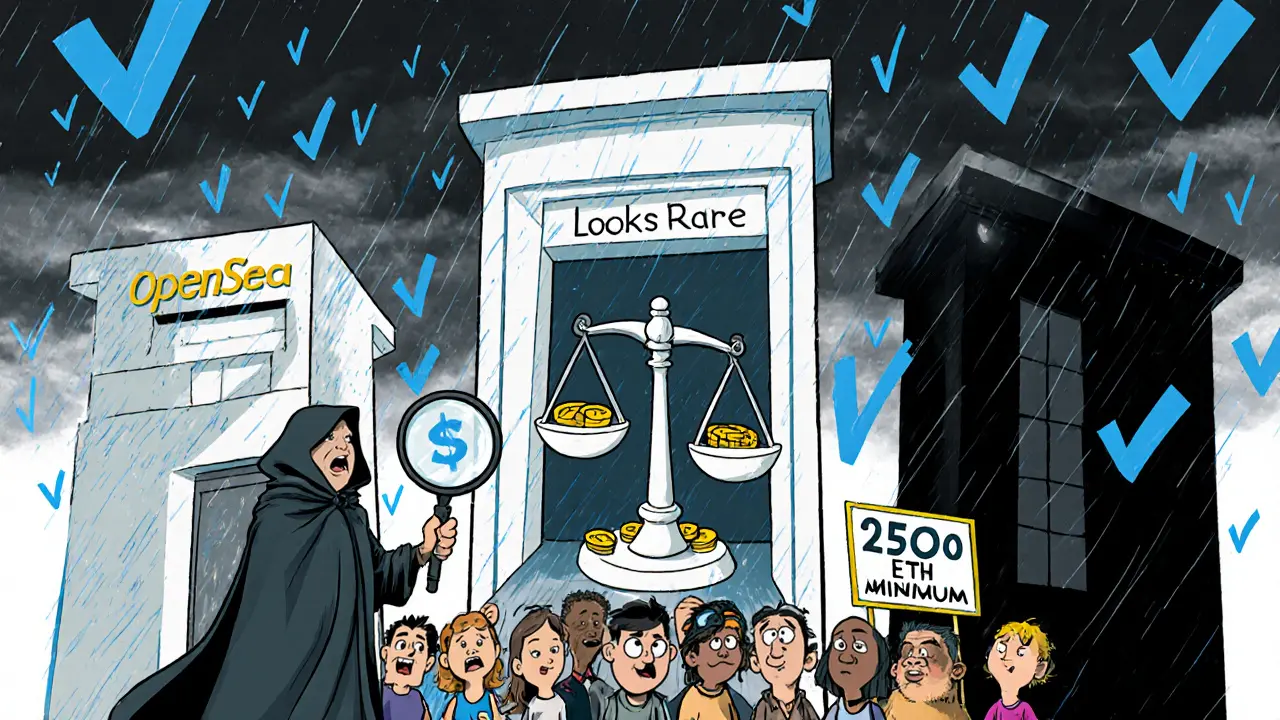
When you see a blue checkmark next to an NFT collection on OpenSea or LooksRare, it doesn’t mean the art is good. It doesn’t even mean it’s valuable. It just means the platform thinks it’s real. And in a world where fake Bored Apes sell for thousands, that checkmark is the only thing standing between you and a scam.
Why Verification Matters More Than You Think
In 2022, NFT scams cost users over $142 million. Most of those weren’t hacks. They were impersonations. Someone creates a collection called "Cool Cats" - same name, same art style - but it’s not the real one. They list it on OpenSea. You buy it thinking you’re getting the OG project. You’re not. You’re holding garbage. Verification exists to stop that. But here’s the problem: there’s no universal rule. Each marketplace has its own system. And none of them are simple.OpenSea: The Opaque Gatekeeper
OpenSea handles about 65% of all NFT trading. That makes their verification system the most sought-after - and the most mysterious. You can’t apply directly. There’s no form you fill out that says, "Here’s my project, please verify me." Instead, OpenSea’s team looks for signals: media coverage (TechCrunch, CoinDesk), verified social accounts from the founders, active Discord communities, and consistent trading volume. Even then, most projects get rejected. A 2022 Reddit survey of 200 creators found that fewer than 5% got verified on OpenSea. One user spent eight months applying, had over 300 ETH in volume, and got denied twice. Why? Because OpenSea doesn’t tell you why. They don’t have to. The Cool Cats collection got verified in July 2021 after TechCrunch wrote about them and the founders confirmed their identities publicly. That’s the playbook: get press, be public, be active. If you’re anonymous, or you’re just launching, your chances are slim.LooksRare: The Volume-Only System
LooksRare took a different path. They cut through the noise and built a system based on one thing: trading volume. To get verified on LooksRare, your collection needs at least 250 ETH in trading volume on their platform - or 500 ETH across all NFT marketplaces - excluding private sales. That’s about $750,000 at $3,000 per ETH. It’s expensive. But it’s clear. There are two other paths: manual review (to prove you’re not copying another collection) or being "notable" - like partnering with a celebrity or major brand. But for most projects, volume is the only realistic route. The upside? It’s transparent. You know what you need. The downside? It favors rich projects. A new collection with 100 members and a strong community can’t compete with a project that just bought its way to 250 ETH in trades. According to a 2023 survey by NonFungible.com, 78% of creators said this system hurt smaller teams.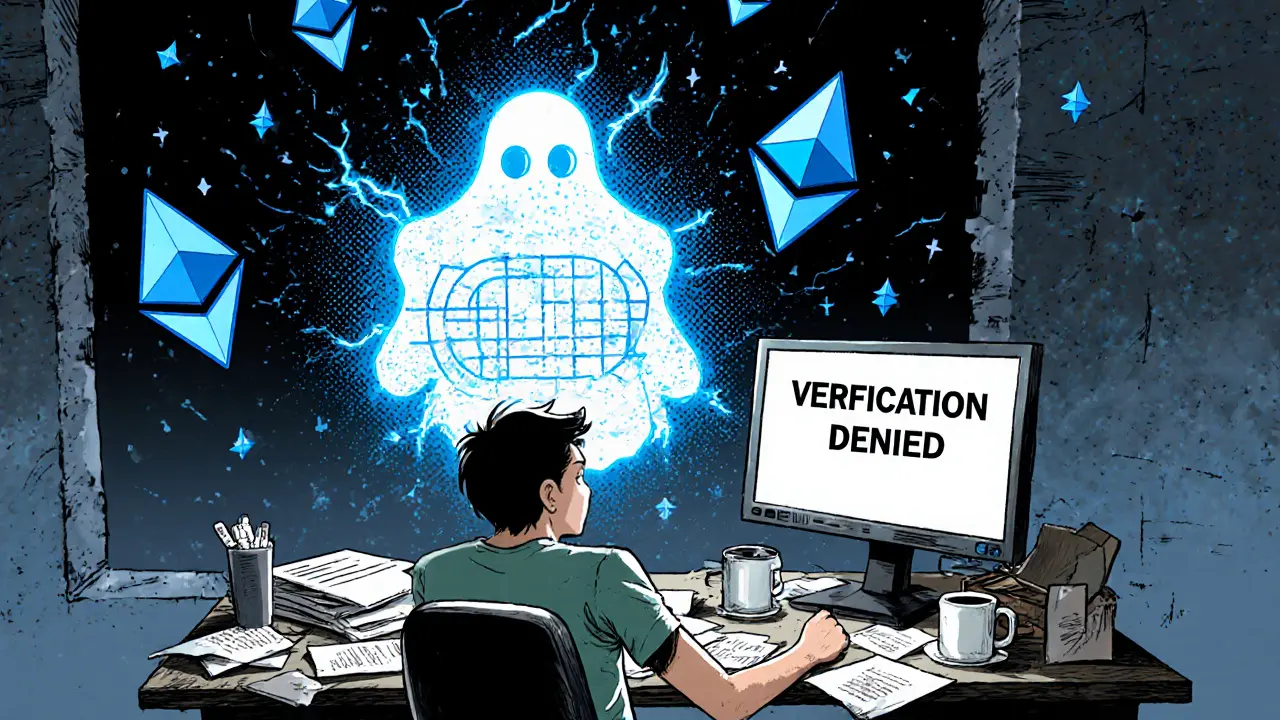
Blur: The Quiet Player
Blur captured 60% of NFT trading volume in Q2 2023. But they don’t talk much about verification. No public criteria. No volume thresholds published. You submit a form. You wait. Sometimes you get verified. Sometimes you don’t. Blur’s approach is the opposite of LooksRare’s transparency. It’s the opposite of OpenSea’s PR focus. It’s a black box. And that’s intentional. Blur caters to professional traders who care more about price action than brand trust. Verification on Blur matters less for users and more for the platform’s internal risk scoring.What About Decentralized Verification?
The Ethereum Research community proposed a solution in May 2023 that could change everything. Instead of relying on humans or trading volume, they suggested using zero-knowledge proofs. Here’s how it would work: when a collection is created, its smart contract generates a cryptographic proof that it’s legitimate. No one needs to know who owns it. No one needs to track sales. The system just checks: "Is this proof valid?" If yes, the collection is verified. It’s elegant. It’s private. It’s immune to manipulation. But it’s also complex. Implementing it requires deep blockchain expertise. The Ethereum Foundation gave $250,000 to a team working on this in June 2023. But it’s still experimental. No major marketplace uses it yet. Meanwhile, ENS (Ethereum Name Service) suggested letting NFT holders prove ownership through their ENS domain. Imagine your avatar showing a badge that says, "This NFT is verified via ENS." But that idea never took off. It’s still just a proposal.How Developers Check Verification
If you’re building a tool, wallet, or dashboard, you don’t have to guess whether a collection is verified. APIs like Moralis let you pull verified status directly. You need an API key, a basic Node.js setup, and a few lines of code. Moralis returns a list of verified collections with their addresses, names, and verification status. It’s fast. It’s reliable. And it’s how apps like NFT trackers and portfolio dashboards know which collections to highlight. For example, if you’re building a wallet that shows your NFTs, you can use this data to flag unverified collections with a warning. That’s real utility - not just a blue checkmark.
The Bigger Picture: Regulation Is Coming
The SEC’s 2023 enforcement action against the Stoner Cats NFT project sent a message: if you’re selling digital assets, you’re subject to financial rules. That means platforms can’t ignore fraud anymore. Gartner predicts that by 2025, 70% of major NFT marketplaces will adopt verification systems that meet new EU regulations under MiCA. That could mean standardized rules. Or at least, more consistency. Right now, verification is a patchwork. OpenSea is about reputation. LooksRare is about money. Blur is about secrecy. And the future? It’s probably going to be a mix - volume checks, technical proofs, and human review - all layered together.What You Should Do
If you’re a creator:- Don’t chase OpenSea verification unless you have media traction or celebrity backing.
- If you’re building volume, focus on LooksRare. It’s the only system where effort equals results.
- Keep your socials public, your team real, and your community active. Even if you don’t get verified, that builds trust.
- Never trust a blue checkmark as a sign of quality. It’s a sign of legitimacy.
- Check the collection’s history. How many owners? How many sales? Is the trading pattern suspicious?
- Use tools like Nansen or DappRadar to see volume trends. Verified doesn’t mean safe.
What’s Next?
The current system is broken. It’s slow, unfair, and inconsistent. But it’s the only thing we have. The real breakthrough won’t come from a marketplace adding a new rule. It’ll come from a technical upgrade - like zero-knowledge proofs - that lets anyone verify a collection without trusting a company. Until then, treat verification like a license plate, not a stamp of approval. It tells you the car exists. It doesn’t tell you it’s fast, safe, or worth buying.What does a blue checkmark on an NFT collection actually mean?
A blue checkmark means the marketplace has confirmed the collection is legitimate and not a copycat or scam. It does NOT mean the project is valuable, well-made, or a good investment. It only confirms authenticity.
Can I apply for NFT collection verification on OpenSea?
No, you cannot directly apply. OpenSea’s team manually reviews collections based on signals like media coverage, founder identity, and community activity. Most applications go unanswered. There’s no public form or timeline.
How much trading volume do I need to get verified on LooksRare?
You need at least 250 ETH in trading volume on LooksRare itself, or 500 ETH across all marketplaces (excluding private sales). This is the most common path to verification on the platform.
Why do some verified NFT collections still get scammed?
Verification confirms the collection’s identity, not its security. Scammers can still create fake websites, phishing links, or fake Discord servers that mimic verified projects. Always double-check URLs and official channels - even verified collections can be impersonated outside the marketplace.
Are there any free ways to verify my NFT collection?
No. All major marketplaces require either significant trading volume, media exposure, or direct outreach to their teams. There are no free, automated systems available yet. Decentralized solutions like zero-knowledge proofs are still in development and not live on any major platform.
Can I verify my collection on multiple marketplaces?
Yes. Verification is platform-specific. A collection can be verified on OpenSea but not on LooksRare, or vice versa. Each platform has its own criteria and process. You’ll need to meet each one separately.
How long does NFT verification take?
On LooksRare, it typically takes 3-7 business days after meeting volume requirements. On OpenSea, it can take 4-12 weeks - if you get a response at all. Blur doesn’t publish timelines. There’s no guaranteed speed.
Is verification worth the effort for small NFT projects?
For most small projects, no. The cost of reaching volume thresholds or gaining media attention is often higher than the benefit. Instead, focus on building a loyal community, being transparent, and using tools like Moralis to display verified status in your own app. Trust comes from consistency, not a blue checkmark.
Eddy Lust
November 26, 2025 AT 02:35Man, I just bought a 'verified' Bored Ape last week and it turned out to be a fake. The blue checkmark felt like a safety net, but it’s really just a fancy lock on a broken door. I’m not mad, just… disappointed. Guess I’m learning the hard way that trust has to come from the community, not a platform’s logo.
Still, props to the devs trying to fix this. At least we’re talking about it now.
Casey Meehan
November 27, 2025 AT 02:17LMAO 😂 OpenSea’s verification is basically a lottery where you need to be rich, famous, or both. I’ve got a 100-person Discord with daily memes and 200 ETH in volume on LooksRare… and still no checkmark. Meanwhile, some guy with a Canva-generated PFP got verified because his ‘founder’ tweeted once with a Tesla emoji. 🤡
Tom MacDermott
November 27, 2025 AT 10:37Oh wow. So the entire NFT ecosystem is held together by corporate whim and arbitrary volume thresholds? How poetic. We’ve traded the wild west for a corporate boardroom where your worth is measured in ETH and your voice is silenced unless you’ve paid your dues to the gatekeepers.
And yet somehow, people still think this is ‘decentralized.’ What a joke. The only thing more absurd than the verification system is the people who still defend it.
Zero-knowledge proofs? Cute. Until then, it’s all just theater. The blue checkmark? A placebo for the gullible.
Martin Doyle
November 27, 2025 AT 15:55You’re all missing the point. Verification isn’t supposed to be fair-it’s supposed to be profitable. OpenSea and LooksRare aren’t charities. They’re businesses. If you’re not generating volume or hype, you’re not worth their time. Period.
Stop whining about ‘small projects.’ If your collection can’t hit 250 ETH in volume, it’s not a project-it’s a hobby. Build something people want to buy, not something you think is ‘art.’
And if you’re still using OpenSea as your main marketplace in 2024? You’re already behind. Blur’s eating their lunch, and they don’t even care if you know how they work.
Susan Dugan
November 27, 2025 AT 16:06Okay but let’s be real-verification is like a driver’s license. It doesn’t mean you’re a good driver. It just means you passed the test. And the test? It’s outdated. We need systems that verify the *intent* behind the NFT, not just its trading history or media clout.
I love that ENS is trying to tie ownership to identity, but it’s too clunky. What if your NFT could prove it was minted by the original artist via on-chain metadata? No middleman. No fees. Just cryptography doing its job.
And honestly? If you’re buying NFTs for the blue checkmark, you’re already losing. The real value is in the community, the story, the culture. Not the badge.
SARE Homes
November 29, 2025 AT 12:15STOP. JUST STOP. You people are delusional. You think verification is about fairness? It’s about control. OpenSea doesn’t care if you’re a genius artist-they care if you’re a profitable asset. LooksRare doesn’t care if you’re ethical-they care if you’re liquid. Blur? They don’t care at all-they’re just extracting value from traders who think they’re ‘in the know.’
And zero-knowledge proofs? Please. That’s a 5-year-old’s solution. The real problem is that creators are still begging for approval from centralized platforms instead of building their own trust layers. You’re not victims-you’re enablers.
And if you’re still using Moralis to ‘check verification’? You’re not a developer. You’re a rent-seeker.
Grace Zelda
November 30, 2025 AT 13:54What if verification wasn’t about platforms at all? What if it was about the people who hold the NFTs? Like… if 1000 people who’ve held your NFT for over a year all agree it’s legit, maybe that’s the real signal?
I’m not saying we need a DAO to vote on every collection-but what if your wallet could show a ‘community trust score’ based on holder behavior? No volume needed. No PR needed. Just time, consistency, and real adoption.
It’s not perfect. But it’s more human than a corporate algorithm that rejects you because your Discord has 300 members instead of 500.
Just… think about it.
Sam Daily
December 1, 2025 AT 11:50Guys. I built a tool that auto-checks verified status via Moralis and flags unverified collections in my wallet. It saved me from 3 scams already. Seriously, if you’re not using something like this, you’re leaving money on the table.
And yeah, the blue checkmark is meaningless. But the API response? That’s gold. Use it. Share it. Build on it. Don’t wait for OpenSea to fix their broken system-just build around it.
Also, if you’re a creator: stop chasing verification. Start building tools. The real power move isn’t getting the badge-it’s making the badge obsolete.