Imagine selling your Bitcoin after a profitable year, only to find out that you owe more in taxes than your actual profit suggests. For many Indian traders, this isn't hypothetical; it's the reality of the country's strict digital asset regime. If you hold Bitcoin is a decentralized digital currency that operates on a blockchain network, serving as a store of value and medium of exchange., you need to understand exactly how the government calculates what you owe. The rules are rigid, the deductions are limited, and the penalties for non-compliance can be steep.
This guide breaks down the mechanics of India's 30% tax on Virtual Digital Assets (VDAs). We will look at how the calculation works, why loss offsetting is banned, and how the recent addition of Goods and Services Tax (GST) changes the game. Whether you are a casual holder or an active day trader, knowing these specifics can save you from costly mistakes during filing season.
The Core Structure: What Is the 30% Tax?
Effective April 1, 2022, the Indian government introduced a flat tax rate on all gains from virtual digital assets. This rule lives under Section 115BBH is a specific provision in the Income Tax Act of India that mandates a flat 30% tax rate on income from the transfer of virtual digital assets. of the Income Tax Act. Unlike traditional stocks where holding period matters, crypto gains are taxed uniformly. You pay 30% plus applicable surcharge and cess, which brings the effective rate to roughly 31.2% for most individuals.
This flat structure means there is no distinction between short-term and long-term capital gains. If you bought Bitcoin six months ago and sold it today, you pay the same rate as if you had held it for five years. This uniformity simplifies the rule but removes a key advantage that traditional investors enjoy. The definition of VDAs is broad, covering not just major coins like Bitcoin and Ethereum but also Non-Fungible Tokens (NFTs) and other digital tokens, excluding only gift cards and vouchers.
How to Calculate Your Liability
The formula for calculating your tax is straightforward, though the inputs require careful tracking. The basic equation is:
- Gross Sale Proceeds: The total amount you received when selling the crypto.
- Cost of Acquisition: The original price you paid to buy the crypto.
- Taxable Gain: Gross Sale Proceeds minus Cost of Acquisition.
- Tax Payable: Taxable Gain multiplied by 30%.
A critical restriction here is that you can only deduct the cost of acquisition. You cannot subtract transaction fees, gas costs, storage fees, or any other administrative expenses from your gain. This makes the taxable base higher than it would be in many other jurisdictions. For example, if you buy Bitcoin for ₹10,00,000 and sell it for ₹15,00,000, your taxable gain is ₹5,00,000. Your tax liability is 30% of that, which is ₹1,50,000. Any fees you paid to the exchange do not reduce this number.
The Loss Offsetting Ban: A Major Pain Point
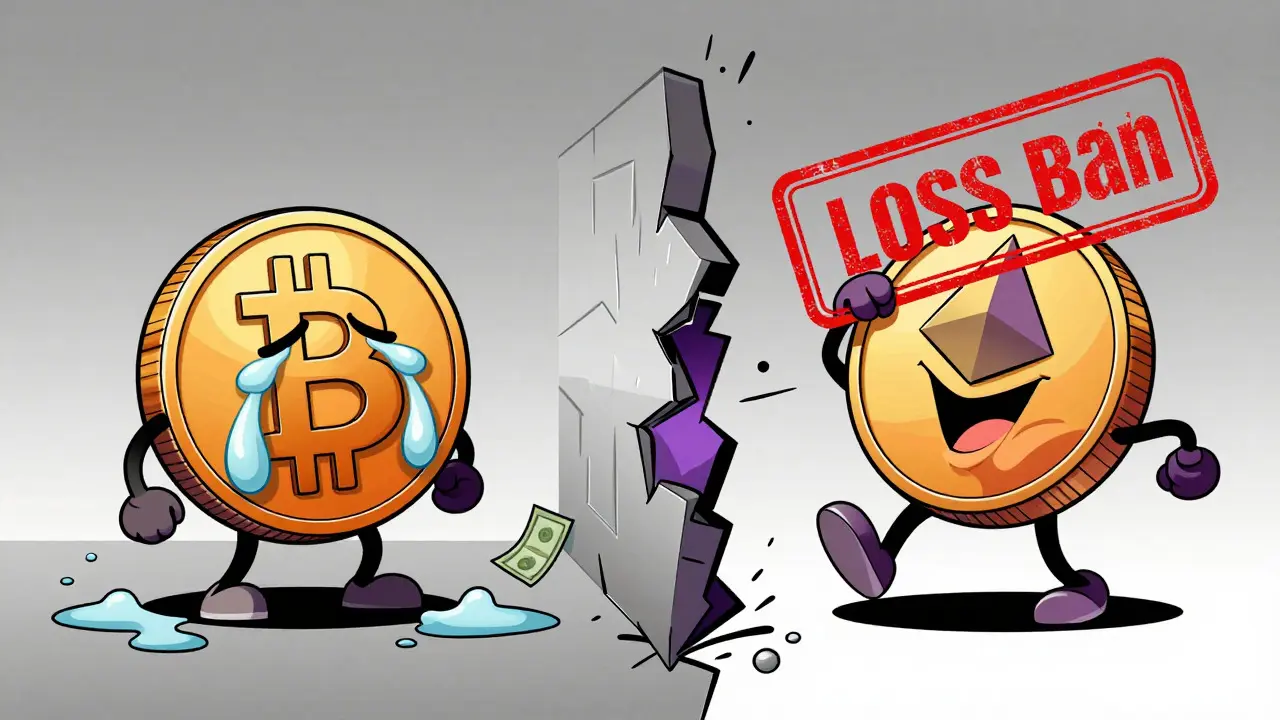
One of the most controversial aspects of this regime is the prohibition on setting off losses. In most investment scenarios, if you lose money on one asset, you can use that loss to offset gains on another. In India’s crypto framework, this is not allowed. Losses from one cryptocurrency cannot be set against gains from another, nor can they be carried forward to future financial years.
Consider a scenario where you lose ₹30,000 on a Bitcoin trade but make a ₹30,000 profit on an Ethereum trade. Economically, your net position is zero. However, for tax purposes, you still owe 30% tax on the ₹30,000 Ethereum gain. This creates an artificial tax burden that doesn't reflect your actual economic outcome. Many traders report owing significant taxes even when their overall portfolio is down for the year, simply because they realized gains on some assets while holding losses on others.
TDS and GST: The Additional Layers
Income tax is not the only deduction you face. Since July 1, 2022, a 1% Tax Deducted at Source (TDS) applies to crypto transfers exceeding certain thresholds. Under Section 194S is a tax provision requiring sellers to deduct 1% TDS on crypto transactions above specified limits, aiding in tax compliance and revenue collection., if you sell crypto worth more than ₹50,000 in a year (or ₹10,000 in specific cases), the buyer must deduct 1% before paying you. This amount is credited toward your final tax liability, but it requires careful reconciliation.
Recently, in July 2025, the government added another layer: 18% Goods and Services Tax (GST) on services provided by crypto platforms. This applies to exchange fees and other platform charges. So, now you have a three-tier structure: 30% income tax on gains, 1% TDS on sales, and 18% GST on service fees. Managing all three simultaneously adds complexity to your bookkeeping. You must ensure that the TDS deducted by buyers is properly reported and that GST invoices from exchanges are correctly accounted for.
Global Comparison: How Does India Stack Up?
To understand the severity of India's approach, it helps to compare it with other major economies. The table below highlights the differences in tax treatment for crypto assets across several countries.
| Country | Tax Rate on Gains | Loss Offsetting Allowed? | Holding Period Benefit |
|---|---|---|---|
| India | 30% Flat + Cess | No | No |
| United States | 0%, 15%, or 20% | Yes | Yes (Long-term rates lower) |
| Germany | Up to 42.5% | Yes | Yes (Tax-free after 1 year) |
| Singapore | 0% (Capital Gains) | N/A | N/A |
| United Kingdom | 10% or 20% | Yes | Yes (Different rates for LT/ST) |
As you can see, India stands out for its high flat rate and lack of flexibility. While Singapore offers no capital gains tax, and Germany allows tax-free gains after one year, Indian traders face a consistent 30% hit regardless of their strategy. This has led to criticism from industry experts who argue that the regime discourages innovation and drives activity to international platforms.

Compliance and Record Keeping
Given the strict rules, keeping accurate records is non-negotiable. You must track every single transaction, including purchase dates, sale dates, amounts, and exchange rates. The Income Tax Department requires reporting via Schedule VDA in your annual return. For simple buy-and-hold investors, this might take 10-15 hours annually. However, for active traders managing multiple assets across different exchanges, the time investment can soar to 40-50 hours.
Common pitfalls include failing to track cost basis across multiple wallets or ignoring P2P transactions. If you moved crypto between your own wallets, you generally don't trigger a taxable event, but you must update your cost basis records. Using specialized software like ClearTax or Koinly can help automate this process, as these tools now support India-specific crypto tax modules. Manual spreadsheets are risky and prone to error, especially when dealing with volatile prices and multiple currencies.
Impact on Trading Behavior
The introduction of this tax regime has visibly changed how Indians trade crypto. Industry reports suggest a 40-60% decline in trading volumes on domestic exchanges shortly after implementation. Many traders have shifted to long-term holding strategies to avoid frequent taxable events. Others have migrated to international platforms or P2P markets, though this introduces additional compliance risks. The high tax burden effectively penalizes active trading, making it less attractive compared to traditional equity markets where loss offsetting and lower long-term rates exist.
For institutional investors, the unfavorable tax treatment has kept participation minimal. Most large players prefer jurisdictions with clearer, more favorable tax frameworks. This has slowed the growth of India's crypto ecosystem relative to its potential, despite high retail interest in digital assets.
Frequently Asked Questions
Can I deduct trading fees from my crypto gains in India?
No. Under Section 115BBH, only the cost of acquisition is deductible. Transaction fees, gas costs, and storage fees cannot be subtracted from your gross proceeds to calculate taxable gains.
What happens if I have a net loss in my crypto portfolio?
You still owe tax on any individual gains realized during the year. Losses cannot be offset against gains, nor can they be carried forward to future years. If you have no realized gains, you may not owe tax, but you must still file the relevant schedule if required.
Does the 1% TDS apply to all crypto transactions?
It applies to transfers exceeding ₹50,000 in aggregate per year (or ₹10,000 in specific cases). The buyer is responsible for deducting and depositing this amount. Ensure your exchange or counterparty handles this correctly to avoid double taxation or penalties.
Is GST applicable to buying crypto directly?
GST does not apply to the purchase of the crypto asset itself. However, since July 2025, 18% GST applies to services provided by crypto platforms, such as exchange fees, custody services, and advisory charges. Keep separate invoices for these services.
How should I report crypto income in my ITR?
You must report crypto gains in Schedule VDA of your Income Tax Return. Include details of all transfers, gross proceeds, cost of acquisition, and taxable gains. Attach supporting documents if requested. Professional assistance is recommended for complex portfolios.





Kiran Jayaram
August 18, 2026 AT 10:02another day another way to bleed the middle class dry
you guys in the west think you have it bad but india is actually leading the charge on how to make crypto unprofitable for normal people
30% flat tax with no loss offsetting is basically a confidence trick
why would anyone trade here when the government takes a cut just for breathing
Nikki keller
August 20, 2026 AT 08:12It is certainly a rigid framework, isn't it? The lack of flexibility regarding holding periods seems to remove much of the strategic nuance that traditional investing offers. I wonder if this approach is intended to simplify compliance at the cost of economic efficiency.
Uday N M
August 21, 2026 AT 23:09At least we have clarity. No ambiguity. Just pay up.
Aaron Morrissey
August 23, 2026 AT 21:00One must observe the stark contrast between the vibrant, chaotic energy of the Indian market and the somewhat sterile, predictable nature of European regulatory frameworks. It is a fascinating dance of fiscal policy where the state asserts its dominion over the decentralized dream, painting a picture of bureaucratic rigidity that stands in sharp relief to the wild, untamed spirit of blockchain innovation. The imposition of such a flat rate serves as a blunt instrument, carving away the intricate details of individual trading strategies and reducing them to a singular, monolithic figure. It is, in many ways, a testament to the enduring power of the nation-state to impose order upon what was once considered an ungovernable frontier of digital finance. The silence of the compliant trader speaks volumes about the weight of these new obligations.
Patrick Quairoli
August 24, 2026 AT 01:47its not even a tax its a control mechanism they are watching every single satoshi move u know the tds thing is just a way to track who is who
they want to kill the privacy aspect dead
look at the gst layer too its all about squeezing the life out of the ecosystem before it gets too big for them to handle
paranoid much?
Evelyn Kula
August 25, 2026 AT 01:47Oh, darling, did you truly believe the 'decentralized' narrative was going to save you from the clutches of the IRS... er, I mean, the Indian Income Tax Department? 🤨 It’s simply adorable how people cling to the illusion of financial freedom while ignoring the very real, very heavy hand of the state. One expects a certain level of sophistication from those who trade in volatile digital assets, yet here we are, discussing flat rates as if they are some kind of democratic victory. The audacity! 😂
Sarah Hafner
August 26, 2026 AT 02:35This is a really helpful breakdown, thank you! : ) One thing I found particularly interesting was the note about record-keeping. For active traders, spending 40-50 hours just on compliance sounds incredibly daunting. It makes sense why so many people might be shifting to long-term holding or using specialized software to keep their heads above water. It's important to highlight these practical challenges alongside the theoretical tax rules.
Calliope Clio
August 26, 2026 AT 07:28Boring. 🥱 Another country punishing its own citizens for being smart enough to diversify. Can't wait to see how this affects global adoption. Spoiler alert: it won't help. 💅