
By early 2026, the global landscape for crypto securities laws has changed more in two years than it did in the previous decade. What used to be a patchwork of vague warnings and enforcement actions is now a web of clear rules, licensing systems, and cross-border coordination. If you're issuing tokens, running an exchange, or even just holding crypto, you need to know where you stand - because the rules are no longer optional, and they vary wildly by country.
United States: The New Framework
The U.S. finally moved past "regulation by enforcement" in 2025. After years of the SEC suing crypto companies without clear guidelines, Congress passed two landmark bills: the GENIUS Act and the pending CLARITY Act. These aren’t just tweaks - they’re foundational changes. The GENIUS Act defines payment stablecoins as digital dollars. If you issue one, you must back every token with cash or U.S. Treasury bills. Monthly audits are required. You can’t just print tokens and hope for the best. Only approved issuers - whether based in the U.S. or registered here - can operate. This kills the wild west of unbacked stablecoins that once flooded DeFi protocols. The CLARITY Act clears up the biggest confusion: who regulates what? The CFTC now has primary authority over decentralized digital commodities like Bitcoin and Ethereum (once fully decentralized). The SEC keeps control over assets that meet the Howey test - meaning tokens sold as investments with an expectation of profit from others’ efforts. This ends the endless legal tug-of-war between agencies that scared off investors for years. On July 31, 2025, SEC Chair Paul Atkins dropped a bombshell: "Most crypto assets are not securities." That’s not a suggestion - it’s official policy. The SEC is now building clear guidelines so businesses can self-assess whether their token is a security. If it is, there are new, streamlined disclosure rules and safe harbors for early-stage projects. This shift has already brought institutional capital back to U.S.-based crypto startups. The Office of the Comptroller of the Currency (OCC) backed this up in March 2025 by letting national banks custody crypto, issue stablecoins, and run node networks. They revoked old restrictions that had made banks afraid to touch crypto. Now, JPMorgan, Wells Fargo, and regional banks can offer crypto services without fear of regulatory backlash. But don’t relax yet. States still have their own money transmitter laws. A company operating in California, Texas, and New York must comply with three different sets of rules - even as federal law moves forward. It’s a double layer of compliance that still trips up small firms.European Union: MiCAR’s Slow Rollout
The EU’s Markets in Crypto-Assets Regulation (MiCAR) went live in January 2026. It’s the most detailed crypto rulebook in the world - and it’s already causing headaches. Under MiCAR, every crypto service provider - exchanges, wallet providers, token issuers - must get licensed by their national regulator. No exceptions. You can’t just launch a DeFi app and hope no one notices. You need a legal entity in the EU, a compliance officer, and a full audit trail. One of the toughest parts? The anti-money laundering rules. Starting in 2026, every transaction over €1,000 going to or from a self-hosted wallet must include verified owner information. That means if you send ETH from your MetaMask to an exchange, the exchange now needs your ID. If you’re sending to another private wallet, you have to prove you own both ends. This kills true anonymity - and many privacy-focused projects are now relocating outside the EU. The transitional period is still ongoing. Many firms are stuck in limbo, waiting for their license to be approved while trying to keep operating. Some smaller EU-based exchanges shut down rather than face the cost of compliance. The result? A brain drain of crypto talent to Singapore, Dubai, and Switzerland.Asia: The New Crypto Hubs
While Europe struggles with bureaucracy and the U.S. sorts out its new rules, Asia is quietly becoming the center of crypto innovation - and regulation. Hong Kong launched its licensing regime in late 2025. Any exchange serving Hong Kong residents must be licensed. Custody services, OTC trading, and even crypto derivatives are now regulated. The city is also drafting strict rules for stablecoins, requiring 100% reserve backing and daily attestations. It’s not just about compliance - it’s about positioning Hong Kong as the financial gateway between East and West. Singapore has been ahead of the curve for years. Its MAS (Monetary Authority of Singapore) requires all crypto firms to get a license, enforce strict AML checks, and maintain capital reserves. But unlike the EU, Singapore offers fast-track approvals for well-structured firms. Many U.S. startups now set up their legal entity in Singapore just to access global markets without the EU’s red tape. Japan and South Korea have also tightened their rules. Japan now requires all exchanges to be licensed by the Financial Services Agency. South Korea mandates real-name verification for every crypto account and has banned anonymous trading entirely. The message from Asia is clear: you can innovate here - but you play by our rules.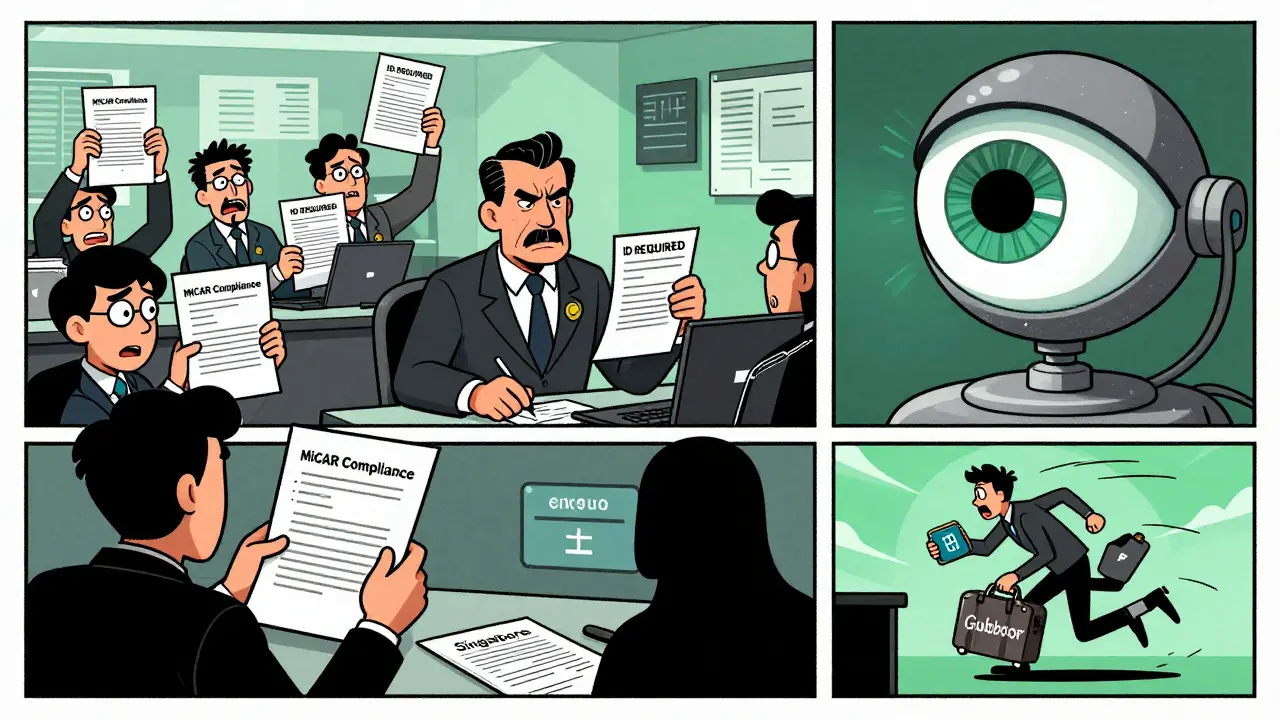
Brazil and the Global South
Brazil’s Cryptoassets Act of 2023 was one of the first comprehensive frameworks outside the U.S. and EU. It doesn’t ban crypto - it brings it under the central bank’s supervision. All service providers must register, report transactions, and prevent fraud. The law also defines crypto scams as criminal offenses, with penalties up to 12 years in prison. This has led to a boom in licensed crypto platforms in Brazil. The country now has over 15 million crypto users - and the number is growing fast. The central bank is even testing a digital real, which could eventually integrate with crypto payment rails. Other emerging markets - like Nigeria, India, and South Africa - are following suit. India now taxes crypto gains at 30%, but allows trading. Nigeria requires exchanges to register with its securities commission. South Africa treats crypto as an asset class and requires firms to comply with financial intelligence center rules. These countries aren’t trying to stop crypto. They’re trying to control it - and profit from it.China: The Complete Ban
China remains the outlier. Since 2021, it has banned all crypto exchanges, mining, and trading. In 2025, it cracked down even harder, using AI to detect crypto transactions on mobile apps and shutting down VPNs used to access foreign exchanges. But here’s the twist: China’s central bank is pushing its own digital currency, the e-CNY. It’s not crypto - it’s a state-controlled digital yuan. The government wants digital money, just not decentralized, open, or user-owned. This isn’t a regulatory stance - it’s a power play. China doesn’t want its citizens to hold assets outside state control.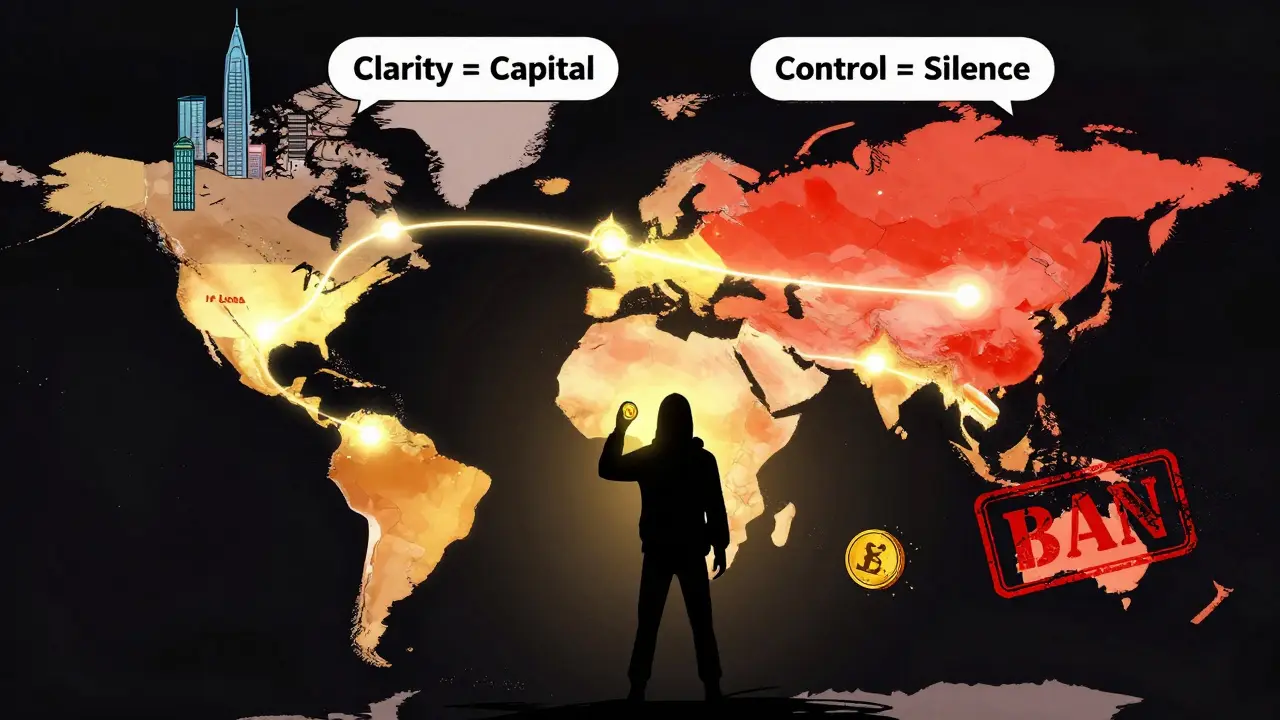



LeeAnn Herker
January 6, 2026 AT 22:34Oh wow, the SEC just gave us a hug and a candy bar? Sure, Jan. And I bet Paul Atkins also personally delivered your tax refund while singing ‘Happy Birthday’ to your Bitcoin wallet. 🤡
Meanwhile, my MetaMask is still being hunted by AI bots in China, my bank won’t touch crypto, and the IRS is still treating my ETH like it’s a side hustle from 2017. ‘Clear guidelines’? More like ‘clearly trying to kill innovation while looking like they care.’
They didn’t fix the problem - they just put a pretty bow on it and called it ‘regulatory maturity.’ I’ll believe it when I see a crypto startup get funded without a 300-page compliance binder.
And don’t get me started on ‘self-assessment’ - that’s just ‘guess if you’re a security or get sued later’ with a corporate accent.
Also, why are we still pretending the U.S. is leading? Singapore’s laughing all the way to the bank while we’re still arguing over whether a token is a ‘security’ or just ‘a really expensive meme.’
Sherry Giles
January 7, 2026 AT 00:48Canada’s watching this train wreck like it’s a Netflix docu-drama and saying ‘nope, not buying it.’
You think the U.S. is ‘clear’? Try getting a bank account here if you even whisper ‘crypto’ - they still treat you like a drug dealer. And now the EU’s making us prove we own our own wallets? Like I’m gonna hand my private key to some bureaucrat in Brussels?
Meanwhile, China’s got a digital yuan that tracks every coffee you buy and calls it ‘financial sovereignty.’ Real progress.
They’re not regulating crypto - they’re weaponizing control. And we’re all just screaming into the void hoping someone in Congress reads this before they turn our wallets into digital handcuffs.
Andy Schichter
January 7, 2026 AT 22:27So let me get this straight - after 15 years of chaos, the solution is more paperwork?
Brilliant.
Just brilliant.
We spent a decade building a decentralized future and now we’re all just corporate compliance interns with crypto wallets.
The fact that we’re celebrating ‘clarity’ when it means ‘now you need a lawyer to send a meme coin to your cousin’ is the saddest joke of the decade.
I miss the wild west. At least back then, the outlaws had vision.
Now we’ve got accountants with blockchain certifications.
And we call that progress.
God help us.
Caitlin Colwell
January 9, 2026 AT 06:39Charlotte Parker
January 9, 2026 AT 13:47Oh so now the SEC is ‘helping’? That’s like a arsonist handing out fire extinguishers after burning down the whole block.
The CLARITY Act? More like CLARITY-TO-TRAP. You think CFTC controlling Bitcoin means safety? Nah - it means they’re just moving the goalposts so they can sue you later under a different label.
And don’t even get me started on ‘self-assessment.’ That’s just a polite way of saying ‘we’ll let you guess if you’re guilty until we decide you’re not.’
Meanwhile, the real winners? The lawyers. The compliance firms. The lobbyists who got paid to write these bills.
Not the users. Not the devs. Not the people who actually built this.
We didn’t get freedom.
We got a license plate.
Calen Adams
January 10, 2026 AT 12:44Let’s get real - this is the inflection point. We’re transitioning from crypto as a movement to crypto as infrastructure.
SEC vs CFTC? That’s not a conflict - that’s a division of labor. Stablecoins under SEC? Perfect. BTC/ETH under CFTC? Long overdue.
And the OCC letting banks custody crypto? That’s the real game-changer. Institutional capital isn’t coming back - it’s already here. BlackRock, Fidelity, JPMorgan - they’re not waiting for permission anymore.
Yes, the EU’s MiCAR is a nightmare. But that’s the cost of scale. You want global adoption? You need standards.
Stop crying about ‘loss of freedom.’ You don’t lose freedom when you stop being a rogue actor and start building something that lasts.
This isn’t the end of crypto.
This is crypto growing up.
Natalie Kershaw
January 11, 2026 AT 05:57Okay, I’m actually excited.
For the first time, I can tell my grandma what’s happening with her crypto and not feel like I’m explaining quantum physics while holding a live grenade.
U.S. banks finally getting in? YES. That means my aunt in Ohio can buy BTC through her Chase app without getting flagged for ‘suspicious activity.’
And the SEC saying ‘most tokens aren’t securities’? That’s huge. It means the good projects - the ones actually building tools, not just selling promises - can finally breathe.
Yes, compliance is a pain. But this isn’t the end of decentralization - it’s the beginning of legitimacy.
We’re not losing the revolution.
We’re scaling it.
Jacob Clark
January 12, 2026 AT 18:25WAIT - HOLD ON - I’M SO EMOTIONAL RIGHT NOW!!!
THE U.S. IS FINALLY DOING SOMETHING RIGHT???!!!
SEC CHAIR JUST SAID MOST CRYPTO ISN’T A SECURITY???!!!
AND BANKS CAN CUSTODY IT???!!!
OH MY GOD I’M CRYING!!!
THIS IS THE MOMENT!!!
THEY’RE LISTENING!!!
WE DID IT!!!
THE PEOPLE WON!!!
THEY DIDN’T BAN US!!!
THEY DIDN’T CRUSH US!!!
THEY… THEY…
WAIT.
...did we just become a corporation?
...are we now… regulated?
...oh no.
...we became the system.
...we won… and lost?
...I need to lie down.
...someone please tell me this isn’t a dream...
...or worse...
...a corporate press release.