You’re staring at a $45 gas fee on Ethereum. You just want to swap some ETH for METIS or buy a niche token on the Metis network, but the cost of doing business on mainnet feels like paying a toll booth for a dirt road. Enter Netswap, a decentralized exchange (DEX) built specifically for the Metis Andromeda Layer 2 network. It promises to slash those fees by up to 97% and let you trade with leverage right from your wallet. But does it deliver? Or is it another ghost town with empty liquidity pools?
Here’s the reality check before we get into the weeds. Netswap isn’t trying to beat Uniswap at its own game. It’s trying to solve a specific problem: expensive, slow trades on Layer 1. If you’re already deep in the Metis ecosystem, this might be your go-to spot. If you’re looking for deep liquidity for a $10,000 trade, you might find yourself waiting a long time-or losing money to slippage. Let’s break down what actually works, what doesn’t, and whether you should connect your wallet.
What Exactly Is Netswap?
Netswap is an automated market maker (AMM), much like Uniswap v2, but optimized for the Metis Andromeda Layer 2 blockchain. Unlike centralized exchanges where you trust a company with your funds, Netswap is non-custodial. Your tokens stay in your wallet until the moment you click "swap." The platform launched as a community-driven alternative, meaning no pre-sales and no team allocations hoarding the supply. All NETT tokens were distributed via liquidity mining.
The core appeal is speed and cost. Because it runs on Metis, transaction finality happens in about 4 seconds compared to Ethereum’s 13-15 seconds. More importantly, the gas fees are negligible-often under $0.05 per transaction. For small traders, this changes the math entirely. On Ethereum, a $50 trade might cost $20 in gas. On Netswap, that same trade costs pennies.
The Good: Why Traders Are Hooked
If you live on Layer 2, Netswap offers three distinct advantages that larger DEXs struggle to match without complex routing.
- Dirt-Cheap Fees: The most obvious win. Users report saving over $2 per transaction compared to Ethereum mainnet. If you make ten small trades a day, you’re saving enough to cover a coffee.
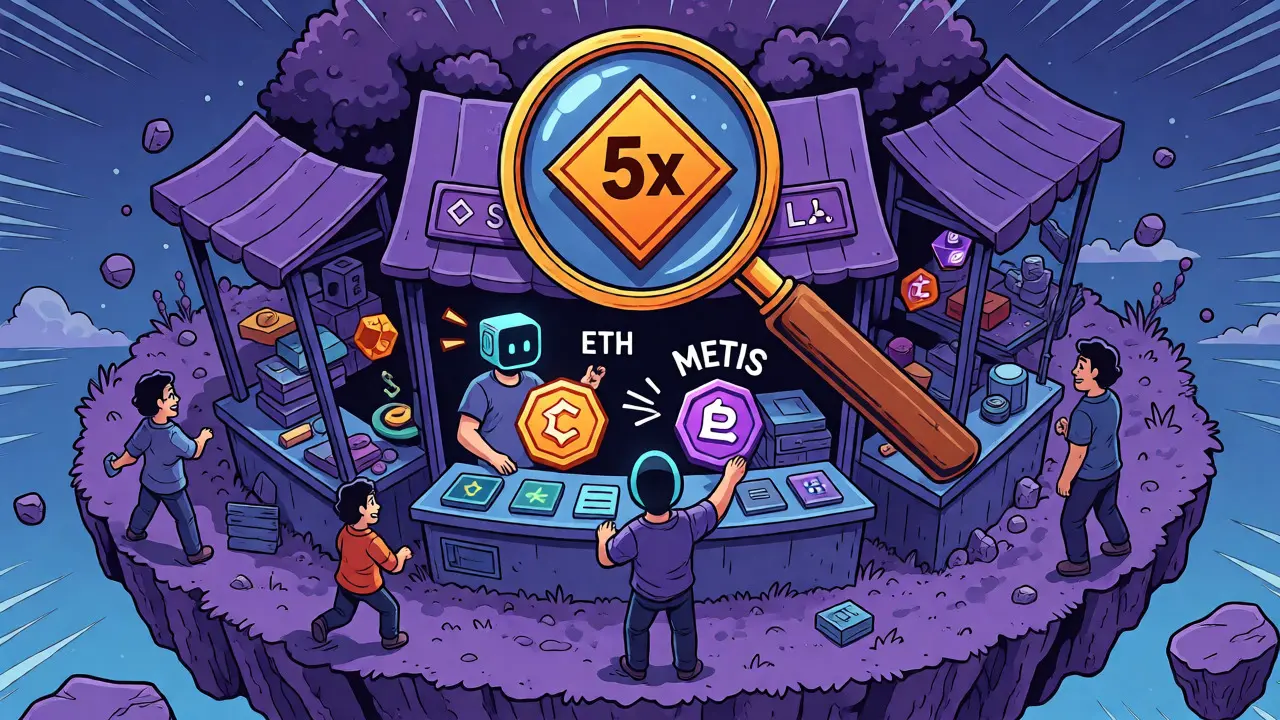
- Built-in Leverage: Most AMMs don’t offer leverage. Netswap allows up to 5x leverage on certain pairs directly within the interface. This lets you amplify positions without needing a separate margin trading platform.
- Fair Launch Model: The NETT token distribution was transparent. No VC insiders dumping on retail investors. The governance is truly in the hands of the community, which has kept the project aligned with user interests rather than investor returns.
One Reddit user, u/CryptoSurfer2022, noted: "Used Netswap for small ETH-METIS swaps and the fees were amazing ($0.03 vs $2.50 on Uniswap)." That kind of feedback highlights exactly who this platform is for: frequent, smaller-value traders who prioritize efficiency over massive depth.
The Bad: Liquidity and Slippage Warnings
Here is where things get tricky. Netswap is tiny. As of late 2023, its Total Value Locked (TVL) hovered around $1.85 million, and daily volume was often below $25,000. Compare that to Uniswap’s hundreds of millions, and the difference is stark.
Low liquidity means high slippage. If you try to swap $500 worth of a less popular token, you might see a price impact of 10-15%. One user reported having to break a $500 trade into five $100 chunks just to avoid getting wrecked by slippage. If you’re moving large amounts, Netswap is currently not viable. You’ll pay more in lost value than you save in gas fees.
| Feature | Netswap | Uniswap V3 | PancakeSwap |
|---|---|---|---|
| Network | Metis L2 | Ethereum L1/L2 | BSC |
| Avg Gas Fee | $0.02 - $0.05 | $1.50 - $5.00+ | $0.10 - $0.30 |
| Leverage Support | Up to 5x | No (Spot only) | Via Perp Markets |
| Trust Score (CoinGecko) | 3.2 / 10 | 8.7 / 10 | 7.9 / 10 |
| Best For | Small Metis trades | High liquidity ETH pairs | General BSC trading |
The Trust Score of 3.2/10 on CoinGecko reflects this risk. It’s not because the code is broken; it’s because there’s barely anyone using it. Low volume makes it vulnerable to manipulation and makes exits difficult if you buy into a thin pool.
Security: What We Know (And Don’t Know)
Security is a mixed bag. Netswap uses standard AMM logic, which is battle-tested elsewhere. However, unlike Uniswap or Aave, Netswap lacks prominent, public third-party audit reports from top-tier firms like CertiK or Trail of Bits. The smart contracts are verified on Etherscan (for Metis), so you can read the code, but that requires technical skill.
Dr. Elena Rodriguez, a blockchain security researcher, pointed out that while the model follows standard patterns, the absence of published audits is a significant risk factor. Smaller projects often skip expensive audits to preserve capital. For now, treat Netswap like a new startup bank: safe enough for your pocket change, risky for your life savings.
User Experience: Simple but Sparse
The interface is clean. You connect MetaMask, select your pair, set slippage tolerance (default is usually too low for thin markets, so bump it to 1-2%), and swap. There are no limit orders or stop-losses yet. It’s purely spot trading plus the leverage feature.
Support is minimal. There’s no live chat. You rely on the Telegram group (which had ~2,300 members recently) and a basic FAQ. If a transaction fails during congestion-which happens-you’re on your own to troubleshoot via block explorers. Documentation is functional but lacks depth for advanced users.

Who Should Use Netswap?
This isn’t for everyone. Here’s a quick decision tree:
- Use Netswap if: You are active in the Metis ecosystem, make frequent small trades (<$200), want to experiment with leverage on L2, or need to bridge assets between Ethereum and Metis efficiently.
- Skip Netswap if: You are trading large volumes (> $1,000), require deep liquidity for stablecoins, need advanced order types, or prefer exchanges with comprehensive insurance and support teams.
The upcoming V2 upgrade promises concentrated liquidity (like Uniswap V3), which could improve capital efficiency and reduce slippage. Until then, manage your expectations.
Final Verdict
Netswap is a useful tool in a specific toolbox. It solves the gas fee problem for Metis users brilliantly. The leverage feature adds utility that many competitors lack. However, its tiny liquidity profile limits its usefulness for serious traders. It’s a place for experimentation and small-scale DeFi activity, not for heavy lifting.
If you’re already holding METIS or tokens on that chain, give it a try with a small amount. Watch the slippage. Check the TVL before entering large positions. And keep an eye on the V2 roadmap-if they fix the liquidity fragmentation, Netswap could become a key player in the L2 space.
Is Netswap safe to use?
Netswap operates on a non-custodial model, meaning you retain control of your private keys. While the underlying AMM logic is standard, the project lacks widely publicized third-party security audits. Treat it with caution suitable for experimental DeFi protocols, limiting exposure to amounts you can afford to lose.
Why are my transactions failing on Netswap?
Transaction failures are often due to insufficient slippage tolerance settings or network congestion on the Metis layer. Try increasing your slippage tolerance to 1-2% for volatile pairs. Also, ensure you have enough METIS in your wallet to cover gas fees, even though they are very low.
Can I trade Bitcoin or Ethereum directly on Netswap?
You cannot trade native Bitcoin or Ethereum directly unless they are wrapped versions bridged to the Metis Andromeda network. You must first bridge your assets from Ethereum to Metis using the official Metis bridge before swapping them on Netswap.
Does Netswap require KYC verification?
No, Netswap is a decentralized exchange and does not require Know Your Customer (KYC) identity verification. You simply connect a compatible Web3 wallet like MetaMask to start trading.
What is the NETT token used for?
NETT is the native governance and utility token of Netswap. It is used for voting on protocol upgrades, earning rewards through staking, and incentivizing liquidity providers. The token distribution was fair-launch style with no pre-sale.