You look at a blockchain project’s whitepaper. It promises revolutionary tech. But the real engine driving its success isn’t just code-it’s tokenomics. This field sits at the messy intersection of traditional economics and digital infrastructure. It answers a critical question: how do tokens actually create, capture, and distribute value within an ecosystem? If you’re trying to figure out why some platforms thrive while others collapse into zero, understanding platform token economics is your only reliable compass.
Think about the last time you bought a crypto asset. Did you check if the supply schedule made sense? Or did you just follow the hype? Most people skip the math. That’s a mistake. Dr. Ye Li from the Federal Reserve Bank of Cleveland established in 2019 that a token’s value hinges on the ratio between its supply and the platform’s productivity. When this ratio gets too high, the system inflates, and platforms cut back on rewards. When it’s low, they issue more tokens to attract users. It’s a balancing act. Get it wrong, and you get TerraUSD-style disasters where billions evaporate overnight. Get it right, and you build sustainable network effects like Ethereum or Bitcoin.
The Core Mechanics of Value Creation
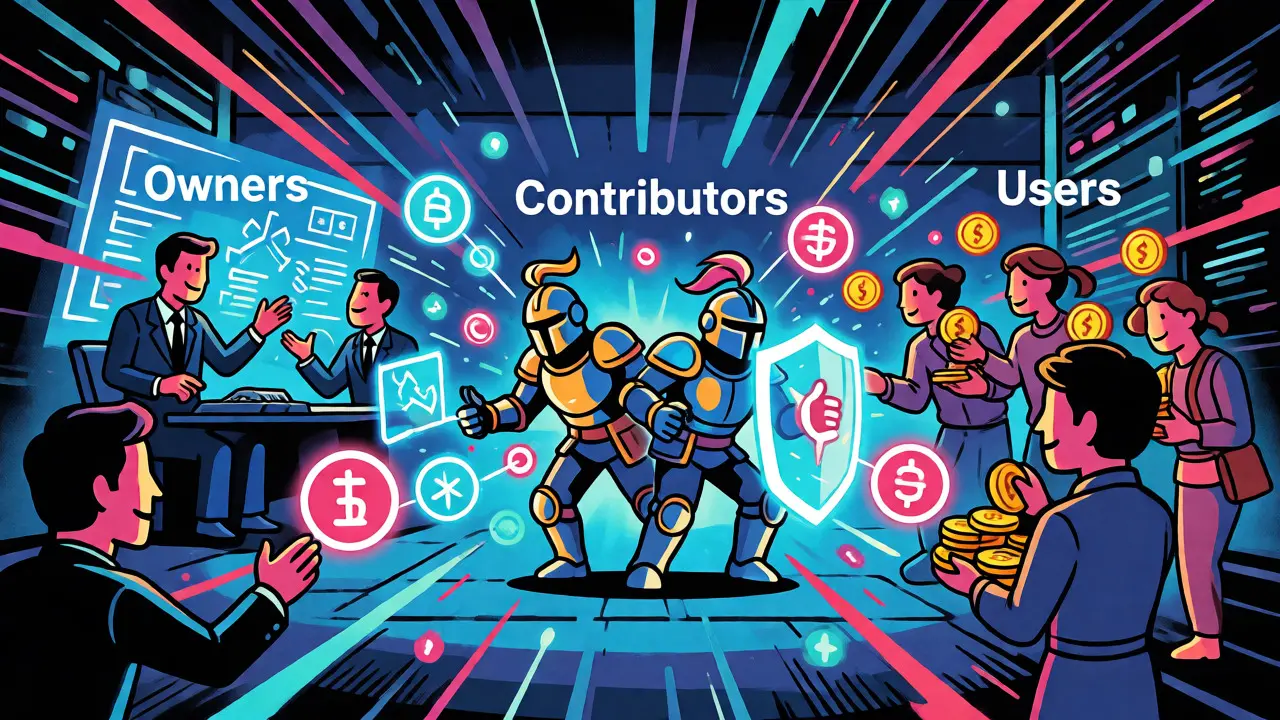
At its heart, platform token economics aligns incentives between three groups: platform owners, contributors, and users. Owners design the rules. Contributors provide security or liquidity. Users pay for services. The token acts as the glue holding these interests together. Without proper alignment, one group extracts value at the expense of the others, leading to collapse.
Consider Bitcoin. Its model is brutally simple: a hard cap of 21 million coins with halving events every four years. This deflationary pressure creates scarcity. But simplicity comes at a cost. During peak demand, such as the 2017 scaling crisis, transaction fees spiked to $55. Users got frustrated because the token tried to be both a store of value and a medium of exchange simultaneously. They clashed.
Ethereum took a different route. Since the London hard fork in 2021, it uses EIP-1559 to burn base fees during high activity. This offsets new issuance, often making ETH net deflationary when the network is busy. The result? A self-correcting mechanism that stabilizes value without needing a hard cap. According to Ultrasound Money data, this shift reduced annual issuance from 4.3% to 0.43%, correlating with a 37% increase in staker participation between 2022 and 2023.
Single vs. Dual-Token Models
Not every problem fits a single-tool solution. About 32% of major blockchain platforms now use dual-token models. These systems separate the functions of value storage and utility usage. Think of VeChain (VET/VTHO) or NEO (NEO/GAS). One token holds value; the other pays for gas or operations.
| Feature | Single-Token Model | Dual-Token Model |
|---|---|---|
| Complexity | Low (easier onboarding) | High (steeper learning curve) |
| User Engagement | Standard | +40% higher (VeChain Q4 2023 report) |
| Onboarding Failure Rate | Lower baseline | +22% higher (Ontology 2022 data) |
| Primary Risk | Conflicting utility/value roles | UX friction and complexity |
| Best For | Simple payment networks | Enterprise or complex DeFi apps |
The trade-off is clear. Dual-token systems offer better economic stability by decoupling speculation from usage. VeChain reported 40% higher user engagement in 2023 compared to single-token competitors. However, this sophistication scares off newcomers. Ontology noted a 22% higher onboarding failure rate among new users in 2022. If your audience is mainstream, keep it simple. If you’re targeting enterprise clients who need predictable costs, split the tokens.

Mechanisms That Drive Value Capture
How does a platform ensure its token retains worth? It uses specific mechanisms to manage supply and demand. Three dominate the landscape: staking, burning, and governance rights.
- Staking: Locking tokens to secure the network reduces circulating supply. Solana uses stake-weighted fee discounts to encourage this behavior, effectively lowering token velocity.
- Burning: Permanently removing tokens from circulation increases scarcity. Binance’s BNB quarterly burns reduced total supply by 16.5% from 2017 to 2023, while market cap grew 4,800%. This signals commitment to holders.
- Governance: Giving token holders voting power on protocol changes adds utility beyond speculation. Messari’s 2024 report found that platforms with buyback-and-burn mechanisms outperformed those without by 27.3% annually from 2020 to 2023.
But beware the "Ponzi" critique. SEC Chair Gary Gensler has called many tokenomics models "Ponzi-like schemes without fundamental value." He’s not entirely wrong. If a token’s only purpose is to pay earlier investors with new money, it’s fragile. Sustainable value requires transactional utility. People must want the token because they need to use the service, not just because they hope to sell it to someone else later.
Pitfalls and Implementation Challenges
Designing tokenomics is harder than coding smart contracts. You need expertise in monetary economics, game theory, and behavioral psychology. Missteps are common and costly.
Take EOS.IO. Launched in 2018, it suffered from excessive initial supply and poor sink mechanisms. Result? A 73% price depreciation in the first year. Another example is Iron Finance in 2022. Its TITAN token dropped from $60 to near-zero in 24 hours due to flawed incentive loops. CryptoSlate forum analysis showed 87% of affected users cited "flawed tokenomics" as the primary cause.
Transparency helps mitigate these risks. Platforms with clear, published supply schedules see 43% higher user retention than those with opaque policies. Use simulation tools before launching. Tokenomics Designer reports that projects using their simulators face 28% fewer post-launch economic issues. Don’t guess. Model your scenarios.
Regulatory and Market Context
You can’t ignore the law. The SEC’s enforcement actions against unregistered token offerings jumped from 3 cases in 2018 to 27 in 2023. The Howey Test remains the gold standard for determining if a token is a security. If you promise profits derived from the efforts of others, you’re likely in securities territory.
Geographic trends also matter. Chainalysis’ 2023 regional analysis shows Asia favors utility tokens (68% of projects), while Europe leans toward governance tokens (61%). If you’re building globally, you might need jurisdiction-specific economic models. Currently, 78% of token projects maintain separate models for different regions to comply with local laws.
The market itself is growing fast. Grand View Research estimates the global tokenomics market hit $18.7 billion in 2023, growing at a 34.2% CAGR. Yet, adoption lags behind experimentation. Gartner notes that while 57% of Fortune 500 companies experiment with token incentives, only 12% have production systems. The gap between pilot and profit is wide.
Frequently Asked Questions
What is the difference between tokenomics and cryptocurrency?
Cryptocurrency refers to the digital asset itself, while tokenomics is the study of the economic rules governing that asset. Tokenomics defines supply limits, distribution schedules, and utility mechanisms. A cryptocurrency exists regardless of its design quality, but tokenomics determines whether it sustains value over time.
Why do some tokens fail despite good technology?
Poor token design often overrides technical merit. Issues like misaligned incentives, excessive inflation, or lack of real-world utility lead to collapse. For instance, Iron Finance failed not because its tech broke, but because its algorithmic stablecoin model couldn't sustain confidence during a bank run.
Are dual-token models better than single-token models?
Neither is universally better. Dual-token models offer greater flexibility and stability by separating value storage from utility, but they introduce complexity that can hinder user adoption. Single-token models are simpler and easier to onboard but struggle to balance speculative and functional demands.
How does token burning affect price?
Burning permanently removes tokens from circulation, reducing supply. If demand remains constant or grows, this scarcity typically exerts upward pressure on price. Binance’s BNB burns demonstrated this correlation, though external market factors always play a significant role.
What is token velocity?
Token velocity measures how frequently a token changes hands. High velocity means tokens are spent quickly rather than held, which can dampen price appreciation. Platforms use staking rewards or locking mechanisms to reduce velocity and encourage holding.

Sue Howard
October 30, 2026 AT 16:38Oh, great. Another whitepaper that promises to save the world but mostly just confuses people with math they don't care about. I bet half of this is just recycled buzzwords from 2017.
ZACK FX
October 31, 2026 AT 06:43The... uh... 'messy intersection'?? That's a bit vague, isn't it?? We need precise definitions!!! Dr. Li's ratio is critical, yes, but you gloss over the velocity metrics!! If supply/productivity diverges by even 2 basis points, the arbitrage opportunities vanish!!! It’s not just about inflation; it’s about the *structural integrity* of the liquidity pool!!! You can’t just say 'balancing act' and walk away!!! The game theory implications are staggering!!!
Wilson Andres Lopez Martinez
October 31, 2026 AT 12:11It feels like watching a garden grow in fast-forward. You plant the seed (the code), water it with attention (the users), and hope the fruit (value) doesn't rot on the vine. But sometimes, the gardener gets greedy and picks the apples before they're ripe. Then everyone leaves hungry. Simplicity is beauty, but complexity is often necessary for survival in a storm.
Anna Smith
October 31, 2026 AT 17:45I suppose if one has the time to dissect these pedantic economic models, one might find them mildly interesting. Most retail investors lack the intellectual capacity to grasp dual-token dynamics anyway, so why bother explaining it to them? It’s rather exhausting trying to educate the masses.
Gaurav Sharma
November 1, 2026 AT 23:43The article presents a coherent overview, yet it fails to address the regulatory nuances in emerging markets sufficiently. One must consider that compliance costs vary drastically across jurisdictions, which impacts the token's intrinsic value proposition significantly.
VAGHELA SUMIT
November 2, 2026 AT 02:47This is really helpful because it breaks down the scary parts into manageable pieces, and honestly, seeing how Ethereum adjusted its issuance rate gives me a lot of hope that we are moving toward more sustainable systems where real utility matters more than just speculation, which is exactly what we all need right now to feel safe holding our assets long-term.
Kadon Douglas
November 4, 2026 AT 02:34You're missing the biggest point here: cultural adoption drives utility, not just code! In Asia, utility tokens dominate because people actually use them for daily transactions, unlike in the West where governance tokens are just status symbols for whales. Stop ignoring the human element!
Amanda Savluchinske
November 4, 2026 AT 14:04Love the breakdown on burning mechanisms! Binance’s data is compelling evidence that scarcity works when paired with consistent demand. Keep pushing for transparency-it helps everyone stay grounded during volatile markets!
Elisa Gray
November 5, 2026 AT 06:56I appreciate the balanced view on single vs. dual tokens. It reminds me that there is no 'one size fits all' solution, only trade-offs that suit different communities and goals. Respecting those boundaries is key to building trust.