Imagine trying to buy Bitcoin in Seoul but needing a specific bank account just to move your money. For years, that was the reality for South Korean traders. But as of late 2025 and heading into 2026, the landscape has shifted dramatically. The Financial Services Commission (FSC) is no longer just blocking doors; they are building highways for institutional money. If you are trading on Upbit, Bithumb, or planning to enter the market through new regulated channels, understanding these rules isn't optional-it's essential for keeping your assets safe and liquid.
The Core Compliance Framework for Exchanges
At the heart of South Korea’s regulatory stance is the strict definition of who can operate as a Virtual Asset Service Provider (VASP). Unlike jurisdictions where anyone with a website can launch an exchange, the FSC requires every entity to register with the Korean Financial Intelligence Unit (KoFIU). This isn’t just paperwork; it’s a gatekeeping mechanism designed to eliminate anonymous bad actors.
The most critical requirement remains the real-name verification system. You cannot simply send cash to an exchange. Your bank account must be linked directly to the exchange’s authorized bank account at the same institution. This creates a closed loop that makes money laundering incredibly difficult. If you try to use a third-party bank account, the transfer fails. It’s rigid, sure, but it provides a level of transparency that regulators worldwide envy.
- Real-Name Accounts: Mandatory linkage between user bank accounts and exchange accounts.
- KISA Certification: Exchanges must hold Information Security Management Systems (ISMS) certification from the Korea Internet Security Agency.
- AML/KYC Protocols: Continuous monitoring for suspicious activities with mandatory reporting to KoFIU.
The Travel Rule and FATF Standards
South Korea fully implements the Financial Action Task Force (FATF) Travel Rule, which dictates how information moves alongside cryptocurrency transfers. When you send more than KRW 1 million (roughly EUR 800), the originating exchange must share details about you-the sender-with the receiving exchange. This includes your name, account number, and address.
This rule applies to buying, selling, transferring, and even storing assets. It effectively ends the era of pseudonymous large-scale transactions within the domestic market. While this adds friction to peer-to-peer trades, it aligns South Korea with global standards like those in the EU and US, making cross-border integration smoother for international investors.

Institutional Shift: Spot ETFs and Corporate Holdings
The biggest change in recent months is the FSC’s pivot toward institutional adoption. For years, corporations were banned from holding crypto on their balance sheets. That restriction, put in place in 2017 to curb speculative bubbles, is now being phased out. The FSC’s Virtual Asset Task Force proposed relaxing these limits, allowing companies to open KYC-verified accounts and allocate portions of their treasury to digital assets.
Simultaneously, the approval of spot cryptocurrency exchange-traded funds (ETFs) marks a watershed moment. Expected to trade on the Korea Exchange by early 2026, these ETFs allow pensions and mutual funds to gain exposure without managing private keys. The sponsors of these funds face rigorous audits and must provide real-time net asset value reporting. This legitimizes crypto as an asset class comparable to gold or equities in the eyes of traditional finance.
| Feature | Pre-2024 Era | 2025-2026 Era |
|---|---|---|
| Corporate Holdings | Banned | Phased Relaxation Allowed |
| Spot ETFs | Prohibited | Approved for Listing |
| ICO Status | Total Ban | Regulated Token Issuance Pilot |
| Primary Focus | Retail Speculation Control | Institutional Integration |
Taxation: The Delayed Reality
Here is where things get tricky for traders. The government originally planned to tax virtual asset gains starting in 2025. However, due to market volatility and administrative readiness issues, this implementation has been postponed. Currently, profits from trading are not subject to capital gains tax for most retail investors, though this is a temporary reprieve.
Future legislation will likely introduce a flat tax rate on gains, with provisions allowing losses to offset gains within the same tax year. This structure aims to reduce the punitive nature of taxes during bear markets. Until the final bill passes, keep meticulous records. When the tax regime kicks in, having clean data on cost basis and transaction dates will save you headaches and potential penalties.
Regional Hubs and NFT Specifics
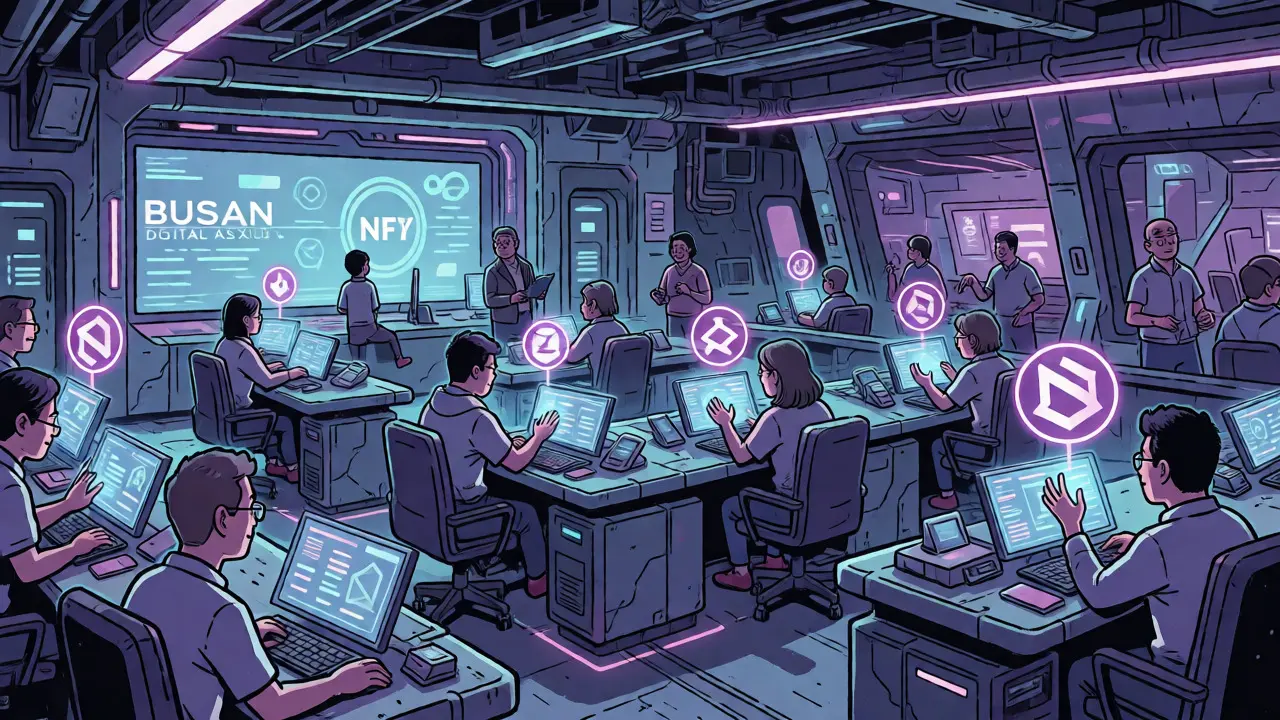
Not all regulations apply uniformly across geography. The Busan Digital Asset Nexus serves as a special economic zone for testing Security Token Offerings (STOs). This initiative allows foreign institutions to participate in tokenized securities under a controlled framework. Jeju and Incheon are watching closely, potentially replicating this model to attract blockchain startups.
NFTs occupy a gray area. If an NFT functions primarily as a collectible, it escapes strict financial regulation. However, if it has investment or payment utility-like fractional ownership rights or revenue-sharing features-it falls under the same stringent rules as other virtual assets. Developers need to design smart contracts carefully to avoid unintentionally triggering security classifications.
What This Means for You
If you are a retail trader, stick to the top four exchanges: Upbit, Bithumb, Coinone, and Korbit. They have the deepest liquidity and full compliance infrastructure. Using offshore exchanges often means losing access to the local banking rails required for fiat deposits. For institutional players, the window is opening. The relaxation of corporate holding bans and the arrival of ETFs mean that treasury managers can finally diversify into digital assets without violating fiduciary duties. The FSC wants to prove that crypto can be safe, regulated, and profitable.
The path forward is clear: South Korea is moving from a restrictive sandbox to a mature financial market. The FSC is balancing innovation with protection, ensuring that while the door opens for big money, it doesn’t swing wide enough to let fraud slip through unnoticed.
Is cryptocurrency legal in South Korea?
Yes, cryptocurrency trading is legal. However, it operates within a strict regulatory framework overseen by the FSC. Initial Coin Offerings (ICOs) remain largely banned, but secondary trading on registered exchanges is fully permitted and protected.
Can foreigners trade on Korean crypto exchanges?
Generally, no. Most major Korean exchanges require a local resident registration number and a Korean bank account for real-name verification. Foreigners typically use global exchanges that support Korean Won via P2P methods or specialized services, though regulations are slowly evolving to accommodate international users.
When will crypto taxes start in South Korea?
The original timeline for 2025 was postponed. As of late 2025, the government is still refining the legislative details. Traders should expect future implementation with a focus on offsetting losses against gains, but exact commencement dates depend on final parliamentary approval.
What is the Travel Rule threshold in Korea?
The threshold is KRW 1 million (approximately USD 750-800 depending on exchange rates). Transfers above this amount require exchanges to share originator and beneficiary information with each other to comply with AML standards.
Are spot Bitcoin ETFs available in South Korea?
They are approved and expected to begin trading on the Korea Exchange by early 2026. These instruments allow institutional and retail investors to gain exposure through traditional brokerage accounts without direct custody risks.