Blockchain Compliance: What It Means and Why It Matters in 2025
When we talk about blockchain compliance, the set of legal and operational rules that crypto businesses must follow to operate legally. Also known as crypto regulation, it's what separates real projects from scams and lets exchanges like Buda and CySEC-licensed platforms keep running. Without it, crypto would be stuck in the gray zone—where users risk losing funds, exchanges get shut down, and governments crack down hard.
Blockchain compliance isn’t just about banning things. It’s about making sure VASP licensing, the requirement for crypto businesses to register as Virtual Asset Service Providers is clear. Countries like Georgia and Cyprus now require exchanges to get official licenses before they can serve customers. That’s why Cypriots can trade safely on EU-approved platforms under MiCAR, the EU’s Markets in Crypto-Assets regulation that sets uniform rules across member states. Meanwhile, in China and Morocco, compliance means either total ban or underground workarounds—because the rules are too strict to follow openly.
And it’s not just exchanges. crypto regulation, the broader legal framework governing digital assets affects everything: tokenized stocks like COSTon and DIGAU, airdrops like FLY and BATH, even DeFi protocols. If a project doesn’t follow KYC, AML, or reporting rules, it gets delisted. That’s why trading volume dropped 27.7% in Q2 2025—not because people lost interest, but because unregulated platforms vanished. Compliance isn’t the enemy of innovation. It’s the foundation that lets real innovation survive.
What you’ll find below are real stories from the frontlines: how traders in Latin America use Buda because it follows local rules, why BKEX got a bad reputation for ignoring compliance, and how Venezuela’s state-run mining system shows what happens when regulation is chaotic. You’ll see how airdrops like AST Unifarm are fake because they don’t follow transparency standards, and why projects like TopGoal died when they couldn’t meet legal requirements. This isn’t theory. It’s what’s happening right now—on every continent, in every wallet, and in every exchange that still has users.
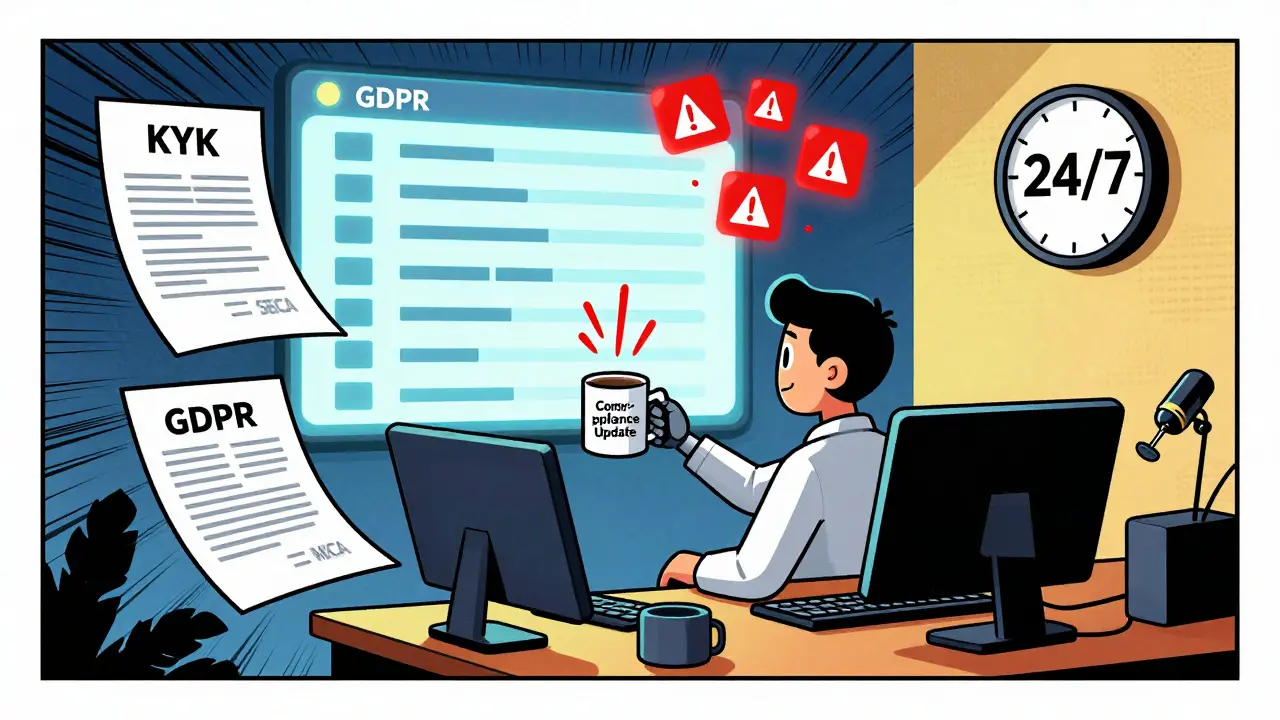
Ongoing Compliance Obligations in Blockchain: What You Must Keep Doing to Stay Legal
- 6 Comments
- Aug, 13 2025
Ongoing compliance obligations in blockchain require constant monitoring of laws like AML, KYC, and securities regulations. Learn how to stay legal, avoid fines, and build trust with users through practical, real-world steps.