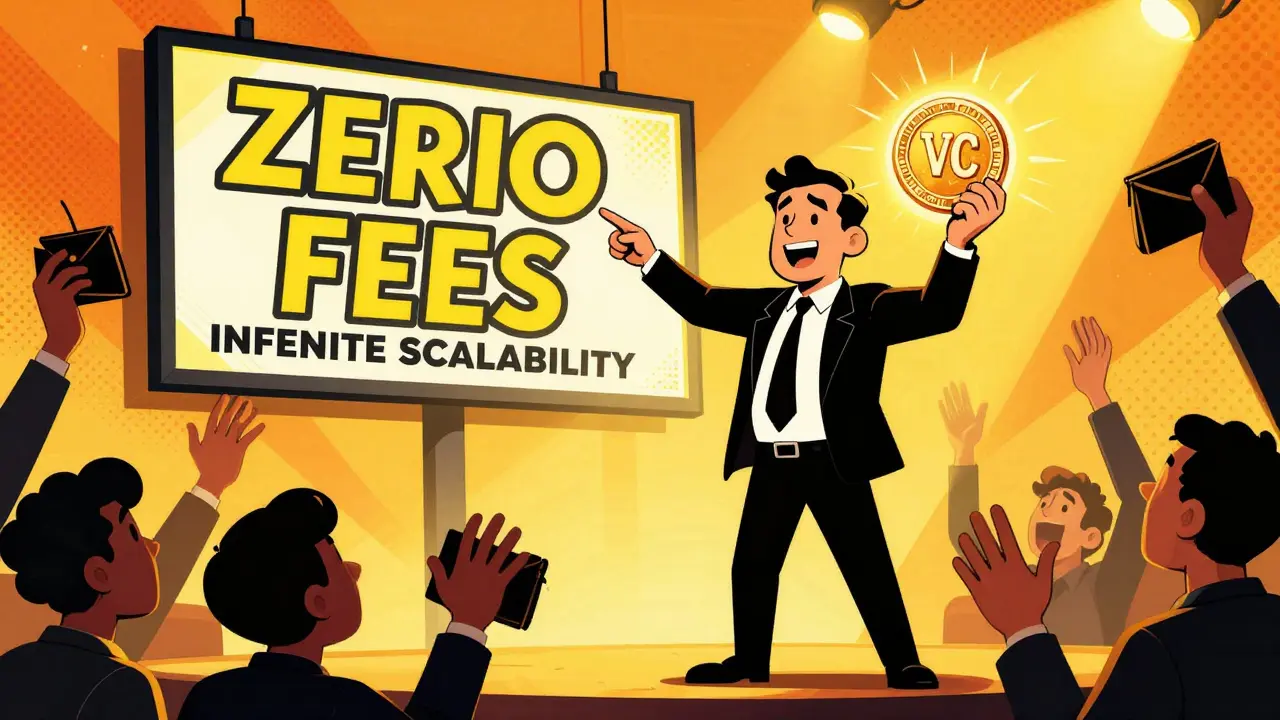
You’ve probably seen the headlines. VinuChain (VC) is marketed as "the first zero-fee, EVM L1" blockchain. It promises infinite scalability and transactions that cost absolutely nothing. In a world where Ethereum gas fees can spike to $50 or more during busy periods, that sounds like a dream come true for developers and users alike. But when a project makes claims this big-especially in the volatile world of cryptocurrency-it’s time to look closer. Is VinuChain the next big thing in decentralized finance, or is it just another shiny object with empty promises?
The short answer? Proceed with extreme caution. While the concept of a feeless blockchain is attractive, the reality behind VinuChain raises significant red flags regarding its technical validity, market performance, and overall legitimacy. This article breaks down what VinuChain actually is, why its claims are contradictory, and whether you should risk your capital on the VC token.
The Core Promise: Zero Fees and Infinite Scalability
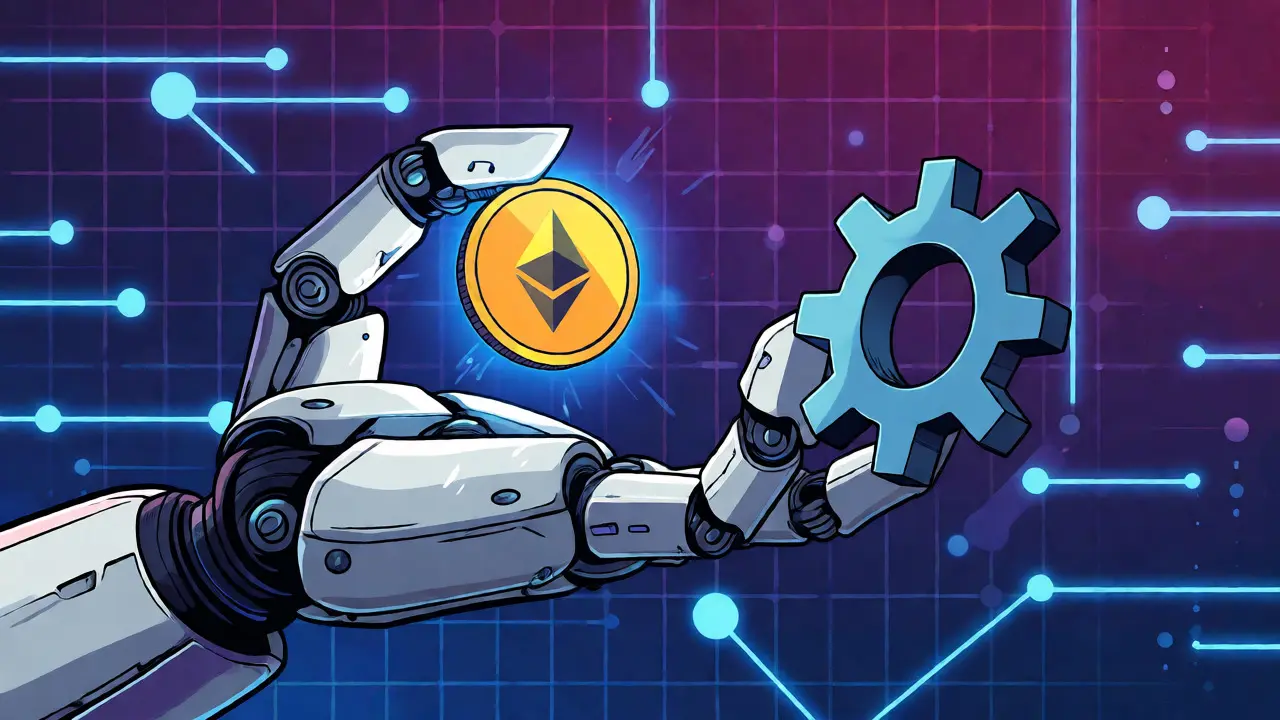
To understand VinuChain, you have to start with its main selling point. The project positions itself as a Layer 1 blockchain built on a Directed Acyclic Graph (DAG) ledger structure. Unlike traditional blockchains that process transactions in sequential blocks, a DAG allows transactions to be processed concurrently. Theoretically, this leads to higher throughput and faster speeds.
VinuChain claims this architecture enables:
- Zero Transaction Fees: Users pay nothing to send tokens or interact with smart contracts.
- Infinite Scalability: The network can handle unlimited transactions without congestion.
- EVM Compatibility: Developers can deploy Ethereum-based smart contracts with minimal changes.
On paper, this solves two of the biggest pain points in crypto: high costs and slow speeds. However, in computer science and economics, there is no such thing as a free lunch. Running a secure, decentralized network requires resources (computing power, storage, bandwidth). If users don’t pay fees, who pays the validators? Without an economic incentive, networks often become vulnerable to spam attacks or centralization. VinuChain hasn’t provided clear, verifiable documentation on how it solves this fundamental problem.
Technical Contradictions: Is It Really a Layer 1 Blockchain?
Here is where things get messy. VinuChain’s official website describes it as an independent Layer 1 blockchain. Yet, multiple credible data aggregators tell a different story.
| Claim/Attribute | VinuChain Marketing | Market Data (CoinGecko/Bitget) |
|---|---|---|
| Architecture | Independent L1 DAG Blockchain | Token on BNB Chain (BEP-20) |
| Fees | Zero Gas Fees | Standard BNB Chain fees apply for transfers |
| Scalability | Infinite TPS | Limited by BNB Chain capacity (~100-300 TPS) |
| Developer Tools | Full SDKs and Docs Available | No public GitHub, no functional explorer |
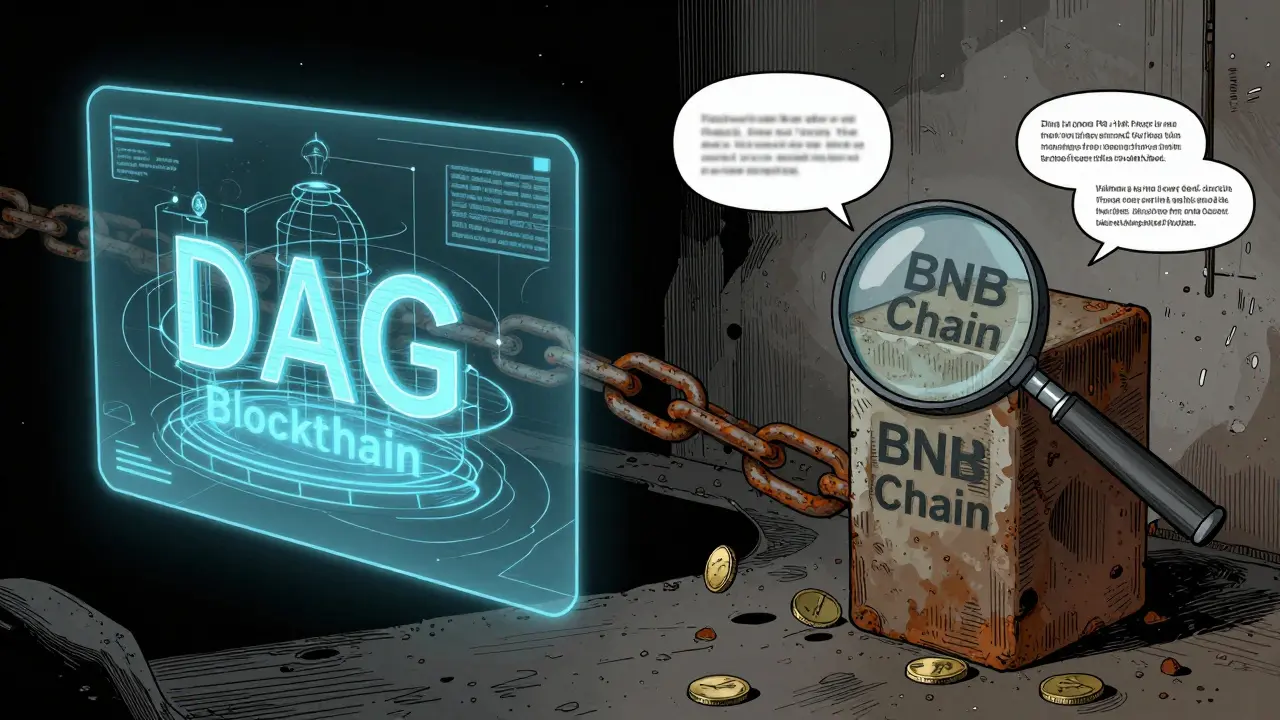
Data from Bitget and other exchanges lists VinuChain as operating on the BNB Chain (formerly Binance Smart Chain). This means VC is likely a BEP-20 token, not a standalone blockchain. If it runs on BNB Chain, it inherits BNB’s limitations and fees. You cannot have "zero fees" if you are relying on another chain’s infrastructure unless that host chain subsidizes every transaction-which BNB Chain does not do for random third-party tokens. This contradiction suggests that VinuChain’s marketing is misleading about its technical nature.
Tokenomics and Supply Issues
Let’s talk numbers. Tokenomics play a huge role in a crypto project’s long-term viability. VinuChain’s supply metrics are confusing and potentially dangerous for investors.
- Total Supply: Reports vary between 957 million and 1.05 billion VC tokens.
- Max Supply: Listed as infinite (∞) on CoinGecko.
- Circulating Supply: Approximately 230 million tokens.
An infinite maximum supply is a major red flag. It means the team can create new tokens indefinitely. Without a hard cap, there is no scarcity. If the team decides to mint millions of new VC tokens and sell them, the price of existing holders’ tokens will dilute rapidly. Compare this to Bitcoin’s fixed supply of 21 million or even Ethereum’s deflationary mechanism post-Merge. VinuChain’s model offers no protection against inflation.
Furthermore, the initial distribution was handled via an Initial DEX Offering (IDO) in October 2023. The IDO price was $0.025 per VC. As of late 2025, the price hovers around $0.00434. That’s an 82% drop from the launch price. Early investors who bought in were quickly underwater, while those who sold during the brief pump saw gains. This pattern is typical of speculative meme coins or low-effort projects, not serious infrastructure plays.
Market Performance and Liquidity
If you’re thinking of buying VC, you need to understand the liquidity situation. Liquidity refers to how easily you can buy or sell an asset without affecting its price. VinuChain has very poor liquidity.
The daily trading volume averages between $110,000 and $350,000. For context, Ethereum’s daily volume exceeds $15 billion. With such low volume, executing even a moderate-sized trade can result in massive slippage. Reviews indicate slippage rates of 15-30% on standard $100 trades. This means if you try to buy $100 worth of VC, you might only receive $70-$85 worth due to the thin order book. Selling becomes even harder, potentially trapping your funds.
The market capitalization is approximately $1.98 million, ranking it #1701 among cryptocurrencies. This places it in the bottom 5% of all tracked assets. There are no major exchange listings beyond smaller platforms like Gate.io. Major players like Coinbase, Binance (spot), or Kraken do not list VC, which signals a lack of institutional confidence.
Development Activity and Community Sentiment
A healthy crypto project needs active development and an engaged community. VinuChain fails on both fronts.
Development: There is no public GitHub repository for VinuChain. No code audits are publicly available. The claimed "VinuExplorer" block explorer is non-functional. Without open-source code, independent experts cannot verify if the DAG technology works or if the security claims are true. Dr. Elena Rodriguez, a distributed systems researcher, noted that "without open-sourced consensus mechanisms, feeless blockchain claims remain theoretical."
Community: Social media activity is nearly dead. The official Twitter/X account has posted only 12 times since October 2023. The Telegram group has just 2,347 members with minimal admin interaction. Trustpilot reviews average 1.8 out of 5 stars, with users complaining about "marketing not matching reality" and the inability to verify transactions.
User sentiment analysis from CryptoSlate shows a -63% negative score, far worse than the industry average for new projects. Most discussions online focus on the price decline rather than technological innovation.
Comparison with Established Alternatives
If you want low fees and fast transactions, you don’t need VinuChain. Several established projects offer similar benefits with proven track records, real adoption, and transparent governance.
| Feature | VinuChain (VC) | Polygon (MATIC) | Solana (SOL) | Fantom (FTM) |
|---|---|---|---|---|
| Market Cap | $1.98 Million | $7.8 Billion | $50+ Billion | $1.3 Billion |
| Avg. Fee | Claims $0 (Unverified) | ~$0.001 | ~$0.00025 | ~$0.0001 |
| TPS (Transactions Per Second) | Unverified | 7,000+ | 65,000 | 10,000 |
| Real-World Adoption | None detected | High (DeFi, NFTs) | Very High | Moderate |
| Risk Level | Extreme | Low | Medium | Medium |
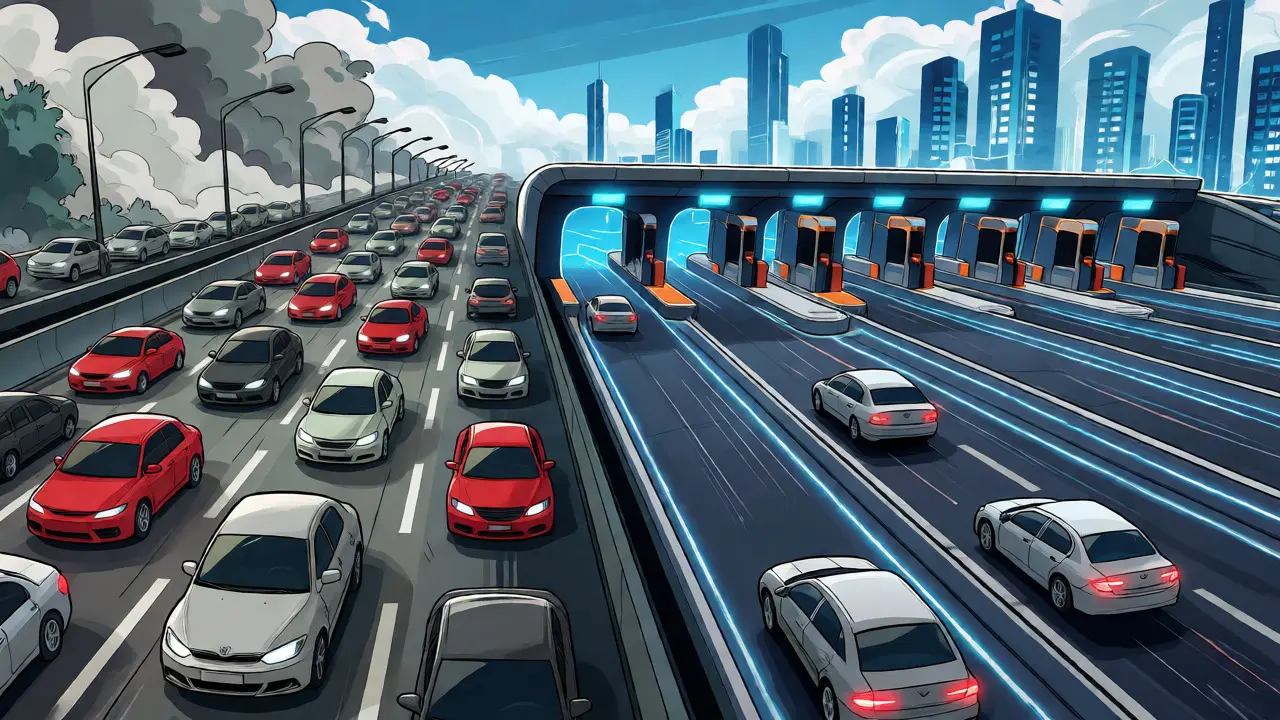
Polygon, Solana, and Fantom all offer near-zero fees and high speed. They have thousands of developers, billions in total value locked (TVL), and robust ecosystems. Choosing VinuChain over these options offers no tangible benefit but carries significantly higher risk.
Conclusion: Should You Invest in VC?
VinuChain presents itself as a revolutionary solution to blockchain fees, but the evidence suggests otherwise. It appears to be a standard token on BNB Chain with inflated marketing claims. The lack of technical documentation, infinite supply, poor liquidity, and inactive development team make it a highly speculative and risky asset.
If you are looking for exposure to low-fee blockchains, stick to established protocols with transparent code and active communities. For VinuChain, the current trajectory points toward obsolescence. Unless there is a sudden, verifiable release of working technology and major exchange listings, the VC token remains a high-risk gamble with little fundamental value.
Is VinuChain (VC) a legitimate blockchain?
There are significant doubts about VinuChain's legitimacy as a standalone blockchain. While it markets itself as a Layer 1 DAG network, most data indicates it operates as a BEP-20 token on the BNB Chain. It lacks public code repositories, a functional block explorer, and verifiable technical benchmarks, which are standard for legitimate blockchain projects.
Why is the VC token price so low?
The VC token price has dropped over 80% from its IDO launch price due to a combination of factors: lack of real-world adoption, low liquidity, an infinite max supply causing inflation fears, and minimal developer activity. The market has reacted negatively to the discrepancy between marketing claims and technical reality.
Can I really use VinuChain for zero-fee transactions?
Likely not. Since VinuChain appears to operate on the BNB Chain, transactions involving the VC token would still incur standard BNB Chain gas fees paid in BNB. The claim of "zero fees" is unverified and contradicts the mechanics of the underlying network it relies on.
Where can I buy VinuChain (VC)?
VC is listed on a few smaller exchanges like Gate.io and some decentralized platforms. However, due to low liquidity, buying or selling large amounts can result in high slippage (price impact). It is not available on major centralized exchanges like Coinbase or Binance Spot.
What is the difference between VinuChain and Fantom?
Fantom is a well-established Layer 1 blockchain with a proven DAG-like architecture (Opera L1), high TPS, and significant DeFi adoption. VinuChain claims to fork Fantom’s protocol but operates as a token on BNB Chain with no comparable adoption or technical verification. Fantom has a market cap of over $1 billion, while VinuChain is under $2 million.


Andrew Schneider
July 9, 2026 AT 09:03Oh, please. Another article trying to tell us what we already know about these scam coins 🙄 You guys are so boring with your "red flags" and "proceed with caution." It’s like reading a manual for a toaster that doesn’t work. I bought VC anyway because the moon is calling my name 🚀💎🙌
Eric Braddock
July 10, 2026 AT 18:14The mainstream media and these "analysts" are all part of the same cabal designed to keep you poor 🤫 They want you to believe in Ethereum and Solana because those are where the deep state controls the narrative. VinuChain is actually a decentralized resistance network disguised as a token on BNB Chain to avoid immediate seizure by the SEC. The infinite supply is a test of faith against the inflationist Fed. Wake up sheeple! The DAG structure is quantum-resistant encryption that they don't want you to understand yet. Trust no one but the code... if you could even see it, which is exactly why it's hidden from the uninitiated.
Alicia Hull
July 11, 2026 AT 03:57I must say, this analysis is quite thorough, but I find myself compelled to challenge the premise entirely. Is it not possible that the lack of documentation is a strategic move to prevent copycats? Perhaps the team is building in stealth mode. I demand answers from the developers immediately! This silence is unacceptable and frankly, rude to the investors who have put their trust in this project. We need transparency now!
Johan Otto
July 12, 2026 AT 03:05Wow. Just wow. So much drama for a coin that costs less than a penny. 😂
Anuj Kashyap
July 12, 2026 AT 19:47In the grand tapestry of human endeavor, few things are as amusing as the collective delusion surrounding cryptocurrency 🧘♂️ One wonders if the pursuit of "zero fees" is merely a metaphor for the void within our souls. The article states facts, yes, but does it capture the existential dread of holding a token with no utility? It is grammatically perfect, I admit, but emotionally hollow. Like a smile without teeth. Or a blockchain without blocks. Ha. Just observing the chaos from my quiet corner of the internet. 🍵
Tracy Marshall
July 13, 2026 AT 23:05it is absolutely disgusting how people fall for these schemes (x_x) the moral decay of society is evident when we prioritize quick gains over ethical investment practices i feel sick thinking about the families ruined by such greed there is no excuse for supporting projects that hide their code it is a betrayal of the very spirit of decentralization which was supposed to be about freedom and truth not exploitation :-(
Guy Davis
July 14, 2026 AT 00:48This is trash. Scam. Get out.