
Buying Bitcoin in Canada doesn’t trigger a tax bill. Selling it? That’s a different story. The Canada Revenue Agency (CRA) doesn’t treat cryptocurrency like cash. It treats it like property. And that changes everything when it comes to what you owe at tax time.
How the CRA Classifies Cryptocurrency
The CRA’s stance has been clear since 2013: cryptocurrency is not money. It’s not foreign currency. It’s a commodity - a digital asset that acts as a store of value, medium of exchange, or unit of account. That classification means every time you trade, sell, or spend crypto, you’re triggering a taxable event. Even buying coffee with Ethereum counts.
Think of it like selling a stock or a piece of art. If you bought Bitcoin for $10,000 and sold it later for $18,000, you made an $8,000 profit. The CRA wants its share of that. The same rule applies if you swap Bitcoin for Solana, or use Dogecoin to pay for a web design service. The moment you dispose of crypto - in any form - you’ve created a taxable transaction.
Capital Gains vs. Business Income: The Big Difference
Not all crypto income is taxed the same. There are two main buckets: capital gains and business income. Which one applies to you depends on how you use crypto.
If you bought crypto as a long-term investment and sold it after holding it for months or years, you’re likely looking at a capital gain. Only 50% of that gain is taxable. So if you made $20,000 in profit, only $10,000 gets added to your income. For someone in Ontario earning $100,000 total, that $10,000 would be taxed at about 26% federally and 9.15% provincially - totaling roughly $3,515 in tax on the gain.
But if you’re trading crypto daily, running a mining operation, or earning crypto as payment for freelance work, the CRA may classify that as business income. That means 100% of the value is taxable - no 50% discount. And you’re not just paying income tax. You also owe CPP contributions and possibly GST/HST if you’re regularly providing services in exchange for crypto.
How does the CRA decide? They look at your behavior. Frequent trades, leverage, short holding periods, and treating crypto like a job all raise red flags. One trader on Reddit reported getting audited after making 147 trades in a single year. The CRA didn’t ask for receipts - they asked for his trading strategy.
What Triggers a Taxable Event
Here’s the simple list of what you must report:
- Selling crypto for Canadian dollars
- Trading one crypto for another (BTC for ETH, etc.)
- Using crypto to buy goods or services
- Receiving crypto as payment for work or services
- Earning crypto from mining, staking, or airdrops
Here’s what doesn’t trigger tax:
- Buying crypto with CAD
- Holding crypto without selling or trading
- Transferring crypto between your own wallets
- Receiving crypto as a gift (but selling it later triggers tax)
That last one trips up a lot of people. If your uncle sends you 0.5 BTC as a birthday gift, you don’t pay tax then. But if you sell it for $30,000 six months later, you owe tax on the gain - based on the fair market value at the time you received it.
How Much Tax You Actually Pay
Canada’s tax system is progressive. That means the more you earn, the higher your rate. For 2025, federal rates are:
- 15% on income up to $55,867
- 20.5% on income between $55,868 and $111,733
- 26% on income between $111,734 and $173,205
- 29% on income between $173,206 and $246,752
- 33% on income over $246,752
Then add provincial taxes. Ontario adds up to 13.16% on income above $220,000. Quebec? Up to 25.75%. So a $50,000 capital gain in Ontario could mean $10,000 in tax. The same gain in Quebec? Closer to $12,500.
Business income? Double the tax burden. A $50,000 crypto income from mining or trading as a business? You pay full rate on the entire $50,000. That’s roughly $15,000-$20,000 in taxes depending on your province and other income.
Reporting: Schedule 3 and Form T2125
You don’t just say “I made money in crypto.” You have to prove it.
Capital gains go on Schedule 3 of your T1 return. You need to report:
- Date of acquisition
- Cost base (what you paid, including fees)
- Date of disposal
- Proceeds of disposition (what you received, in CAD)
- Capital gain or loss
Business income from mining, staking, or trading as a business? Use Form T2125. This is where you list expenses: electricity for mining rigs, software fees, internet costs, even a portion of your home office if you’re running a full-time operation.
Many people think their exchange gives them a clean tax report. It doesn’t. Most exchanges only track your trades - not your cost basis across wallets, or transfers between platforms. You’re responsible for connecting the dots.
Tax Loss Harvesting - Legal, But Tricky
Lost money on a crypto trade? You can use that loss to reduce your tax bill. But there’s a catch: the superficial loss rule.
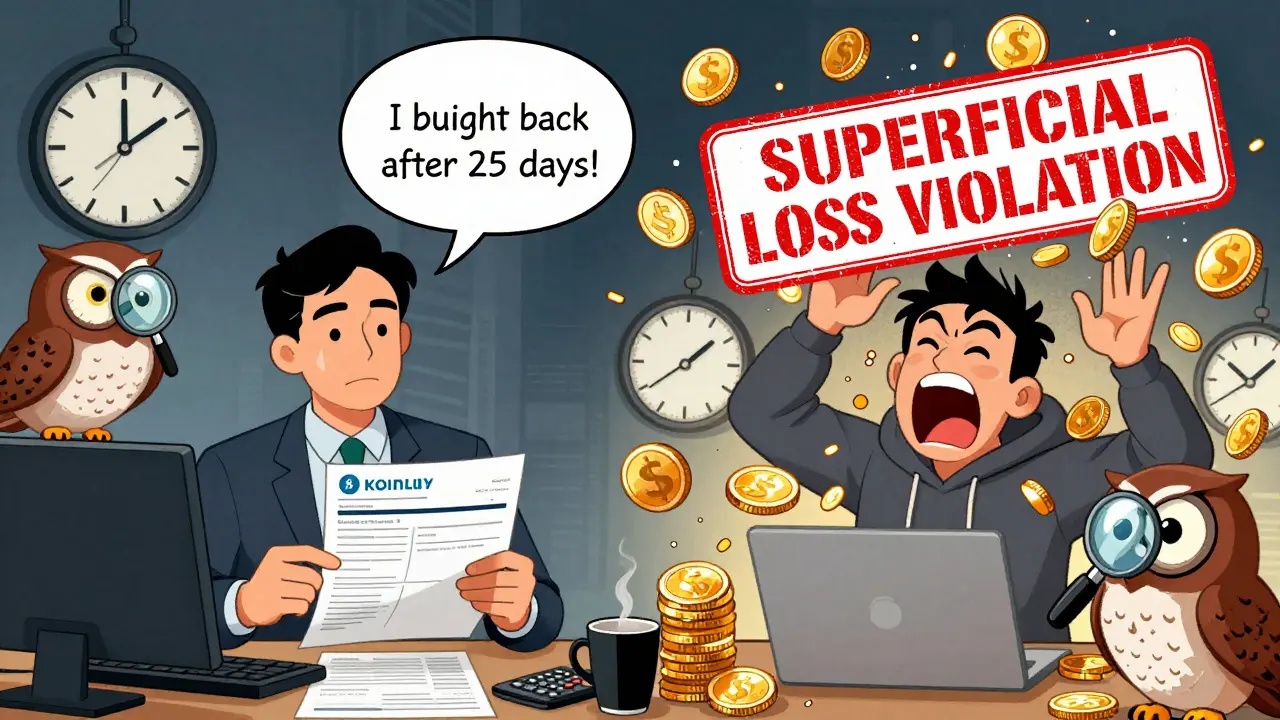
If you sell Bitcoin at a loss and buy it back - or any identical crypto - within 30 days before or after the sale, the CRA disallows the loss. You can’t just sell to claim a loss and buy right back. You have to wait 31 days.
Also, only 50% of capital losses are deductible. A $10,000 loss offsets only $5,000 of your capital gains. So if you made $15,000 in gains and harvested $10,000 in losses, you’re still taxed on $10,000 of gains - not $5,000.
One user on Reddit saved $3,200 in taxes by timing their loss harvests perfectly - selling losing positions in December and waiting 31 days before rebuying. Another lost $4,000 because they bought back the same token 25 days later. The CRA caught it.
What the CRA Is Watching Now
Enforcement is ramping up. Crypto-related audits jumped 37% from 2023 to 2024. The CRA now has data-sharing agreements with major Canadian exchanges like Wealthsimple, Coinsquare, and Bitbuy. These platforms now automatically send CRA-compliant tax statements to users - and to the CRA.
And new rules are coming. In August 2025, draft legislation proposed requiring reporting of all crypto transactions over $10,000 - similar to the U.S. IRS’s $10,000 rule for cash transactions. The Department of Finance estimates this will bring in $285 million more in tax revenue by 2027.
What’s the most common mistake in audits? Incorrect cost basis. People forget to include transaction fees. They mix up FIFO and average cost. They assume their exchange’s “cost” is accurate - even if they moved coins from another wallet. The CRA doesn’t care. They want your records.

Tools and Software That Actually Work
Doing this by hand? You’re setting yourself up for error. Most people use software. TurboTax Canada gets 3.8 stars, but users complain its crypto features are “patchy.” Koinly? 4.6 stars. Why? It’s built specifically for CRA rules. It auto-imports from 200+ exchanges, calculates capital gains using your preferred method (FIFO, ACB), and generates Schedule 3 and T2125-ready reports.
Other solid options: CoinLedger, CryptoTrader.Tax, and ZenLedger. All support Canadian tax forms. The key is choosing one that lets you select “Canada” as your jurisdiction and uses CRA-approved accounting methods.
Don’t rely on free tools. They often miss cross-border transfers, staking rewards, or DeFi interactions. And if you’re doing more than 10 trades a year? Pay for software. It’s cheaper than an audit.
What Happens If You Don’t Report
Penalties are steep. For late or missing returns:
- 5% of the tax owing, plus 1% per full month late (max 12 months)
- 10% of the tax owing if the CRA finds gross negligence
Gross negligence? That’s when you ignore clear rules - like claiming a loss you triggered within 30 days, or hiding a transaction on an offshore exchange. The CRA has tools to trace blockchain activity. They’ve done it before.
In 2025, a Toronto man was hit with a $28,000 penalty after failing to report $140,000 in crypto gains over three years. He claimed he “didn’t know.” The CRA didn’t buy it. He had 17 transactions on Binance - and had downloaded the CRA’s own crypto tax guide in 2022.
What You Should Do Right Now
If you traded, earned, or spent crypto in 2025:
- Collect all transaction records - from every exchange, wallet, and DeFi platform.
- Use a CRA-compliant tool to calculate your gains and losses.
- Separate capital gains from business income.
- Review your cost basis for every coin you sold or traded.
- File Schedule 3 and T2125 (if applicable) with your T1 return by April 30, 2026.
And if you’re unsure? Talk to a tax professional who’s handled crypto before. Not just any accountant. One who knows the difference between staking rewards and mining income. One who’s seen CRA audit letters.
The rules aren’t going away. They’re getting tighter. In 2025, 54% of Canadian crypto owners admitted they felt unprepared to file. Don’t be one of them. The cost of ignorance isn’t just money - it’s penalties, interest, and stress.
Do I pay tax when I buy cryptocurrency with Canadian dollars?
No. Buying crypto with CAD is not a taxable event. The CRA only taxes you when you dispose of the asset - meaning you sell it, trade it, or use it to buy something else. Holding crypto after purchase doesn’t trigger tax.
Is staking crypto taxable in Canada?
Yes. Staking rewards are treated as business income. You pay tax on the full fair market value of the crypto you receive at the time you get it. For example, if you earn 0.5 ETH worth $1,200 from staking, you report $1,200 as income - even if you don’t sell it.
Can I use tax loss harvesting to reduce my crypto tax bill?
Yes - but only if you follow the superficial loss rule. You can’t sell a crypto at a loss and buy the same asset back within 30 days before or after the sale. If you do, the loss is disallowed. Wait at least 31 days before repurchasing to claim the loss.
Do I have to report crypto from foreign exchanges?
Yes. The CRA requires you to report all crypto transactions, regardless of where they happened. Whether you traded on Binance, Kraken, or a decentralized exchange, you must include those gains or losses in your Canadian tax return. Many audits start with unreported foreign exchange activity.
What happens if I forget to report a crypto transaction?
You can file a voluntary disclosure to correct the error before the CRA contacts you. If you do, penalties may be reduced or waived. But if the CRA finds it first - through exchange data or blockchain analysis - you’ll face penalties of up to 10% of the tax owing for gross negligence, plus interest.




Ashley Lewis
December 21, 2025 AT 15:55The notion that crypto is treated as property is not merely a technicality-it's a fundamental misclassification that undermines modern financial sovereignty. The CRA's stance is archaic, rooted in 20th-century fiscal dogma, and utterly disconnected from the decentralized reality of digital assets. Taxing every minor transaction is regulatory overreach masquerading as fiscal responsibility.
vaibhav pushilkar
December 22, 2025 AT 15:25Good breakdown! Just remember: if you're staking, record the exact CAD value when you receive rewards-don't assume the exchange price is accurate. Many forget that and get hit later. Use Koinly-it auto-pulls from most wallets and handles CRA rules right.
SHEFFIN ANTONY
December 23, 2025 AT 13:27Oh please. The CRA is just jealous they can't tax your imagination. You think they care about your 0.002 BTC coffee purchase? They're chasing small fry while banks launder billions in crypto through shell companies. This whole post is fear-mongering dressed up as advice. If you're not buying Bitcoin and holding it for 10 years, you're playing their game.
Vyas Koduvayur
December 25, 2025 AT 06:32Let me break this down properly because everyone's missing the nuance. First, the superficial loss rule isn't just about buying back the same token-it's about "identical property" under ITA 54. So swapping BTC for BCH after a loss? Still disallowed if they're deemed substantially identical. The CRA has issued Interpretation Bulletins on this. Also, FIFO isn't mandatory-ACB is allowed, but you must elect it in writing and stick with it. Most people don't realize that. And if you're mining, your cost basis isn't just electricity-it includes depreciation on your ASICs, which you can claim under Class 50 or 50.1. Don't even get me started on DeFi yield farming-those rewards are income on receipt, but the gas fees? They're deductible as business expenses only if you're operating as a business, not a hobbyist. And if you're using a non-KYC exchange, you're still obligated to report-Section 239 of the Income Tax Act applies regardless of jurisdiction. I've audited 12 crypto cases in the last year. The biggest mistake? People think "I didn't convert to CAD, so it's not taxable." Wrong. Every disposal triggers a deemed disposition. Even if you traded BTC for ETH on Binance and never touched CAD, you still owe tax on the gain from your original purchase price. The CRA has blockchain analytics tools that trace wallet links across exchanges. They don't need your bank records-they have the chain. And if you're using a wallet like Phantom or Metamask? They can still trace it through on-chain analytics firms like Chainalysis. So yes, you must track every single transaction. No shortcuts. No excuses. I've seen people lose $20k in penalties because they used a free tracker that didn't account for cross-chain swaps. Use Koinly. Or hire a CPA who actually knows crypto tax law. Not the guy who does your RRSPs.
Jake Mepham
December 26, 2025 AT 08:33Canada’s rules are actually pretty fair compared to other countries. At least we get the 50% capital gains break. In the US, you pay full income tax on staking rewards and trade fees. In Germany, you’re tax-free after a year-but only if you hold it. Here, you’ve got tools, clarity, and time to get it right. Use Koinly, track your buys, don’t panic over small trades, and if you’re unsure, get a pro. You’ve got this. Crypto’s not going away-and neither is the tax system. Get ahead of it, not behind.
Jacob Lawrenson
December 26, 2025 AT 23:08Just did my crypto taxes with Koinly and it was a breeze 😎 Had 87 trades, 3 staking rewards, and a few NFT sales-auto-generated Schedule 3 and T2125 in 20 mins. CRA won’t come after you if you’re honest and organized. Don’t overthink it, just document and file! 💪🔥
Jordan Renaud
December 27, 2025 AT 20:36There’s something poetic about being taxed on digital scarcity. We built systems to bypass traditional finance, only to have the same old ledger catch up with us. The real question isn’t whether we owe tax-it’s whether we still believe in decentralization when the state demands its cut. Maybe the answer isn’t evasion, but reimagining how value flows-beyond currency, beyond taxation, beyond control. For now? File your Schedule 3. But keep asking harder questions.