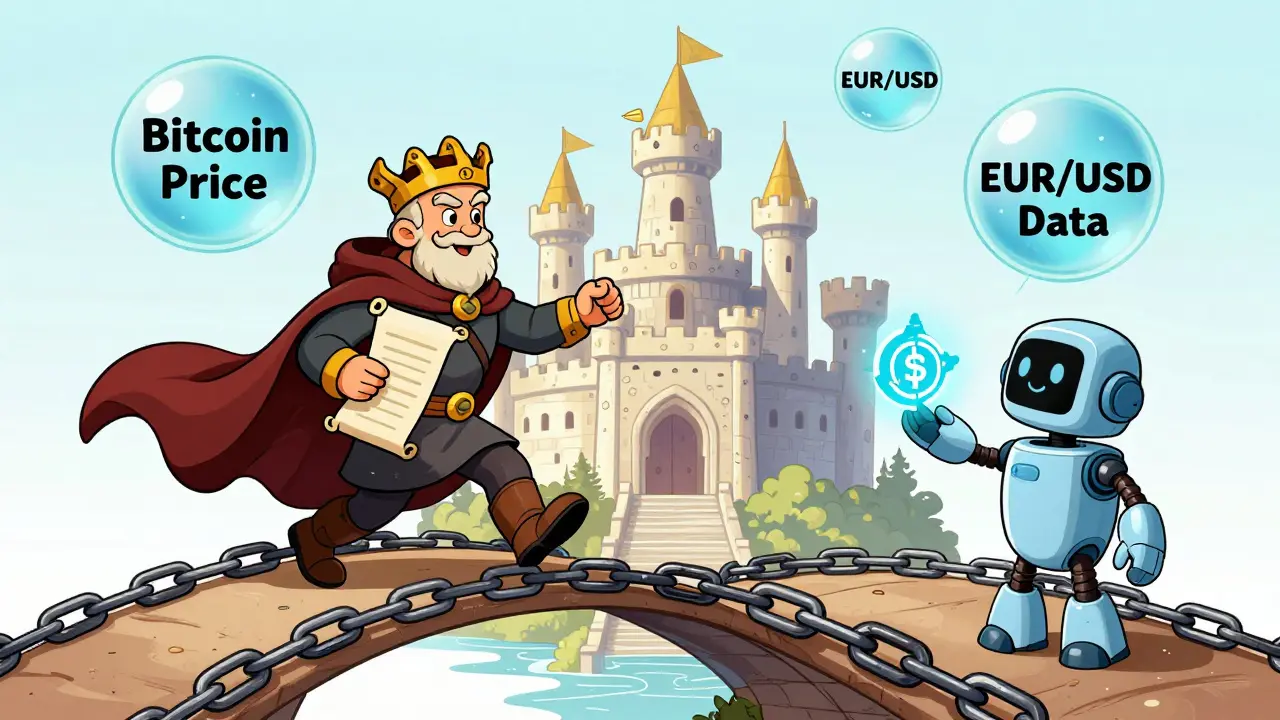
Smart contracts are supposed to run automatically-no middlemen, no human intervention. But here’s the problem: they can’t see the outside world. If you want a smart contract to pay out when the price of Bitcoin hits $60,000, it needs to know what Bitcoin’s price actually is. That’s where Chainlink oracle comes in.
What Is a Chainlink Oracle?
A Chainlink oracle is a bridge between blockchains and real-world data. Think of it like a trusted messenger that goes out, checks the temperature outside, the stock market, or the exchange rate for EUR/USD, and brings that information back to a smart contract. Without this, smart contracts are stuck in a bubble, unable to react to anything happening beyond their own network. Chainlink doesn’t rely on one source. It pulls data from dozens, sometimes hundreds, of independent data providers-like Tiingo, CoinMarketCap, and even enterprise APIs-and then aggregates them. If one source says Bitcoin is $59,000 and another says $60,500, Chainlink doesn’t just pick one. It uses a weighted average, filters out outliers, and delivers a single, tamper-proof number to the contract. This is how it solves what’s called the “oracle problem”-the biggest roadblock to real-world blockchain adoption.How Chainlink Works: The Three Layers of Decentralization
Chainlink’s security doesn’t come from one clever trick. It’s built on three overlapping layers of decentralization:- Data source decentralization: Instead of using one weather API or one price feed, Chainlink pulls from multiple providers. Even if one gets hacked or goes offline, the others keep the data flowing.
- Node operator decentralization: Thousands of independent operators run Chainlink nodes. These aren’t companies-they’re individuals, crypto teams, even small businesses. Each node fetches data, signs it with its private key, and submits it to the network. They’re paid in LINK tokens for honest work and slashed if they lie or fail.
- Network-level decentralization: Multiple oracle networks can run in parallel. One might handle ETH/USD prices, another might verify insurance claims using flight data. Each is its own mini-network with its own set of nodes and data sources.
Chainlink Price Feeds: The Backbone of DeFi
The most widely used Chainlink service is Price Feeds. These are pre-built, ready-to-use data streams for crypto and fiat asset prices. Over $30 billion in DeFi protocols rely on them-including Aave, Compound, and MakerDAO. These platforms use Chainlink’s price data to determine when to liquidate loans, when to mint stablecoins, or when to adjust interest rates. These feeds update every 60 minutes under normal conditions. But if prices swing wildly-like during a market crash-they can refresh in under 10 seconds. That speed and accuracy are why DeFi projects trust Chainlink over centralized alternatives. A centralized oracle could be manipulated or shut down. Chainlink’s decentralized model makes that nearly impossible.
LINK Token: The Fuel for the Network
LINK isn’t a currency you trade for profit-it’s the payment system for the oracle network. Node operators need LINK to accept jobs. When a smart contract wants data, it sends LINK to the oracle contract as payment. The more reliable and responsive the node, the more jobs it gets-and the more LINK it earns. If a node submits bad data, it loses some of its staked LINK. This creates a strong economic incentive to be honest. It’s not just about reputation. It’s about money. Lose too much, and you’re out of the game. LINK is built on ERC-677, an upgraded version of ERC-20 that lets data be bundled with token transfers. This small technical detail lets Chainlink deliver data and payment in a single transaction-making everything faster and cheaper.Chainlink 2.0: The Next Evolution
Launched in early 2023, Chainlink 2.0 isn’t just an upgrade-it’s a whole new architecture. It introduces three major improvements:- Hybrid smart contracts: These combine on-chain logic with off-chain computation. For example, a contract can trigger a payment only after verifying a user’s identity via a third-party KYC service-something impossible on-chain alone.
- Chainlink Functions: Now, developers can call APIs directly from their smart contracts without writing custom oracle code. Need to check if a flight was delayed? Just ask Chainlink Functions. It handles the API call, data parsing, and security-all in one line of code.
- Cross-Chain Interoperability Protocol (CCIP): This lets smart contracts on Ethereum talk to those on Solana, Polygon, or even private enterprise chains. It’s the first truly universal bridge for data and value across blockchains.
Who Uses Chainlink? Real-World Examples
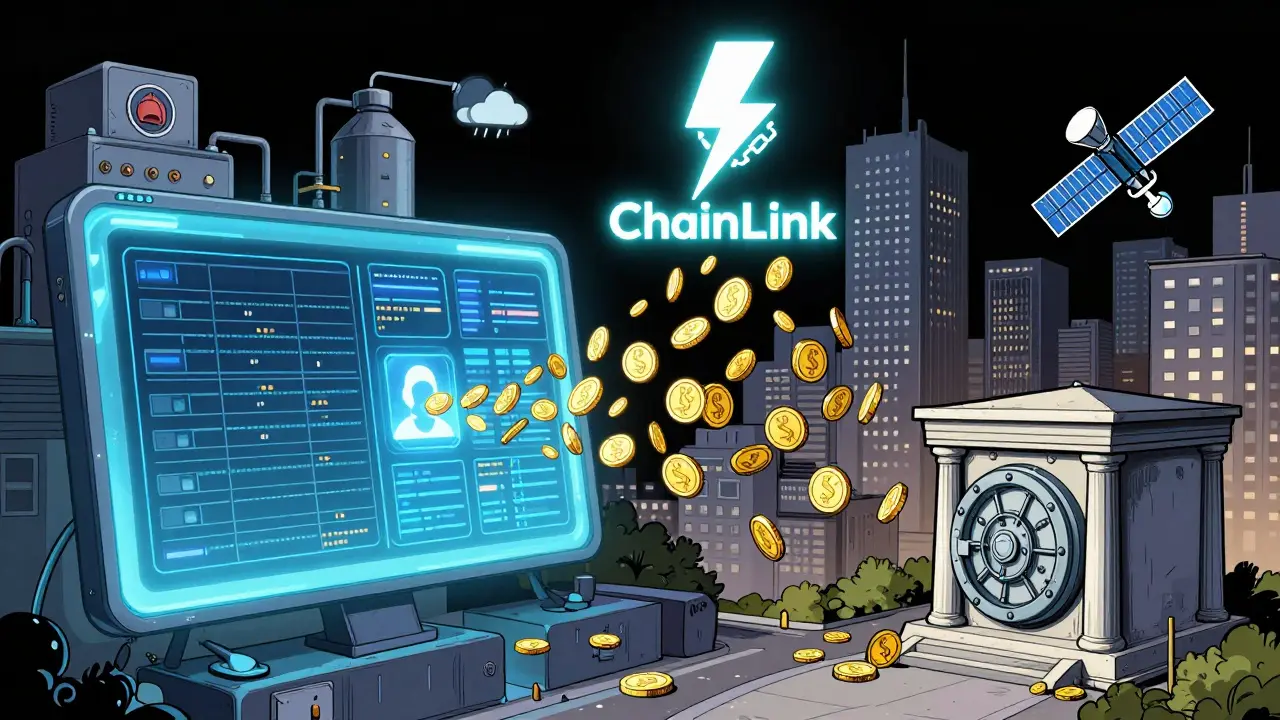
You don’t need to be a DeFi whale to use Chainlink. Here’s where it’s actually making a difference:- DeFi lending: Aave and Compound use Chainlink Price Feeds to avoid liquidating borrowers during fake price spikes.
- Stablecoins: Tether and other tokenized assets use Chainlink’s Proof of Reserve to prove they hold enough cash backing. Regulators are starting to require this.
- Gaming: Chainlink VRF (Verifiable Random Function) ensures fair dice rolls and loot drops in blockchain games. No one can cheat because the randomness is cryptographically proven.
- Insurance: Parametric insurance contracts pay out automatically when weather data from Chainlink confirms a hurricane hit a specific region.
- Enterprise: Companies like SAP and SWIFT are exploring Chainlink to connect legacy systems to blockchain ledgers without rebuilding everything.
Challenges and Criticisms
Chainlink isn’t perfect. The biggest complaint? It’s complex. Setting up a custom oracle node requires Solidity knowledge, understanding of job specifications, and careful LINK token management. One developer spent three weeks just to get a simple price feed working. Some argue that the LINK tokenomics are fragile. If the crypto market crashes, fewer contracts pay for data, so node operators earn less. But Chainlink 2.0’s improved incentive structures are designed to handle this-nodes can stake LINK to earn more rewards, even during low-demand periods. There’s also competition. Band Protocol and API3 offer alternatives. API3, for example, lets data providers run their own nodes-no middlemen. But Chainlink’s scale is unmatched. It’s integrated into over 1,000 projects across 10+ blockchains. That network effect is hard to beat.Is Chainlink the Future?
Gartner predicts that by 2026, 80% of enterprise blockchain applications will need an oracle. Chainlink isn’t just meeting that demand-it’s defining it. Its combination of security, scalability, and real-world use cases makes it the de facto standard. The future isn’t just on-chain. It’s hybrid. Smart contracts that talk to banks, sensors, weather stations, and stock markets. Chainlink is the glue holding that world together. Without it, blockchain would stay a closed system-interesting, but limited. With it, it becomes a layer of the global economy.What is the main purpose of a Chainlink oracle?
The main purpose of a Chainlink oracle is to securely connect smart contracts on blockchains to real-world data like prices, weather, or flight status. Without oracles, smart contracts can’t interact with anything outside their own network, which limits their usefulness in real-world applications.
How does Chainlink ensure data accuracy?
Chainlink uses multiple data sources and node operators. It collects data from dozens of independent providers, filters out outliers, and uses cryptographic proofs to verify the final result. This multi-layered approach prevents manipulation from any single source or node.
What is LINK token used for?
LINK is the native token used to pay node operators for delivering data to smart contracts. Operators earn LINK for honest, accurate work and lose LINK if they provide bad data. It’s the economic incentive that keeps the network secure and reliable.
Can Chainlink be hacked?
Chainlink’s architecture makes it extremely difficult to hack. Even if one data source or node operator is compromised, the network aggregates data from many others. The system only accepts results that are statistically valid and cryptographically verified. There have been no major successful attacks on Chainlink’s core infrastructure.
Do I need to run a Chainlink node to use it?
No. Most users interact with Chainlink through pre-built services like Price Feeds or Chainlink Functions. You only need to run a node if you want to become a data provider and earn LINK. For developers building apps, Chainlink provides easy-to-use libraries and documentation to integrate without running infrastructure.
What’s the difference between Chainlink and API3?
Chainlink uses third-party node operators to fetch data from various APIs, while API3 lets the data providers themselves run the oracle nodes. Chainlink offers more flexibility and scale; API3 reduces trust by removing intermediaries. Chainlink has a larger ecosystem, but API3 appeals to those who want data providers to be directly accountable.





Gareth Fitzjohn
January 30, 2026 AT 19:12Chainlink’s real genius is how it turns abstract blockchain ideas into something that actually works in the real world. No more guessing if a price feed is fake. It’s like having a team of accountants double-checking every number before it gets used.
Simple, reliable, and quietly revolutionary.
Katie Teresi
January 31, 2026 AT 07:21USA built this. Europe just copies it. Chainlink isn’t just tech-it’s American innovation at its finest. The rest of the world is still playing catch-up with their half-baked alternatives.
Moray Wallace
February 1, 2026 AT 17:15I appreciate how Chainlink doesn’t pretend to be magic. It’s a tool, not a religion. The layered decentralization makes sense-no single point of failure, no overpromising.
Still, I wish the docs were less jargon-heavy for newcomers.
Dylan Morrison
February 3, 2026 AT 01:56Imagine a world where your car insurance pays out automatically when a storm hits your neighborhood… or your rent adjusts based on local inflation data…
Chainlink isn’t just connecting blockchains to data-it’s connecting human life to digital trust.
❤️ This is the quiet revolution we didn’t know we needed.
William Hanson
February 4, 2026 AT 20:24Everyone acts like Chainlink is the only option but honestly? It’s overhyped. The tokenomics are a mess, the dev experience is a nightmare, and most of these ‘enterprise’ use cases are just PR stunts.
Stop drinking the Kool-Aid.
Lori Quarles
February 5, 2026 AT 12:33William, you’re just mad because you spent three weeks trying to set up a node and gave up.
Chainlink is the backbone of DeFi-and you know it. Stop being salty and start building.
Stop complaining. Start coding. 💪
Jeremy Dayde
February 6, 2026 AT 11:02When I first heard about oracles I thought it was some kind of sci-fi fantasy like predicting the future with crystals but then I saw how Chainlink actually works and it hit me like a truck
It’s not about magic it’s about math and economics and incentives and honestly if you think about it this is the first time in history that you can have a system where people get paid to tell the truth and punished for lying and it’s not run by a government or a bank
It’s just code and tokens and people who want to do the right thing because it pays better than lying
And that’s not just tech that’s a new kind of social contract
I’ve been in crypto since 2017 and I’ve seen a lot of hype but this one… this one actually feels different
It’s not flashy but it’s solid and it’s growing and it’s being used by real companies doing real things
And yeah the docs are rough but once you get past the first wall it opens up this whole world of possibilities
Like imagine your fridge ordering milk when it’s low and paying for it automatically with crypto
That’s not a dream anymore
That’s Chainlink