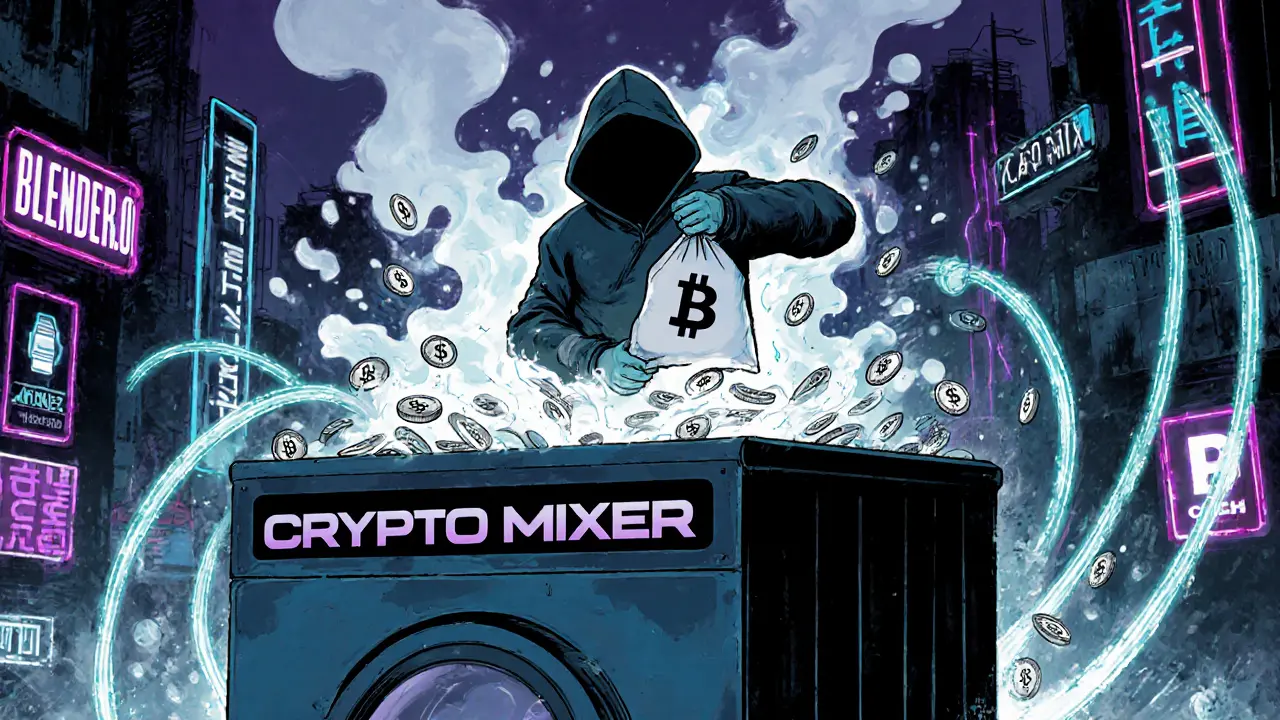
Crypto Mixing Cost Calculator
See how much stolen cryptocurrency gets reduced by mixing fees. Used by North Korean hackers to launder billions in stolen funds.
North Korea's Crypto Laundering Impact
$2.1B+ stolen since 2017
1-3% mixer fee
$200M+ processed by Blender.io alone
When you send Bitcoin from one wallet to another, the whole world can see it. Not your name, maybe - but the path of your coins, every step, every transfer, every connection. That’s the truth of blockchain. It’s public. Permanent. Traceable. And that’s exactly why criminals, including state-backed hackers from North Korea, turn to cryptocurrency mixing services - to erase that trail.
North Korea has spent over a decade building one of the most sophisticated cybercrime operations on Earth. Their hackers don’t just steal data. They steal cryptocurrency. Billions of dollars worth. And every time they do, they use mixing services to turn stolen coins into untraceable cash. It’s not speculation. It’s documented. The U.S. Treasury, Europol, and the UN have all tied North Korean groups like Lazarus to crypto thefts worth more than $2 billion since 2017. And mixers are their go-to tool.
How Cryptocurrency Mixers Work - The Digital Laundromat
Think of a cryptocurrency mixer like a coin-operated laundry for digital money. You drop in dirty coins - say, Bitcoin stolen from an exchange in Seoul - and after a few minutes, you get back clean ones. Same amount. Different origin. No way to prove they came from you.
The process is simple, but powerful:
- You send your stolen Bitcoin to the mixer’s address.
- The mixer pools your coins with hundreds or thousands of others - from regular users, criminals, and even legitimate businesses trying to protect privacy.
- It shuffles them using complex algorithms, sometimes across multiple blockchains.
- After a delay (to break timing patterns), it sends you back the same amount, but from completely new addresses.
The mixer charges 1% to 3% for this service. That’s the cost of anonymity. For North Korea’s hackers, it’s a bargain. A $10 million heist becomes $9.7 million in clean, untraceable Bitcoin - perfect for buying weapons, funding missile programs, or paying spies.
Centralized vs. Decentralized Mixers - Which One Does North Korea Use?
There are two kinds of mixers. And North Korea uses both.
Centralized mixers are the old-school kind. You send your coins to a company - like Blender.io or Sinbad.io - and they handle everything. These are risky. The company holds your coins. They could vanish. They could get hacked. They could keep logs. But they’re easy to use. No tech skills needed. And that’s why North Korean operatives rely on them. In 2022, U.S. authorities shut down Blender.io, which had processed over $200 million in illicit funds. Investigators traced transactions back to Lazarus Group wallets. The operators? Four Russians. But the money? It came from Pyongyang.
Decentralized mixers are newer. They use smart contracts and zero-knowledge proofs. No middleman. No logs. No one to subpoena. Protocols like Tornado Cash and Wasabi Wallet let users mix coins directly on the blockchain. These are harder to shut down. And they’re becoming more popular with state actors because there’s no company to raid, no server to seize. Just code. And code can’t be arrested.
After Tornado Cash was sanctioned by the U.S. Treasury in 2022, North Korean groups didn’t stop. They switched to newer, less-known decentralized mixers. Or they layered multiple mixers - sending coins through three or four different protocols to break any remaining link. It’s like washing your clothes in five different laundromats before selling them.
Why Mixers Are a Nightmare for Law Enforcement
Blockchain analysts can track Bitcoin. They’ve done it for years. But when coins go through a mixer, it’s like throwing a net over a school of fish - you see movement, but you can’t tell which fish is which.
Here’s the problem: mixers don’t just hide North Korean money. They hide everything. Legitimate users use them to protect their privacy. Donors to political causes. Journalists in repressive regimes. People avoiding corporate surveillance. That’s why regulators can’t just ban mixers outright - they’d be punishing millions of innocent people.
But that’s exactly the loophole North Korea exploits. They hide in plain sight. They blend their stolen coins with clean ones. They use mixers that claim to be for privacy, not crime. And when law enforcement tries to freeze funds, they’re stuck. The mixer doesn’t know who sent the money. The blockchain doesn’t know either. All it sees is a transaction from Address A to Address B. No names. No IDs. No fingerprints.
The U.S. Department of Justice indicted the operators of Blender.io - but the case collapsed. Why? Because prosecutors couldn’t prove the operators knew the money was from North Korea. They didn’t have logs. They didn’t ask questions. They just ran a service. And under current laws, that’s not enough to convict. The system isn’t built to catch anonymous criminals using anonymous tools.
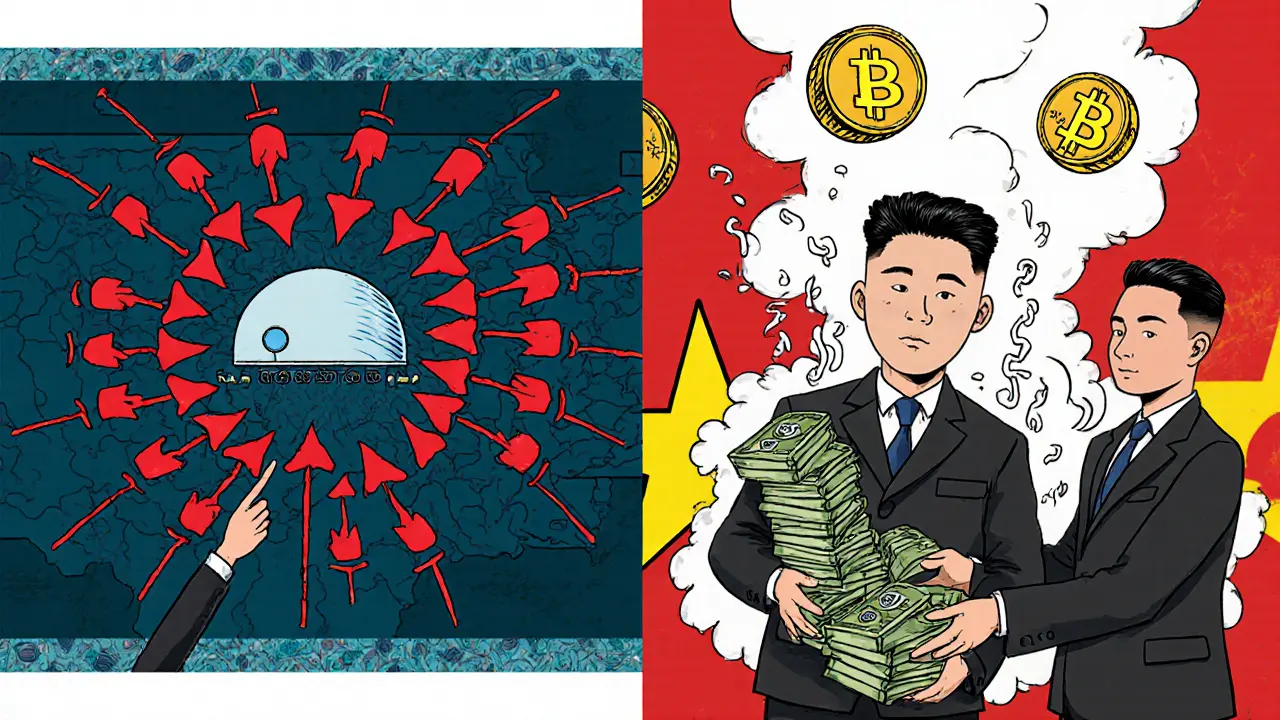
How North Korea Turns Stolen Crypto Into Real-World Power
Stolen crypto isn’t useful unless it becomes something real. Weapons. Fuel. Technology. Food. That’s where the real laundering begins.
After mixing, North Korean groups use three main methods to cash out:
- Peer-to-peer exchanges: They trade crypto directly with brokers in China, Russia, or Southeast Asia. No KYC. No questions. Just cash.
- Stablecoin bridges: They convert Bitcoin into USDT or USDC - stablecoins pegged to the U.S. dollar - then move them through offshore banks.
- Darknet marketplaces: They buy gold, electronics, or luxury goods online, then ship them to North Korea via third-party countries.
In 2023, South Korean intelligence uncovered a network of shell companies in Vietnam and Cambodia that were laundering North Korean crypto through fake e-commerce stores. The goods? High-end GPUs. Used for mining. Sold to crypto farms in Brazil. The money? Back to Pyongyang.
It’s not just one operation. It’s a global supply chain - built on anonymity, fueled by mixers, and protected by legal gray zones.
What’s Being Done - And Why It’s Not Enough
Regulators know what’s happening. The Financial Action Task Force (FATF) has labeled cryptocurrency mixers as high-risk. The U.S. Treasury has sanctioned over 15 mixing services. The EU has passed laws requiring exchanges to block transactions from known mixer addresses.
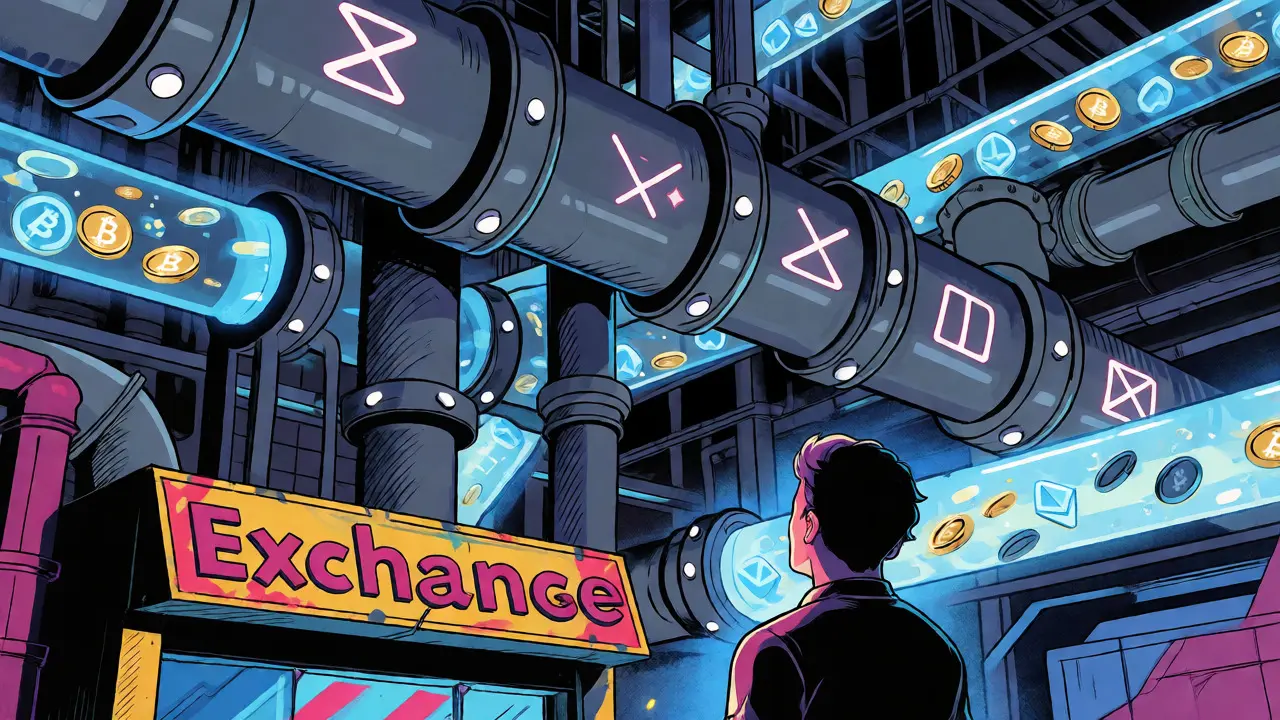
But here’s the catch: mixers are decentralized. You can’t shut down code. You can’t arrest a smart contract. And when one mixer gets blocked, three more pop up in its place - often hosted on servers in countries with no extradition treaties.
Exchanges are trying. Coinbase, Kraken, and Binance now flag and freeze funds that come from known mixer addresses. But that’s reactive. By the time they spot the connection, the money’s already been split into hundreds of wallets. And those wallets? They’re now clean.
Even if you track a single transaction back to a North Korean wallet, you can’t prove the mixer operator knew. And without intent, you can’t prosecute.
The only real solution? Global cooperation. Real-time blockchain analytics. And mandatory reporting from all crypto services - even those that claim to be "privacy-focused." But that’s a political fight. And so far, no country wants to be the first to demand total transparency.
What This Means for Regular Crypto Users
Are you using a mixer? Maybe you’re not a hacker. Maybe you just want to protect your financial privacy. That’s valid. But now, every time you use a mixer, you’re adding to the noise that helps North Korea hide.
Exchanges are getting smarter. If you send coins from a mixer to your wallet, your account might get flagged. Your funds might be frozen. You might get asked for proof of origin - even if you bought the coins legally.
There’s no easy answer. Privacy matters. But so does stopping state-sponsored crime. Right now, the system forces you to choose. And that’s a dangerous place to be.
For now, the best advice? Avoid mixers entirely. If you need privacy, use wallets that support CoinJoin or other on-chain privacy tools - not centralized services. And if you’re a crypto user, know this: your transaction history might be public. But your responsibility? That’s private. And it matters.
Are cryptocurrency mixers illegal?
It depends. In the U.S., using a mixer isn’t automatically illegal - but if you’re using it to hide money from a crime, you’re breaking the law. The U.S. Treasury has sanctioned specific mixers like Tornado Cash and Blender.io, making it illegal to interact with them. Even if you didn’t know the funds were stolen, you could still face penalties. Many countries now treat mixers as unregistered money services businesses - meaning using them could violate anti-money laundering rules.
Can North Korea be stopped from using crypto mixers?
Not easily. North Korea doesn’t rely on one mixer - they use dozens, often layered. They switch protocols every few months. They use decentralized mixers that don’t require registration. They hide behind fake identities and offshore accounts. Law enforcement can freeze known wallets and shut down centralized services, but new ones appear faster than they can be tracked. The only real way to stop them is to cut off their cash-out channels - like cracking down on unregulated P2P exchanges in China and Southeast Asia - but that requires international cooperation that doesn’t exist yet.
Do legitimate users still use crypto mixers?
Yes. Many people use mixers to protect their financial privacy - activists in authoritarian countries, journalists, or even businesses that don’t want competitors to track their transactions. Some use CoinJoin or Wasabi Wallet for this purpose. But because these tools are also used by criminals, regulators now treat all mixer usage with suspicion. That’s created a dangerous dilemma: if you value privacy, you might get flagged. If you avoid mixers, you might be exposed.
How do investigators trace money through mixers?
It’s hard, but not impossible. Investigators look for patterns: timing, amounts, and addresses that appear across multiple transactions. If a wallet sends 100 BTC to a mixer, and 99.5 BTC comes out 12 hours later to a known North Korean wallet, that’s a red flag. Chainalysis and Elliptic use AI to detect these patterns. Sometimes, mixers make mistakes - like sending coins back to the same address or using predictable delays. Those errors can be exploited. But if the mixer is well-run and the user is careful, tracing becomes nearly impossible.
Is there a difference between mixing and laundering?
Yes. Mixing is a technical process - it obscures the origin of coins. Laundering is the criminal act of making illegally obtained money look legal. You can mix coins without laundering - like hiding your own earnings from prying eyes. But if you mix stolen crypto, you’re laundering. The mixer itself isn’t illegal. The intent behind using it is.
What Comes Next?
The arms race between privacy tools and enforcement is accelerating. New mixing protocols are being built with AI-resistant obfuscation. North Korea is investing in quantum-resistant crypto to future-proof its thefts. Meanwhile, governments are pushing for mandatory blockchain analytics tools on every exchange.
The endgame? Either we give up privacy on the blockchain - or we accept that criminals will always find a way to hide. There’s no middle ground. And right now, the world is choosing neither.




Rachel Thomas
November 27, 2025 AT 12:28This is so overblown. Everyone knows mixers are just for privacy. Why are we acting like North Korea invented Bitcoin? 😒
Sierra Myers
November 28, 2025 AT 16:08Let’s be real - if you’re using a mixer, you’re probably shady. No one needs this level of obfuscation unless they’re hiding something. I don’t care if you’re a journalist - just use Monero if you want real privacy. 🤷♀️
Wilma Inmenzo
November 30, 2025 AT 02:16STOP. STOP. STOP. 🚨 Do you really think this is just about North Korea?!?!?!?! They’re USING mixers - but WHO CREATED THEM?!?!?!? The CIA! The NSA! The same people who told us the internet was free! They built the tech, then outlawed the privacy tools so they could spy on YOU! Tornado Cash? Sanctioned. Blender? Shut down. But the real mixers? The ones run by the Five Eyes? Those are LEGAL! They’re called ‘blockchain intelligence platforms’! And they’re harvesting YOUR data while you’re over here worrying about Kim Jong-un! 🤯
They want you to think it’s about criminals. It’s not. It’s about control. And if you’re still using Coinbase after this? You’re the puppet. 🎭
Tony spart
December 1, 2025 AT 05:42USA all day. We shut down those commie mixers. North Korea? They steal, we track, we freeze, we punish. Simple. If you wanna be private, move to China. They got privacy there - for the party. We got freedom. And freedom means you don’t get to hide your dirty cash. 💪🇺🇸
Abby cant tell ya
December 2, 2025 AT 15:27Ugh. I knew this was gonna happen. People think privacy is a right? Nah. It’s a luxury for the guilty. If you’re not doing anything wrong, why are you hiding? I’ve seen your transaction history. You’re not a journalist. You’re just embarrassed you bought crypto in 2021. Grow up.
jeff aza
December 2, 2025 AT 17:18Let’s not conflate technical obfuscation with illicit intent - the conflation is the real regulatory failure. Mixers, as protocol-level primitives, are neutral instruments. The intent vector is the locus of liability - but current AML frameworks lack ontological granularity to distinguish between privacy-preserving CoinJoin and laundering pipelines. Hence: false positives at scale. The FATF’s ‘travel rule’ extension to mixers is a sledgehammer to a Swiss watch. We need zero-knowledge compliance - not blanket bans.
Eddy Lust
December 3, 2025 AT 02:38it’s wild how we’re all just… pretending we can fix this. like, yeah, north korea’s using mixers. but so is my grandma sending money to her cousin in ukraine. so is that activist in iran. so is that guy who got hacked and wants his coins back. we’re punishing everyone because one bad actor figured out how to hide. and honestly? i don’t know the answer. but i know banning stuff doesn’t make the problem go away. it just makes it harder for the good people. and that’s… sad.
Casey Meehan
December 4, 2025 AT 08:59So… mixers = bad? 😔 But what if I just don’t want my boss to know I bought a Tesla with crypto? 😅 Can’t we all just chill? 🤖💸 #PrivacyIsNotACrime #CryptoIsForPeople