NFT Minting Cost Calculator
Calculate Your NFT Costs
Estimate gas fees for minting NFTs on different blockchains
Imagine buying a painting for $50,000 - only to later find out it’s a fake. Not a copy. Not a print. A full-on forgery, signed by someone pretending to be the artist. This isn’t science fiction. It happens all the time. The global art market loses about $6 billion a year to forgeries, according to the FBI Art Crime Team. And digital art? It’s even more vulnerable. Screens can be duplicated. Files can be copied. A JPEG can be downloaded and sold a thousand times. So how do you prove something digital is real, original, and yours? That’s where NFTs come in.
What NFTs Actually Do for Art
NFTs aren’t the artwork itself. They’re not the image you see on your screen. They’re a digital certificate - a tamper-proof record stored on a blockchain. Think of it like a car’s title. The car is the physical thing. The title proves who owns it, where it came from, and if it’s been in any accidents. NFTs do the same for digital art.
Unlike Bitcoin or Ethereum, which are interchangeable (one Bitcoin is the same as another), NFTs are unique. Each one has a unique ID, a history of owners, and a link to the original file. This comes from the ERC-721 standard on Ethereum, which was formalized in early 2018. Before that, digital art had no reliable way to prove scarcity or ownership. CryptoPunks, launched in 2017, were among the first to show it could work. Now, millions of digital artworks are backed by NFTs.
The real power? Immutability. Once an NFT is created and recorded on the blockchain, it can’t be changed, deleted, or forged. No central authority controls it. No gallery or auction house holds the keys. The record lives on thousands of computers around the world. If you own the NFT, you own the verified original.
How Physical Art Gets Verified with NFTs
You might think NFTs only work for digital art. But they’re now being used to authenticate physical paintings, sculptures, and even luxury goods. How? By linking the physical object to a digital token.
There are three main ways this happens:
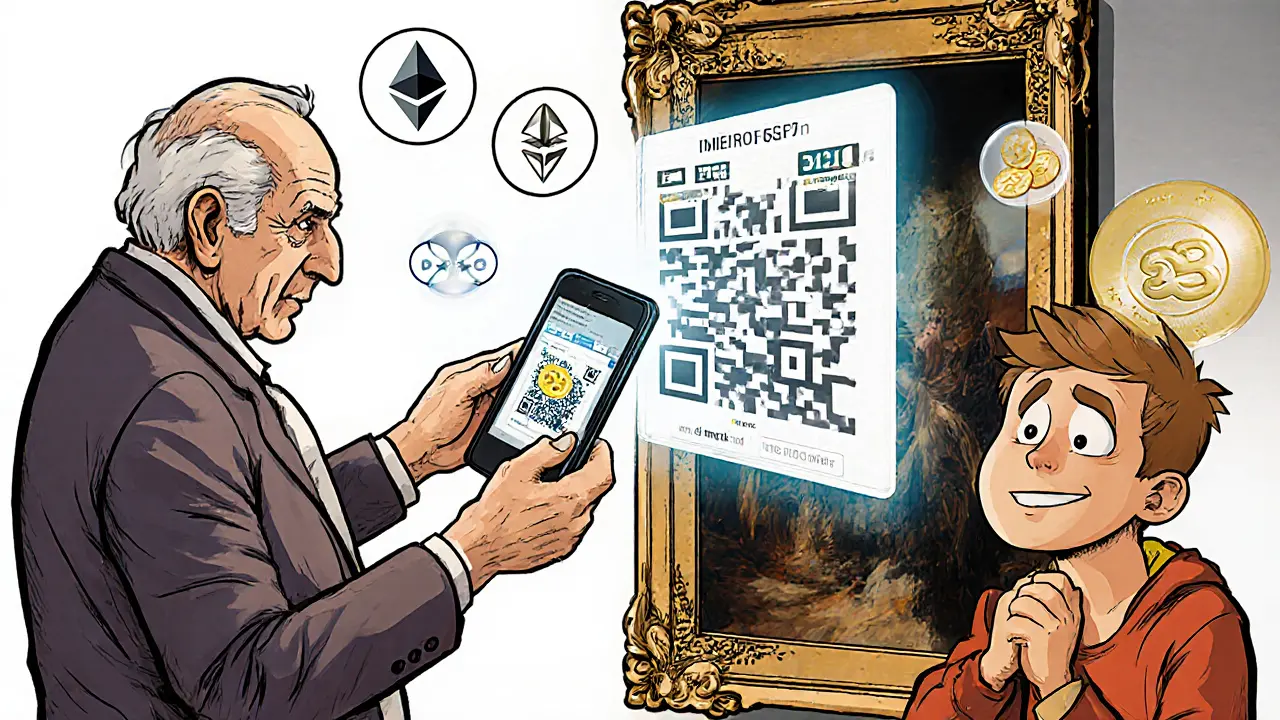
- QR Codes - Hidden on the back of a frame or under the canvas. Scan it with your phone, and you see the full history: who made it, who owned it, when it was sold, and the current owner.
- NFC Chips - Tiny chips embedded in the frame or backing. Tap your phone to them (like Apple Pay), and they unlock encrypted data. These are tamper-evident - if someone tries to remove or replace the chip, the system flags it.
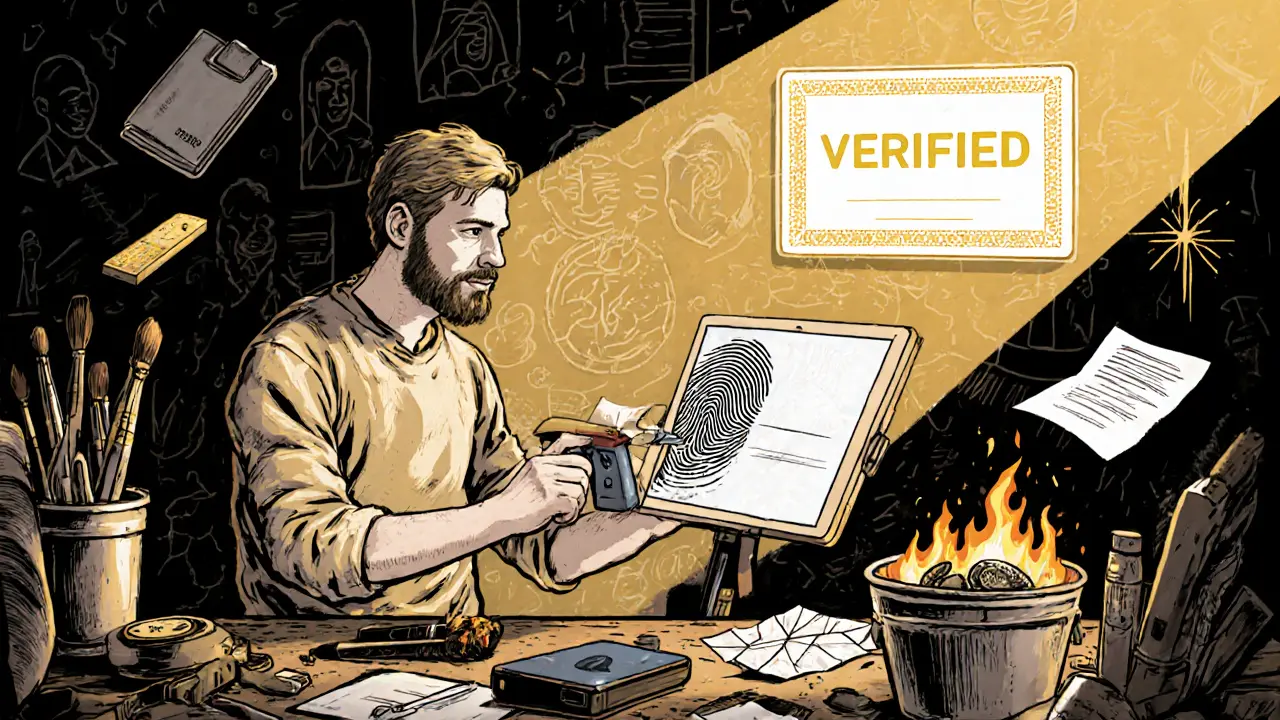
- Digital Watermarks - Invisible codes embedded in the image file itself. You need a special app to detect them, but they can’t be removed without damaging the image. New versions, like those from VeriArt (launched March 2025), now include biometric data tied to the artist’s fingerprint or signature.
Brands like Louis Vuitton are already using this. Their 2023 “LV Vault” collection uses NFC chips linked to Ethereum to prove each handbag is genuine. Galleries from New York to London are following suit. By Q1 2025, 41 of the top 100 art galleries globally had integrated NFT authentication.
Why This Beats Paper Certificates
For decades, art buyers relied on paper certificates of authenticity. They were signed by the artist or a gallery. But they’re easy to fake. You can print one. You can forge a signature. You can lose it. And if the gallery goes out of business? The certificate becomes useless.
NFTs fix all that.
First, they’re digital and permanent. No paper to tear, fade, or burn. Second, they’re public. Anyone can verify ownership on a blockchain explorer like Etherscan. No need to call the artist’s estate or track down a curator. Third, they’re automated. Smart contracts handle sales automatically. When an NFT is sold, the new owner gets the token instantly. No middlemen. No delays. No human error.
According to ZenLedger (2023), NFTs eliminate the possibility of forgeries because the record is cryptographically sealed. You can’t fake the blockchain. You can’t alter the ownership history. That’s why 92% of collectors surveyed by Verifyed.io in 2024 said they felt more confident buying art with NFT verification.
How Artists Actually Use NFTs to Protect Their Work
If you’re an artist, here’s how it works in practice:
- Create a digital wallet (MetaMask, Phantom, or Coinbase Wallet).
- Upload your artwork to a platform like OpenSea, Foundation, or SuperRare.
- Mint the NFT - this means recording it on the blockchain. You pay a gas fee (transaction cost), which varies by network.
- Link your NFT to the physical piece if needed - embed a QR code, NFC chip, or watermark.
- Share the NFT link with buyers. That’s your proof of authenticity.
Artists who are already tech-savvy usually need 10-15 hours to learn the process. Those coming from traditional backgrounds - oil painters, sculptors - often need 25-40 hours, according to the Art Authentication Institute’s 2024 study. It’s not hard, but it’s different. You’re not just making art anymore. You’re managing a digital identity.
And security matters. Chainalysis reports that 43% of NFT thefts in 2024 happened because people lost their private keys or fell for phishing scams. Never share your recovery phrase. Use a hardware wallet like Ledger or Trezor for high-value art. And always double-check the platform you’re using. OpenSea has 127 pages of documentation. Smaller platforms? Not so much.
The Real Limits of NFT Authentication
NFTs don’t solve every problem. They verify digital ownership. They don’t verify physical authenticity.
Here’s the catch: You can have a perfect NFT tied to a fake painting. The NFT proves the token is real. It doesn’t prove the canvas, paint, or brushstrokes are original. That’s where human experts still matter.
Dr. Emily Watson, an art authentication expert quoted in ArtForum (August 2024), says: “Blockchain verifies digital ownership records but cannot confirm physical artwork authenticity without expert human verification.”
That’s why top institutions combine NFTs with traditional methods:
- Infrared imaging reveals hidden sketches or overpainting.
- X-ray radiography shows changes in materials or structure.
- AI tools analyze brushstroke patterns and pigment composition.
These tools don’t replace NFTs. They support them. A painting with an NFT and an infrared scan that matches the artist’s known technique? That’s the gold standard.
Also, not everyone can use this tech. A 2024 MyArtBroker survey found that 68% of collectors over 55 struggled with setting up wallets or scanning QR codes. NFT authentication isn’t just about tech - it’s about accessibility. Platforms are starting to simplify this. Some now let you buy art with a credit card and receive the NFT automatically in your email.
What’s Next for NFT Art Authentication
The industry is moving fast. In January 2025, Christie’s, Sotheby’s, and major blockchain platforms launched the Universal Art Authentication Protocol (UAAP). It’s a new standard that makes NFT verification consistent across platforms. No more confusion between different blockchains or metadata formats.
Gas fees on Ethereum are still a pain. But Solana and Polygon are gaining ground - they’re cheaper and faster. Solana handles 15% of art NFTs, and Polygon 8%, according to DappRadar’s Q2 2025 data. Ethereum still leads at 72%, especially for high-value pieces, but that’s changing.
Regulation is catching up too. The EU’s MiCA framework, effective December 2024, requires NFT marketplaces to verify users’ identities (KYC) and report suspicious activity (AML). That’s a big step toward legitimacy.
Gartner predicts that by 2027, 75% of high-value art transactions will include blockchain authentication. That doesn’t mean paper certificates are gone. It means they’re becoming obsolete. The future isn’t NFTs or experts. It’s NFTs and experts.
What Buyers Should Know Before Buying
If you’re thinking of buying NFT-authenticated art, here’s what to check:
- Is the NFT on a major blockchain? (Ethereum, Solana, Polygon)
- Can you verify the ownership history on a public explorer?
- Is there a QR code, NFC chip, or watermark on the physical piece?
- Does the artist have a verified profile on the platform?
- Have you checked the metadata? (Creation date, artist name, previous owners)
And never skip cross-checking. A Reddit user named u/NFTAuthSpecialist, with over 1,200 upvotes on a September 2024 post, says: “Always cross-check metadata on at least two blockchain explorers.” One might be down. One might be fake. Two is safer.
Community matters too. Join r/NFT on Reddit. Watch YouTube tutorials. Ask questions. The NFT art world is still new, and most people are learning together.
At the end of the day, NFTs aren’t magic. They’re a tool. A powerful one. They’ve turned digital art from something you could copy with a right-click into something you can truly own. They’ve made forgery harder. They’ve made verification easier. And they’ve given artists back control over their work - something the art world took away for centuries.
Janice Jose
November 26, 2025 AT 20:33I’ve bought two digital pieces with NFTs now, and honestly? It felt like finally getting a receipt that can’t be stolen. No more wondering if the artist actually sold it to me or if some bot scraped it from Instagram. The blockchain doesn’t lie, and that’s huge when you’re spending real money on something you can’t hold.
Savan Prajapati
November 27, 2025 AT 21:35NFTs are scam. Everyone copy art. Blockchain just make it fancy.
jeff aza
November 29, 2025 AT 15:21Okay, let’s be real - NFTs aren’t ‘authentication,’ they’re metadata wrappers with gas fees. You’re not proving the *art* is real; you’re proving the *token* is real. And that’s a critical distinction. The ERC-721 standard? Solid. But the metadata? Often hosted on centralized servers. IPFS? Sure, if you’re lucky. Most platforms still use HTTP links that could vanish tomorrow. And don’t even get me started on how 87% of NFT metadata lacks proper provenance fields per ISO 19115-1. This isn’t authentication - it’s digital wishful thinking with a blockchain veneer.
Vijay Kumar
November 30, 2025 AT 01:41You think owning a token means you own art? You’re confused. Art is soul. Blockchain is code. One breathes. The other just stores.
Vance Ashby
November 30, 2025 AT 14:06Wait - so if I mint an NFT of a Picasso I found in my grandma’s attic… does that make it real? 😅 I mean, I’ve got the token, but I still don’t know if the paint’s legit. Maybe we need a ‘NFT + Expert’ badge? Like a Yelp review for art authenticity?