Angola shut down crypto mining because its power grid was failing
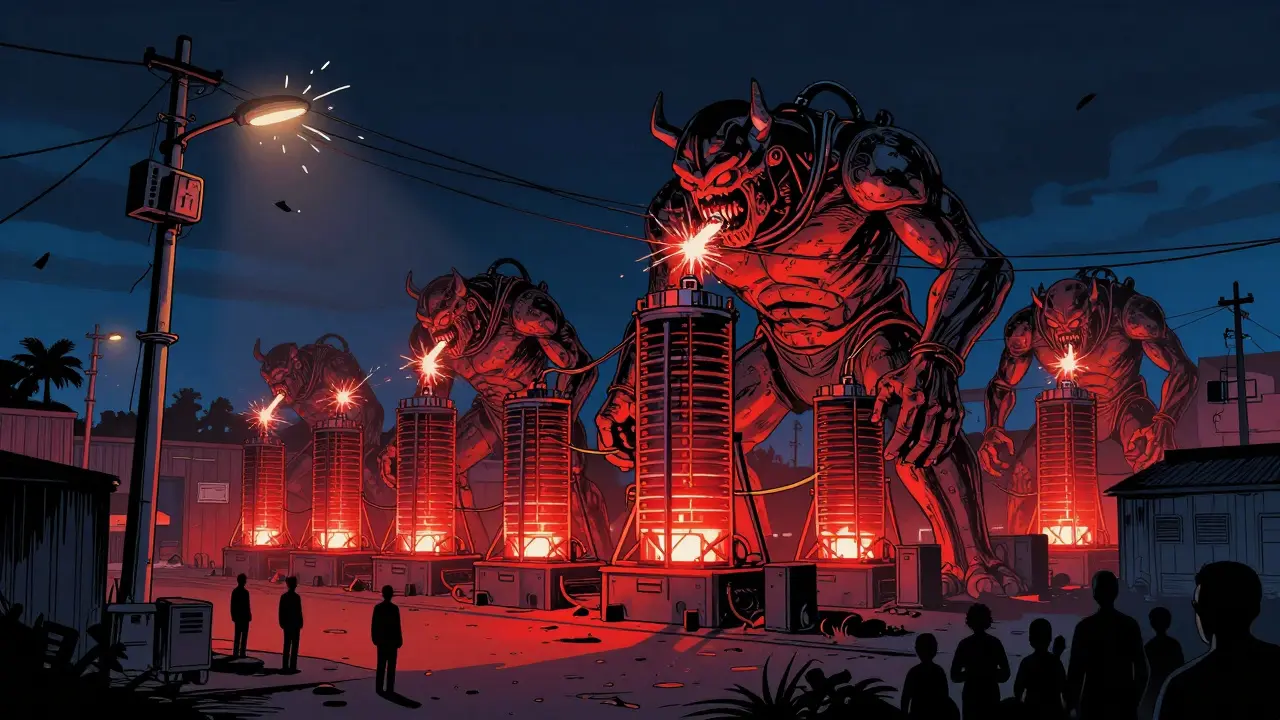
In April 2024, Angola made a hard choice: it banned cryptocurrency mining entirely. Not just regulated it. Not just taxed it. Crypto mining became a crime punishable by up to five years in prison, with all equipment seized on the spot. The reason wasn’t ideology. It wasn’t fear of digital currency. It was simple: the lights were going out across the country, and mining rigs were stealing the last bits of power.
Angola’s national grid, already stretched thin, was losing 28% of its electricity before it even reached homes. In cities like Luanda and Benguela, 60% of households faced daily blackouts. Meanwhile, illegal mining farms-mostly run by Chinese nationals-were pulling between 50 and 200 megawatts of electricity. That’s the same amount of power needed to run 300,000 homes. And they weren’t even paying for it. Many had hacked into the grid, bypassing meters and safety systems. Some operations used industrial transformers meant for hospitals and schools.
How much power were these mining rigs using?
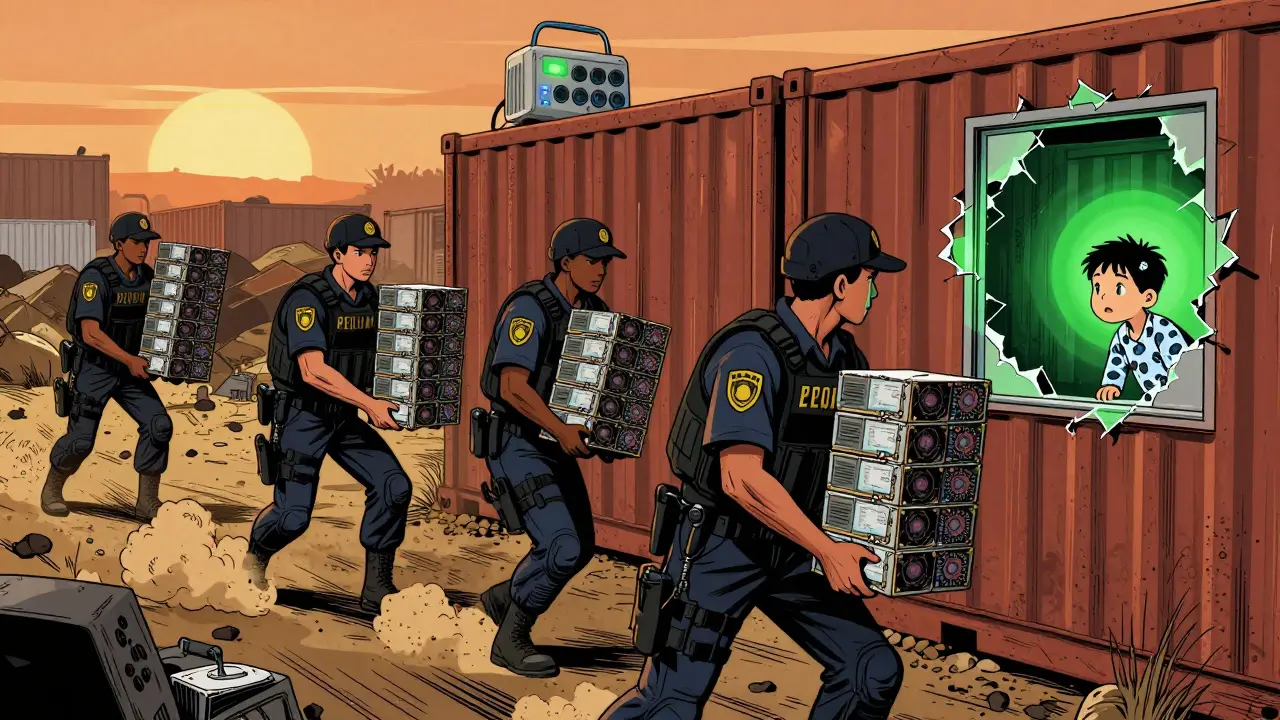
Each ASIC miner, the kind used for Bitcoin, consumed 3,200 watts nonstop. GPU rigs used 1,500 watts. In August 2025, Angolan police raided 25 mining centers and seized 8,300 ASIC units and 15,000 graphics cards. That’s over 23,000 machines running 24/7, siphoning power from a grid that serves just 47% of the population with reliable electricity.
One Bitcoin mine in Angola used 1,440 kilowatt-hours to produce a single coin. That’s 40 times more energy than a typical bank transaction. For comparison, the average American uses about 1,000 kWh per month. One Bitcoin mine in Angola used more power than a small town.
And it wasn’t just the machines. Operators built 45 illegal power stations-temporary substations that tapped directly into high-voltage lines. These weren’t licensed. They weren’t safe. They caused transformer explosions in neighborhoods like Sambizanga, knocking out power to clinics for hours. One mother in Luanda told local reporters her child’s ventilator stopped working during a blackout caused by a mining farm’s overload.
Why did Chinese nationals dominate the mining scene?
Before the ban, electricity in Angola cost as little as $0.03 per kilowatt-hour-less than half the global average. That made it a magnet for miners from China, who arrived with shipping containers full of hardware. But the low cost came with brutal trade-offs. Grid instability meant 40% of mining equipment failed within months. Miners reported weekly outages of 18 to 24 hours during dry seasons, forcing them to run diesel generators that increased costs by 35%.
Some paid $500 a month in bribes just to keep their operations running. Others rigged their own power lines, creating fire hazards. When Interpol’s Operation Serengeti 2.0 rolled through in August 2025, 60 Chinese nationals were arrested. All of them. No Angolans. The operation recovered $37.2 million in equipment and dismantled the entire underground mining network.
What happened after the ban?
The crackdown didn’t just stop mining-it changed the conversation. The government started redistributing seized equipment. 65% went to universities for computer science labs. 35% went to local governments to power digital ID systems and online health records. No one got rich off the auctioned gear. The goal wasn’t profit. It was recovery.
Community reporting became key. A whistleblower program offered up to $50,000 for tips. Over 70% of raids came from neighbors who’d had enough. One Reddit user in Angola summed it up: “I saw our local clinic running on generators while mining farms had their own transformers. The ban made sense.” That post got over 1,200 upvotes.
Electricity tariffs had jumped 22% in 2023 because of grid strain from mining. After the ban, prices stabilized. Hospitals reported fewer blackouts. Schools got consistent power for online learning. The government didn’t announce a victory. It just let the results speak.
Why didn’t Angola allow mining with renewable energy?
Angola has huge solar potential-2,200 kWh per square meter annually. But the government refused to make exceptions. Why? Because even solar-powered mining would still need batteries, inverters, and grid backups. And if those systems ever connected to the national grid-even accidentally-it would reopen the same risks.
In September 2025, President João Lourenço met with solar company Solax Power to discuss pilot projects. But Energy Minister João Baptista Borges was clear: “Any future mining must be 100% off-grid. No connection to the national system. Not even a wire.”
That’s a high bar. Most miners can’t afford standalone solar farms with battery storage. And Angola doesn’t have the infrastructure to support thousands of isolated microgrids. So for now, mining stays banned-even if it runs on sunshine.

What’s happening in neighboring countries?
Angola’s ban pushed miners across the border. Namibia saw a 200% surge in mining operations from Angolan operators. But Namibia’s electricity costs $0.12 per kWh-four times higher than Angola’s old rate. Profit margins dropped by 60%. Many miners left after a few months.
South Africa took a different route: it taxed mining at 15% of energy use and used the $120 million a year to upgrade its grid. Zambia cracked down on crypto fraud but didn’t ban mining. Nigeria and Kenya still allow it, focusing on exchange regulation instead.
Angola chose the hardest path: zero tolerance. It didn’t want to regulate a problem. It wanted to erase it.
Will Angola ever allow crypto mining again?
Not anytime soon. The country’s grid still loses nearly a third of its power. Only 47% of people have reliable electricity. The Cambambe III hydropower project, set to add 1,150 megawatts, won’t be online until 2028. Even then, experts say Angola needs $12 billion in infrastructure upgrades by 2030 just to hit 85% electrification.
Standard Bank’s digital assets head, Naledi Molefe, says Angola won’t consider legal mining until grid reliability hits 90%. That’s not expected before 2027. The World Bank has pledged $15 million to help design energy allocation systems that could one day prioritize industrial users-but only if they’re clean, efficient, and off-grid.
For now, Angola’s message is simple: when your people don’t have power, you don’t give it to machines.
What does this mean for the global crypto mining industry?
Angola’s hash rate collapsed from 0.8% of the global total to 0.02% after the ban. That’s 1.2 exahashes gone overnight. The industry absorbed the loss. Mining shifted to places like Kazakhstan, the U.S., and Canada-where energy is abundant and regulated.
But Angola’s case became a warning. It showed that in places with weak infrastructure, crypto mining isn’t innovation. It’s theft. And when the lights go out for a hospital, a school, or a water pump, the cost isn’t just financial. It’s human.
Angola didn’t ban Bitcoin because it was dangerous. It banned it because it was unsustainable. And in a country where 15 million people still live without reliable electricity, sustainability isn’t a buzzword. It’s survival.
Why did Angola ban cryptocurrency mining?
Angola banned cryptocurrency mining because illegal mining operations were consuming up to 15% of the country’s total electricity supply during peak hours, worsening chronic power shortages. With 60% of urban households experiencing daily blackouts and critical services like hospitals and schools losing power, the government prioritized human needs over speculative mining operations. The ban was a direct response to grid instability, not ideology.
Was crypto mining legal in Angola before the ban?
No, it was never officially legal. But before April 2024, enforcement was weak. Many mining operations operated in a gray zone, using bribes and hacked power lines to avoid detection. The government didn’t have the resources to stop them-until the energy crisis became unbearable. The 2024 ban made mining a criminal offense with prison time and equipment confiscation.
What happened to the mining equipment seized in Angola?
All seized mining equipment-over 23,000 units including ASICs and GPUs-was inventoried using blockchain tracking systems. 65% was allocated to university computer science departments for research and education. 35% went to municipal e-government projects, like digital ID systems and health records. Equipment worth over $10,000 was auctioned after 90 days, but proceeds went to the state, not private buyers.
Can you mine crypto in Angola using solar power now?
No. Even solar-powered mining is banned unless it’s completely off-grid with zero connection to the national electricity system. The government has rejected all proposals for exceptions, fearing any link to the grid could lead to theft or overload. While pilot projects with solar companies are being discussed, no legal framework for mining exists as of 2026.
How did Angola detect illegal mining operations?
The National Electricity Agency (INE) used smart meter data to spot 24/7 power usage patterns above 100 kilowatts. Police used thermal imaging to find heat signatures from mining rigs, and Interpol trained officers to identify ASIC and GPU hardware. A whistleblower program offered up to $50,000 for tips, leading to 73% of raids. In 2025, 200 new smart grid sensors were installed to detect electromagnetic signals from mining hardware, cutting detection time from weeks to 72 hours.
Is Angola the only African country banning crypto mining?
No. Seven of 15 countries in the Southern African Development Community (SADC) have imposed some form of mining restriction since 2022. But Angola’s ban is the strictest: it criminalizes possession of mining equipment and carries jail time. Nigeria and Kenya allow mining but regulate exchanges. South Africa taxes mining to fund grid upgrades. Angola chose to eliminate the practice entirely.





Rachel Stone
January 30, 2026 AT 13:45Gurpreet Singh
January 31, 2026 AT 17:20Edward Drawde
January 31, 2026 AT 23:03Elizabeth Jones
February 1, 2026 AT 18:56There’s a difference between innovation and exploitation. One builds. The other consumes. And when your society is already fraying at the edges, you don’t hand the scissors to someone who only sees profit in the threads.
Will Pimblett
February 3, 2026 AT 18:05Tressie Trezza
February 3, 2026 AT 23:53Nickole Fennell
February 4, 2026 AT 10:29Calvin Tucker
February 6, 2026 AT 02:35Gustavo Gonzalez
February 6, 2026 AT 10:00Richard Kemp
February 7, 2026 AT 16:05