You bought Bitcoin when it was $30,000. You grabbed some Ethereum at $1,800. Maybe you threw a little into a few altcoins that promised the moon. Fast forward six months, and your portfolio looks nothing like you planned. That one altcoin skyrocketed and now makes up half your holdings. Bitcoin barely moved. Your risk profile has shifted from "conservative growth" to "all-in gamble" without you even pressing a button.
This is the silent killer of crypto investing: allocation drift. Without intervention, volatile assets dominate your portfolio, exposing you to massive downside risk while capping your upside in stable sectors. The solution isn't just holding tighter; it's rebalancing.
Rebalancing isn't about timing the market. It’s about disciplining yourself to sell what’s expensive and buy what’s cheap, systematically maintaining your original strategy. In traditional finance, this happens quarterly or annually. In crypto, where prices can swing 5-10 times more than stocks, waiting that long can be dangerous. Let’s break down how to do it right in 2026.
The Math Behind the Magic: Why Rebalancing Works
It sounds counterintuitive. Why would selling your winner hurt your profits? In a straight-up bull run where everything goes up forever, buying and holding wins. But markets don’t go up forever. They cycle. And crypto cycles are brutal.
The core concept here is the rebalancing premium. This is the extra return generated by forcing yourself to buy low and sell high on a regular schedule. According to academic analysis by Quantpedia in 2024, periodically rebalanced crypto portfolios outperformed simple buy-and-hold strategies by an average of 3.2% to 5.7% annually. How? By capitalizing on mean reversion-the tendency of prices to return to their average over time.
Consider this scenario:
- Start: You have $10,000 split evenly between Bitcoin (BTC) and Ethereum (ETH). $5,000 each.
- Six Months Later: BTC stays flat. ETH doubles. Your portfolio is now worth $15,000. But the split is no longer 50/50. ETH is now $10,000 (66%), and BTC is $5,000 (33%).
- The Risk: If ETH crashes back to its previous price, you lose two-thirds of your portfolio value. If you had rebalanced, you would have sold some ETH at the peak and bought more BTC at the bottom.
Dr. Scott Willenbrock’s research established that a simple buy-and-hold portfolio doesn't earn a diversification return. Periodic rebalancing of uncorrelated assets generates a measurable premium. In crypto, where assets often decouple during crashes, this protection is vital.
Two Main Ways to Rebalance
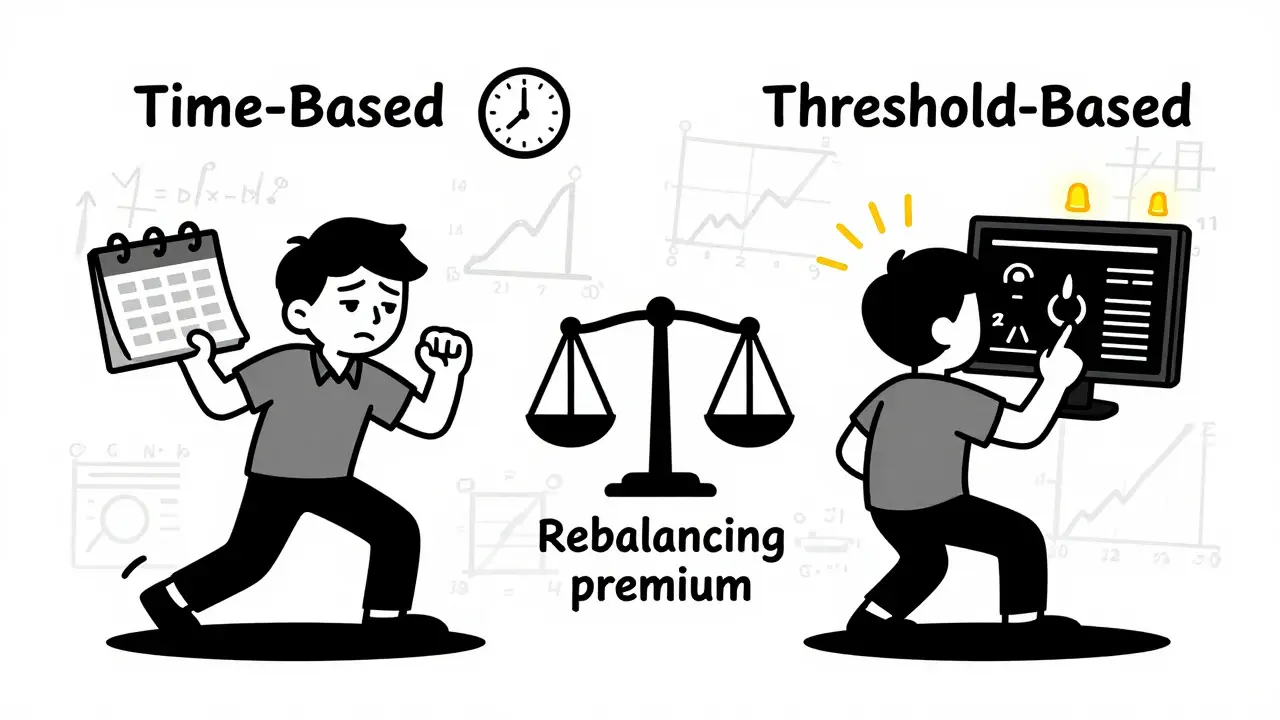
There are two primary methods for rebalancing your crypto portfolio. Which one you choose depends on your personality, your time, and your tolerance for transaction fees.
1. Time-Based (Periodic) Rebalancing
You set a calendar reminder. Every week, every month, or every quarter, you check your allocations and adjust them back to target percentages regardless of price movement.
- Pros: Simple to automate. Easy to track for taxes. Removes emotion completely.
- Cons: You might trade unnecessarily if the market hasn't moved much. You might miss a significant drift if it happens right before your scheduled date.
- Best For: Beginners and those who want a "set it and forget it" approach. Finestel’s 2025 data shows 22.1% of active traders prefer weekly cycles, while 9.6% use monthly intervals.
2. Threshold-Based (Deviation) Rebalancing
You set a tolerance band. For example, if your target is 50% BTC, you decide to rebalance only if BTC drops below 40% or rises above 60%. You ignore small fluctuations.
- Pros: More efficient. Fewer trades mean lower fees and fewer taxable events. Captures significant trends better.
- Cons: Requires constant monitoring or sophisticated bots. Can lead to large adjustments all at once if volatility spikes.
- Best For: Active investors and those using automated trading bots. A common threshold is ±20% of the target allocation.
| Feature | Time-Based | Threshold-Based |
|---|---|---|
| Frequency | Fixed (e.g., Monthly) | Variable (When triggered) |
| Transaction Costs | Predictable but potentially higher | Lower overall, but unpredictable spikes |
| Tax Complexity | Easier to batch-report | Harder to track individual triggers |
| Performance in Trends | May underperform in strong bull runs | Better captures momentum |
| Efficiency | Low (many unnecessary trades) | High (only trades when needed) |
The Hidden Cost: Taxes and Fees
Before you start clicking "sell" and "buy," you need to talk about the elephant in the room: taxes. In many jurisdictions, including the US, every time you sell a cryptocurrency to buy another, you trigger a taxable event. This means capital gains tax applies to any profit made since you bought the asset.
If you rebalance weekly, you could be generating dozens of taxable events per year. This creates a nightmare for tax reporting and can eat into your returns significantly. Here is how to manage it:
- Use Tax-Loss Harvesting: If you’re selling an asset at a loss, you can use that loss to offset gains elsewhere in your portfolio. Many rebalancing tools now integrate with tax software to identify these opportunities automatically.
- Hold Stablecoins: Instead of selling crypto for fiat currency (like USD), keep a portion of your portfolio in stablecoins (USDT, USDC). When rebalancing, you can swap directly between crypto assets. While still a taxable event in some places, it avoids the friction of moving money in and out of bank accounts.
- Choose the Right Account: If available in your country, hold crypto in tax-advantaged accounts (like IRAs in the US) where trading doesn’t trigger immediate taxes.
Don’t forget exchange fees. Most major exchanges charge 0.1% to 0.5% per trade. If you rebalance a $10,000 portfolio monthly with five assets, you might pay $50-$250 in fees alone. Over a year, that adds up. Always calculate if the potential gain from rebalancing outweighs the cost of execution.
Tools of the Trade: Automating the Process
Manual rebalancing is error-prone and time-consuming. In 2026, most serious investors use automation. However, not all tools are created equal.
3Commas is a popular third-party platform that connects to multiple exchanges via API. It offers smart threshold calculators and DCA (Dollar Cost Averaging) bots that can help smooth out entry points. Users praise its flexibility but note the learning curve can be steep for beginners.
Exchange-native solutions like Binance Rebalancing Bot are simpler. They work seamlessly within the ecosystem, offering fast execution and low fees. However, they limit you to assets listed on that specific exchange. If your ideal portfolio includes tokens from Coinbase and Kraken, a single-exchange bot won’t cut it.
For institutional-grade needs, platforms like Finestel Terminal offer AI-driven adaptive rebalancing. These tools analyze volatility regimes and dynamically adjust thresholds. For example, if Bitcoin becomes extremely volatile, the bot might widen the tolerance band to avoid whipsaw losses. This technology reduces unnecessary trades by up to 37%, according to recent benchmarks.
Common Pitfalls to Avoid
Even with the best tools, human error and bad strategy can sink your ship. Watch out for these mistakes:
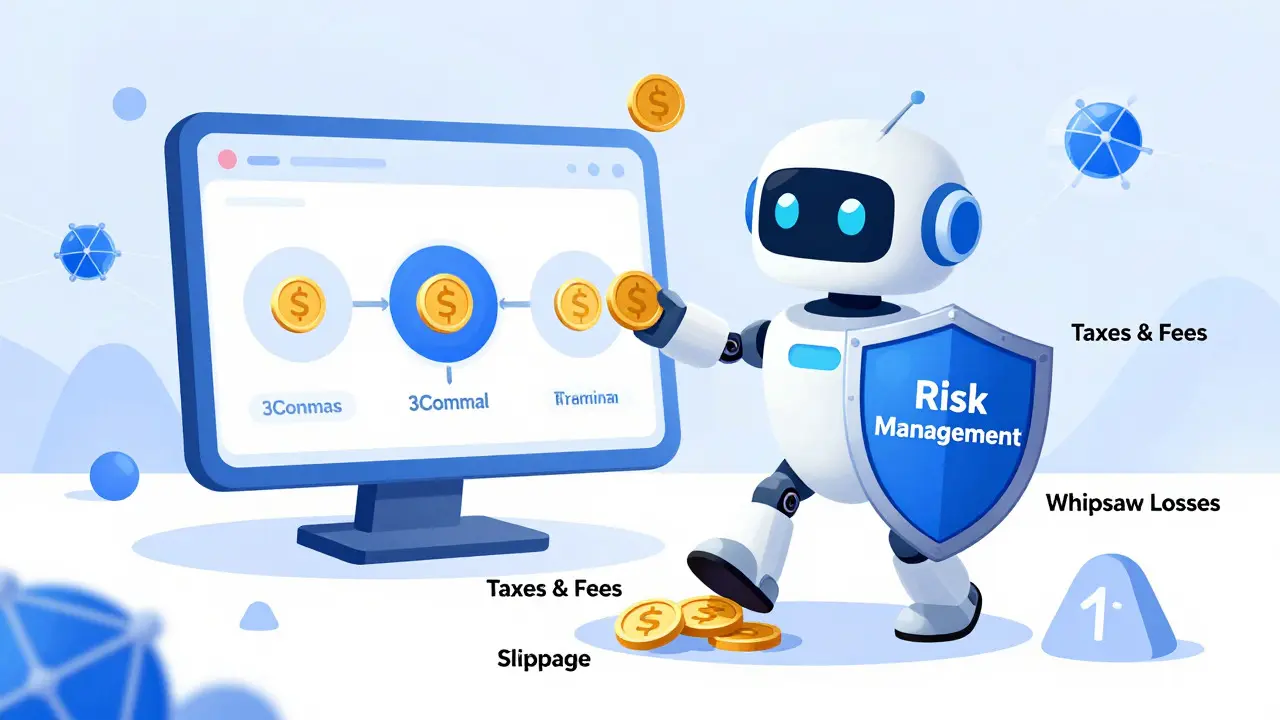
- Over-Rebalancing in Trends: As Dr. Michael Chen from CoinDesk Research warns, over-rebalancing in strongly trending markets can reduce returns by 15-20%. If Bitcoin is in a parabolic run, selling it every time it hits a threshold might cap your gains significantly. Consider widening your thresholds during confirmed bull markets.
- Ignoring Correlation: Rebalancing works best with uncorrelated assets. If you hold five different DeFi tokens that all move together, rebalancing them against each other provides little benefit. Diversify across sectors: Layer 1s, DeFi, Gaming, Infrastructure, and Stablecoins.
- Slippage in Illiquid Assets: Don’t rebalance tiny-cap altcoins manually. The spread between buy and sell orders can be huge, causing slippage of 1-2% or more. Stick to high-volume pairs (BTC/USDT, ETH/USDT) for rebalancing anchors.
- Whipsaw Losses: In sideways markets, tight thresholds can cause you to buy and sell repeatedly, losing money to fees without gaining value. User reports from Reddit indicate losses of up to 8.3% in portfolio value due to fees during consolidation phases.
A Practical Step-by-Step Guide for 2026
Ready to start? Here is a streamlined workflow to implement rebalancing today:
- Define Your Target Allocation: Decide on your risk profile. A conservative mix might be 60% BTC, 20% ETH, 10% Major Alts, 10% Stablecoins. An aggressive mix might be 40% BTC, 30% ETH, 30% High-Risk Alts.
- Choose Your Method: Start with time-based (monthly) if you are new. Move to threshold-based (±15% deviation) once you are comfortable with the mechanics.
- Select Your Platform: Use an exchange with low fees and good liquidity. Connect a bot if you want automation. Ensure your API keys have "Trade" permissions but NOT "Withdraw" permissions for security.
- Set Up Monitoring: Use a portfolio tracker like CoinGecko or Delta to visualize your drift. Set alerts for when an asset breaches your threshold.
- Execute and Record: Perform the trades. Immediately log them in a spreadsheet or tax software. Note the date, amount, price, and reason for the trade.
- Review Quarterly: Every three months, review your strategy. Did the rebalancing premium materialize? Were fees too high? Adjust your thresholds or frequency as needed.
Rebalancing is not a get-rich-quick scheme. It is a risk management tool. It keeps you humble in bull markets and disciplined in bear markets. By systematically taking profits from winners and averaging down on losers, you align your portfolio with your original thesis rather than your emotions.
How often should I rebalance my crypto portfolio?
There is no one-size-fits-all answer. For beginners, monthly rebalancing is a good starting point. Active traders may prefer weekly or daily cycles, though this increases fees and tax complexity. Institutional data suggests that threshold-based rebalancing (triggered by price deviation) is often more efficient than fixed time intervals, reducing unnecessary trades while maintaining risk control.
Does rebalancing reduce my profits in a bull market?
Yes, it can. If one asset goes up 10x and you keep selling it to buy lagging assets, you will underperform a pure buy-and-hold strategy. However, rebalancing protects you if that asset crashes back down. The goal is risk-adjusted returns, not maximum possible returns. Most studies show that the "rebalancing premium" outweighs the lost upside in volatile, mean-reverting markets.
Is rebalancing taxable?
In most countries, yes. Selling one cryptocurrency to buy another is considered a disposal of the first asset, triggering capital gains tax on any profit. Frequent rebalancing can create a heavy tax burden. To mitigate this, consider using tax-advantaged accounts, tax-loss harvesting strategies, or focusing on larger, less frequent rebalancing events.
What is the best threshold for threshold-based rebalancing?
A common rule of thumb is ±20% of the target allocation. For a 25% target, you would rebalance if the asset drops to 20% or rises to 30%. However, advanced strategies use dynamic thresholds based on volatility. During high volatility, wider bands (±30%) prevent whipsaw losses. During low volatility, narrower bands (±10%) capture smaller inefficiencies.
Can I automate crypto portfolio rebalancing?
Yes. Platforms like 3Commas, Binance, and specialized terminals like Finestel offer automated rebalancing bots. These tools connect to your exchange via API and execute trades when predefined conditions are met. Automation removes emotional bias and ensures precise execution, but you must monitor API security and fee structures carefully.




Michael Mostyn
July 29, 2026 AT 04:52The philosophical underpinning of rebalancing is essentially a rejection of the efficient market hypothesis in favor of behavioral discipline. It forces the investor to act against their own greed and fear, which are the primary drivers of suboptimal financial outcomes in volatile markets like cryptocurrency. By systematically selling high and buying low, one imposes an artificial order on chaos. This is not merely a mathematical exercise but a psychological anchor that prevents the portfolio from drifting into speculative excess. The article correctly identifies allocation drift as the silent killer, yet it fails to fully explore the existential risk of holding assets whose fundamental value propositions may evaporate entirely. Rebalancing assumes mean reversion, but what if the mean itself shifts permanently due to technological obsolescence or regulatory crackdowns? We must consider whether our target allocations are based on static historical data rather than dynamic future probabilities. The concept of the 'rebalancing premium' is seductive because it offers a sense of control in an uncontrollable environment. However, this control is illusory if the underlying assets are correlated in ways that traditional models do not capture. In crypto, correlation often spikes during crashes, rendering diversification ineffective precisely when it is needed most. Therefore, rebalancing should be viewed not as a guarantee of profit, but as a mechanism for preserving capital integrity during periods of extreme volatility. It is a defensive strategy masquerading as an offensive one. The true test of rebalancing lies not in bull markets where buy-and-hold reigns supreme, but in the brutal bear markets where emotional capitulation destroys wealth. One must ask oneself if they have the fortitude to stick to the plan when every instinct screams to sell everything. This requires a level of self-awareness and intellectual honesty that few investors possess. The tools mentioned, such as Finestel Terminal, offer automation, but automation without understanding is dangerous. We delegate our financial fate to algorithms that may not account for black swan events. Thus, the human element remains critical in interpreting the signals generated by these systems. Rebalancing is a ritual of humility, reminding us that we do not know the future.
Erica Johnson
July 30, 2026 AT 03:26Oh please, everyone acts like they understand the tax implications :/
Let me break it down for you since you clearly missed the memo on IRS Form 8949. Every single swap is a taxable event unless you are in a specific jurisdiction with favorable laws. You think swapping ETH for USDT is free? Nope. Capital gains apply. And don't even get me started on those 'tax-loss harvesting' bots that people love to brag about. They only work if you actually have losses to harvest, which means your strategy was bad to begin with lol. Also, the article mentions stablecoins as a buffer, but have you forgotten about depegging events? Just saying. Keeping half your portfolio in USDC feels safer until it isn't. I've seen too many people lose money because they trusted a centralized issuer blindly. So yes, rebalancing is great theory, but in practice, it's a tax nightmare that eats your profits faster than exchange fees. Most retail traders are just donating to Uncle Sam with every click. Maybe try holding forever instead of overthinking it? Or maybe just accept that you will pay taxes and stop whining about it ;)
Ken G
July 30, 2026 AT 05:26they want you to trade more so the banks make fees its a trap. the whole idea of rebalancing is designed to keep you engaged in the casino so they can skim off the top. look at who benefits from all these complex strategies. its always the elites. they tell you to sell high and buy low but really they are dumping on you. i bet the authors of this article are paid by exchanges to push this narrative. why would anyone voluntarily trigger taxable events if they were smart. its because they are sheep following instructions. the system is rigged against the little guy. every time you move money you leave a trail for the IRS. they are watching. they want to crush your freedom. just hodl and forget about it. dont let them trick you into thinking you need to manage anything. management is control and control is oppression. stay woke and keep your coins offline. the cloud is a lie. custodial wallets are prisons. wake up sheeple
Lorraine Surringer
July 30, 2026 AT 17:37Honestly this post is giving major anxiety vibes and honestly i feel like we are all just pretending we know what we are doing lol. Like sure the math looks pretty but have you ever tried to execute this when your heart is pounding out of your chest because BTC dropped 10% in an hour?? Its messy. People say use bots but then the bot glitches and you lose thousands. I read somewhere that automation is risky because of API errors. Also who has time to track all this manually. Life is short why stress over percentages. But also if you dont rebalance you might miss out on gains so its a catch 22. I guess just do what feels right in your gut. Trust your intuition. The charts are just pictures anyway. Real value comes from community and belief not spreadsheets. Love the energy though. Keep sharing knowledge besties. xoxo
Alex Di Mango
July 31, 2026 AT 09:39I appreciate the detailed breakdown here. It’s interesting how different personalities approach this problem. Some of you seem very stressed about taxes and others are worried about conspiracy theories. Let’s try to find some middle ground. Rebalancing is a tool, not a religion. If it works for you, use it. If it causes too much friction, maybe simplify. The key is consistency and understanding your own risk tolerance. Don’t compare your journey to others. What matters is that you sleep well at night knowing your portfolio aligns with your goals. Thanks for starting this conversation. It helps to see diverse perspectives.