
Five years ago, crypto companies were fleeing the U.S. because regulators didn’t know how to handle them. Today, the opposite is happening. The U.S. is now actively building rules to bring crypto back - and other countries are watching closely. This isn’t just about tightening rules. It’s about crypto regulation finally catching up to reality: digital assets aren’t going away, and governments need to work with the industry, not against it.
United States: From Enforcement to Framework
The biggest shift in 2025 isn’t in Asia or Europe. It’s in Washington. After years of lawsuits, cease-and-desist letters, and vague warnings, the U.S. government has officially abandoned the "regulation by enforcement" model. The new administration made it clear: if you want innovation in digital assets, you need clear rules, not fear. The Commodity Futures Trading Commission (CFTC) launched its "crypto sprint" in August 2025. It’s not a buzzword - it’s a full-speed effort to rewrite outdated guidance, remove barriers, and open up spot crypto trading on regulated futures exchanges. For the first time, U.S. investors can buy Bitcoin and Ethereum directly on platforms that are licensed, audited, and overseen by federal regulators. The goal? Make it as easy to trade crypto legally as it is to trade stocks. Meanwhile, the Securities and Exchange Commission (SEC) did something unthinkable just a year ago: it admitted that most crypto assets are not securities. Chair Atkins said it plainly: if a token isn’t sold as an investment contract, it doesn’t belong under securities law. That’s a massive shift from the previous regime, which treated every token like a stock. Now, the SEC is focused on drafting clear rules for when securities laws do apply - and creating safe harbors for things like airdrops, staking rewards, and initial coin offerings that don’t fit traditional models. The real game-changer? The Stablecoin Trust Act and the FIT Act are both moving through Congress. The Stablecoin Trust Act would require every issuer - whether it’s Circle, Coinbase, or a new startup - to hold fully backed, audited reserves in U.S. dollars or short-term Treasuries. These reserves must be kept separate from company funds. The Federal Reserve and OCC will oversee compliance. The FIT Act creates a clean split: SEC handles tokens that act like securities, CFTC handles everything else. No more jurisdictional battles. No more confusion.Asia: Building Hubs, Not Just Rules
While the U.S. is fixing its house, Asia is building new ones. Hong Kong and Singapore aren’t just reacting to regulation - they’re designing ecosystems to attract global crypto firms. Hong Kong introduced a full licensing system in 2024 and expanded it in early 2025. Now, exchanges must get separate licenses for spot trading, OTC desks, custody services, and derivatives. The government is also drafting rules for crypto lending platforms and stablecoins, borrowing heavily from the EU’s MiCAR framework but adding stricter local oversight. The message is clear: you can operate here, but you’ll be monitored closely. Singapore took it further. It already had one of the world’s toughest licensing regimes for crypto firms. In 2025, it finalized its stablecoin framework - requiring 1:1 backing, daily audits, and public disclosure of reserve holdings. Unlike the U.S., where stablecoin rules are still being debated, Singapore’s are already live. Firms like Binance, Kraken, and Circle have all moved key operations to Singapore because they know exactly what’s expected. These aren’t just regulatory wins - they’re economic strategies. Both jurisdictions are betting that crypto will become a core part of global finance. They’re offering tax incentives, fast-track visas for blockchain talent, and partnerships with banks to build tokenized asset platforms. The result? A growing list of fintech companies choosing Asia over traditional financial centers.Europe: MiCAR’s Long Shadow
The European Union’s Markets in Crypto-Assets Regulation (MiCAR) was supposed to be the blueprint for global crypto rules. But it’s turning into a cautionary tale. MiCAR went live in June 2024, but full compliance isn’t required until late 2025. That’s created a weird limbo. Companies are stuck between two worlds: they can’t fully operate under the new rules yet, but they’re already being asked to prepare for them. Many small EU-based exchanges are delaying launches, waiting for final guidance. Token issuers are holding off on fundraising until they know exactly what disclosures are needed. The EU’s approach is thorough - but slow. Every stablecoin issuer must submit detailed white papers. Every exchange must prove its cybersecurity protocols. Every custodian needs insurance. That’s good for safety. But it’s expensive. A startup in Germany might spend $2 million just to get licensed, while a similar firm in Singapore spends $300,000. That’s why some EU firms are relocating operations to Switzerland, Dubai, or even the U.S. MiCAR isn’t failing - it’s just proving that heavy regulation takes time. The EU is learning as it goes. In late 2025, regulators are expected to release technical guidance on DeFi protocols, NFTs, and staking services - areas MiCAR didn’t fully cover. For now, the message is: proceed with caution.
Emerging Markets: Catching Up Fast
You might think regulation only matters in Wall Street or Singapore. But it’s spreading everywhere. Bahrain launched its crypto license program in 2023 and has already approved over 40 firms. South Africa passed the Crypto-Asset Regulatory Framework in early 2025, requiring all exchanges to register with the Financial Sector Conduct Authority. Nigeria, once hostile to crypto, now allows licensed firms to operate under strict AML rules. Even Saudi Arabia and the UAE are building sandbox environments for blockchain startups. These countries aren’t trying to compete with the U.S. or EU. They’re filling gaps. They’re offering faster licensing, lower fees, and fewer bureaucratic hurdles. For crypto firms looking to expand globally without the red tape of Europe or the political uncertainty of the U.S., these markets are becoming attractive alternatives. What’s driving this? Two things: remittances and financial inclusion. In Nigeria, 60% of adults don’t have bank accounts. Crypto is filling that gap. In Bahrain, crypto payments are cutting transaction costs for cross-border trade. Governments see regulation not as a barrier - but as a tool to bring informal markets into the formal economy.What’s Changing for Users and Businesses?
The new wave of regulation isn’t just about rules. It’s about trust. For users, it means safer platforms. If you’re buying Bitcoin on a U.S.-licensed exchange, your funds are protected by insurance and segregated accounts. Stablecoins you hold are backed by real assets, not promises. If a company goes under, regulators can step in. For businesses, it means predictability. You no longer have to guess whether the SEC will sue you next week. You know what licenses you need, what disclosures to file, and who to talk to if you’re unsure. That’s why venture capital is flowing back into crypto startups - especially those building compliance tools, audit platforms, and institutional-grade custody solutions. The biggest change? The industry stopped fighting regulators. In 2022, after FTX collapsed, crypto firms were on the defensive. Today, they’re in the room helping write the rules. Trade associations are submitting detailed feedback on proposed laws. Executives are testifying before Congress. Developers are working with regulators to design token standards that meet compliance needs without killing innovation.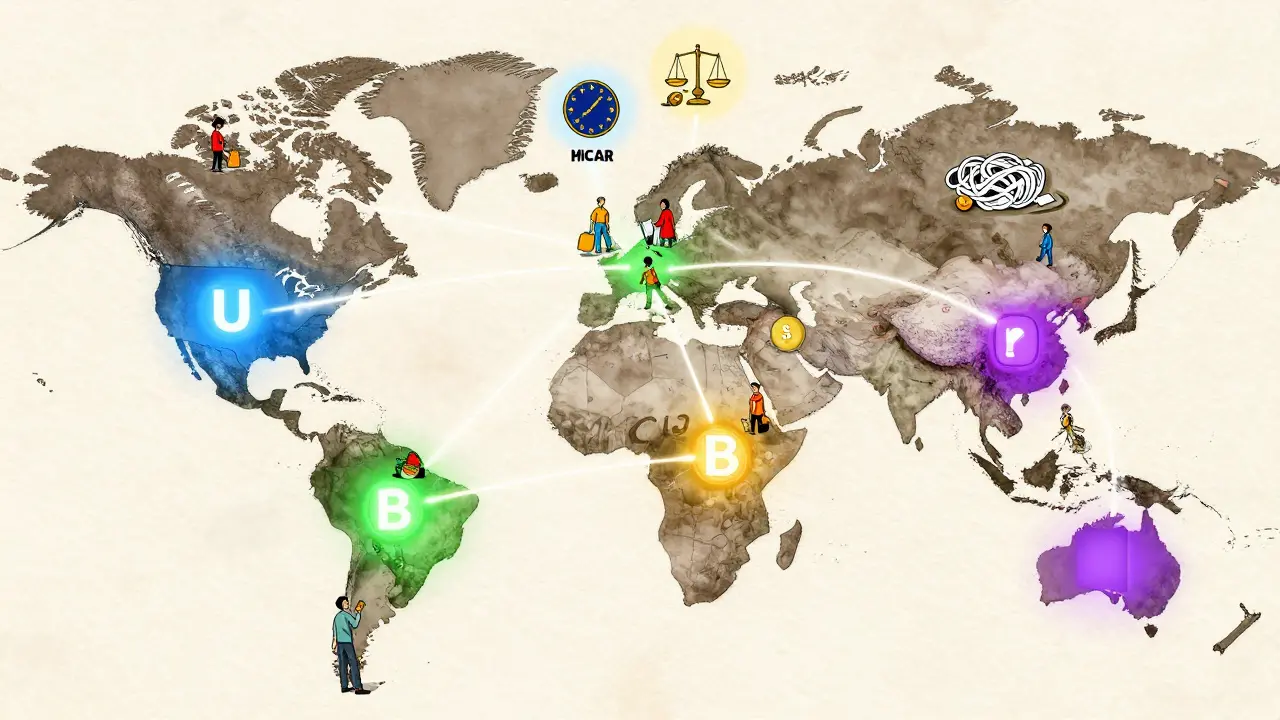
What’s Still Unclear?
Even with all this progress, big questions remain. Will the U.S. finally pick one primary regulator? Right now, you need to deal with both the SEC and CFTC - and sometimes the IRS too. That’s messy. The FIT Act tries to fix that, but it’s not law yet. What happens to DeFi? No country has figured out how to regulate decentralized protocols that run on code, not companies. The EU is testing a "service provider" approach - holding wallet providers or analytics firms accountable. The U.S. is still debating whether to go that route. And what about CBDCs? Central bank digital currencies are being tested in over 100 countries. Will they compete with crypto? Or will they coexist? The answer will shape the next decade of money.The Bottom Line
Crypto regulation in 2025 isn’t about stopping crypto. It’s about making it work - safely, transparently, and at scale. The U.S. is building the infrastructure. Asia is creating the hubs. Emerging markets are proving crypto can serve real economic needs. Europe is learning that rules take time. And the industry? It’s no longer hiding. It’s showing up, ready to play by the rules. If you’re holding crypto, you’re safer than ever. If you’re building something in crypto, you have a clearer path forward. And if you’re watching from the sidelines? The moment of uncertainty is over. The era of real regulation has begun.Is crypto legal in the U.S. in 2025?
Yes, crypto is legal in the U.S. in 2025 - and it’s more regulated than ever. You can buy, sell, and trade Bitcoin, Ethereum, and other tokens on licensed exchanges. The key change is that now there are clear rules: the CFTC oversees crypto as a commodity, the SEC handles tokens that are securities, and stablecoins must meet strict reserve and audit requirements. It’s no longer a gray area.
Which countries have the best crypto regulations?
In 2025, Singapore and Hong Kong lead in clarity and structure. Both offer full licensing for exchanges, custody services, and stablecoins, with transparent rules and fast approval times. The U.S. is catching up fast, especially with the proposed FIT Act and Stablecoin Trust Act. Switzerland and the UAE also rank high for their balanced approach - supportive of innovation but strict on AML and consumer protection.
Are stablecoins regulated now?
Yes, and it’s a major shift. In the U.S., the Stablecoin Trust Act (expected to pass in 2025) requires issuers to hold 100% reserves in cash or short-term U.S. Treasuries, keep those funds separate from company assets, and undergo monthly audits by the Federal Reserve or OCC. Singapore and the EU’s MiCAR have similar rules. No more algorithmic stablecoins or unbacked tokens - if you want to issue one, you need real money behind it.
Will the SEC still sue crypto companies?
Not like before. Under Chair Atkins, the SEC has shifted from enforcement to rulemaking. They’ve stated that most crypto assets are not securities and are now focused on writing clear guidelines. That doesn’t mean they won’t act - if a token is clearly sold as an investment contract, they still will. But the days of surprise lawsuits against exchanges or DeFi protocols are over. The goal now is to create a predictable system.
How does MiCAR affect non-EU crypto firms?
If your company serves EU customers, MiCAR applies to you - even if you’re based in the U.S. or Asia. That means you need to comply with disclosure rules, reserve requirements, and licensing if you offer crypto services in Europe. Many firms have set up EU subsidiaries just to handle European clients. Others are avoiding the EU market entirely until the final guidance comes out in late 2025.




Joe West
December 4, 2025 AT 08:48Finally, some clarity. I’ve been holding BTC since 2017 and watched every panic attack from regulators. Now? I can actually recommend crypto to my cousins without feeling like a con artist. The Stablecoin Trust Act alone is a game-changer - no more Terra-style collapses. Real backing, real audits. That’s not regulation, that’s responsibility.
Martin Hansen
December 5, 2025 AT 16:28Oh please. You think this is progress? You’re just drinking the Kool-Aid from Coinbase’s PR team. The SEC still has a monopoly on interpretation - they just swapped the gun for a PowerPoint. And don’t get me started on ‘safe harbors’ - that’s just corporate lobbying dressed up as law. This isn’t regulation, it’s capture. Real innovation dies when it needs a lawyer to breathe.
Chris Mitchell
December 6, 2025 AT 21:37Regulation isn’t the enemy of innovation. It’s the scaffolding. Without it, crypto was a carnival ride with no seatbelts. Now, it’s a train - still fast, still risky, but predictable. The real win? The industry showed up. That’s maturity. Most industries don’t get to rewrite their own rulebook while staying relevant. We’re watching history, not gossip.
rita linda
December 8, 2025 AT 01:30Let’s be honest - this is just America flexing. The U.S. didn’t ‘catch up’ - it weaponized its dollar. Stablecoins backed by Treasuries? That’s not financial innovation, it’s financial imperialism. Singapore and Dubai are building alternatives because they know: the dollar isn’t sacred, it’s systemic. And now we’re forcing the world to play by our rules. Cute.
Regina Jestrow
December 9, 2025 AT 09:09Okay, but what about DeFi? I love that exchanges are regulated now - but if I’m swapping tokens on Uniswap and a hacker drains my wallet, who do I call? The Fed? The CFTC? No one. That’s the elephant in the room. Regulation is great for centralized players, but the whole point of crypto was to bypass intermediaries. Are we just replacing Wall Street with a slightly nicer Wall Street?
jonathan dunlow
December 10, 2025 AT 01:18Look, I’ve been in this space since the early days of mining on my laptop. I remember when people called us criminals. I remember when exchanges got shut down overnight. I remember losing friends to scams. And now? Now we have real frameworks. Yes, it’s messy. Yes, there’s still gray. But we’re not hiding anymore. We’re not begging for permission. We’re sitting at the table. And that? That’s worth celebrating. If you’re still scared, you’re not ready for the future - and that’s okay. But don’t let your fear drown out the progress of everyone else who’s been fighting for this.
Mariam Almatrook
December 11, 2025 AT 11:52One must observe, with a degree of scholarly detachment, that the ostensible maturation of cryptocurrency regulatory architecture constitutes less a paradigmatic evolution than a reterritorialization of capital under the auspices of state-sanctioned financial hegemony. The very notion of ‘safe harbors’ betrays an ontological contradiction: if the state can define what is legitimate, then decentralization is merely performative. One is compelled to ask: is this the end of crypto - or merely its assimilation?
nicholas forbes
December 11, 2025 AT 13:22Someone needs to say it: the real winners here aren’t the big exchanges. They’re the auditors, compliance software firms, and lawyers who finally have a market. This whole thing is just a revenue stream for consultants. The user? Still gets charged fees. Still gets locked out of their wallet. Still gets confused by ‘stablecoin’ vs ‘token’. Regulation didn’t fix crypto - it just made it more expensive to use.