It’s easy to stumble upon old names in the crypto world and wonder if they’re still worth your attention. If you are looking at Linkswap, here is the short answer: it is gone. The platform that once promised a blend of Chainlink and Yearn Finance mechanics is no longer operational. Trying to trade there today would be like trying to buy tickets at a movie theater that closed five years ago.
This review isn’t just about confirming that the lights are off. It’s about understanding why Linkswap failed, what happened to its users, and how this specific case study helps you avoid similar traps in the decentralized finance (DeFi) space today. We’ll look at the technical setup, the tokenomics that promised much but delivered little, and the broader market forces that swept it away.
The Rise and Fall of Linkswap
To understand why Linkswap disappeared, we have to rewind to early 2021. This was the peak of the "DeFi Summer" aftermath, a time when anyone could launch a protocol with a clever name and hope for liquidity. Linkswap emerged as an automated market maker (AMM) built by a project called YF Link. The name itself was a marketing play, attempting to borrow credibility from two giants: Chainlink and Yearn Finance.
The premise was simple. Users could swap ERC-20 tokens for ETH directly through their wallets without a centralized intermediary. It was non-custodial, meaning you never handed over your private keys. On paper, this sounded safe. In practice, it lacked the one thing every exchange needs: deep liquidity.
By mid-2021, reviews from outlets like Cryptowisser noted that while the tech worked, the volume was thin. Fast forward to 2025 and 2026, and data aggregators like CoinCodex and Holder.io explicitly list Linkswap as "no longer operational" with zero active trading pairs. The site is effectively dead.
How Linkswap Worked When It Was Alive
If you were using Linkswap back in 2021, the experience followed the standard playbook for Ethereum-based decentralized exchanges. Here is how the mechanism functioned:
- Wallet Connection: You didn’t create an account. You connected a Web3 wallet like MetaMask or Trust Wallet. This meant no KYC (Know Your Customer) checks, which appealed to privacy-focused traders.
- Automated Market Maker (AMM): Instead of an order book where buyers match sellers, Linkswap used liquidity pools. Prices were determined by a mathematical formula (x*y=k). If you wanted to swap Token A for ETH, you pulled from a pool funded by other users.
- Fees: The platform charged a flat 0.30% fee on every trade. This was split between liquidity providers (who got 83%) and stakers of the governance token (who got 17%).
The friction point? Gas fees. Since Linkswap ran exclusively on the Ethereum blockchain, every transaction required paying network fees. During the 2021 bull run, gas fees often spiked to $50 or more per transaction. For a small trader swapping $100 worth of crypto, paying $20 in gas made the trade unprofitable. Linkswap offered no Layer-2 solutions or alternative chains to mitigate this cost.
The YF Link Tokenomics Trap
A major part of Linkswap’s pitch was its governance token, $YFL. The team claimed this token would drive value through scarcity. There were only 50,000 YFL tokens in total circulation. The idea was that periodic buy-backs from trading fees would push the price up.
In theory, artificial scarcity creates demand. In reality, it creates volatility and illiquidity. With such a tiny supply, large moves in price were common, making it risky for holders. More importantly, the tokenomics did not solve the core problem: lack of users. Without a massive user base generating those 0.30% fees, there wasn’t enough capital to sustain the buy-back mechanism.
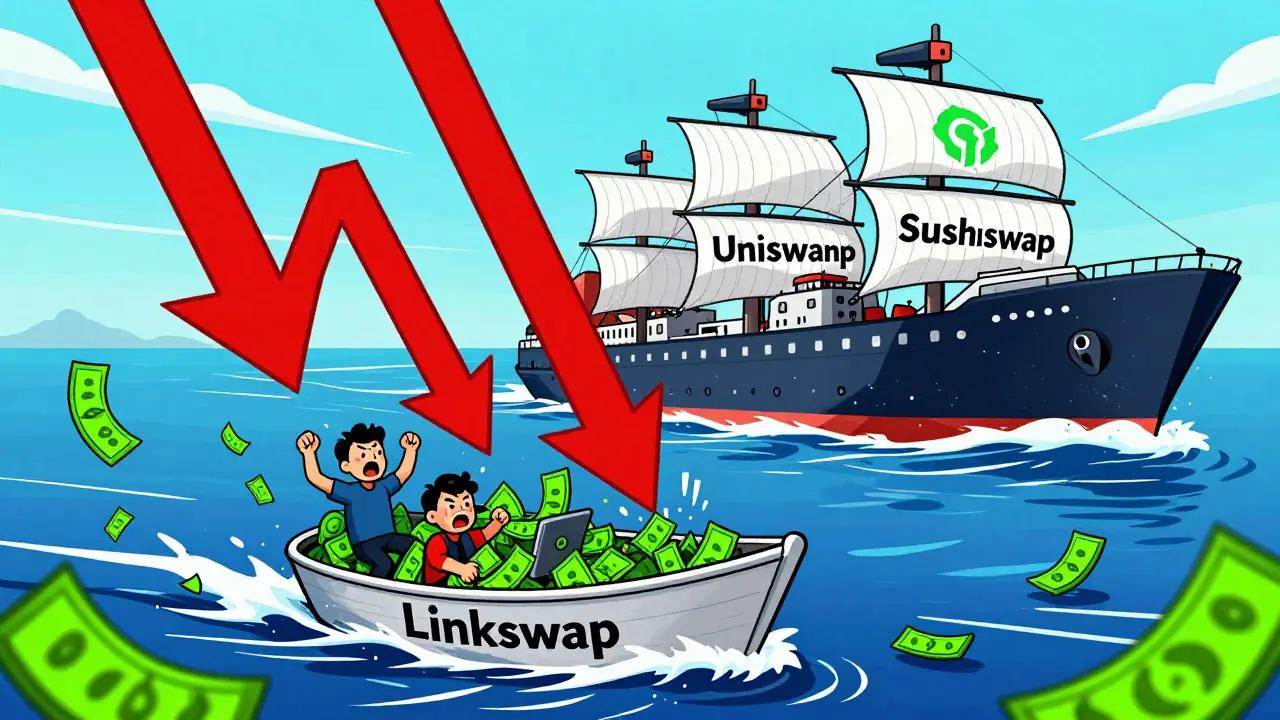
Compare this to Uniswap, which distributed 1 billion UNI tokens to bootstrap community governance and liquidity. Uniswap’s model created a broad ecosystem. Linkswap’s model created a bottleneck. When the hype faded, the token lost its value, and the incentive for liquidity providers to stay vanished.
Why Linkswap Failed: A Competitive Analysis
Linkswap didn’t fail because it was technically broken. It failed because it entered a saturated market with no unique advantage. Let’s compare it to the leaders that survived.
| Feature | Linkswap (Defunct) | Uniswap (Active) | Sushiswap (Active) |
|---|---|---|---|
| Network Support | Ethereum Only | Multi-chain (ETH, Arbitrum, Optimism, etc.) | Multi-chain (ETH, BSC, Polygon, etc.) |
| Fee Structure | Flat 0.30% | Variable (0.05%, 0.30%, 1%) | Standard 0.30% + Fee Switching |
| Liquidity Depth | Low (Insufficient for large trades) | High (Billions in TVL) | Medium-High |
| Governance | $YFL (50k supply, limited impact) | $UNI (Broad community governance) | $SUSHI (Community-driven) |
| Current Status | Shut Down | Dominant Market Leader | Active Competitor |
The table above highlights the fatal flaws. By 2025, platforms like Symbiosis.finance supported swaps across 30+ blockchains. Linkswap was stuck on Ethereum. As users migrated to cheaper chains like Polygon or Binance Smart Chain to save on gas, Linkswap became irrelevant. It couldn’t bridge assets. It couldn’t offer lower fees. It simply faded into obscurity.
Security and User Risks
One common misconception is that because Linkswap is shut down, it was a scam. That’s not necessarily true. Many DeFi projects fail due to poor business models rather than malicious intent. However, the risk to users was real.
Because Linkswap was non-custodial, your funds were always in your wallet, not on Linkswap’s servers. This meant hackers couldn’t drain a central database. But there was a different danger: smart contract risk. If the code had vulnerabilities, anyone could exploit it. While no major hacks were widely reported during its brief life, the abandonment of the project means there is no team left to patch bugs or respond to issues.
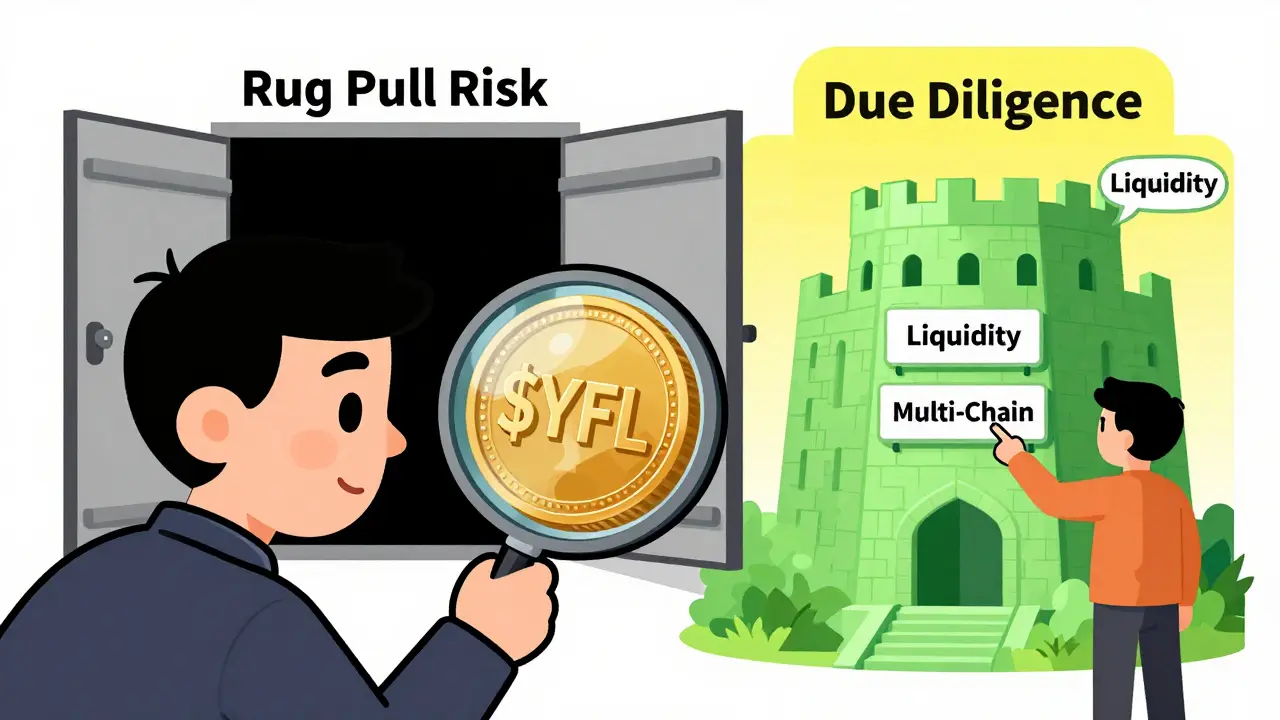
For current users, the lesson is clear. Just because a platform is "non-custodial" doesn’t mean it’s safe forever. If a project abandons its contracts, liquidity dries up, and you might find yourself holding a token that has nowhere to go. This is known as "rug pull" dynamics, even if unintentional.
What Should You Use Instead?
If you are looking for the features Linkswap once offered-decentralized trading, no KYC, and Ethereum support-you have far better options today. The market has consolidated around protocols with proven track records and multi-chain capabilities.
- Uniswap: The gold standard for Ethereum swaps. It has the deepest liquidity, meaning less slippage on your trades. It now supports multiple networks, reducing gas costs.
- Sushiswap: A strong alternative that operates on many chains. It offers similar fee structures but with a more active community and governance model.
- Symbiosis.finance: If you need cross-chain swaps (e.g., moving assets from Ethereum to Solana), this platform specializes in bridging across 30+ blockchains securely.
These platforms have survived the regulatory scrutiny that increased after 2023. They have transparent teams, audited smart contracts, and active development roadmaps. Linkswap had none of these safeguards in place for the long term.
Lessons for Future DeFi Investors
The story of Linkswap is a cautionary tale for anyone diving into new crypto projects. Here are three key takeaways to keep in mind:
- Liquidity is King: Always check the Total Value Locked (TVL) before trading. Low liquidity means high slippage and difficulty exiting positions. Tools like Dune Analytics can help you verify real-time volume data.
- Tokenomics Matter: Be wary of projects with artificially low token supplies that promise huge returns. Sustainable economics usually involve broader distribution and clear utility, not just scarcity.
- Multi-Chain is Essential: In 2026, a single-chain DEX is a niche product. Look for platforms that integrate with Layer-2 solutions or alternative chains to ensure you aren’t locked out by high gas fees.
Don’t let nostalgia for early DeFi days trick you into chasing ghosts. Linkswap served its purpose as an experiment in 2021. Today, it serves as a reminder to do your due diligence. Stick to established protocols with active communities and transparent operations. Your portfolio will thank you.
Is Linkswap still operational in 2026?
No, Linkswap is definitively defunct. Data from CoinCodex and Holder.io confirms that the exchange has zero active trading pairs and is listed as "no longer operational." Users cannot deposit, withdraw, or trade on the platform.
Where is my money if I held funds on Linkswap?
If you used Linkswap, your funds were likely in your personal wallet (like MetaMask) because it was a non-custodial DEX. However, if you provided liquidity to pools, those tokens may be stuck in abandoned smart contracts with no way to redeem them. Check your wallet balance for any remaining ERC-20 tokens associated with the protocol.
What happened to the YF Link ($YFL) token?
The $YFL token has lost its utility and value following the shutdown of the Linkswap platform. With no trading fees being generated and no active governance, the token is considered worthless. Holders should be cautious of any attempts to sell or trade it on secondary markets, as liquidity is non-existent.
Why did Linkswap fail compared to Uniswap?
Linkswap failed due to insufficient liquidity, lack of technological innovation, and an unsustainable tokenomic model. Unlike Uniswap, which expanded to multiple blockchains and improved its fee structure, Linkswap remained confined to Ethereum with a flat fee and no competitive advantages.
Are there safe alternatives to Linkswap for decentralized trading?
Yes, several reputable alternatives exist. Uniswap is the leading choice for Ethereum-based swaps. Sushiswap offers multi-chain support. For cross-chain swaps, Symbiosis.finance is a robust option. Always verify the platform’s audit status and community activity before trading.