Remember when you could trade on a decentralized exchange without waiting ten minutes for confirmation or paying $50 in gas fees? That was the promise of Serum DEX, a high-speed decentralized exchange built on the Solana blockchain that uses an order book model instead of automated market makers. Launched in 2020, it looked like the future of DeFi. Fast, cheap, and familiar to anyone who had used Binance or Coinbase Pro. Then came November 2022.
The collapse of FTX didn’t just take down one centralized giant; it nearly killed Serum too. Because FTX held the upgrade authority for the protocol, the original Serum effectively froze. But here is the twist: the community didn’t let it die. They forked it. Today, in mid-2026, Serum is still running, but it’s a different beast than the one launched five years ago. Is it worth your time? Let’s break down what actually works, what doesn’t, and whether you should trust your keys to this platform.
How Serum Actually Works (And Why It’s Different)
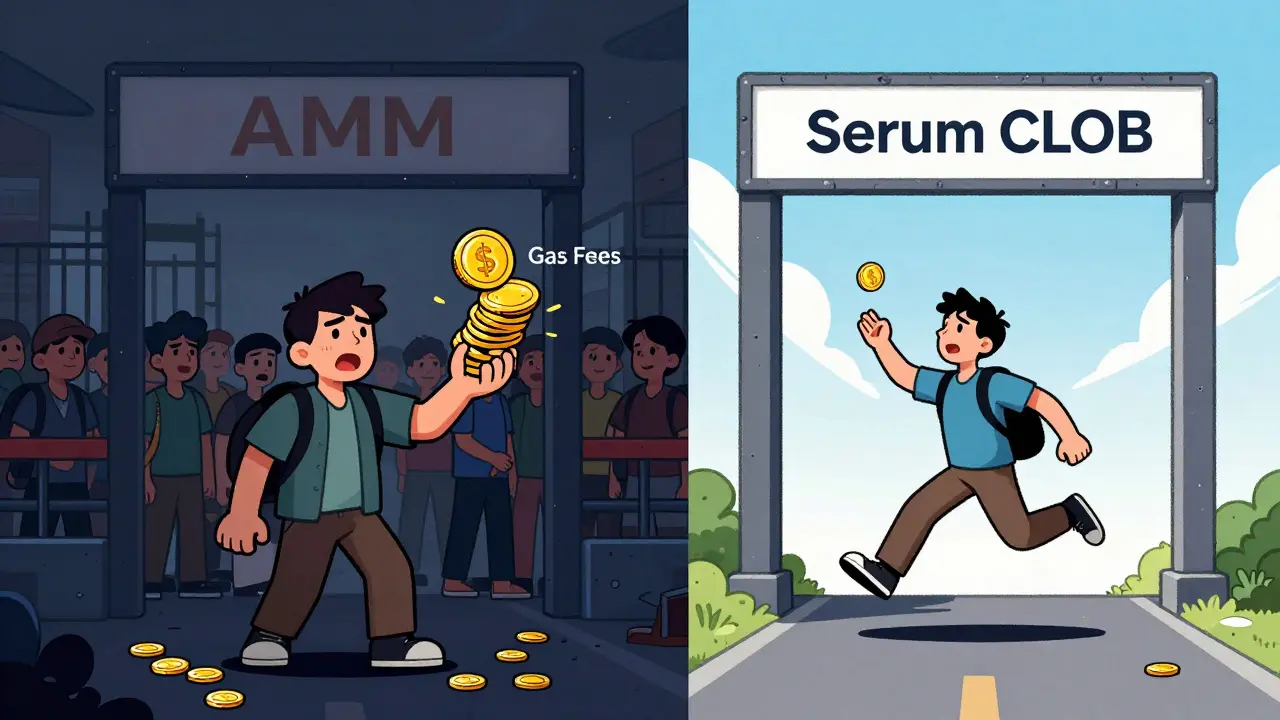
Most decentralized exchanges like Uniswap or PancakeSwap use something called an Automated Market Maker (AMM). You swap tokens against a liquidity pool, and the price changes based on supply and demand formulas. It’s simple, but it can be slow and expensive during volatile markets.
Serum does not do that. It uses a central limit order book (CLOB), just like traditional stock exchanges or centralized crypto platforms. This means you can place limit orders, set stop-losses, and see real-time buy and sell walls. For professional traders, this is a game-changer. You get the control of a centralized exchange with the self-custody of a decentralized one.
The magic happens because Serum runs on Solana, a blockchain designed for speed. While Ethereum might handle 15 transactions per second, Solana aims for 65,000. Serum leverages this infrastructure to execute trades in milliseconds. If you are scalping SOL or trading meme coins during a pump, that speed matters. Slippage stays low, and your order fills exactly where you want it.
The FTX Shadow: What Happened and Where We Stand Now
You cannot talk about Serum without talking about FTX. Before its collapse, FTX acted as the custodian for wrapped assets on Serum and held the private keys to upgrade the smart contracts. When Sam Bankman-Fried’s empire crumbled in November 2022, Serum’s functionality halted. Users couldn’t withdraw wrapped Bitcoin or Ethereum easily, and trust evaporated overnight.
But the story didn’t end there. The open-source nature of the project allowed developers to create a community fork. By early 2023, a new version of Serum was live, governed by the community rather than a single entity. As of 2026, this forked version is the active platform. It removed the dependency on FTX for asset wrapping, introducing direct cross-chain messaging capabilities in January 2025. This allows you to bridge assets from Ethereum directly to Serum without a centralized intermediary.
Does this fix the trust issue? Mostly. The governance is now more distributed, though it’s still evolving. Delphi Digital rates Serum’s survival probability at 65% over the next three years, citing strong tech but lingering governance questions. It’s a cautionary tale: even decentralized projects can have centralized points of failure if you aren’t careful.
Fees and Costs: The Hidden Savings
Here is where Serum shines. On Ethereum-based DEXes, you pay two types of fees: trading fees (usually 0.3%) and network gas fees (which can skyrocket to $50+ during congestion). Serum charges zero trading fees. Yes, zero. The platform makes money through other ecosystem incentives, not by taking a cut of your trades.
You only pay the Solana network fee, which averages around $0.00025 per transaction. Even during peak hours, it rarely exceeds a few cents. Compare that to PancakeSwap’s 0.25% fee or Uniswap’s variable gas costs, and the savings add up fast. If you’re making multiple trades a day, Serum saves you hundreds, if not thousands, of dollars annually.
However, keep in mind that while trading is free, bridging assets onto Solana might involve small fees depending on the bridge you use. Always check the current bridge rates before moving large amounts of capital.

Serum vs. The Competition: A Quick Comparison
| Feature | Serum DEX | Uniswap | Raydium |
|---|---|---|---|
| Trading Model | Order Book (CLOB) | Automated Market Maker (AMM) | Hybrid (AMM + Order Book) |
| Blockchain | Solana | Ethereum / Layer 2s | Solana |
| Trading Fees | 0% | 0.05% - 1% | 0.25% |
| Avg. Network Fee | $0.00025 | $1 - $50+ | $0.00025 |
| Best For | Pro Traders, Scalpers | Swapping Major Tokens | Liquidity Providers |
Notice how Serum stands out with its order book model and zero fees. Uniswap remains the king of liquidity for major ERC-20 tokens, but it’s slower and costlier. Raydium, another Solana-native DEX, integrates with Serum’s order book to provide liquidity, creating a symbiotic relationship. If you need precision and speed, Serum wins. If you just want to swap ETH for USDC quickly, Uniswap might be simpler.
User Experience: Is It Beginner Friendly?
Honestly? Not really. Serum assumes you know what a wallet is, how to manage private keys, and understand Solana’s transaction structure. New users often spend 2-4 hours just setting up their environment correctly. You’ll need a Solana-compatible wallet like Phantom or Solflare. Serum offers a built-in wallet creator, but most experienced users prefer Phantom for its security features and browser extension convenience.
The interface itself is clean and professional, resembling traditional trading platforms. You’ll see charts, order books, and trade history. However, there is no customer support team. If you get stuck, you’re on your own. The community Discord has 38,500 members, and they’re generally helpful, but don’t expect instant answers. Trustpilot reviews highlight this friction, with some users rating the setup process poorly due to technical hurdles.
If you’ve never used a DEX before, start with a small amount. Learn how to approve transactions, monitor gas prices, and verify contract addresses. Once you get the hang of it, the experience is smooth. But the learning curve is real.
Security and Risks: What Could Go Wrong?
Serum’s security relies heavily on Solana’s network stability. Remember September 2021, when Solana went down for 17 hours? All trading on Serum stopped. No funds were lost, but you couldn’t move them. This highlights a key risk: dependency on a single blockchain. If Solana fails, Serum fails.
Another concern is smart contract risk. While the code is open-source and audited, bugs can still exist. The FTX incident showed that even well-funded projects can have hidden vulnerabilities. Since the fork, the community has worked hard to decentralize governance, reducing the risk of a single point of failure. Still, always do your own research (DYOR) before connecting your main wallet.
To mitigate risks, use a hardware wallet like Ledger or Trezor for storing significant amounts of SOL. Never share your seed phrase, and double-check every transaction URL. Phishing attacks targeting Solana users are common, so stay vigilant.
Who Should Use Serum DEX?
Serum isn’t for everyone. Here’s a quick breakdown:
- Active Traders: If you scalp, day trade, or use limit orders, Serum’s order book and zero fees make it ideal.
- Solana Ecosystem Enthusiasts: If you hold SOL and want to trade native tokens efficiently, Serum is the best option.
- DeFi Veterans: Comfortable with wallets, bridges, and managing gas fees yourself.
On the flip side, avoid Serum if:
- You’re a Beginner: The setup complexity and lack of support can be overwhelming.
- You Trade Only Major Pairs: Uniswap or centralized exchanges might offer better liquidity for BTC/ETH swaps.
- You Hate Technical Issues: Network congestion or failed transactions require troubleshooting skills.
Final Thoughts: Is Serum Worth It in 2026?
Serum DEX survived its darkest hour and emerged stronger, albeit scarred. It remains one of the fastest, cheapest ways to trade cryptocurrencies on-chain. The zero-fee structure and order book model give it a unique edge over competitors. However, the reliance on Solana’s stability and the historical baggage from FTX mean you must approach it with caution.
If you value speed, control, and low costs, Serum is a powerful tool. Just remember: you are responsible for your security. Start small, learn the ropes, and leverage the community resources. The future of decentralized trading is bright, and Serum is still playing a key role in it.
Is Serum DEX safe to use in 2026?
Yes, Serum is generally safe, provided you follow standard security practices. The platform operates on the secure Solana blockchain, and the community fork after the FTX collapse improved governance. However, always use a reputable wallet like Phantom, enable two-factor authentication where possible, and never share your private keys. Be aware that smart contract risks always exist in DeFi.
What happened to Serum after FTX collapsed?
When FTX collapsed in November 2022, the original Serum protocol became defunct because FTX held the upgrade authority. The community responded by forking the project, creating a new, decentralized version that removed FTX’s control. This forked version continues to operate today with enhanced cross-chain capabilities and community-driven governance.
Does Serum charge any trading fees?
No, Serum does not charge any trading fees. You only pay the minimal Solana network transaction fee, which is typically less than $0.001. This makes it significantly cheaper than most other decentralized exchanges that charge between 0.05% and 1% per trade.
Can I trade Bitcoin or Ethereum on Serum?
Yes, but you need to use wrapped versions of these assets (wBTC and wETH) on the Solana network. As of 2025, Serum supports direct bridging from Ethereum, allowing you to move assets without relying on centralized custodians. Ensure you use trusted bridges to minimize slippage and fees.
How does Serum compare to Uniswap?
Serum uses an order book model on Solana, offering faster speeds and zero trading fees. Uniswap uses an AMM model on Ethereum, providing deeper liquidity for major tokens but with higher gas fees and slower execution. Choose Serum for active trading and low costs; choose Uniswap for simplicity and broad token availability.
Do I need a specific wallet to use Serum?
You need a Solana-compatible wallet. Phantom and Solflare are the most popular choices. Serum also offers a built-in wallet creator, but using a dedicated wallet like Phantom provides better security and integration with other Solana DeFi apps.