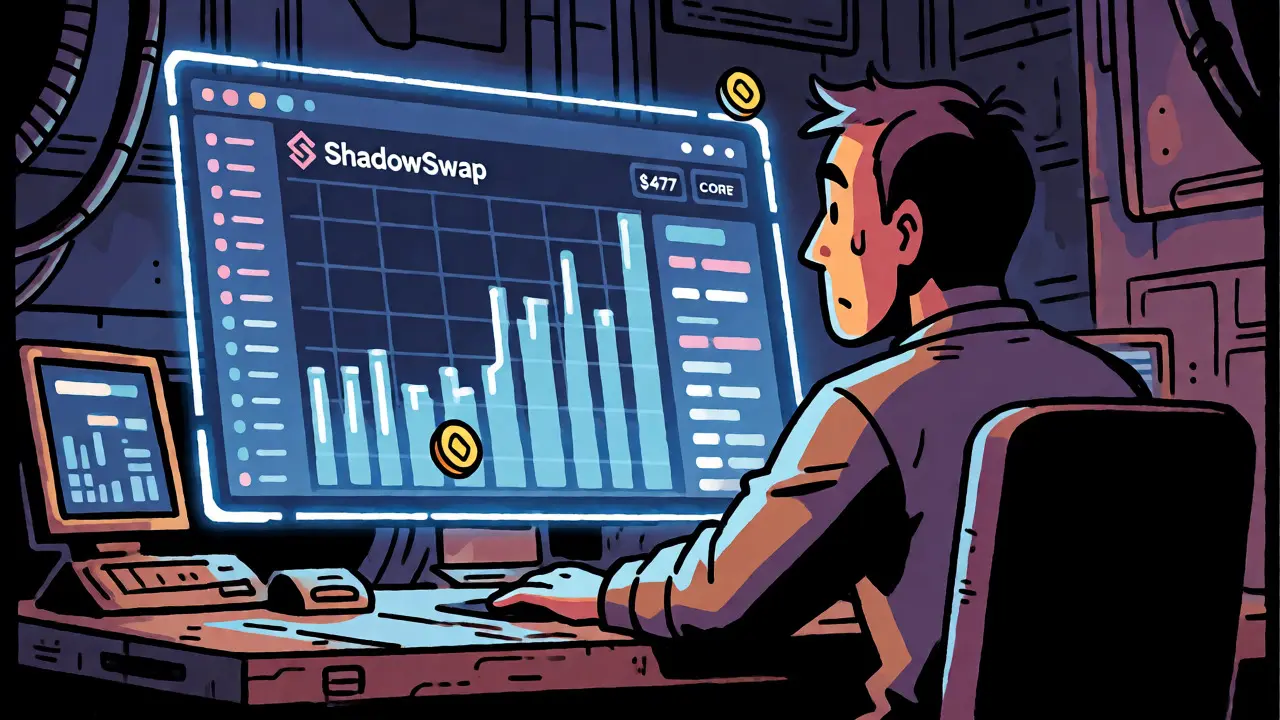
You’re staring at a chart where ShadowSwap is a decentralized exchange (DEX) built specifically for the Core blockchain network. It launched in 2023 with big promises of low fees and high yields. But here’s the kicker: as of late 2025, its daily trading volume hovers around $477. That’s not a typo. Four hundred seventy-seven dollars. For an entire day.
If you are digging through the latest DeFi launches on Core Network, you’ve likely stumbled upon ShadowSwap Finance. The question isn’t just "does it work?"-it works fine technically. The real question is whether this niche platform offers enough utility to justify the risk of parking your capital in a pool with minimal exit liquidity. Let’s break down what actually happens when you use ShadowSwap, who it’s really for, and why that tiny volume number matters more than the flashy features list.
What Exactly Is ShadowSwap?
ShadowSwap Finance operates as an Automated Market Maker (AMM), similar to Uniswap or PancakeSwap, but exclusively on the Core blockchain. Unlike centralized exchanges like Binance or Coinbase, you don’t deposit funds into a company account. You interact directly with smart contracts using your own wallet (like MetaMask configured for Core).
The platform’s main job is simple: facilitate token swaps without intermediaries. However, it tries to be more than just a swap interface. It bundles staking, yield farming, and an NFT marketplace called "Shadow Puppets." The native governance and utility token is SHDW.
| Metric | Value | Context |
|---|---|---|
| Network | Core Blockchain | EVM-compatible, focuses on Bitcoin security model |
| Daily Volume | ~$477 USD | Extremely low; indicates limited user activity |
| Trading Pairs | 6 Active Pairs | Very narrow selection compared to major DEXs |
| SHDW Price | ~$0.002 USD | Down from ATH of $10.88 |
| Fees | Variable (Gas + Swap Fee) | Lower gas than Ethereum, but swap fees apply | d>
The Good: Why People Still Use It
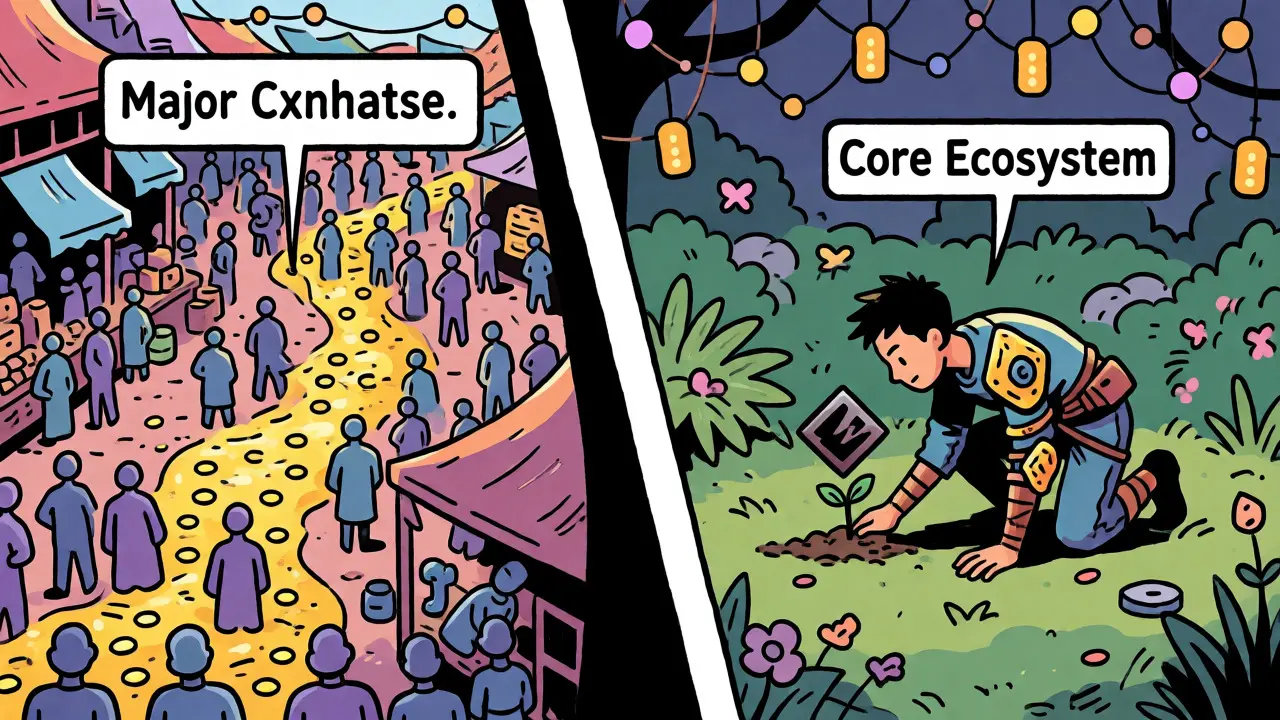
So why bother with a DEX that has less daily volume than a local coffee shop makes in tips? Three reasons stand out if you are already deep in the Core ecosystem.
First, cost efficiency. Because it runs on Core, transaction fees are significantly lower than Ethereum mainnet. If you are swapping small amounts of tokens frequently, those savings add up. Second, exclusive access. The Shadow Launchpad feature gives early access to new projects launching on Core. If you believe Core will have its next big breakout app, being on the ground floor via ShadowSwap might offer better entry prices than waiting for it to hit larger aggregators. Third, yield stacking. Users can provide liquidity to earn trading fees, then stake their LP tokens in Farms to earn SHDW rewards, and sometimes even farm additional partner tokens. It’s a classic DeFi "stacking" strategy, albeit on a much smaller scale.
Also, the anonymity factor appeals to privacy-focused traders. No KYC means no ID uploads. You connect your wallet, sign transactions, and go. For many, this simplicity is worth the trade-off in liquidity.
The Bad: The Liquidity Problem
Here is where things get tricky. With only six active trading pairs and under $500 in daily volume, ShadowSwap suffers from severe liquidity constraints. What does this mean for you practically?
- High Slippage: If you try to swap $1,000 worth of tokens, you might lose 2-5% of your value just to price impact because there aren't enough buyers/sellers in the pool.
- Exit Risk: If you buy a niche token listed on ShadowSwap, you might find it hard to sell later. Who is buying? If the daily volume is $477, selling a $200 position could move the market against you.
- Limited Asset Selection: You cannot trade BTC, ETH, or SOL directly here. You are mostly trading CORE, SHDW, and a handful of other project-specific tokens. If you want diversity, this isn't the place.
The data shows a normalized trading volume ratio of 1.0, which sounds good, but it’s misleading when the absolute numbers are so small. It essentially means the reported volume matches the on-chain reality-there’s no wash trading inflating the stats, but there’s barely any real trading either.
Who Should Actually Use ShadowSwap?
This isn’t a one-size-fits-all exchange. Here’s a quick decision tree:
Use ShadowSwap if:
- You are already holding CORE tokens and want to swap them for other Core-based assets.
- You are hunting for early-stage gems launching on the Core network via the Launchpad.
- You understand AMMs and are comfortable managing slippage manually.
- You want to participate in community-driven governance via SHDW staking.
Skip ShadowSwap if:
- You need to trade large volumes (>$500 per transaction).
- You require a wide variety of assets (stablecoins, L1s, L2s).
- You prefer the safety and insurance of centralized exchanges (CEXs).
- You are looking for high-yield farms with proven track records (many new DEX farms fail quickly).
How to Get Started: A Quick Walkthrough
If you decide to test the waters, here’s how you actually use it without getting burned.
- Set Up Your Wallet: Ensure your MetaMask (or compatible wallet) is connected to the Core Network. Add the network RPC details if they aren’t auto-detected.
- Fund Your Wallet: Deposit CORE tokens. These are needed for both the swap itself and the gas fees.
- Connect to ShadowSwap: Go to the official website. Click "Connect Wallet." Verify the URL carefully-scams love new DEXs.
- Select Tokens: Choose the token you want to sell (e.g., CORE) and the token you want to buy (e.g., SHDW). Check the price impact warning. If it says "High," consider splitting your trade into smaller chunks.
- Approve and Swap: First, approve the contract to spend your tokens. Then, confirm the swap. Wait for the transaction to clear on the block explorer.
- Optional: Stake or Farm: If you provided liquidity, take your LP tokens and stake them in the "Farms" section to earn SHDW rewards.
Security and Trustworthiness
Is ShadowSwap safe? Technically, yes. It uses standard open-source AMM codebases, often forked from established protocols like Uniswap V2/V3 or SushiSwap. This reduces the risk of novel bugs. However, "code is law" doesn’t protect you from rug pulls by third-party projects listed on the DEX. Since anyone can list a token on a permissionless DEX, always verify the contract address of the token you are buying. Don’t just trust the name.
Regarding the SHDW token itself: it experienced a massive drop from its all-time high of $10.88 to roughly $0.002. This suggests either initial overvaluation, token unlocks dumping supply, or lack of sustained demand. Treat SHDW as a high-risk speculative asset, not a stable store of value.
The Verdict
ShadowSwap is a functional, low-fee gateway to the Core blockchain economy. It does exactly what it says on the tin: swaps tokens cheaply. But calling it a "major exchange" would be generous. It’s a niche tool for a specific community.
If you are a casual trader wanting to buy Bitcoin or swap USDT for ETH, look elsewhere. But if you are a Core Network enthusiast wanting to support the ecosystem, grab early positions in new projects, and stack some yields while you wait for adoption to grow, ShadowSwap is a viable, low-barrier entry point. Just keep your position sizes small relative to the available liquidity, and never invest money you can’t afford to see sit idle due to low trading volume.
Is ShadowSwap regulated?
No, ShadowSwap is a decentralized protocol and does not hold licenses like traditional financial institutions. It operates globally without KYC requirements, meaning users are responsible for their own tax reporting and compliance based on their local laws.
Why is the trading volume on ShadowSwap so low?
The low volume stems from two factors: the Core blockchain itself is still growing its user base, and ShadowSwap competes with other emerging DEXs on the same chain. Additionally, the limited number of supported trading pairs restricts overall activity compared to multi-chain giants like Uniswap.
Can I withdraw my funds anytime?
Yes, since it is non-custodial, your funds remain in your wallet until you initiate a swap or stake them. If you are staked in a farm, you must unstake first, which may involve a small waiting period depending on the specific contract terms, before you can swap back to CORE or another liquid asset.
What are the risks of using ShadowSwap?
Primary risks include smart contract vulnerabilities (though mitigated by using standard codebases), impermanent loss when providing liquidity, and high slippage due to low liquidity. There is also the risk of listing fraudulent tokens, as the DEX is permissionless.
Does ShadowSwap support fiat currency?
No, ShadowSwap is a pure cryptocurrency-to-cryptocurrency exchange. To buy tokens on ShadowSwap, you must first acquire crypto (usually CORE or stablecoins bridged to Core) on a centralized exchange and transfer it to your Web3 wallet.