You just watched a video about earning passive income by providing liquidity to decentralized exchanges. It sounds simple: you deposit two tokens, wait, and collect fees. But then you check your portfolio and realize you have less money than if you had just held the tokens in your wallet. What happened? You likely encountered impermanent loss, the silent killer of many DeFi strategies.
Liquidity provision is the engine that keeps Decentralized Finance running. Without it, there are no swaps, no lending markets, and no yield farming. But acting as a Liquidity Provider (LP) isn't just about parking assets; it's an active trading strategy with specific risks and technical requirements. This guide breaks down exactly how LPs work, why you might lose money despite earning fees, and how to choose the right pool for your risk tolerance.
What Is a Liquidity Provider?
In traditional finance, when you buy a stock or currency, you trade against a market maker-a large institution with deep pockets that ensures there’s always someone on the other side of your trade. In DeFi, there are no central banks or brokerage firms holding inventory. Instead, regular users like you step into this role.
A Liquidity Provider is a user who deposits cryptocurrency assets into a smart contract-based liquidity pool to facilitate token swaps. These pools are the backbone of Automated Market Makers (AMMs). When you deposit funds, you aren't just storing them; you are actively enabling other traders to swap one token for another instantly. In exchange for locking up your capital, you earn a portion of the trading fees generated by those swaps.
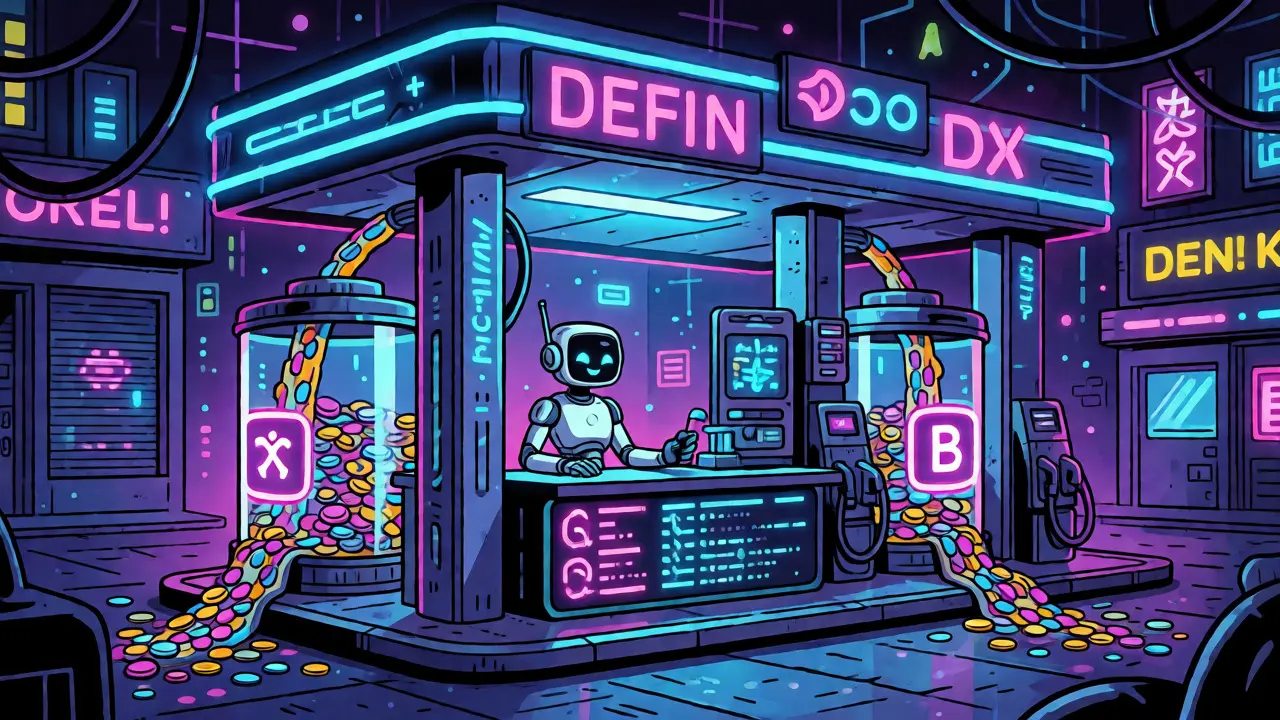
Think of it like being a gas station owner. Traders (cars) need fuel (tokens) to go somewhere. If you have the fuel available, they stop at your station and pay a fee. If you don't have the fuel, they drive elsewhere. Your job is to keep the tanks full so transactions can happen smoothly.
How Automated Market Makers Work
To understand LPing, you must understand the math behind AMMs. Most popular DEXs, like Uniswap, use a constant product formula: x * y = k.
- x is the amount of Token A in the pool.
- y is the amount of Token B in the pool.
- k is a constant value that remains unchanged during trades.
When someone buys Token A from the pool, the amount of Token A (x) decreases. To keep k constant, the price of Token A automatically rises because there is now less supply relative to Token B. This mechanism allows prices to adjust continuously without needing an order book where buyers and sellers match manually. It’s elegant, but it creates the conditions for impermanent loss.
The Trap: Understanding Impermanent Loss
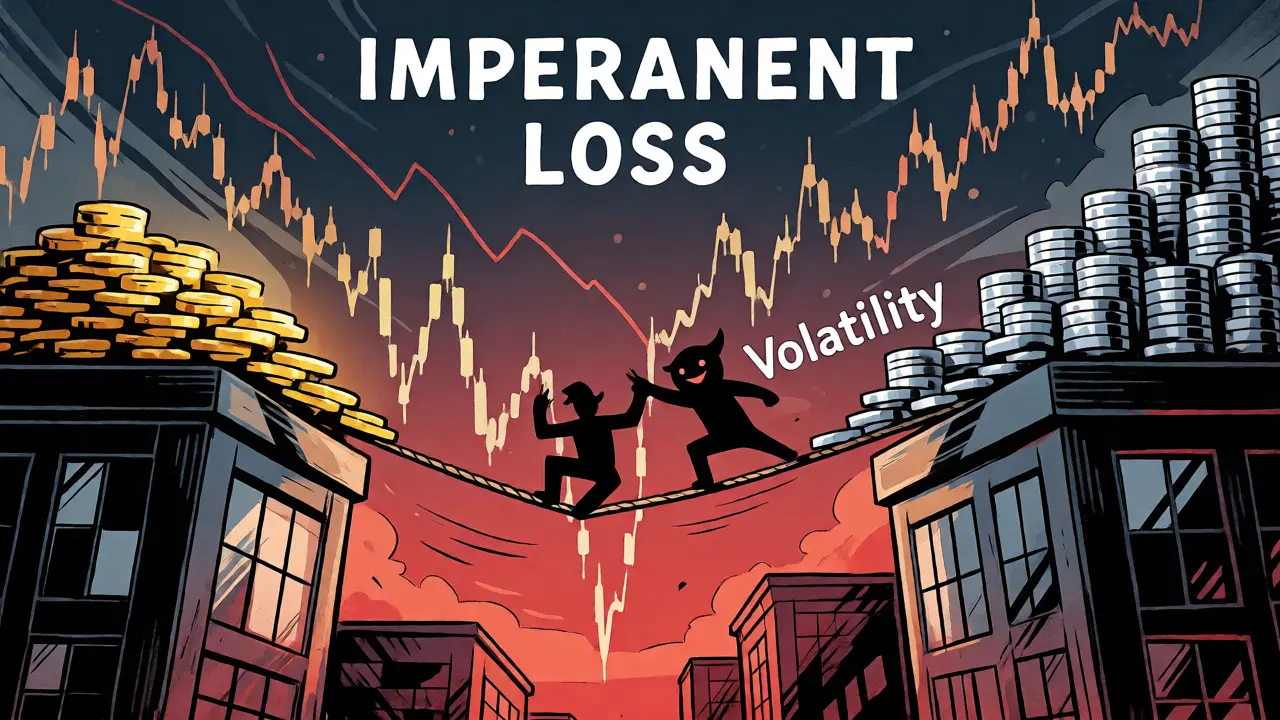
This is the part most beginners ignore until it hurts their wallets. Impermanent loss occurs when the price of your deposited tokens changes compared to when you deposited them. The term "impermanent" is misleading-it only becomes permanent if you withdraw your funds while the price divergence persists.
Here’s a concrete example. Imagine you deposit $500 worth of ETH and $500 worth of USDC into a pool. The ratio is 1:1 in value. Suddenly, the price of ETH doubles. The AMM algorithm automatically sells some of your ETH for USDC to maintain the balance. Now, you hold more USDC and less ETH. If you withdrew your funds at this point, you would have less total value than if you had simply held the original $500 ETH and $500 USDC in your wallet.
| Price Change Ratio | Impermanent Loss (%) | Description |
|---|---|---|
| 1.25x | ~0.6% | Negligible impact; fees likely cover it. |
| 1.5x | ~2.0% | Noticeable; requires higher volume fees to offset. |
| 2.0x | ~5.7% | Significant; you need substantial trading fees to break even. |
| 3.0x | ~13.4% | Severe; often results in net losses unless rewards are high. |
Research from Gauntlet Network suggests that during volatile periods, nearly 68% of liquidity positions on older protocols experienced net losses from impermanent loss that exceeded their fee earnings. This doesn't mean LPing is bad-it means it’s not passive. It’s a bet that trading volume will outweigh price volatility.
Types of Liquidity Pools and Protocols
Not all pools are created equal. Choosing the right protocol depends on your risk appetite and technical knowledge.
Standard Constant Product Pools (Uniswap V2)
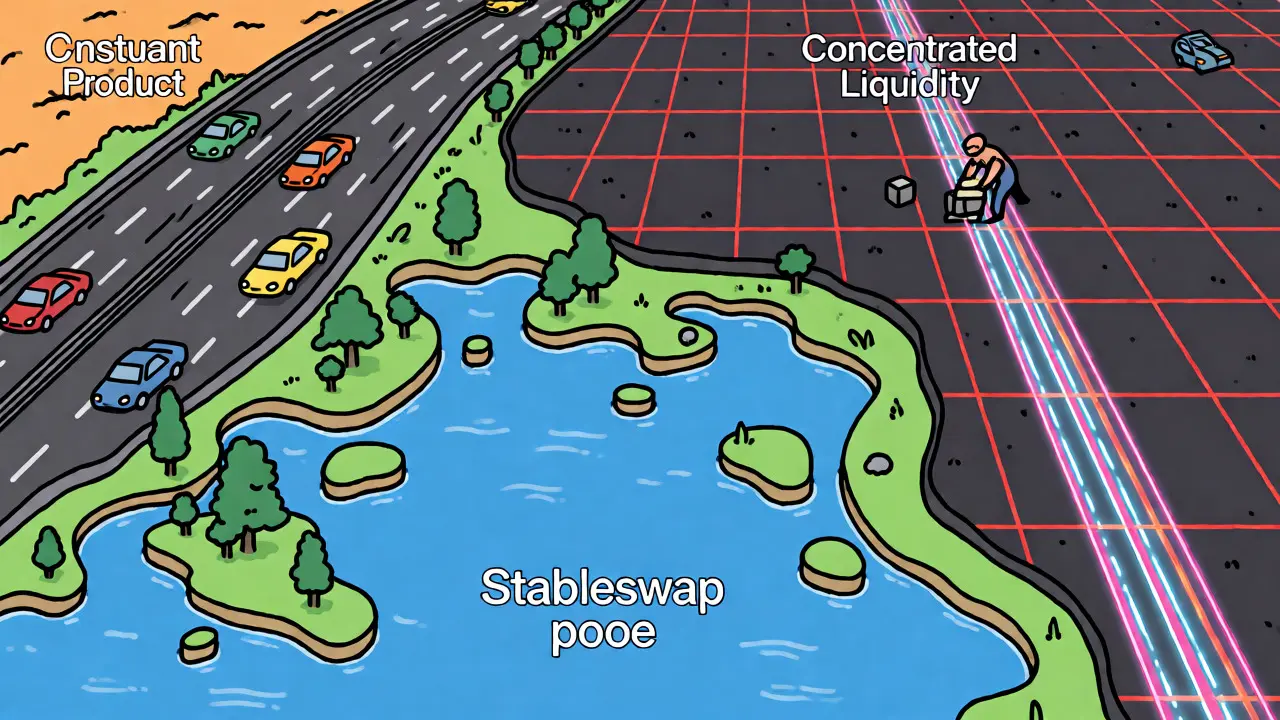
This is the classic model. You provide a 50/50 split of two tokens. It’s simple and works well for any pair, but it suffers from capital inefficiency. Only about 25% of your deposited capital is actually used within typical price ranges, meaning the rest sits idle. Returns here come strictly from trading fees, typically around 0.3% per trade on Uniswap.
Concentrated Liquidity (Uniswap V3)
Launched in 2021, this innovation lets you choose a specific price range for your liquidity. If you believe ETH will stay between $2,000 and $2,200, you only deposit funds within that band. This dramatically increases capital efficiency-up to 4,000x better than V2 in some cases-but it also increases risk. If the price moves out of your range, your position stops earning fees entirely and converts fully into one asset.
Stableswap Pools (Curve Finance)
If you hate volatility, look at Curve Finance. Designed specifically for stablecoins or pegged assets (like USDC/USDT), Curve uses a different mathematical curve that minimizes slippage. Because these assets rarely diverge in price, impermanent loss is almost non-existent. However, returns are lower, often averaging 5-10% APY, though incentives can boost this.
How to Become a Liquidity Provider: Step-by-Step
Ready to try it? Here is the practical workflow for adding liquidity on a major DEX.
- Connect Your Wallet: Use a Web3 wallet like MetaMask or Rabby. Ensure you have enough ETH (or the native chain token) to cover gas fees.
- Select a Pool: Go to the "Pool" or "Add Liquidity" section. Choose your token pair. For beginners, stick to correlated pairs (ETH/WBTC) or stablecoins (USDC/DAI).
- Deposit Tokens: Enter the amount for one token. The interface will calculate the required amount of the second token to maintain the current pool ratio. Approve both tokens for spending if prompted.
- Confirm Transaction: Pay the gas fee. Once confirmed, you receive LP Tokens. These ERC-20 tokens represent your share of the pool.
- Monitor and Manage: Use tools like Zapper.fi or DeBank to track your position. Check your APR (Annual Percentage Rate) and monitor for significant price deviations.
Pro Tip: On Ethereum mainnet, gas fees can eat up 15-20% of small deposits ($500-$1,000). If you’re testing with small amounts, consider Layer-2 networks like Arbitrum or Optimism, where transaction costs drop to under $0.20.
Risks Beyond Impermanent Loss
While IL is the big headline, other dangers lurk in the shadows.
- Smart Contract Risk: You are trusting code, not people. If a bug exists in the protocol, hackers can drain the pool. In 2022 alone, over $2.8 billion was lost to DeFi hacks. Stick to audited protocols with long track records.
- Token Risk: One of the tokens in your pair could crash to zero. If you provided liquidity for a new meme coin paired with ETH, and the meme coin dies, you are left holding worthless tokens.
- Regulatory Uncertainty: The SEC has scrutinized whether LP tokens constitute unregistered securities. While enforcement is still evolving, changing regulations could impact tax treatment or legal status of your holdings.
Strategies for Success
Don’t just throw money at a random pool. Use data to guide your decisions.
Check Volume-to-Liquidity Ratios: High trading volume relative to the pool's total value locked (TVL) means more fees. A pool with $1 million TVL and $10 million daily volume generates far more fees than a pool with $10 million TVL and $1 million daily volume.
Hedge with Derivatives: Advanced users open short positions on perpetual futures to hedge against impermanent loss. If the price of ETH drops, your LP position loses value, but your short profit offsets it. This is complex and carries liquidation risk.
Use Yield Aggregators: Platforms like Yearn Finance automate the process of moving liquidity to the highest-yielding farms. They compound rewards for you, saving time and gas fees.
Do I need to be wealthy to become a liquidity provider?
No. DeFi is permissionless, meaning anyone can participate regardless of capital size. However, on high-gas chains like Ethereum, very small deposits (under $100) may see their profits erased by transaction fees. Layer-2 solutions make micro-LPing viable.
Is impermanent loss guaranteed?
It is guaranteed if the price of the assets diverges significantly from the entry price. If prices remain stable or move back to the original ratio before you withdraw, the loss disappears. That’s why it’s called "impermanent." However, if you withdraw after a large divergence, the loss becomes real.
What are LP tokens?
LP tokens are digital receipts that prove your ownership share in a liquidity pool. They are transferable ERC-20 tokens. You can sell them, send them to friends, or use them as collateral in other DeFi protocols. When you want to exit, you burn these tokens to get your underlying assets back.
Can I lose my entire investment?
Yes, primarily through smart contract exploits or if one of the tokens goes to zero. Unlike bank deposits, DeFi is not insured. Always assess the reputation and audit history of the protocol before depositing.
How are LP rewards taxed?
Tax laws vary by jurisdiction. In the US, receiving LP rewards is often treated as ordinary income at the fair market value upon receipt. Additionally, swapping tokens within a pool may trigger capital gains events. Consult a crypto-savvy tax professional, as frequent compounding can create complex tax liabilities.