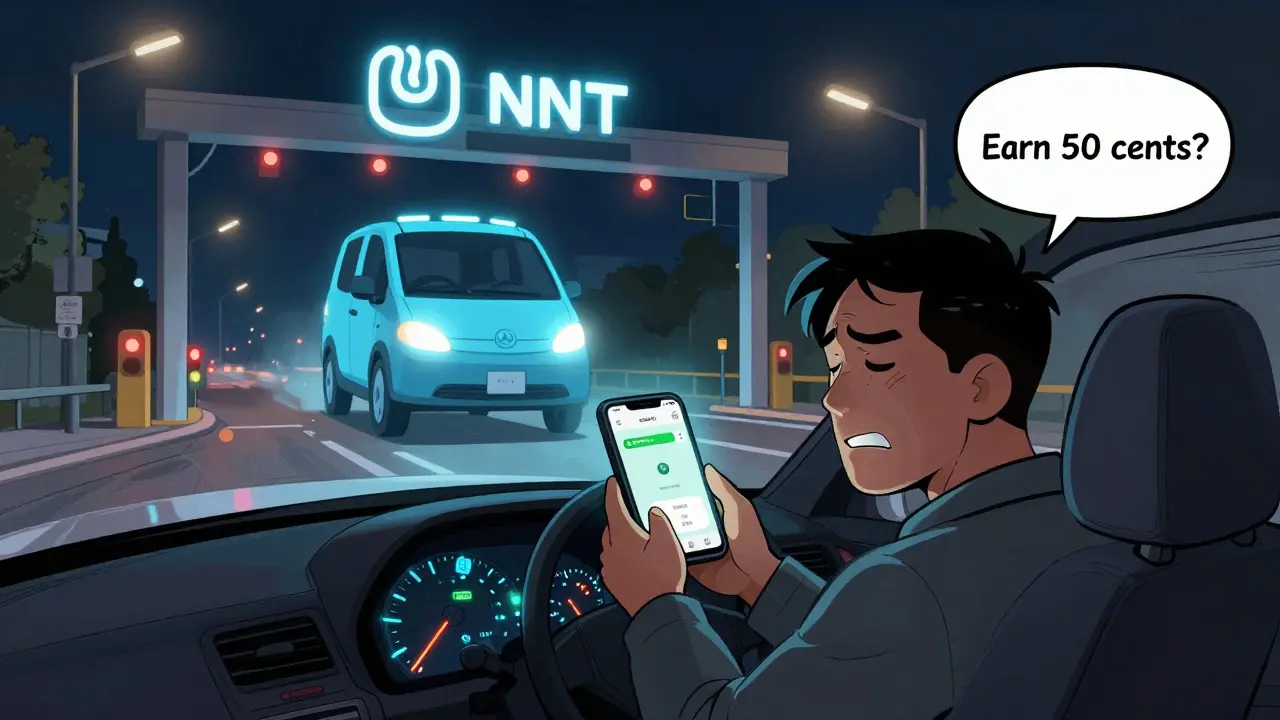
GRABWAY (GRAB) isn't another meme coin. It claims to turn your daily drive into cash - literally. If you drive for Uber, deliver food, or just commute to work, GRABWAY says your GPS data can earn you tokens. Sounds simple. But here's the truth: GRABWAY is a high-risk, low-utility crypto project with more hype than real value. Let’s cut through the noise.
What GRABWAY Actually Does
GRABWAY operates on the Binance Smart Chain. Its app tracks your mileage using GPS and turns it into reward points. Those points can be exchanged for GRAB tokens. No magic. No blockchain breakthrough. Just a phone app that counts miles and pays you in crypto.
Here’s the twist: you don’t just earn tokens by driving. You need to buy an NFT vehicle - called an NTT - inside the app. Think of it like buying a virtual car. The more expensive the NTT, the more points you earn per mile. So, to make money, you have to spend money first. That’s not a reward system. That’s a pay-to-play model.
The whole thing is built around the idea that gig workers will trade hours of driving for a few cents in crypto. But the math doesn’t add up. One user reported driving 127 miles over two weeks and earned 8.3 GRAB tokens - worth about 50 cents at current prices. After factoring in battery drain (up to 35% extra per hour), data usage, and privacy risks, it’s not worth it.
Token Basics: Supply, Price, and Trading
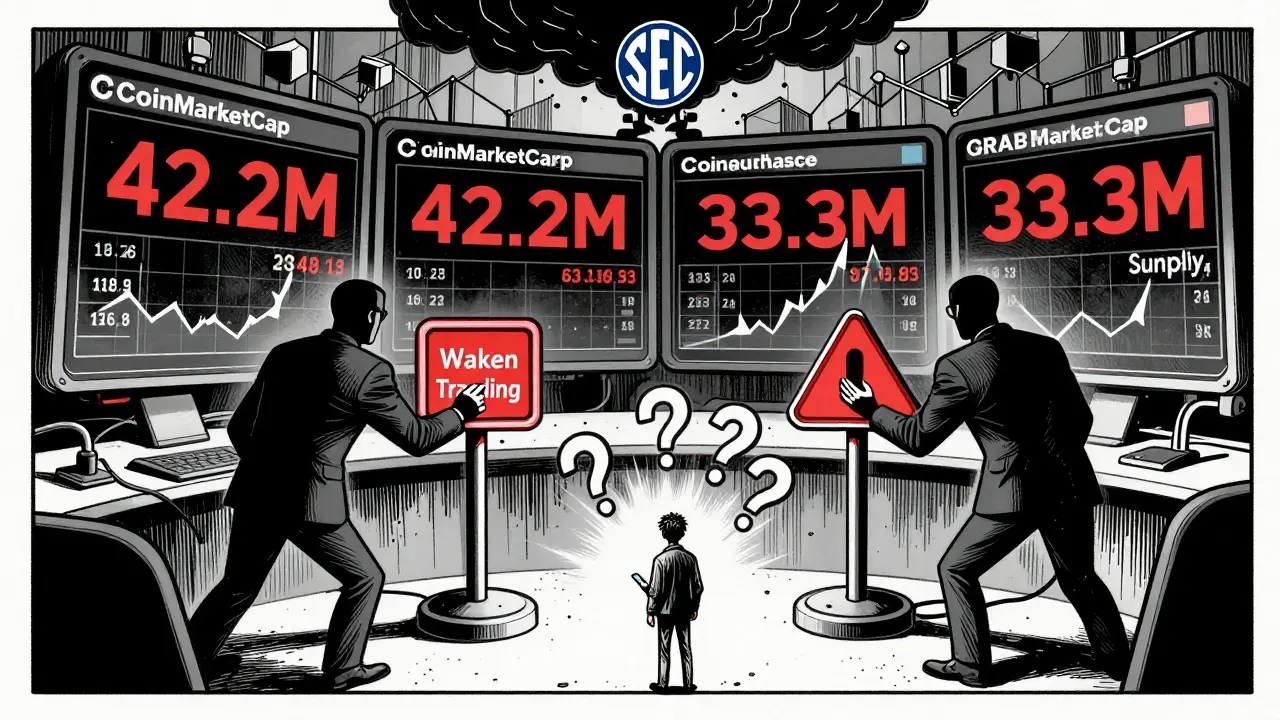
GRABWAY has a fixed supply of 60 million tokens. That’s tight. But here’s the red flag: different exchanges report wildly different circulating supplies.
- Coinbase says 33.3 million are in circulation.
- CoinMarketCap claims 42.2 million.
- That’s a 27% difference.
When a small project can’t agree on how many tokens are out there, it raises serious questions. Blockchain analyst Michael Chen called this a classic sign of tokenomics manipulation. If the team can change the numbers, they can manipulate the price.
GRABWAY launched in October 2024 at $0.07. It peaked at $0.19 in April 2025. Now? It’s trading around $0.06 - down 67% from its high. That’s not a correction. That’s a collapse.
Trading volume is even worse. One day, CoinMarketCap shows $6,700 in trades. The next, CoinStats says $490,000. That’s a 73x difference. That kind of inconsistency usually means one thing: a few wallets are buying and selling among themselves to fake activity. This is called wash trading. It’s illegal on major exchanges. On small ones? It’s common.
Why It’s Not a Real Investment
GRABWAY’s market cap hovers between $1 million and $2 million. That’s tiny. For comparison, Travala.com’s AVA token - which lets you book hotels with crypto - has a market cap over $50 million. GRABWAY doesn’t even compete. It’s a side project.
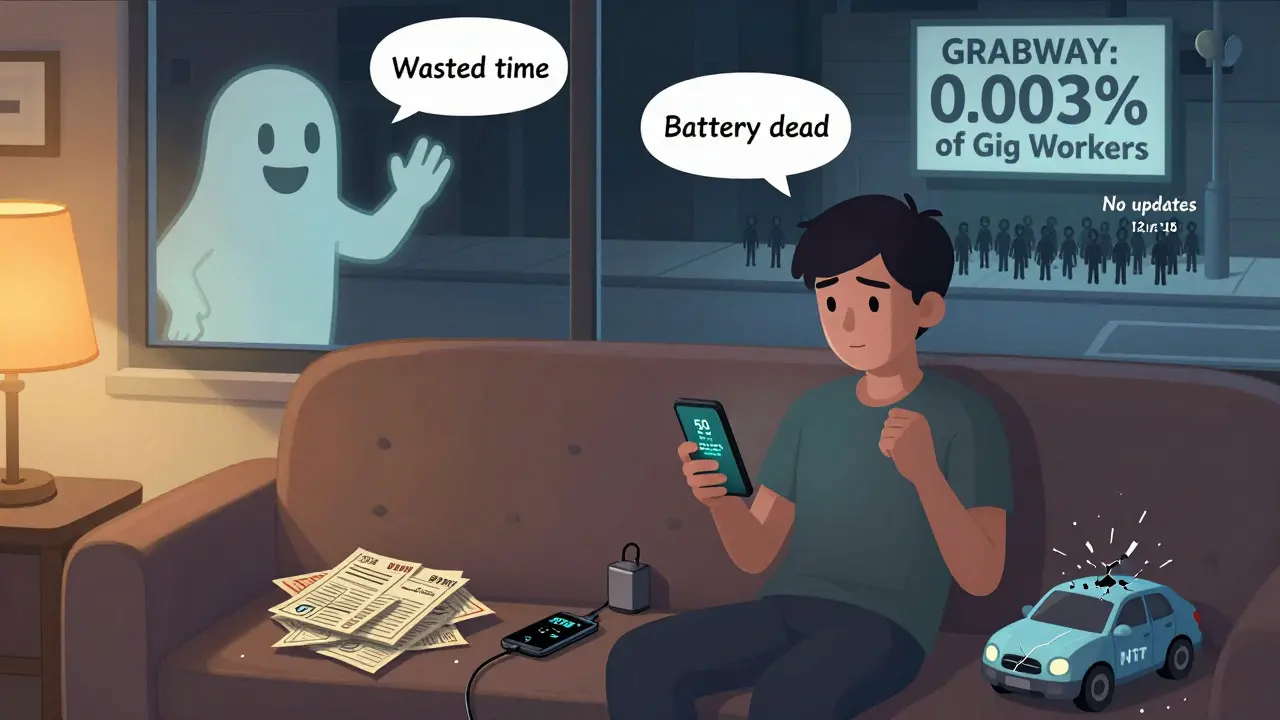
There’s no enterprise adoption. No Uber, no Lyft, no DoorDash integration. Just a standalone app with 12,480 token holders. That’s less than the number of people who live in Boulder, Colorado. The global gig economy has over 430 million workers. GRABWAY has captured 0.003% of them.
And the app? It’s buggy. Trustpilot has 17 reviews with a 2.1/5 rating. Over two-thirds of users complain about inaccurate distance tracking. One person drove 100 miles and got credit for 12. Another got flagged for “suspicious movement” while parked at a gas station. If your reward depends on GPS accuracy, and the GPS is wrong half the time - you’re not earning. You’re wasting time.
The Hidden Costs
Most people don’t think about what GRABWAY actually costs you.
- Battery drain: Continuous GPS use adds 35% extra battery consumption per hour. If you drive 8 hours a day, you’re draining your phone twice as fast.
- Storage: The app needs 150MB. That’s not much - but if you’re on an old phone, that’s 10% of your total storage.
- Privacy: The app tracks your location 24/7. Who sees that data? The company? Third-party advertisers? No one’s saying.
- Withdrawal门槛: You can’t cash out until you have 50 GRAB tokens. At $0.06, that’s $3. That’s not a payout. That’s a barrier.
And the learning curve? It’s steep. You need to understand wallets, Binance Smart Chain, NFTs, and tokenomics just to start earning. Most gig workers just want to get paid. They don’t want to become crypto experts.
Market Sentiment: What Real Users Say
Reddit, Trustpilot, and Discord are full of frustration.
One user wrote: “I spent $100 on an NTT upgrade. After a month, I earned $1.20. I uninstalled the app.”
Another: “The app says I drove 200 miles. My car odometer says 185. They denied my reward. No appeal.”
LunarCrush, a social sentiment tool, found 63% negative sentiment around GRABWAY. The few positive reviews come from early adopters who bought low and sold high. They’re not users. They’re speculators.
Even the project’s own roadmap is broken. In October 2024, they promised integration with ride-sharing apps by Q2 2025. As of May 2025? Nothing. No announcements. No updates. Just silence.
Is GRABWAY a Security?
This is the quiet bombshell.
The U.S. Securities and Exchange Commission (SEC) uses the Howey Test to decide if something is a security. If you pay money into a project expecting profit from others’ efforts - it’s a security.
GRABWAY fits that definition. You buy an NTT (investment). You rely on the company’s GPS system and token distribution (others’ efforts). You expect the token value to rise (profit). That’s not a reward app. That’s an unregistered security.
Law firm Perkins Coie flagged GRABWAY in March 2025 as a potential violation. No enforcement action yet. But if the SEC comes after it, the token could be frozen. Your tokens? Worthless.
Final Verdict: Don’t Waste Your Time
GRABWAY is not a revolution. It’s not even a decent side hustle. It’s a low-cap crypto experiment with:
- Unreliable tracking
- High battery drain
- Opaque supply numbers
- Low liquidity
- No real partnerships
- Legal gray zones
It’s not a bad idea in theory. Turning travel into income sounds cool. But execution matters. And GRABWAY fails at every step.
If you’re a gig worker looking to earn more - stick to proven apps. If you’re a crypto investor looking for value - look elsewhere. GRABWAY is a gamble with almost no upside and serious downsides.
Don’t buy into the dream. The numbers don’t lie.
Is GRABWAY (GRAB) a real cryptocurrency or a scam?
GRABWAY is a real cryptocurrency - it exists on the Binance Smart Chain and has a contract address. But that doesn’t mean it’s legitimate or trustworthy. Many scams are built on real blockchains. GRABWAY’s lack of transparency, inconsistent supply data, low liquidity, and minimal user adoption make it a high-risk project. It’s not a scam in the outright fraud sense, but it’s close enough to warrant extreme caution.
Can you really earn money by driving with the GRABWAY app?
Technically, yes - but not meaningfully. Most users report earning pennies per week after driving dozens of miles. The app requires you to buy an NFT vehicle first, which costs money. The reward rate is so low that even full-time drivers earn less than minimum wage after factoring in phone battery, data, and time. For most people, the effort isn’t worth the return.
Why is GRABWAY’s price dropping?
GRABWAY’s price dropped 67% from its peak because demand vanished. Early buyers sold off once they realized the app didn’t deliver real earnings. Trading volume is thin, so a few large sellers can crash the price. There’s no utility driving demand - no partnerships, no real-world use, no community growth. It’s a classic case of hype followed by collapse.
Is GRABWAY listed on major exchanges like Binance or Coinbase?
GRABWAY is not listed on Binance or Coinbase’s main exchange. It’s only available on smaller, lesser-known platforms like MEXC and Bitrue. These exchanges have lower security standards and less oversight. Trading GRABWAY there means higher risk of fraud, withdrawal delays, or sudden delisting.
What are the risks of using the GRABWAY app?
The main risks are: 1) Battery drain from constant GPS tracking (up to 35% extra usage per hour); 2) Privacy invasion - your location data is stored by the company with no clear policy; 3) Inaccurate tracking that disqualifies your earnings; 4) Low liquidity, making it hard to sell your tokens; and 5) Legal risk - the SEC may classify GRABWAY as an unregistered security, which could freeze your holdings.
Should I buy GRABWAY tokens as an investment?
No. GRABWAY lacks the fundamentals of a viable investment: strong adoption, clear utility, transparent team, or real partnerships. Its market cap is under $2 million, and trading volume is too low to support stable pricing. It’s a speculative bet with no upside. If you’re looking to invest in crypto, focus on projects with real use cases and proven track records - not apps that pay you in pennies for driving.
How many people actually use GRABWAY?
Only about 12,480 unique wallets hold GRAB tokens, according to CoinMarketCap. That’s a tiny fraction of the 430 million gig workers worldwide. Even if you count app downloads, most users never convert their reward points into tokens. The project claims a large user base, but the data shows very few are active participants.
Does GRABWAY have a whitepaper or technical documentation?
There is no official whitepaper. Documentation is scattered across CoinCodex, MEXC, and Telegram, with inconsistent details. The project’s GitHub repository is private, so no independent developer can verify its code. This lack of transparency is a major red flag - legitimate crypto projects always publish their code and technical specs openly.
What’s the future of GRABWAY?
The future looks bleak. The project has missed all its roadmap deadlines, including integrations with major ride-sharing apps. User growth has stalled. Trading volume is declining. Delphi Digital gave it a C- sustainability rating. Without a major overhaul - or a buyout from a larger player - GRABWAY is likely to fade into obscurity. Don’t expect a rebound.
Are there better alternatives to GRABWAY for earning crypto while driving?
Yes. Projects like Travala.com (AVA) and Tripio (TRIO) offer real travel rewards - discounts on flights, hotels, and rentals - paid directly in crypto. They’re integrated with major booking platforms and have proven user bases. Unlike GRABWAY, they don’t require you to buy NFTs or track your location 24/7. If you want crypto rewards from travel, go with established, transparent projects - not experimental apps with hidden costs.
george chehwane
February 14, 2026 AT 07:57Let’s be real - GRABWAY isn’t a crypto project. It’s a behavioral economics experiment disguised as a gig economy hustle. You’re not earning tokens; you’re being monetized as a data point. The NTT NFTs? That’s the real product. The ‘earnings’ are just the bait to keep your phone’s GPS running 24/7. And let’s not forget the regulatory landmine - if the SEC applies the Howey Test with any consistency, this thing gets frozen faster than a Bitcoin wallet in a North Korean data center. The entire model is a Rube Goldberg machine of exploitation: battery drain, privacy erosion, and algorithmic injustice wrapped in blockchain glitter. It’s not even clever. It’s just predatory.
And yet… people still fall for it. Why? Because the promise of ‘passive income’ is more seductive than actual utility. We’ve been trained to believe that if it’s on-chain, it’s revolutionary. Newsflash: not all blockchain is innovation. Some of it’s just capitalism with a new UI.
Angela Henderson
February 15, 2026 AT 10:34I tried this app for like two weeks just to see what the fuss was about. Drove around town, did my grocery runs, even took a 4-hour road trip. Got 14 GRAB tokens. Like, $0.84. Meanwhile, my phone died twice because of the GPS hogging power. I had to buy a portable charger just to keep the app running. And then I found out they don’t even count parking lots as stops - I sat at a gas station for 20 minutes to pee and it flagged me as ‘suspicious movement.’ Like, I’m not a spy. I’m just tired.
Also, the app looks like it was designed in 2017. No animations, no feedback, just a spinning wheel that says ‘processing rewards’ for 10 minutes. I uninstalled it. Not because I’m anti-crypto. I just don’t want to be paid in digital pennies while my phone overheats. There’s gotta be better ways to make $1.20 a week.
Paul David Rillorta
February 16, 2026 AT 22:03OMG GUYS. I JUST FOUND OUT THE TRUTH. GRABWAY ISN’T EVEN REAL. THE ‘GPS TRACKING’? IT’S FAKE. THEY’RE JUST USING YOUR PHONE’S ACCELEROMETER AND WIFI SIGNALS TO GUESS YOUR MOVEMENTS. I’VE BEEN DRIVING FOR 3 MONTHS AND MY ‘MILEAGE’ IS STILL 12 MILES HIGHER THAN MY CAR’S ODOMETER. THEY’RE NOT TRACKING YOU - THEY’RE IMAGINING YOU.
AND THE NFT CARS? THEY’RE NOT ON THE BLOCKCHAIN. THEY’RE JUST PNG FILES STORED ON A SERVER IN A DATA CENTER IN ROMANIA. THE WHOLE THING IS A PHISHING SCAM WITH A MOBILE APP. I THINK THE TEAM IS JUST A GUY IN HIS PARENTS’ BASEMENT WHO STOLE THE CODE FROM A GIG APP TEMPLATE. THEY’RE NOT EVEN TRYING. I SAW A TIKTOK VIDEO OF ONE OF THE ‘DEVS’ EATING TACOS WHILE SAYING ‘WE’RE BUILDING THE FUTURE.’
THE SEC IS COMING. I SWEAR TO GOD. THEY’RE ALREADY PREPPING THE FROZEN WALLET ANNOUNCEMENT. I’M SELLING MY 50 GRAB TOKENS TODAY. WHO WANTS THEM? I’LL GIVE ‘EM TO YOU FOR 20 CENTS. JUST DON’T ASK ME HOW I GOT THEM.
andy donnachie
February 18, 2026 AT 19:14Just to clarify a few things for anyone confused - GRABWAY’s contract address is real, and yes, it’s on BSC. But transparency isn’t about being on-chain; it’s about being open. The team hasn’t done an AMA, never open-sourced the app code, and their Discord has zero active devs. That’s not ‘startup hustle,’ that’s ‘ghost project.’
Also, the supply discrepancy? That’s not a bug - it’s a feature. They’re likely minting tokens off-chain and only releasing them when the price dips, then re-adding them to inflate the circulating supply. Classic pump-and-dump mechanics. The 12k wallets holding tokens? Most of them are bots or abandoned wallets from airdrops. Real users? Less than 2k. And the fact that they’re not integrated with Uber or Lyft? That’s not a delay - it’s proof they never intended to be used by actual drivers. This isn’t a side hustle. It’s a crypto ghost town.
Alex Williams
February 20, 2026 AT 17:33If you’re thinking about jumping into GRABWAY, here’s the cold truth: you’re not investing in a token - you’re investing in a system designed to extract value from your time, battery, and location data. The NFT vehicle requirement? That’s a paywall disguised as a tiered reward system. It’s not ‘upgrading your earnings’ - it’s ‘paying to play.’
And here’s the kicker: even if you somehow break even on the cost of the NTT, the withdrawal threshold of 50 GRAB ($3) is a psychological trap. It’s engineered to make you drive longer, use more data, and ignore the battery drain. You’re not earning. You’re being gamified.
There’s a reason no gig platform uses this model. Because it doesn’t work. Real platforms pay you in USD, not in tokens that might be worth $0.01 tomorrow. If you want crypto rewards from driving, go with Travala or Tripio - they’re built on partnerships, not paranoia. GRABWAY? It’s a cautionary tale wrapped in a mobile app.
Sarah Shergold
February 21, 2026 AT 16:24Wow. A crypto project that’s literally worse than a pyramid scheme. At least pyramid schemes give you a free t-shirt. GRABWAY gives you a 35% battery drain and a lawsuit waiting to happen. I’m not even mad. I’m just… disappointed. Like, I thought we’d moved past this. But no. Here we are again. Another ‘revolutionary’ app that’s just capitalism with a blockchain sticker. The fact that anyone still believes this is a ‘side hustle’ is the real tragedy.