
Most crypto coins are built to be traded, speculated on, or used as digital cash. But Ink Finance (QUILL) isn’t one of them. It’s not meant to make you rich overnight. It’s built to help decentralized organizations - DAOs - manage their money like a professional finance team, but without any middlemen.
Think of a DAO like a company run by code and votes. Members vote on spending, investments, and rules. But what happens when they need to lend money, track assets across chains, or secure their treasury? That’s where QUILL comes in. It’s the fuel that powers Ink Finance’s system - a financial toolkit designed specifically for DAOs that don’t want to hire a CFO or build custom software from scratch.
What Exactly Is Ink Finance?
Ink Finance is a financial infrastructure platform built for DAOs. It’s not a wallet, not a DEX, and not a lending protocol like Aave or Compound. Instead, it’s a full-stack financial operating system. It gives DAOs tools to handle:
- Governance economics - tying voting power to financial contributions
- Asset management - tracking and moving funds across blockchains
- Credit financing - letting DAOs borrow based on their on-chain reputation
- Fiscal control - setting spending rules, approvals, and audit trails
All of this runs on a plug-and-play system that connects to major chains: Avalanche, Polygon, Arbitrum, BNB Smart Chain, and Bitlayer. As of late 2024, over 390 DAOs are using it, managing more than $750,000 in combined treasury activity.
What Is the QUILL Token?
QUILL is the native token of Ink Finance. It’s not a store of value like Bitcoin. It’s a utility token - the key that unlocks the platform’s features.
Here’s how it works in practice:
- Stake-to-use: DAOs stake QUILL to access advanced financial tools. The more you stake, the more control and features you unlock.
- Rent-to-use: Instead of buying tools outright, DAOs can lease them by paying QUILL as a recurring fee - like renting accounting software.
- Governance: QUILL holders vote on upgrades, fee structures, and new features.
- Fees: Every transaction on the platform - asset transfers, credit approvals, vault access - generates a small fee paid in QUILL.
The total supply is capped at 100 million QUILL. As of January 2026, the price hovers around $0.0036. That’s down from its all-time high of $1.16 in December 2024, but it’s also up from its low of $0.003476 in July 2025. The trading volume is low - between $15K and $60K daily - which means it’s not liquid enough for big investors. But for DAOs, liquidity isn’t the point. Functionality is.
How Does Ink Finance Stand Out?
There are plenty of tools for DAOs. Aragon handles voting. Safe manages multisig wallets. Llama tracks treasury balances. But none combine all these functions - plus credit and cross-chain asset abstraction - into one system.
The real differentiator? InkEnvelope.
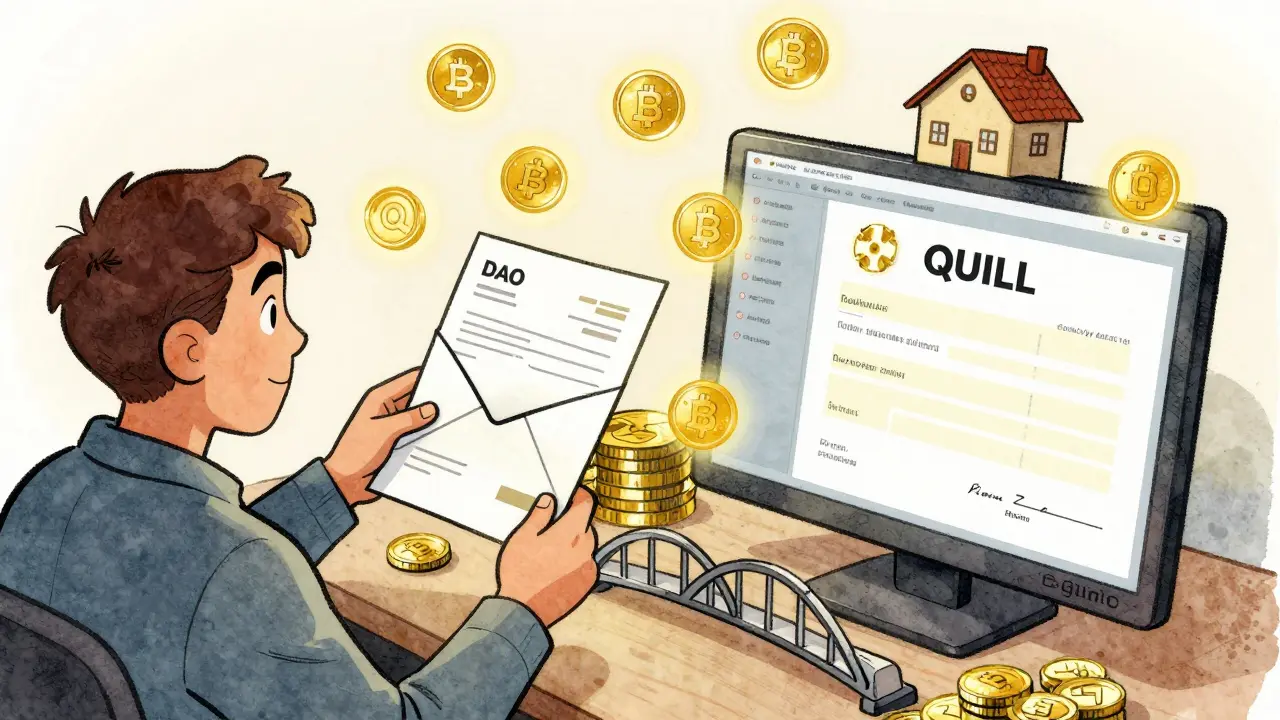
This is a proprietary layer that lets DAOs treat real-world assets - like invoices, real estate deeds, or even royalties - as if they were on-chain tokens. A DAO that owns rental property can tokenize the income stream and manage it alongside its crypto assets. No bridges. No third-party custodians. Just one unified dashboard.
Compare that to Centrifuge or Goldfinch, which focus on RWA tokenization but require complex integrations. Ink Finance builds it in. For DAOs that want to move beyond crypto-only treasuries, this is a game-changer.
Who Uses Ink Finance?
It’s not for beginners. You won’t find it used by casual NFT collectors or meme coin traders.
The main users are mid-sized DAOs with treasuries between $500,000 and $5 million. These are organizations that:
- Have active contributors who need to be paid
- Run grants or funding programs
- Hold assets across multiple chains
- Want to avoid relying on centralized finance platforms
One Reddit user, who manages a Web3 education DAO, said: “We deployed Ink Finance and saved over 40 developer hours. We didn’t need to code our own treasury system.”
Another user, who moved $1.2M in assets from Avalanche to Polygon, said: “The InkEnvelope system worked without a single failed bridge transaction.”
Enterprise adoption is still low - only 7% of users are large organizations. But Ink Finance is targeting that gap. In August 2024, it launched INK.HK, a commercial arm focused on partnering with Asian banks to connect traditional finance with DAOs. Three banking groups are already running pilot programs.
What Are the Downsides?
For all its strengths, Ink Finance isn’t perfect.
Low liquidity: With daily trading volume under $60K, it’s hard to buy or sell large amounts of QUILL without moving the price. That’s why you won’t find it on Binance or Coinbase.
Hard to use: The dashboard is no-code for basic tasks, but advanced features require understanding Solidity, gas fees, and cross-chain mechanics. One user on Twitter said: “The staking interface had no examples. I spent three days just trying to get it to work.”
Learning curve: Based on user surveys, it takes 15-20 hours for a DAO treasurer to become proficient. That’s a lot for volunteers running a community project.
Regulatory risk: The SEC’s recent guidance on “programmatic tokens” could classify QUILL as a security if it’s used too much like an investment. That’s a looming threat - especially as Ink Finance starts working with banks and real-world assets.

How to Get Started
If you’re part of a DAO and want to try Ink Finance:
- Connect your Web3 wallet (MetaMask, WalletConnect, etc.) to the Ink Finance dashboard.
- Choose your blockchain (Avalanche is the most stable for now).
- Set up your treasury - add assets, assign roles, define spending limits.
- Optionally, stake QUILL to unlock governance rights and fee discounts.
- Use the InkEnvelope tool to link off-chain assets (like invoices or contracts) to your on-chain treasury.
The platform offers video tutorials, a Discord server with 3,200+ members, and a support team that answers 85% of questions within four hours. It’s not perfect, but it’s one of the few DAO tools that actually listens to its users.
The Bigger Picture
The DAO financial tools market grew from $120 million in 2022 to $1.2 billion in 2024. Ink Finance holds only 3.2% of that market - far behind Safe (28.5%) and Llama (18.7%). But it’s growing fast. Quarterly deployments are up 47%.
Why? Because DAOs are maturing. They’re not just voting on memes anymore. They’re managing budgets, paying contractors, investing in startups, and even buying real estate. They need real financial tools - not just voting interfaces.
Ink Finance isn’t trying to be the biggest. It’s trying to be the most complete. If it succeeds, it could become the standard for how decentralized organizations handle money - not just in crypto, but in the real world.
For now, QUILL isn’t a coin you buy to flip. It’s a tool you use to build something bigger - a DAO that can operate like a real business, without needing a bank.
What’s Next for Ink Finance?
The roadmap for 2025 is ambitious:
- Integration with Solana and Ethereum L2s
- Institutional-grade custody solutions for larger treasuries
- Expanding InkEnvelope to include more real-world assets - stocks, bonds, supply chain receipts
- Launching a rental marketplace where DAOs can lease QUILL-based financial tools to each other
Industry analysts from Delphi Digital predict 300-500% growth in usage by mid-2025 - if the team delivers on these updates.
But growth depends on two things: fixing liquidity and navigating regulation. Without either, Ink Finance could remain a niche tool - powerful, but unseen by the broader crypto world.




Joseph Pietrasik
January 29, 2026 AT 22:57Pamela Mainama
January 30, 2026 AT 09:16Rachel Stone
January 30, 2026 AT 15:26Nickole Fennell
January 31, 2026 AT 15:19Rico Romano
February 1, 2026 AT 01:42Freddy Wiryadi
February 2, 2026 AT 02:07Dahlia Nurcahya
February 2, 2026 AT 19:26William Hanson
February 4, 2026 AT 14:55Lori Quarles
February 4, 2026 AT 16:29Jeremy Dayde
February 6, 2026 AT 04:44