Sturdy (STRDY) Leverage Calculator
How Sturdy Works
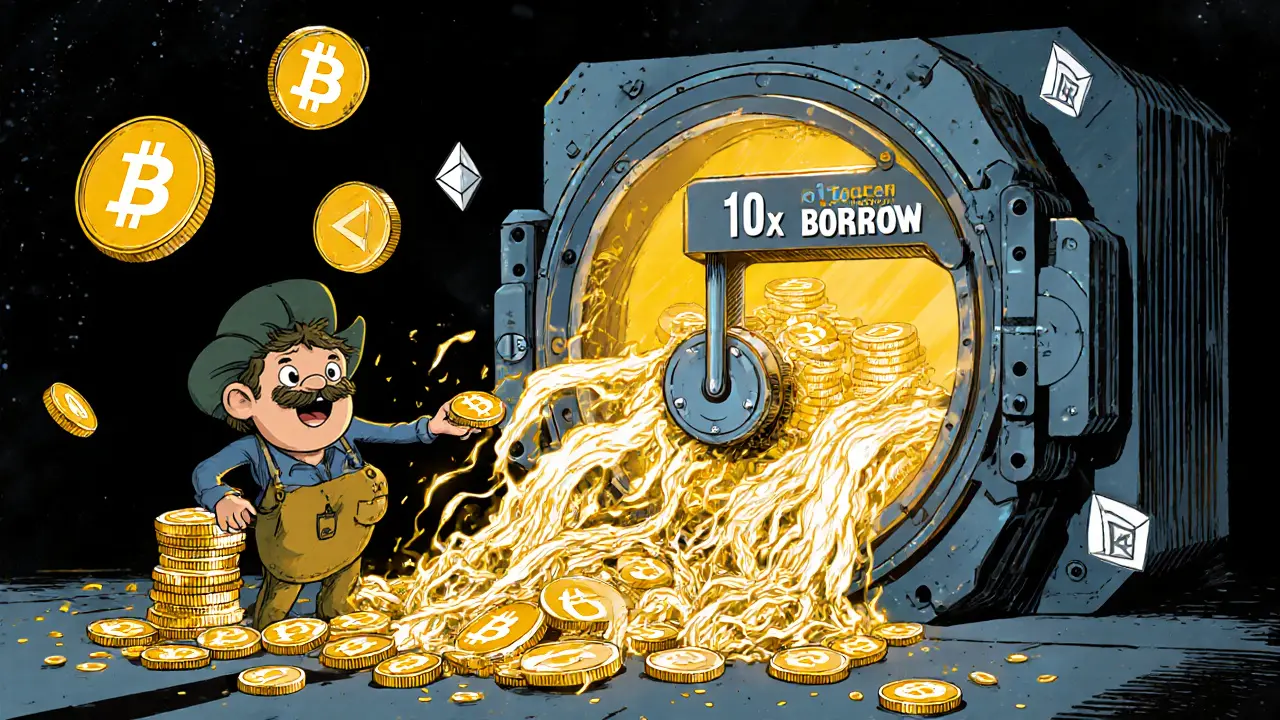
Sturdy lets you deposit interest-bearing tokens (like aDAI or cETH) to borrow against them up to 10x their value. This enables leveraged yield farming by allowing you to reinvest borrowed funds to increase your returns.
Warning: Leverage increases potential returns but also significantly increases risks. Liquidation can occur if collateral value drops below the required threshold. Only use this calculator if you fully understand the risks.
Your Leverage Potential
Important: Sturdy requires 10x collateralization (100% value of borrowed amount). If your collateral drops below this value, your position will be liquidated.
Sturdy (STRDY) isn’t just another crypto coin. It’s a DeFi lending protocol built to solve a specific problem: letting yield farmers borrow against interest-bearing tokens like aTokens and cTokens - and borrow up to 10x their value. If you’ve ever tried to stack yield on Aave or Compound and wanted to amplify it without selling your assets, Sturdy was made for you.
What does Sturdy actually do?
Most DeFi lending platforms - like Aave or Compound - let you deposit stablecoins or ETH to borrow other assets. Sturdy flips that. It lets you deposit tokens that are already earning interest - like aDAI from Aave or cETH from Compound - and use them as collateral to borrow more crypto. That’s the key difference.
Here’s how it works in practice:
- You deposit aDAI (which earns interest from Aave) into Sturdy’s vault.
- Sturdy lets you borrow USDC or ETH against that aDAI - up to 10 times its value.
- You use that borrowed USDC to buy more aDAI, deposit it back, and repeat.
- Each cycle multiplies your yield, because you’re earning interest on more than you originally had.
This is called leveraged yield farming. It’s high-risk, high-reward. One wrong move - like a sudden drop in the value of your collateral - and you get liquidated. But if the market moves right, your returns can explode. That’s why Sturdy targets experienced DeFi users, not beginners.
What is STRDY, the token?
STRDY is the native token of the Sturdy protocol. It’s not just a speculative asset - it has three real jobs inside the system:
- Governance: STRDY holders vote on protocol upgrades, fee structures, and new asset listings.
- Fee distribution: A portion of the borrowing fees generated by the protocol is distributed to STRDY stakers.
- Security layer: STRDY tokens are used as a backstop in case of undercollateralized loans. If a borrower defaults, STRDY is minted and sold to cover the loss - acting like insurance for the system.
This means holding STRDY isn’t just about hoping the price goes up. It’s about participating in the protocol’s survival and growth.
Technical details you need to know
Sturdy runs on Ethereum as an ERC-20 token. The smart contract address is 0xaeb3607ec434454ceb308f5cd540875efb54309a. It has 18 decimal places, which is standard for most DeFi tokens.
The total supply of STRDY is capped at 100 million tokens. But here’s where things get messy:
- CoinMarketCap says 19.12 million are in circulation.
- CoinGecko says 20 million.
- CoinDesk reports 20.32 million.
Why the mismatch? Because some platforms count locked tokens, others don’t. Some include team allocations, others exclude them. There’s no single official source, which is a red flag for transparency.
Token distribution is split between investors (including Pantera Capital and Coinbase Ventures), the team, ecosystem grants, and community incentives. Exact percentages aren’t public, so you’re guessing how much is still locked up or being released over time.
Price and market performance - a rollercoaster
STRDY’s price history tells a story of hype and crash.
On November 25, 2024, it hit an all-time high of $3.81. Today, as of November 25, 2025, it’s trading around $0.02 - a 99.46% drop. That’s not a correction. That’s a collapse.
Current price data varies wildly:
- CoinMarketCap: $0.019017
- 3commas.io: $0.020271
- CoinDesk: $0.5885 (October 2025 data - likely outdated or misreported)
Market cap numbers are even more confusing. CoinMarketCap reports $395K. CoinDesk says $11.9 million. That’s a 30x difference. Either one is wrong, or the liquidity is so thin that small trades move the price dramatically.
Trading volume is inconsistent too. CoinGecko shows $10,772 in 24 hours. CoinDesk claims over $2.8 million. Liquidity Finder says $0. That suggests the token trades on low-volume exchanges, or bots are manipulating the numbers.
Short-term volatility is extreme. One day it’s up 9.9%, the next it’s down 21.5% over seven days. That’s not a mature asset. That’s a speculative gamble.
Who backs Sturdy? The institutional angle
Despite the price crash, Sturdy has serious backing. Its investors read like a who’s who of crypto venture capital:
- Pantera Capital - early investor in Ethereum and Polkadot
- Coinbase Ventures - has invested over $500 million across 200+ crypto projects
- Y Combinator - backed Airbnb, Dropbox, and now crypto startups
- KuCoin Ventures, SoftBank, OrangeDAO, Dialectic Capital, mgnr, One Block Capital
This isn’t a team of anonymous devs. These are institutions with deep pockets and long-term bets. They’re not betting on STRDY’s price going to $10 tomorrow. They’re betting that Sturdy’s unique model - leveraging interest-bearing tokens - will become essential in DeFi.
That’s why the project still exists. Many projects with this kind of price drop die. Sturdy hasn’t. That suggests the team is still building, even if the market isn’t paying attention.
How does Sturdy compare to Aave or Compound?
Sturdy isn’t trying to replace Aave or Compound. It’s trying to plug a gap they left open.
Aave and Compound let you deposit ETH, USDC, DAI, etc. They don’t let you deposit aTokens or cTokens directly. So if you’re already earning yield on Aave, you can’t use that yield as collateral to borrow more - unless you sell your aTokens first. That breaks your yield stream.
Sturdy fixes that. It lets you keep your yield and borrow against it. That’s a niche, but it’s a real one. Yield farmers who want to scale up without liquidating are drawn to it.
But here’s the catch: Sturdy’s total value locked (TVL) is tiny compared to Aave ($2.3 billion) or Compound ($1.2 billion). It’s a speck in the DeFi universe. That means less liquidity, higher slippage, and more risk.

Is Sturdy safe?
No one has published a formal security audit report for Sturdy’s smart contracts. That’s a red flag. In DeFi, audits aren’t optional - they’re the baseline.
Sturdy does have a two-tiered risk isolation system. It separates volatile assets (like ETH) from stable assets (like USDC) to prevent a collapse in one pool from dragging down the whole protocol. That’s smart design.
But without an audit, you’re trusting code that hasn’t been publicly reviewed by third-party experts. That’s risky.
Also, the protocol depends entirely on Ethereum. If gas fees spike, your leveraged positions could become too expensive to manage. If Ethereum goes down, so does Sturdy.
What’s next for Sturdy?
No official roadmap is published. But here’s what’s likely:
- Expansion to Layer 2 networks like Arbitrum or Optimism to reduce gas costs.
- Adding support for more interest-bearing tokens - like those from Curve or Yearn.
- Integrating with other DeFi protocols to let users move assets seamlessly between platforms.
The fact that SoftBank and Coinbase Ventures are still involved suggests they’re not walking away. They’re waiting. Maybe for better market conditions. Maybe for more adoption.
Should you buy STRDY?
Here’s the truth: STRDY isn’t a store of value. It’s not a payment token. It’s not even a reliable investment.
It’s a speculative tool for advanced DeFi users who understand leverage, liquidations, and yield mechanics. If you’re not actively farming yield and using Aave or Compound, you don’t need STRDY.
If you are:
- Consider STRDY only if you plan to use the protocol - not to flip the token.
- Never invest more than you can afford to lose. The price could go to $0.005 or lower.
- Watch for an official audit. Until then, treat it like untested code.
- Ignore price predictions. LiteFinance and Wallet Investor’s forecasts are guesses. No one can predict a token with this level of volatility and low liquidity.
Sturdy has a smart idea. But the market hasn’t rewarded it yet. The team has deep pockets. That gives them time. But time doesn’t guarantee success.
STRDY is a high-risk, high-reward experiment. Not a crypto coin you buy and hold. A tool for those who know how to use it - and can survive the ride.
Is Sturdy (STRDY) a good investment?
STRDY is not a traditional investment. It’s a utility token for a niche DeFi protocol. Its price has dropped over 99% from its all-time high, and liquidity is extremely low. Only consider it if you’re an experienced DeFi user who plans to use the protocol for leveraged yield farming. Do not buy it expecting price appreciation - the risk of total loss is very high.
How does Sturdy make money?
Sturdy earns revenue from borrowing fees charged to users who take out loans against their interest-bearing tokens. A portion of these fees is distributed to STRDY token holders who stake their tokens. The protocol also uses STRDY as a backstop to cover losses in case of undercollateralized loans.
Can I use STRDY on other blockchains?
As of now, Sturdy only operates on Ethereum. There are no official announcements about cross-chain support. However, given its venture capital backing, expansion to Layer 2 networks like Arbitrum or Optimism is likely in the future to reduce gas costs and improve usability.
Why is the STRDY price so different on different websites?
STRDY trades on low-volume exchanges with inconsistent reporting. Some platforms show inflated prices due to fake trading volume or outdated data. CoinDesk’s higher price is from October 2025 and may not reflect current conditions. Always check multiple sources and prioritize data from exchanges with real trading activity.
Is Sturdy audited?
No public security audit report has been released for Sturdy’s smart contracts. This is a major risk in DeFi, where bugs can lead to permanent loss of funds. Until an audit by a reputable firm like CertiK or Trail of Bits is published, treat the protocol as untested.
How many STRDY tokens are there?
The total supply is fixed at 100 million STRDY tokens. However, circulating supply varies by platform: CoinMarketCap reports 19.12 million, CoinGecko says 20 million, and CoinDesk lists 20.32 million. This discrepancy suggests some tokens are locked, unclaimed, or counted differently across trackers.




George Kakosouris
November 27, 2025 AT 15:31Sturdy’s leverage model is fucking brilliant if you’re not getting liquidated on the first dip. 10x collateralized aTokens? That’s not DeFi, that’s financial engineering with a side of Russian roulette. And STRDY as a backstop? Classic tokenomics theater - mint tokens to cover losses, then pretend it’s ‘insurance.’ The fact that the price crashed 99% but the VCs still haven’t pulled out says everything: this isn’t about returns, it’s about burning through their war chest while pretending they’re building something revolutionary.
Tony spart
November 29, 2025 AT 13:39Bro just sold his ETH for STRDY at $3.80 and now he’s crying because it’s $0.02? LOL. If you don’t understand leverage, don’t touch DeFi. This ain’t Robinhood. You think you’re smart? You’re just another degenerate who thought ‘10x’ meant free money. The audit? Who cares. The team has Coinbase and Pantera behind them - if they wanted to rug, they’d have done it already. Stay mad.
Ben Costlee
December 1, 2025 AT 06:16I’ve been watching this protocol since its early days. The idea is genuinely innovative - leveraging yield-bearing assets without breaking the yield stream is something Aave and Compound should’ve built years ago. The execution is messy, the transparency is lacking, and the price collapse is brutal. But I’m not writing it off. The team’s still active on Discord, they’re talking about Arbitrum integration, and the fact that SoftBank hasn’t walked away tells me they’re playing the long game. This isn’t a coin to flip. It’s a tool for builders. If you’re not farming yield, ignore it. If you are, keep an eye on the next contract upgrade - that’s where the real story unfolds.
Mark Adelmann
December 1, 2025 AT 08:41Just want to say - if you’re new to DeFi and reading this, don’t panic. The price looks scary, but that’s normal for niche protocols. I used Sturdy for a week last year, leveraged my aDAI, made a 22% gain before pulling out. It’s not magic, it’s math. Just don’t go all-in. And please, please get an audit before you deposit anything. I’ve seen too many people lose everything because they trusted a cool whitepaper and zero code review.
Savan Prajapati
December 2, 2025 AT 04:52Too many lies. Price on CoinDesk is fake. TVL is zero. Audit? Never happened. Stay away.
jeff aza
December 3, 2025 AT 14:03Let’s be real: the 10x leverage is a death trap. The fact that the protocol doesn’t even have a clear TVL metric, let alone a published audit, is a catastrophe waiting to happen. And don’t get me started on the supply discrepancies - CoinMarketCap, CoinGecko, CoinDesk all reporting different numbers? That’s not ‘data variance,’ that’s a lack of basic accountability. This isn’t DeFi. It’s a liquidity illusion wrapped in VC hype. The only thing that’s ‘smart’ here is the marketing team’s ability to spin collapse into ‘long-term vision.’
Vijay Kumar
December 3, 2025 AT 21:35You people are missing the point. This isn’t about money. It’s about control. The system was designed to make farmers dependent on a single protocol. They take your yield, lock it, then let you borrow against it - so you never escape. This is financial slavery dressed in blockchain. The VCs don’t care if you win. They care if you stay trapped.
Vance Ashby
December 5, 2025 AT 12:30Just checked my wallet - still holding STRDY. Been down 99% since November 2024. Still sleeping fine. 🤷♂️ The team’s quiet, but they’re not gone. I trust the VCs more than I trust the charts. Also, gas fees on Ethereum are killing my rebalancing cycles… hoping for Arbitrum soon. Fingers crossed.
Felicia Sue Lynn
December 6, 2025 AT 08:23There is a profound irony in how we treat speculative assets as if they were financial instruments. We assign them value based on narratives, institutional backing, and algorithmic volatility - yet we demand transparency, audits, and rational metrics. The disconnect between our emotional investment and our intellectual skepticism reveals more about our cultural relationship with technology than it does about the protocol itself. Sturdy may fail. But the desire to amplify yield - to transcend scarcity - is deeply human. Perhaps the real innovation isn’t in the code, but in the collective delusion that makes it possible.
Christina Oneviane
December 7, 2025 AT 03:26Oh wow, so the ‘brilliant’ DeFi protocol that lets you borrow 10x against your yield is now worth less than a cup of Starbucks coffee? And you’re still defending it? Sweetheart, this isn’t a ‘long-term vision’ - it’s a graveyard with a fancy website. The only thing getting leveraged here is the delusion of the people who bought at $3.80. 🙃